
 AI MODIFIED
Market Analysis
Green Coffee in August 2026: What the World Market Price Really Costs Per Cup
On this page
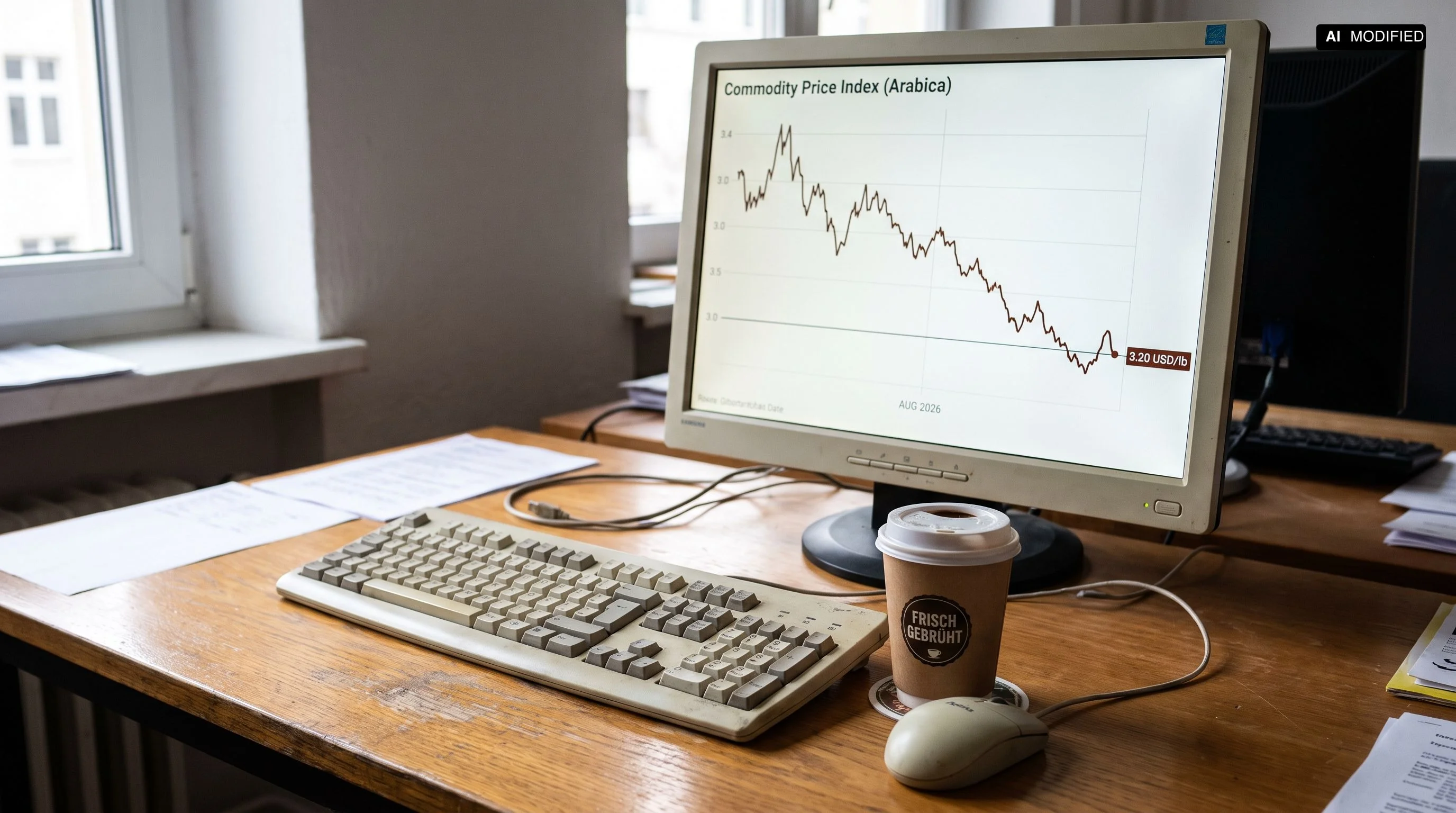
Arabica is trading at around $3.20 per pound on the ICE in mid-August 2026. That's 3.9 percent lower over the last 30 days and 8.0 percent lower over twelve months. At the same time, the U.S. Department of Agriculture expects record production for the 2026/27 season, driven by a significantly larger Arabica harvest in Brazil. Those who have followed recent headlines will read this with astonishment.
For vending machine operators, the more interesting figure is not the market quote, but what it actually costs per cup. The answer is: less than the headlines suggest, and the reason is structural.
A note on reading commodity prices first, because many tables label it incorrectly: Coffee C is quoted in US cents per pound. If a chart shows 320, that's $3.20 per pound, not $320. One source explicitly claimed during fact-checking of this article that it was dollars; $320 per pound would be around $700 per kilogram.
From Quote to Per-Kilogram Price
$3.20 per pound equals $7.06 per kilogram at 0.4536 kilograms per pound. At the European Central Bank's reference rate of EUR 1 = $1.1567 on August 14, 2026, that comes to €6.10 per kilogram of green coffee.
But green coffee is not what goes into the machines. During roasting, the bean loses weight, primarily water. The roast loss ranges from 12 to 18 percent depending on the roast degree, higher for espresso roasts. One kilogram of roasted coffee therefore requires 1.14 to 1.22 kilograms of green coffee, and the raw material value per kilogram of roasted coffee thus increases to €6.93 to €7.44.
What's in a Cup
A cup from a commercial super-automatic machine requires 7 to 9 grams of roasted coffee. The world market value of the green coffee contained in it thus amounts to 4.9 to 6.7 cents per cup.
Measured against the operating costs from the guide to cup pricing, which amount to 22.1 to 28.4 cents per cup for machine, bean, milk, water, electricity and service calls, that is 17 to 30 percent. This range explicitly refers to the world market value of green coffee, not the bean price that an operator pays at purchase. That is higher, and that's exactly the point.
The World Market Is About One-Third of the Per-Kilogram Price
The guide to cup pricing assumes €20 per kilogram of roasted coffee at purchase. Set against the €6.93 to €7.44 raw material value, that means: the world market price accounts for 35 to 37 percent of what the operator pays per kilogram. The remaining 63 to 65 percent is roasting, roast loss, packaging, logistics and the supplier's margin.
This breakdown explains why world market movements have a dampened effect on the cup price. They affect one-third of the base, and they don't take effect immediately because roasters work with contracts and inventory.
What a Price Movement Actually Costs
Let's calculate the sensitivity directly. If green coffee rises by one euro per kilogram, the cup price increases by 0.80 to 1.10 cents, depending on dosage and roast degree. Half a euro per kilogram is 0.40 to 0.55 cents, two euros is 1.59 to 2.20 cents.
Applied to the actually reported movements: the 3.9 percent decline over the last 30 days corresponds to 24 cents per kilogram of green coffee and thus 0.19 to 0.26 cents per cup. The 8.0 percent decline over twelve months is 49 cents per kilogram and 0.39 to 0.54 cents per cup. Both downward, not upward.
An operator who adjusts machine prices because of commodity prices is thus moving in the range of fractions of a cent. Price adjustments on machines have other reasons: milk, wages, energy, maintenance contracts.
Where the Real Leverage Lies
The same calculation shows the converse. Whoever negotiates the purchase price from €20 down to €16 per kilogram saves €4 per kilogram and thus 2.80 to 3.60 cents per cup. That is several times what the world market movement of an entire year accounted for. To achieve the same effect on the world market, the green coffee price would have to jump 66 percent.
For practical purposes, this results in an unspectacular sequence. First the per-kilogram price in the supply contract, then the dosage, then the site utilization. The commodity price is an observation metric, not a control instrument. Whoever accepts it in the contract as a price escalation clause should know that it affects one-third of the base and works in both directions.
What Is Expected for the Season
The U.S. Department of Agriculture's forecast for 2026/27 is clear. World production is expected to increase by 10.8 million bags to 189.7 million, a plus of 6 percent. Arabica reaches a record of 105.9 million bags, an increase of 12.1 percent, while Robusta declines by 0.7 percent.
The driver is Brazil. The harvest there is expected to increase by 8.9 million bags to a record of 71.9 million, with Arabica up 9.5 million to 47.5 million bags. This ends a five-year period of weak yields, when weather had suppressed output. Exports of green beans are expected to increase by 11.0 million to a record of 45.0 million bags. One bag is 60 kilograms.
For operators, this means: the volume side speaks to relaxed prices. But a forecast is not a quote, and the mid-August price already reflects this expectation in the market.
Data date is August 17, 2026. The quote is a snapshot of a volatile market and not a forecast. The cent amounts per cup apply to the assumptions stated here, namely 7 to 9 grams of roasted coffee and 12 to 18 percent roast loss; those who dose differently or roast darker should use their own values and the rule of thumb that one euro per kilogram of green coffee moves about one cent per cup.
Frequently asked questions
- How much of the cup price does green coffee at world market prices account for?
- At 7 to 9 grams of roasted coffee per cup, it is 4.9 to 6.7 cents. Measured against operating costs of 22.1 to 28.4 cents per cup, that is 17 to 30 percent — based on the world market value of green coffee, not the bean price at purchase.
- Is a price adjustment on the machine worthwhile because of coffee prices?
- Hardly. The 3.9 percent decline over the last 30 days corresponds to 0.19 to 0.26 cents per cup, the 8.0 percent over twelve months to 0.39 to 0.54 cents. Price adjustments on machines have other reasons: milk, wages, energy, maintenance contracts.
- Where is the more effective leverage?
- In the per-kilogram purchase price. Negotiating from €20 down to €16 saves 2.80 to 3.60 cents per cup — more than the world market movement of an entire year. As a rule of thumb, one euro per kilogram of green coffee moves about one cent per cup.
Go deeper: related guides
- Cup cost at coffee machines: What a cup really costs the operatorEconomics & TCO · 14 min read
- Retrofit cashless payment to a vending machine: MDB 4.3, costs and selection criteriaFundamentals & Getting Started · 17 min read
- The Ideal Vending Machine Mix: Combining Hot Drinks, Snacks and WaterFundamentals & Getting Started · 14 min read
More news
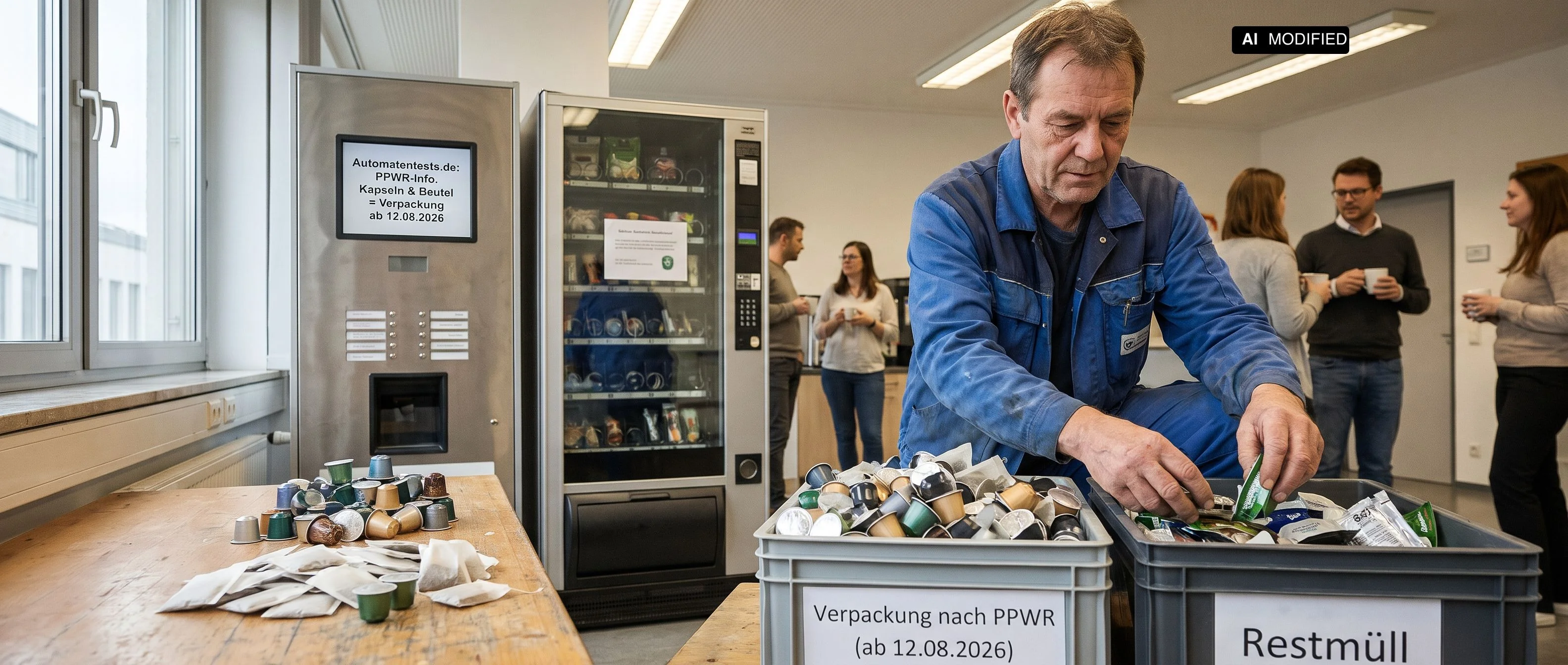
PPWR and Germany’s Packaging Rules: What Vending Operators Should Check
The PPWR and Germany’s current VerpackDG took effect on 12 August 2026, with EU requirements applying in phases. Here is what vending operators should check about reusable offers, employee-only machines and customer-provided containers.

EUDR and coffee vending machines: what the EU Deforestation Regulation requires before it applies
Preparing for the EUDR affects coffee vending operators mainly through coffee products, supply chain evidence and business roles—not the machines themselves. This article explains the deadlines from 30 December 2026 and 30 June 2027, and outlines the data operators should start collecting now.
Commodity Monitor October 2026: Coffee eases, cocoa and sugar in focus
The ICO coffee price fell by 8.7 per cent in September 2026 to 262.18 US cents per pound. The monitor puts the decline in context for vending procurement, presents Fairtrade cocoa minimum prices for Ghana and Côte d’Ivoire separately, and omits a sugar figure because no reliable primary source is available.