
Compliance & News
Packaging Law from 12 August 2026: What's New for Vending-Machine Operators
From 12 August 2026, a new packaging law applies to vending-machine operators. On that date, the Packaging Implementation Law came into force, published on 13 July 2026 in the Federal Law Gazette as part of the Act Amending Packaging Law to align with Regulation (EU) 2025/40. It replaces the Packaging Act, which had set the framework since 2019.
In practice, this means: two legal sources now apply simultaneously. The European Packaging Regulation applies directly and governs design, recyclability and labelling. The German implementing law supplements areas where the regulation leaves room for national discretion—namely in enforcement, dual system participation and the packaging registry. Anyone dispensing cups, lids, stirrers or packaged snacks through vending machines is affected by both.
Three deadlines are closer than most expect, and one falls within this year.
The Classification That Comes First
Almost all new obligations hinge on two roles: manufacturer and producer. If you are neither, you have little to do. If you are one, you have deadlines. This classification is the first step, and it is not self-evident.
Manufacturers remain obliged to register with the Central Packaging Register and enrol packaging subject to dual system participation in a dual system. What is new is that the scope of packaging subject to dual system participation is expanding: primary production packaging is now included, and transport packaging in part. Producers, conversely, face obligations that did not exist under the old packaging law—notably assessing whether their packaging meets the regulation's sustainability requirements and preparing a declaration of conformity.
This pattern is familiar to anyone who has dealt with the single-use plastics fund. There, the question of who first places a product on the market determines who pays and who merely shares the economic burden. When purchasing cups through a German wholesaler, the obligation lies with the upstream supplier; when importing directly, it lies with the operator. The guide to single-use plastics fees at coffee vending machines walks through this scenario in detail. The new packaging regulation poses the same type of question, but with its own terminology, and the answer may differ from the fund's approach.
The Deadline That Falls in 2026
Existing dual system participations remain in force, but only until 31 December 2026 at the latest. Operators currently under contract with a dual system therefore have no indefinite continuation, but a deadline of less than five months. Before year-end, you should therefore verify whether and how the participation must be renewed.
In addition, there is a new licensing requirement for manufacturers of packaging not subject to dual system participation. The LUCID registry remains in its current form for now and will be adapted—good news for operators: registration itself does not need to start over.
PFAS in Food-Contact Packaging
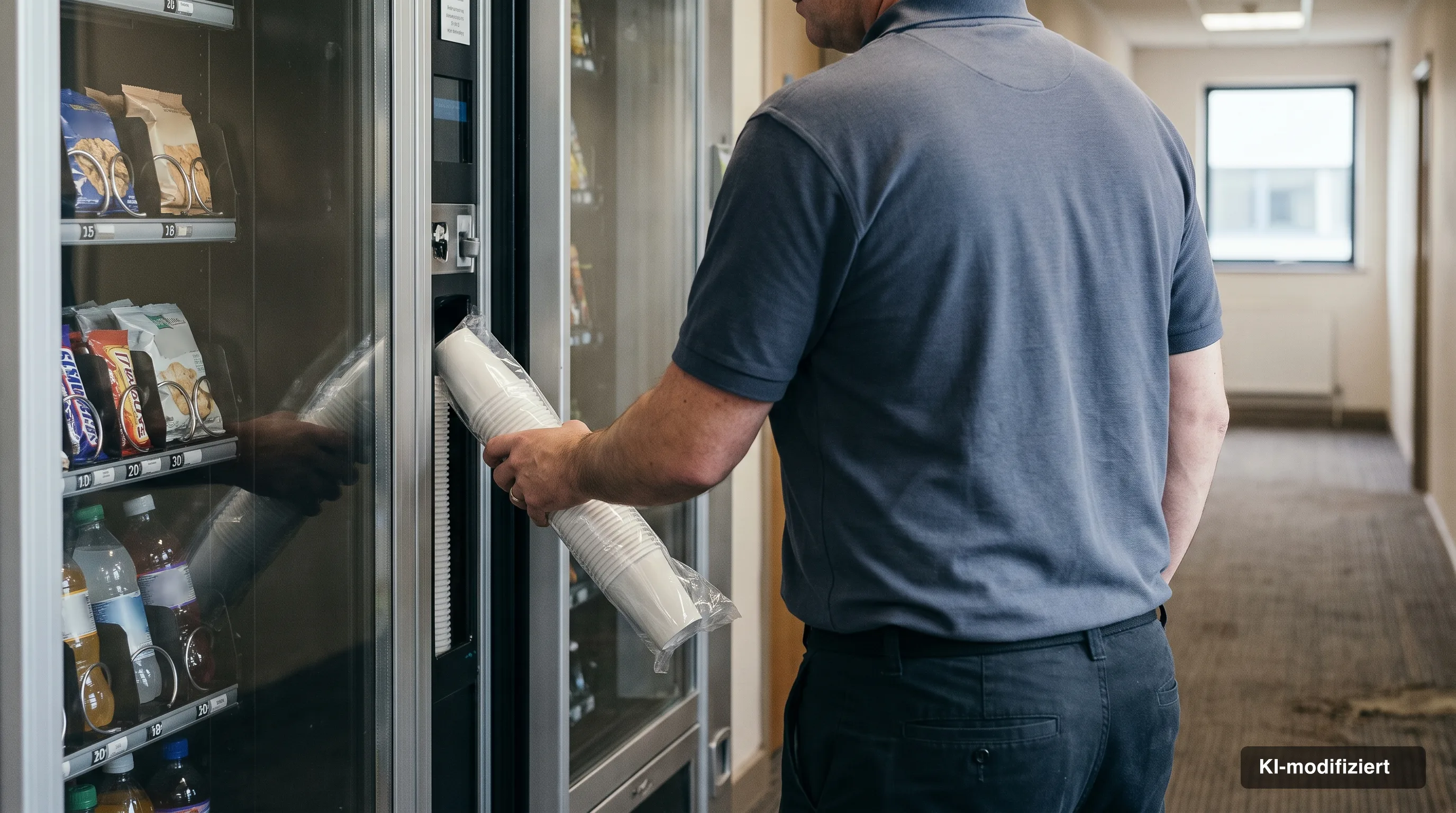
For hot-beverage vending machines, a design requirement is directly relevant: the regulation sets new limits for PFAS in food-contact packaging. Coated paper cups, lids and paper snack packaging fall into this category. Difficult-to-recycle plastics and hazardous substances are also restricted.
The operator does not design these cups. The operator purchases them, and that is the action point: supplier confirmations of conformity must now be part of procurement documentation. Those who do not request them have no evidence in case of doubt. Enforcement includes not only fines but also prohibition of placing packaging and goods in such packaging on the market.
In addition, there is labelling. All packaging will henceforth require an EU-harmonised marking on recycling and disposal. This too is a design requirement that originates with the supplier and reaches the operator.
What Follows in 2027, and This Time for Relief
Not every change in this package tightens requirements. Article 5 of the same law amends the Single-Use Plastics Fund Act and replaces the figure 100 with 10,000 in Section 11, Subsection 4, Sentence 1. Those who must file volume reports with the Federal Environment Agency will now require certification from an expert or auditor only from 10,000 kilograms per year instead of 100 kilograms.
This date is important and differs from the rest of the law. Article 8 provides that Article 5 comes into force on 1 January 2027. The general entry into force of 12 August 2026 therefore does not apply to this amendment.
To put it in perspective: 10,000 kilograms corresponds to approximately 2.5 million vending cups per year at 4.0 grams per cup, or roughly 6,850 per day. The old threshold of 100 kilograms was reached at just under 69 cups per day—well within the capacity of a single busy office location. For small and medium operators, the audit requirement effectively disappears from the 2027 reporting year. The fee itself remains unchanged, as does the reporting obligation.

The Longer Deadlines
Two milestones concern the future but are relevant today because they influence equipment and assortment decisions with long operating lives.
From 1 January 2030, packaging must consist of at least 70 per cent recyclable material. From 1 August 2030, rules on oversized packaging with air cushioning and false bottoms come into effect. From 2028, dual systems must achieve a higher plastic waste recycling rate of 75 per cent. This 75 per cent is a target for the systems, not a quota that individual operators must meet. It works indirectly—through pricing and through what systems will accept in future.
What to Do Now
Four steps, in this order. First, clarify your own role—determine whether your operation is a manufacturer, producer, both or neither. Second, address dual system participation, as it expires on 31 December 2026. Third, procurement—request and file conformity and PFAS confirmations for cups, lids and packaged goods from your supplier. Fourth, volume reporting under the Single-Use Plastics Fund Act, where the audit requirement changes from 2027 but the reporting obligation itself remains.
Legal status as of 13 August 2026. In any individual case, the authoritative guidance is from the competent authority, and classification as manufacturer or producer is expressly case-dependent according to the available guidance.
Frequently asked questions
- What must vending-machine operators complete by end of 2026?
- Existing dual system participations remain in force only until 31 December 2026. Operators with current dual system contracts should verify before year-end whether and how participation must be renewed. Registration in the LUCID registry, however, does not need to start over.
- Does the new PFAS rule apply to hot-beverage vending machines?
- Yes, through consumables: the regulation sets new limits for PFAS in food-contact packaging. For your operation, this means clarifying cup and lid sourcing with your supplier—not modifying the machine.
- From what volume does volume reporting require audit certification?
- The old threshold of 100 kilograms was reached at just under 69 cups per day—well within the capacity of a single busy office location. Article 8 of the amending regulation provides that Article 5 comes into force only on 1 January 2027; until then, the previous rules apply.
More news
Cyber Resilience Act from 11 September 2026: What it means for connected vending machines
From 11 September 2026, the notification obligations of the Cyber Resilience Act apply. What this means for connected vending machines in the installed base — and what it does not.
EUDR from 30 December 2026: What the Deforestation Regulation means for coffee in vending machines
The EU Deforestation Regulation takes effect on 30 December 2026 for coffee too. What vending machine operators need from their suppliers and what they don't need to do themselves.