
Recht & Compliance
Single-use plastic levy on coffee vending machines: Who really pays it
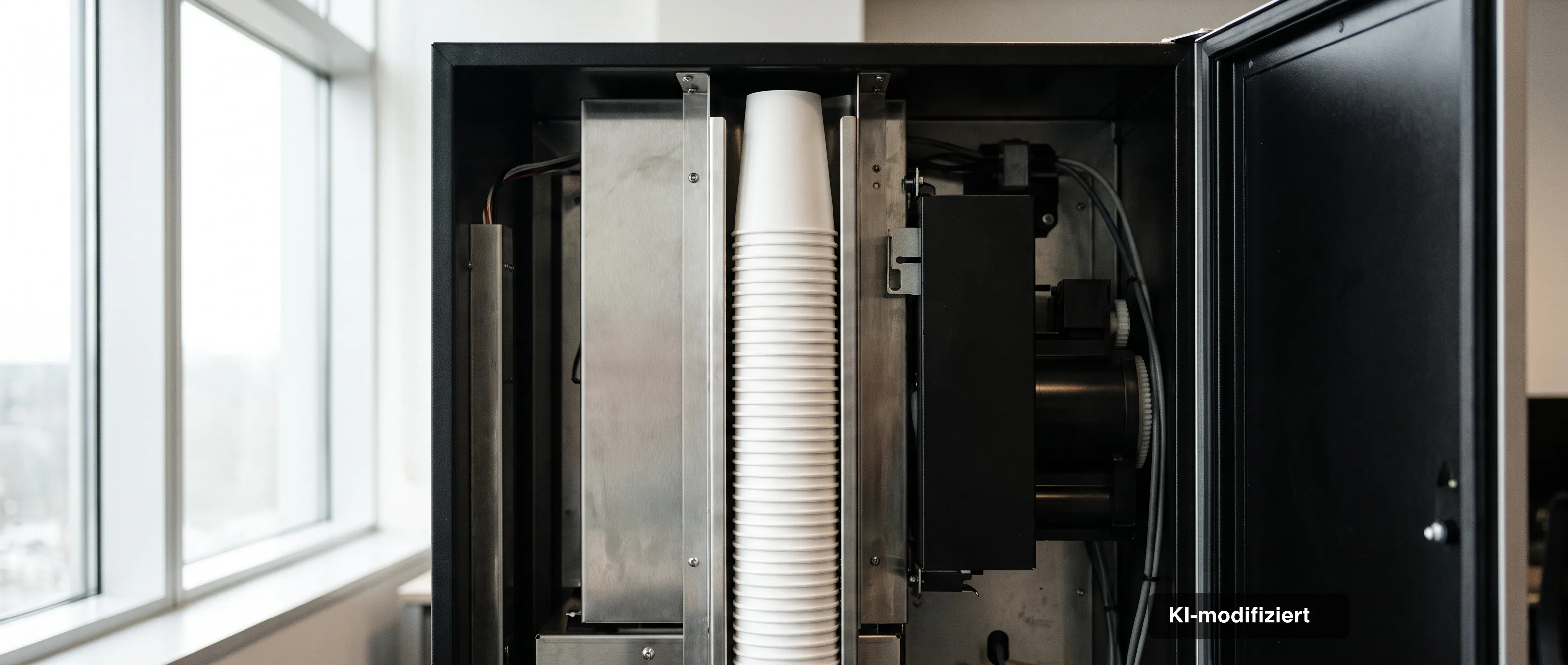
Since 2024, Germany has imposed a levy on single-use cups, and since the first assessment in spring 2025, it lands on someone's bill. Anyone operating a coffee vending machine with cups therefore wants to know two things: whether they must register with the Federal Environment Agency and what it costs them per cup.
The second answer is quick. A standard vending machine cup carries roughly one-third to just over half a cent in levy. The first answer is more important, and it turns out differently for most machine operators than expected: they probably pay the levy, but not to the state. It is built into the cup price. Whoever orders their cups directly from abroad, however, slides into an obligation whose most expensive component until the end of 2026 is not the levy itself, but proof of it. As of 1 January 2027, this very component disappears for small and medium quantities.
What the law imposes and how it calculates
The basis is the Single-Use Plastics Fund Act, announced in May 2023, with staggered entry into force until January 2025. It requires manufacturers of certain single-use plastic products to pay an annual special levy. The fund subsequently compensates municipalities for cleaning and disposal in public spaces.
Two details of the calculation determine the amount, and both are frequently misrepresented.
First, the rate. The Single-Use Plastics Fund Ordinance sets in Section 2 an amount in euros per kilogram for each product type. For beverage cups it is €1.236 per kilogram. Of the nine levy items in the ordinance, only three are higher: tobacco products with filters, balloons, and lightweight plastic carrier bags. Cups thus rank fourth and are roughly seven times higher than food containers, which are assessed at €0.177 per kilogram. In the fund, they are thus explicitly classified as expensive.
Second, the assessment base. Section 13, subsection 1, ties the levy to the reported mass of products first placed on the market, multiplied by the rate. The product itself is weighed, not its plastic content. This sounds technical, but it has an unpleasant consequence for everyone who switched to paper: under Section 3, item 1, a single-use plastic product is a product consisting wholly or partly of plastic. A paper cup with a plastic inner coating consists partly of plastic, falls under the law, and its full mass including the paper is assessed. Switching from plastic to coated paper therefore does not reduce the levy; it typically increases it because the paper cup is heavier.
Then there is the accessories component that many overlook. Schedule 1 of the law lists under item 4 beverage cups including their closures and lids. Anyone who supplies lids reports their mass and pays the same cup rate on it.
The one question that decides the levy obligation
Under Section 3, item 3, a manufacturer is anyone established in the country who, as a producer, filler, seller or importer, commercially places single-use plastic products from Schedule 1 on the market in the country for the first time. The word everything hinges on is first.
A machine operator who buys cups pallet by pallet from a German wholesaler does not place them on the market for the first time. Someone before them already did that: the producer or importer from whom the wholesaler sourced them. In this constellation, the operator bears the levy economically because it is built into the cup purchase price, but they are not the liable party and need not register, report, or expect any notice.
It is different with direct imports. The Federal Environment Agency interprets the importer concept in its information materials such that a company with a German base is covered if it procures products from Schedule 1 from abroad to supply them within the country to third parties, and it is irrelevant who holds responsibility at the border. What matters is the domestic company that places the order and arranges delivery. So if you order your cups cheaply directly from a supplier in another EU country or in Asia, you become a manufacturer under the law yourself. This is the practical crux for the industry: it is not the size of the machine park that decides, but the procurement route.
One restriction absolutely belongs here. For bags and film packaging, the law explicitly states that the filler is the manufacturer—the food provider, not the packaging producer. For beverage cups, there is no such exception, so the general criterion of first placement remains. An official statement that blanket exempts the filling purchaser does not exist for cups, and the self-assessment tools on the DIVID platform are, according to the Federal Environment Agency, decision trees for orientation and explicitly not binding legal interpretation. Only a classification notice under Section 22, which can be requested and incurs a fee, is binding. Anyone with mixed procurement, partly trade, partly direct import, should go this route rather than hope.
What the levy actually amounts to per cup
Because the rate depends on mass, the levy can be reduced to a single figure with which anyone can calculate based on their own cup: €1.236 per kilogram equals 0.1236 cent per gram of product mass.
Standard vending machine cups made from polystyrene weigh, according to dealer information, 3.0 to 4.0 grams at 150 milliliters filling volume and 3.3 to 4.5 grams at 180 milliliters. This results in a levy of 0.37 to 0.56 cents per cup. For a typical 180-milliliter cup of 4.0 grams, it is 0.49 cents.
Measured against the cost of the cup itself, this is modest. The calculation in the guide to cup pricing comes to 22.1 to 28.4 cents in own costs per cup for device, bean, milk, water, electricity and service visits, and 24.1 to 38.1 cents once daily cleaning with labour costs is factored in. Overhead is not included in either range. The single-use levy accounts for 1.0 to 2.5 percent of that. It is not a line item that overturns a price list, and it explains no cup increase of several cents.
On an annual basis, this becomes a manageable sum. A location that dispenses 100 cups per day consumes 146 kilograms per year at 4.0 grams per cup and incurs €180.46 in levy. At 200 cups per day it is 292 kilograms and €360.91, at 500 cups per day 730 kilograms and €902.28. These amounts apply if the operator is themselves liable for the levy—that is, in direct import. Anyone who buys from German trade finds the same magnitude not in the assessment but built into the cup price.
The line item that costs multiples of the levy until 2026
This article would be over if the levy were the most expensive part. For reports through reporting year 2026, it is not.
Section 11, subsection 1, requires manufacturers to report by 15 May each year the quantities placed on the market in the previous year by type and mass in kilograms. Sentence 2 of the same provision adds that this report requires review and confirmation by a registered expert within the meaning of the Packaging Act or by a registered auditor, tax advisor or sworn auditor.
This is where a boundary is usually misunderstood. Subsection 4 exempts anyone who placed less than 100 kilograms on the market in the previous year. But exemption is exclusively from the requirement in subsection 1, sentence 2—that is, from confirmation by an auditor. The reporting obligation under sentence 1 and the levy itself remain. The 100 kilograms are not a de minimis threshold for the levy, but an audit threshold.
And it is low. At 4.0 grams per cup it is reached at 25,000 cups per year, or roughly 69 cups per day. For light 3.0-gram cups it sits at 33,333 pieces per year or 91 per day; for heavy 4.5-gram cups already at 22,222 pieces or 61 per day. A single busy machine in a mid-sized office exceeds it.
What is critical now is that this threshold is set to expire. Article 5 of the Act amending the Packaging Act to Regulation (EU) 2025/40, announced on 13 July 2026 in the Federal Law Gazette, replaces the figure 100 with 10,000 in Section 11, subsection 4, sentence 1. Article 8 of the same act determines that Article 5 enters into force on 1 January 2027. The general entry into force of the act on 12 August 2026 therefore does not apply to this amendment.
The threshold thus rises by a factor of 100, fundamentally changing the situation for machine operators. 10,000 kilograms equals 2.5 million cups per year at 4.0 grams per cup—roughly 6,850 per day. Depending on cup mass, the threshold lies between 2.2 and 3.3 million cups per year, or about 6,100 to 9,100 per day. Anyone at this threshold pays €12,359 per year in cup levy alone. For practically every single operator and for most mid-sized machine parks, the audit requirement is thus off the table from 2027 onward.
What the audit costs is the real finding. Fifteen trade associations led by the German Food Industry Association requested in a letter dated 20 January 2026 permanent suspension of this audit requirement, providing an example: for a company with around 350 kilograms of reported quantity, audit costs would be between €3,000 and €9,000, while the levy itself was only about €100 to €200. Two caveats belong here. The low levy amount in this example applies to a mixed product assortment with significantly lower rates and cannot be transferred to cups assessed at €1.236 per kilogram. And the range of €3,000 to €9,000 is not a general fee schedule but comes from quotes for this single case of around 350 kilograms. What an audit actually costs depends on assortment breadth, documentation, data quality and audit scope. What is certain is that it is based on effort, not levy amount, and therefore is out of proportion for small quantities.
This is exactly where the disproportion arises that applies until the report for 2026. An operator dispensing 100 cups per day and importing themselves pays €180.46 in levy and would incur 16 to 50 times this amount for confirmation, measured against the range cited above. At 200 cups per day it would still be 8 to 25 times; at 500 cups per day 3 to 10 times. The associations estimate that roughly 80 percent of audit-liable companies are small and medium enterprises and call for raising the audit threshold to 30,000 kilograms per year, matching the threshold in the Packaging Act. How serious the enforcement situation is shows another figure from the same letter: of an estimated 55,000 liable companies, only about 7,600 had registered.
For costing, this means two things. For reports through reporting year 2026, the line item "single-use levy" in small to medium quantities does not consist of cents per cup, but predominantly an audit fee. From reporting year 2027 onward, for which reporting is due in May 2028, only the cent amount per cup remains, and it is the smaller portion. Anyone obtaining audit quotes today should first check what quantity they report at all.
Which deadlines and changes are ahead
Three deadlines are relevant. The quantity report for the previous year must be submitted by 15 May each year via the DIVID platform. Registration must occur before commencing activity, not just with the first report. And the levy becomes due one month after receipt of the assessment, with an objection having no suspensory effect.
There is movement on rates. They must be reviewed regularly, at least every three years, and adjusted as needed, for the first time by end of 2026. The cup rate can thus change, and the direction is open.
The product catalogue also grows, and how staggered this proceeds is shown by the example of plastic-containing fireworks. Section 29 as a transitional provision requires manufacturers active before 1 January 2026 only to register by 31 December 2026. The levy obligation itself applies only to the calendar year 2027, and the first quantity report is due by 15 May 2028. A new product type therefore does not mean it is paid in the same year.
Doing nothing is the worst option. Unregistered manufacturers may not place or sell single-use plastic products for the first time, and a distribution ban additionally applies: products may not be commercially offered for sale if their manufacturer is not registered. Violations of manufacturer duties can be punished with fines up to €100,000. And whoever does not submit a report does not escape the levy, because Section 13, subsection 2, allows the Federal Environment Agency to estimate type and mass.
What this means for cup procurement
From all this follows a decision that has nothing to do with environmental policy but with administrative burden. The price difference between a German wholesaler and direct import from abroad is often a few tenths of a cent per piece for cups. Direct import makes the operator a manufacturer subject to registration and reporting in any case. How heavily this weighs depends on timing. For reporting year 2026, the audit requirement kicks in at 100 kilograms, and at 100 cups per day the savings in procurement would have to cover an audit fee of several thousand euros. Spread across 36,500 cups per year that would be 8.2 to 24.7 cents per cup—many times any realistic savings and 17 to 50 times the levy of 0.49 cents that it is really about. From reporting year 2027 this argument disappears because the threshold then sits at 10,000 kilograms. What remains is the administrative burden of registration and annual reporting, and that is a question of hours, not thousands of euros.
Anyone already importing has two sensible paths. Either switch sourcing to domestic suppliers, leaving the obligation where it is already being met, or clarify your own situation via a classification request and for reporting year 2026 calculate the audit once, which then disappears. Whoever is unsure whether they are affected at all checks not the machine park, but last year's invoices for cups and lids: if there is a supplier with a German address who did not import the cups themselves for the purchaser, much speaks for the relaxed variant.
Three things cannot be derived from this presentation. It is not legal advice, and binding in the individual case is only an assessment from the Federal Environment Agency under Section 22. The legal status is 13 August 2026, with the audit threshold increase to 1 January 2027 announced and thus already decided, while the consolidated law text still shows the old 100 kilograms. And the cited cent amounts apply to the cup masses documented here—plastic cups between 3.0 and 4.5 grams. For coated paper cups and lids, reliable unit weights are not publicly available, so no figure is given here. But you do not need to search for the value: multiply your own mass in grams by 0.1236 to get the levy in cents per piece.
Frequently asked questions
- Must a machine operator pay the single-use plastic levy?
- Only with direct import. Anyone who buys cups pallet by pallet from a German wholesaler does not place them on the market for the first time—the producer or importer before them did. The operator then bears the levy economically in the purchase price but is not the liable party: no registration, no report, no assessment.
- How high is the levy per cup?
- The rate depends on mass: €1.236 per kilogram of beverage cup, or 0.1236 cent per gram of product mass. A cup of 4.0 grams thus costs roughly 0.49 cents in levy. Multiply your own cup mass in grams by 0.1236 to get the levy in cents per piece.
- What does the 100-kilogram threshold mean?
- It is an audit threshold, not a de minimis threshold. Anyone who placed less than 100 kilograms on the market in the previous year is only exempt from confirmation of the quantity report by an expert. The reporting obligation itself and the levy remain. The threshold is reached at 4.0-gram cups with roughly 69 cups per day.
Latest on this topic
- Cyber Resilience Act from 11 September 2026: What it means for connected vending machinesCompliance & News · August 17, 2026
- EUDR from 30 December 2026: What the Deforestation Regulation means for coffee in vending machinesCompliance & News · August 14, 2026
- Packaging Law from 12 August 2026: What's New for Vending-Machine OperatorsCompliance & News · August 13, 2026