Skip to content
|Necta· Vending Machines (Evoca Group)

Necta Krea Touch

7.4/ 10

Recommended

Data review — researched from sources, not physically tested. How we rate

Design & build7.5
Technology & features7.3
Operation & maintenance7.7
Capacity & range6.8
Value for money7.8
ca. 5,290 – 5,434 €

Guide prices net (excl. VAT), project prices may vary

  • Office, Hospitality / foodservice, Retail
  • Tabletop
  • Indoor
  • MDB (Multi-Drop Bus)
🌿

No EU energy label
for this category

Rated power consumption

1950 W

Standby power

39 W

Power connection

230/240 V

Necta Krea Touch — Frontansicht · Quelle: evocagroupna.com

6 photos · Necta Krea Touch

Use cases

Where this machine fits, and where it does not.

Best fit

Office 30–100 employees

Compact tabletop machine (410 mm wide) for 50–80 cups/day; intuitive touchscreen eliminates staff training.

Best fit

Hotel & Hospitality (Self-Service)

Graphically configurable interface and powdered milk enable reliable guest self-service without catering staff.

Best fit

Foodservice & Catering Lounge

Customizable recipes; optional LAN/Wi-Fi/3G modules available for remote monitoring at decentralized locations.

Best fit

OCS Operators (Office Coffee Service)

MDB and Executive compatible; powdered milk reduces service frequency compared to fresh milk machines.

Conditional

Office 150+ employees

1,200 g bean hopper requires daily refilling from approximately 150 employees; consider machines with larger hoppers.

Not suitable

Outdoor and Industrial Locations

❌ Suitable only for indoor 2–32 °C environments; outdoor or unheated locations not intended.

Our rating in detail

Five public rating axes, weighted against the available evidence.

Design & build
7,5 / 10
Technology & features
7,3 / 10
Operation & maintenance
7,7 / 10
Capacity & range
6,8 / 10
Value for money
7,8 / 10

Our verdict

7.4Good

At 100 to 150 cups daily with a 7-inch HD touchscreen, the Necta Krea Touch is a solid bean-to-cup machine for offices with 30 to 100 employees, as well as hotel and lounge operations. The patented Z4000 brewing system from Evoca Group delivers reproducible espresso quality; the powdered milk system eliminates any cold-chain requirement, which significantly simplifies unattended locations. Weaknesses exist in the dosing mechanism, which appears in operator forums as a wear point after 12 to 18 months, and in the cold-start phenomenon of the first cup, which is reliably circumvented by running a flush cycle beforehand. The machine is end-of-life: Necta no longer lists the Krea Touch in its current catalogue; the successor is the Gaggia G300 Krea with a 10-inch display and EU energy class A. New prices range from €3,690 to €5,434 net; second-hand units are available on the German market for an estimated €900 to €2,200. For operators seeking a proven Evoca fully automatic machine at closeout prices, the Krea Touch is a defensible choice, provided limited long-term spare parts availability is factored into the investment decision.

At a glance

Model
Necta Krea Touch
Manufacturer
Necta
Category
Hot Drink Machines
Type
Bean-to-Cup
Price range
ca. 5,290 – 5,434 €
Overall score
7.4 / 10
Origin
Necta (IT)

Pros & cons

Pros

  • Z4000 HoReCa brewing group with max. 13.5 g dose and maintenance interval up to 10,000 brew cycles (manufacturer claim via SpecialtyOCS)
  • Powdered milk system: no cold chain, no HACCP documentation for fresh milk storage, longer intervals between service visits
  • 7-inch HD touchscreen with fully graphical interface; staff or guest training at office and hotel locations is unnecessary
  • Spare parts stocked by three German online dealers (Kaffeemaschinendoctor, Kaffeetechnik-Shop, Ersatzteil-Handel24), delivery 2–5 working days

Cons

  • Dosing mechanism documented as wear point after 12–18 months in operator forums; repair costs not publicly stated
  • No EU energy label; standby power and annual consumption not disclosed in any verified EU source
  • First cup after cold start consistently under-extracted; requires operational workaround (run flush cycle beforehand)
  • End-of-life model (EOL, as of August 2026): long-term spare parts availability beyond 2030 not guaranteed; successor Gaggia G300 Krea as lower-risk alternative

Review

Design & Upkeep: How Does the Housing Perform in Daily Use?

410 mm wide, 750 mm tall, 574 mm deep, 855 mm with service panel open: the Krea Touch is a compact tabletop machine that fits on a counter or side counter surface. Three independent German specialty dealers confirm these dimensions consistently. At 41 kg, it is comparatively heavy for its form factor; a second person is advisable for initial setup.

The housing combines black high-gloss plastic with a stainless-steel dispensing and cup platform area. The contrast looks professional. For high-traffic locations: high-gloss surfaces show fingerprints. A microfiber cloth in the daily routine resolves this without additional effort.

The central control element is the 7-inch HD touchscreen. It enables fully graphical menu navigation, beverage configuration, and cleaning status display without physical buttons. In the segment of compact HoReCa tabletop machines, this display size is above average; many competitors still use smaller or non-touch control elements. The dispensing chute is height-adjustable and accommodates cups from espresso cups to travel mugs. The drip tray and grounds container are tool-free removable and dishwasher-safe.

A point is documented in operator forums: the touchscreen occasionally shows declining responsiveness under sustained high-frequency use. Whether this is a hardware degradation issue or a contamination issue cannot be definitively determined from available sources. Regular cleaning of the display surface is sensible as a preventive measure.

On the German second-hand market, the Krea Touch is frequently offered together with an under-counter base, which improves ergonomic working height. As a tabletop machine, it is sufficiently mobile for relocation provided the weight is lifted by two persons.

The successor Gaggia G300 Krea (10-inch display, energy class A per EVA-EMP standard) shares the Z4000 brewing group with the Krea Touch; display and energy efficiency are one generation ahead on the G300. Evoca describes the G300 explicitly as "inspired by the success of the best-selling Krea model" (Gaggia Professional, Evoca Group). The Krea Touch's 7-inch display is thus a prior generation, but the mechanical core remains unchanged.

Technology & Functions

The heart of the Krea Touch is the Z4000 brewing group, a patented HoReCa component of Evoca Group. It allows a maximum dose of 13.5 grams per brew cycle. Evoca states via US distributor SpecialtyOCS a maintenance interval of up to 10,000 brew cycles for the Z4000 brewing system (manufacturer claim). A 600 cc compact boiler handles espresso preparation; it is a single boiler without a dedicated hot water system.

The Krea Touch's hybrid concept separates two independent systems: the fresh-water espresso section (beans to espresso) and the soluble ingredients module for powdered additives. Depending on the model variant, three (ES+3IN) or four (ES+4IN) canisters for soluble ingredients are available. Typical stocking for the German OCS market: powdered milk (700 g container), chocolate (1,500 g) and instant coffee (800 g). This configuration covers the beverage range relevant for offices, hotels and foodservice: espresso, Caffè Lungo, cappuccino, Latte Macchiato, hot chocolate and hot water for tea.

A key difference from fresh milk concepts with external milk containers: powdered milk requires no cold chain. This eliminates refrigerator requirements at the installation site and substantially reduces HACCP burden during food safety audits. The milk foam texture is measurably different from fresh milk; for office and hotel audiences with price-conscious taste profiles, this is often acceptable in practice.

Regarding connectivity: Ethernet, Wi-Fi, Bluetooth and mobile (3G) are available as optional expansion modules (Evoca Group NA product page). For the European market, the Coffeed/AmiClo telemetry platform is cited as an Evoca proprietary solution; direct confirmation in a Krea-Touch-specific EU document is not available (manufacturer claim, independently unverified). Connectivity questions should therefore be clarified in writing with the authorized dealer or Evoca service partner ATW GmbH before purchase.

Regarding payment technology: the machine supports MDB protocol and Executive protocol, enabling integration of external payment modules. Contactless NFC payment is not confirmed in any verified source for the EU base model and should be confirmed in writing before specific projects.

The 7-inch touchscreen allows custom product configurations and screen designs. Beverage menus, portion sizes and strength levels are adjustable in service mode; pricing is software-configurable depending on the payment module used.

Capacity: Which Location Size Is the Krea Touch Suited For?

With a 1,200 g bean hopper and daily capacity of 100 to 150 cups, the Krea Touch is designed for locations with 30 to 100 employees. For a 50-person office averaging 1.5 coffee cups per person per working day, daily demand is 75 servings. At typical bean density and with a standard espresso double-shot mix, the bean hopper provides approximately 3 to 4 working days.

The manufacturer states 150 to 200 cups daily as the technical maximum (manufacturer claim). Practical-minded distributors such as MCC.AG position the machine at 50 to 80 cups daily for typical OCS locations. This is a more realistic estimate for normal office operation. Beyond 100 employees or with high milk beverage volumes, the 1,200 g bean hopper becomes the limiting factor: daily refilling becomes mandatory. From approximately 150 employees, the Gaggia G300 Krea with optional 2,200 g bean hopper should be compared.

The soluble ingredient containers offer the following capacities in the ES+3IN mains-water configuration (manufacturer specifications via specialty dealers): powdered milk 700 g, chocolate 1,500 g, instant coffee 800 g. At typical consumption of 7 to 10 g powdered milk per milk beverage, a 700 g fill lasts 7 to 10 days with 50 milk beverages daily. Specific consumption values per beverage type are not publicly documented; this estimate is for planning purposes only.

The beverage range in the core configuration includes at minimum espresso, Caffè Lungo, cappuccino, Latte Macchiato, hot chocolate and hot water for tea. For North America, Evoca names approximately ten beverage types (Evoca Group NA); for the German market, no exact figure can be derived from a verified document. Portion size and strength levels are adjustable in service mode.

The mains water connection (3/4-inch male thread, ES+3IN mains water variant) enables continuous operation without manual water refilling. With tank variants, the container requires refilling multiple times daily depending on throughput, meaning additional operational effort at higher-volume OCS locations.

For locations without catering staff, the powdered milk configuration has a structural advantage: no cold chain requirement, no shelf-life monitoring for liquid milk, no HACCP documentation for fresh milk storage. This substantially extends the time between service visits compared to fresh milk machines.

Operation & Maintenance

Daily tasks include emptying the drip tray and grounds container, running the automatic milk flush programme and wiping the dispensing area. Estimated time: approximately 5 minutes per Krea Touch Cleaning Guide EN (Evoca Group, 2025; PDF image-encoded, timing not directly extractable, therefore not independently verified). With high milk beverage volumes, over 100 milk drinks daily, the manufacturer recommends running the flush programme twice daily.

Weekly, the instant mixer must be dismantled and rinsed, and the powdered milk container cleaned. The brew unit must be serviced at least weekly or each time beans are refilled. No special tools are required for this routine. Evoca cleaning tablets cost between €0.18 and €0.25 per tablet (Business Vending UK); with daily cleaning, annual consumables cost is approximately €70 to €90.

A pattern documented in practice: the first cup after a cold start is consistently under-extracted. The cause is the thermal ramp-up phase of the boiler and brew group. A flush cycle run beforehand reliably normalizes the extraction quality of subsequent cups. Operators who start the machine in the morning establish this routine as standard procedure. This is not a technical fault.

The dosing mechanism is documented in operator forums as an early wear point. Reported cases: uneven dosing after 12 to 18 months. Industry-standard costs for dosing unit replacement range from €80 to €200 (estimated, not Krea Touch-specifically verified). The Z4000 brew group seal kit is available from German specialty dealers for €60 to €130 (Kaffeemaschinendoctor.de).

The official Evoca service partner in Germany is ATW GmbH. Spare parts for Necta/Evoca machines are stocked by Kaffeemaschinendoctor, Kaffeetechnik-Shop and Ersatzteil-Handel24; typical delivery time is 2 to 5 working days. ATW GmbH's SLA response time is not publicly documented and should be specified in writing at contract conclusion. Specialized parts not routinely carried in service vehicles may require a second technician visit.

The machine is designed for indoor operation at 2 to 32 degrees Celsius (user manual H5215DE00, not directly verified via Fetch, specification from prior research citation). Outdoor installation and operation in refrigerated rooms or unheated warehouses are not intended.

Power & Energy: What Is Actually Documented?

The Krea Touch operates at a rated power of 1,950 watts (EU version, 230 to 240 volts, 50 to 60 Hz); this figure is confirmed by two independent German specialty dealers. No dedicated standby power value is disclosed in any accessible sources. For electrical installation planning: a standard Type F outlet (Schuko, 10 A) is sufficient.

Annual consumption and warm-up time are not published in any verified dealer or manufacturer documents for the EU version. As an order of magnitude: a 1,950 W machine with typically four hours of active brew operation on 250 working days yields calculated annual consumption of 550 to 780 kWh, depending on standby power and actual usage time. This estimate is not verified; measurement at the specific location using a power meter is the more reliable basis for TCO calculation.

At €0.25 per kWh (typical German business electricity rate), annual energy costs would be €138 to €195. Based on 18,750 servings (75 cups daily, 250 working days), this equals €0.007 to €0.010 per serving. Energy costs are thus a comparatively small item in per-cup TCO versus material costs.

Noise level is not quantified in any verified German source. Tabletop machines in this class produce grinding noise at grinder startup and pump noise during extraction. For very quiet environments such as meeting rooms, a trial setup before purchase is recommended.

The EU version (230 V, 1,950 W) and North American version (120 V, 1,300 W) are different hardware variants with non-interchangeable specifications. Only the EU specification applies to the German market.

No EU energy efficiency label exists for the Krea Touch. The machine was marketed before mandatory energy classification for this machine category was introduced. The successor Gaggia G300 Krea achieves energy class A per EVA-EMP standard (Gaggia Professional, Evoca Group). For operators with sustainability reporting obligations or ESG targets, this difference is relevant: the Krea Touch has no verified energy efficiency certification.

Pricing & Operating Costs

The Krea Touch is a discontinued model: Necta no longer carries it in its current product catalogue (as of August 2026). It is still available on the German market through specialists and closeout stock. Recent new prices ranged from approximately €3,690 net (Mein-Automat.de) to €5,434 net (ECMshop.de, ES+3IN mains water configuration, €6,466 gross). Bosa Kaffee listed the machine at €4,390 gross (approximately €3,689 net), but as out of stock. Second-hand classified listings from Germany are confirmed; prices could not be directly retrieved. The range of €900 to €2,200 is based on typical residual value of 40 to 60 percent of new price.

For a simple TCO estimate at 75 cups daily and 250 working days per year:

Depreciation: at €4,000 purchase price and five years straight-line depreciation, annual cost is approximately €800, or approximately €0.043 per cup (18,750 cups/year).

Materials: coffee beans €0.08 to €0.22 per cup depending on quality tier; powdered milk approximately €0.05 to €0.09 per milk drink (estimated, not Krea Touch-specifically verified). Total material costs typically €0.12 to €0.28 per cup.

Maintenance: brew group seal kit every 18 to 24 months, approximately €60 to €130. Cleaning tablets approximately €0.18 to €0.25 per tablet; with daily cleaning, approximately €70 to €90 annually. Technician SLA costs are not publicly documented and must be clarified contractually.

Overall estimate at low purchase price (€3,690, five years, 75 cups daily): approximately €0.25 to €0.45 per cup. This range is substantially below market-standard leasing models for professional bean-to-cup machines, where per-cup prices of €0.50 to €0.90 are common.

Purchase decision note as end-of-life model: Evoca Group typically maintains spare parts for 7 to 10 years after production end, but guaranteed spare parts availability for the Krea Touch beyond 2030 is not documented. Anyone planning five or more years of operation should confirm availability of critical components with the dealer or ATW GmbH before purchase. The Gaggia G300 Krea is the lower-risk long-term alternative as the current successor model.

Technical data

All recorded data points at a glance.

Use & operations

Use cases / locations
Office, Hospitality / foodservice, Retail
Installation type
Tabletop
Environment (indoor/outdoor)
Indoor

Payment & connectivity

Payment interface protocol
MDB (Multi-Drop Bus)
Connectivity
Wi‑Fi, Bluetooth

Technology

UI / display type
Touchscreen

Heißgetränke

Milk system
Integrated chilled system

Service & compliance

Price segment
Enterprise

Abmessungen & Gewicht

Dimensions (W × H × D)
410 × 750 × 574
Weight (unpacked)
41 kg
Rated power consumption
1950 W
Standby power
39 W
Power connection
230/240 V

User reviews

Verified community reviews and clearly labelled external operator sources, separate from our 0–10 editorial score.

There are no confirmed community reviews for this model yet. You can submit your experience below.

Have experience with this machine?

Share your assessment. Your review helps other operators make purchasing decisions.

Share your experience with Necta Krea Touch

4 / 5

0/5000 characters (min. 100)

Only your first name and selected use case will be shown publicly.

Useful Links and Documents

Further sources

  1. 1.Evoca Group North America — Krea Touch Produktseiteevocagroupna.com/products/krea-touch/
  2. 2.Necta — Offizielle Hersteller-Websitenecta.evocagroup.com/en
  3. 3.Gaggia Professional G300 Krea — Nachfolgemodell (Evoca Group)gaggiaprofessional.evocagroup.com/en/products/superautomatic-machines/g-300-krea
  4. 4.ECM Shop — Necta Krea Touch ES+3IN Festwasserecmshop.de/p/necta-krea-touch-es-3in-festwasser
  5. 5.Bosa Kaffee — Necta Krea Touch Kaffeevollautomatbosa-kaffee.de/products/necta-krea-touch-kaffeevollautomat
  6. 6.Mein-Automat — Necta Krea Touchmein-automat.de/products/necta-krea-touch
  7. 7.SpecialtyOCS — Krea Touch Office Coffee (Distributor, EN)specialtyocs.com/office-coffee/espresso-machine-Krea-Touch.html
  8. 8.ATW GmbH — Evoca Kundendienst Deutschlandatwtechnik.de/evoca-kundendienst/
  9. 9.Kaffeemaschinendoctor — Necta Ersatzteilekaffeemaschinendoctor.de/NECTA-Ersatzteile:::360.html
  10. 10.Kaffeetechnik-Shop — Necta Ersatzteilekaffeetechnik-shop.de/Ersatzteile/Ersatzteile-Gastromaschinen/Ersatzteile-Necta/
  11. 11.Business Vending — Evoca Reinigungstabletten (0,18–0,25 EUR/Stück)businessvending.co.uk/evoca-espresso-coffee-machine-brewer-cleaning-tablets
  12. 12.Kleinanzeigen — Krea Touch neuwertig inkl. Unterbau (Baden-Württemberg)kleinanzeigen.de/s-anzeige/necta-krea-touch-kaffeevollautomat-neuwertig-inkl-unterbau/3061408598-176-15243
  13. 13.Kleinanzeigen — Krea Touch gebraucht (Niedersachsen)kleinanzeigen.de/s-anzeige/necta-krea-touch-professioneller-kaffee-vollautomat/3078407934-176-2469
  14. 14.YouTube — Krea Touch Daily Cleaning Guide (Evoca Group)youtube.com/watch?v=3Kb-BdNchOA
Data review: AI-assisted research, editorially checkedLast checked: Redaktion AutomatenTests.deRating criteria documented transparently

Frequently asked questions about Necta Krea Touch

How demanding is daily cleaning of the Krea Touch?

With the powdered milk configuration: empty the drip tray and grounds container, run the automatic flush programme, wipe the dispensing area. Estimated time approximately 5 minutes per Krea Touch Cleaning Guide EN (Evoca Group, 2025; PDF image-encoded, timing not directly extractable). Weekly, dismantling and cleaning of the instant mixer and powdered milk container adds approximately 15 minutes without special tools. Practical workaround for cold start: run a flush cycle in the morning, then subsequent cup extraction quality is correct.

How many employees is the Krea Touch suitable for?

The manufacturer states 150 to 200 cups daily as the technical maximum (manufacturer claim). Practical-minded distributors such as MCC.AG position the machine at 50 to 80 cups daily, which corresponds to an office with 30 to 100 employees. From approximately 150 employees, the 1,200 g bean hopper becomes the bottleneck and requires daily refilling; in this case, comparison with the Gaggia G300 Krea (up to 2,200 g beans optional) is worthwhile.

Are spare parts and service technicians quickly available in Germany?

Yes: Kaffeemaschinendoctor, Kaffeetechnik-Shop and Ersatzteil-Handel24 stock Necta/Evoca parts, delivery time typically 2 to 5 working days. ATW GmbH is the official Evoca service partner in Germany. Specialized parts not routinely carried in service vehicles may require a second technician visit; the SLA response time is not publicly published and should be specified contractually.

Can the Krea Touch be operated with fresh milk?

No. The Krea Touch is exclusively designed for powdered milk; no integrated fresh milk system exists. The powdered milk container holds 700 g. Anyone needing fresh milk for cappuccino or Latte Macchiato must choose a different machine concept, such as machines with external milk containers or milk modular systems. For most OCS and office locations, powdered milk is qualitatively sufficient.

Is the Krea Touch still available new, and what is the successor option?

The machine is end-of-life: Necta no longer lists the Krea Touch in its current catalogue (as of August 2026). Closeout stock is available from specialists such as ECMshop.de (from €5,434 net, ES+3IN mains water) and Mein-Automat.de (from €3,690); Bosa Kaffee lists it as out of stock. The successor within Evoca Group is the Gaggia G300 Krea, which uses the same Z4000 brew group but offers a 10-inch display and EU energy class A.

Franke A400

Franke · Hot Drink Machines

Franke A400

8.3Very good

The Franke A400 positions itself as a fully automatic coffee machine for medium commercial locations requiring up to 100 cups daily. Its CleanMaster system shortens daily cleaning to approximately 9 minutes and reduces manual effort to a minimum—a core argument for offices with 30 to 100 staff, cafes and self-service hotels. The FoamMaster variant delivers barista-level milk foam without requiring specially trained personnel. Capacity remains stable for constant use below the 100-cup threshold; sustained throughput beyond this level stresses grinding mechanisms and brew groups, shortening their operational life. Drawbacks include high acquisition costs in full configuration (up to €10,500) and regular service expenses. The Franke A400 amortizes within several years at high-traffic sites, provided that cleaning effort, service intervals and repair outages are factored into total cost of ownership. For sites requiring 120+ cups daily, upgrading to the larger A600 is recommended.

ca. 4,500 – 10,550 €

Melitta Cafina XT7

Melitta · Hot Drink Machines

Melitta Cafina XT7

8.3Very good

The Melitta Cafina XT7 is engineered for dense output peaks, not for a small location with low volume. The manufacturer specifies approximately 250 cups per day and 176 individual espressos per hour. Two grinding units, TopFoam for 2 milk types, an 8.4-inch touchscreen, CIP cleaning and optional telemetry form a robust feature set for hotels, bakeries or large self-service areas. The trade-offs remain substantial: 300 × 715 × 580 mm, 60 kg, 400 V, maximum 5700 W and daily cleaning demand prepared infrastructure and clear responsibilities. At approximately €13,000–16,000 net for the reviewed configuration, the machine is capital-intensive. Those not regularly requiring the stated capacity purchase expensive reserve capacity. Those using it should calculate accessories, service scope, water treatment and installation work as a complete bill of materials before placing an order.

ca. 13,000 – 16,000 €

No longer availableAnimo OptiBean XL Touch (V2)

Animo · Hot Drink Machines

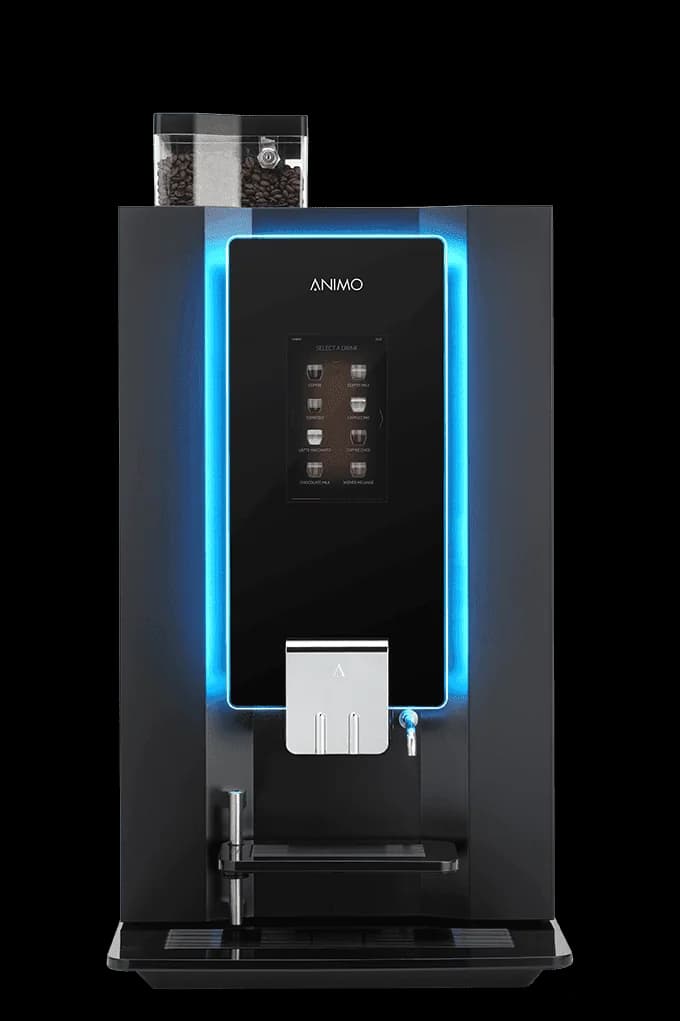
Animo OptiBean XL Touch (V2)

8.6Very good

The Animo OptiBean XL Touch delivers 120 cups per hour, a 1.5 kg bean hopper, and dual instant modules, targeting mid-sized offices, clinics, and educational facilities with approximately 50+ employees. Strengths include high throughput, flexibility for multiple hot beverages, and a freely programmable 7-inch touchscreen. The optional MDB interface enables coin payment and change dispensing but is not standard-fit; cashless payment requires an additional module. Milk supply relies on instant powder only, which sets taste limits in clinical and premium office settings. List price in 2024 ranged from €4,060–4,470 net—for the machine alone without base unit or options. In comparison, the OptiBean offers a robust stainless-steel brew group with Ditting ceramic grinder, though telemetry is available only as an option without remote configuration. Service intervals align with practical use, requiring a maintenance kit after >25,000 vends. For high-volume sites dispensing ≥80 beverages daily, the investment yields mid-term returns; operators prioritising fresh-milk capacity, app payment, or remote service support will find broader feature sets in competing models.

ca. 4,064 – 4,468 €

Necta Kalea Plus

Necta · Hot Drink Machines

Necta Kalea Plus

8.5Very good

200–250 beverages daily, fresh-milk system with automated cleaning and touch operation: The Necta Kalea Plus targets larger offices, canteens and breakfast areas in hotels and foodservice venues with 60 to approximately 150 staff or high-volume guests. Testing confirms the robust Z4000 brew group and modular architecture for beans, instant and milk; the telemetry-capable platform enables straightforward monitoring without add-on modules. Operators praise reliability (with consistent cleaning), rapid beverage dispensing and parts availability (German warehouse: 1–3 days). Weaknesses: daily milk-system cleaning (5–8 minutes, mandatory) cannot be skipped, and every 10,000 vends requires brew-group service—at maximum throughput, this means every 2–3 months. Acquisition cost ranges from €6,800 to €9,400 net; maintenance and consumables are material. For high-throughput sites with professional oversight, the model justifies itself through minimal downtime and predictable follow-on costs.

ca. 6,798 – 9,439 €