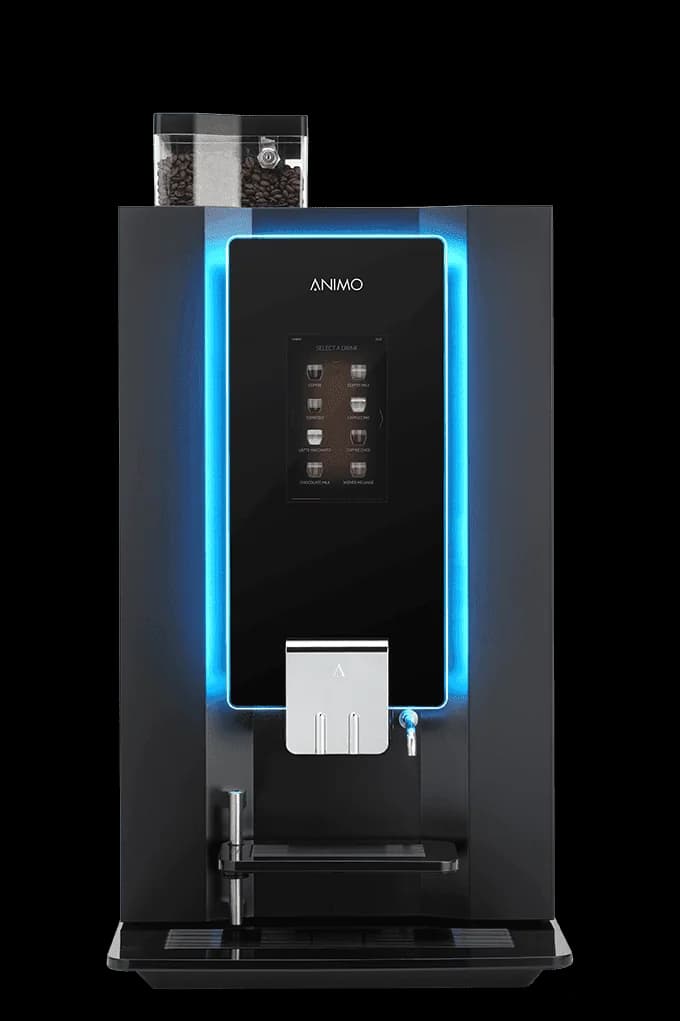
Design & Build
330 mm wide, 732 mm tall, 576 mm deep. Even the technical dimensions signal the point: this is not a kitchen-counter coffee maker, but a large-format machine built for throughput and visibility on the counter. In daily operation, this allows deep work surfaces to be stocked without issue, but particularly in tight break rooms, the standard width often leaves little room when additional accessories such as bean and milk containers are added. At 55 kg empty weight, every installation requires a stable, vibration-damping surface as standard practice. Wall clearances remain relevant when service access and cleaning require space above and to the sides (Source: technical product page, 2025 brochure).
Two display options are available: the Soul 10 uses a 10.4-inch touchscreen, the Soul 12 a 12.1-inch panel. Both employ touchscreen operation with individually configurable icons according to the manufacturer, which suits multicultural teams and changing users, but also introduces configuration overhead. Control console and beverage outlet are accessible from the front. Outlet height ranges continuously from 65 to 185 mm, by hand or optionally touchless, accommodating cup sizes from espresso to thermal containers. Those focused on to-go service should verify whether large reusable containers fit consistently. Automatic cup dispensers are not standard. Material specifications for panels, drip tray and casing are not found in public sources. The technical product page suggests metal and impact-resistant plastics are used — verifiable only in actual operation.
Modularity extends well beyond the 1,000-euro class. One to three bean containers at 1,200 g each are possible, with expandability affecting floor space and accessibility. Spent-grounds container and water supply are likewise on the main axis, important for cleaning. The grounds container holds up to 550 g or 60 to 70 coffee cakes before emptying is required. Tall feet (40 or 70 mm) allow cleaning underneath the machine, but are not a substitute for tight hygienic sealing.
The design is fundamentally oriented toward mid-market and large operations with fixed counter positions. For flexible sites, mobile catering deployments or offices under 40 employees, the machine is poorly suited due to size, weight and maintenance demands. Operators requiring intensive cleaning cycles at the installation site should measure access to all control and service panels before contract execution. Manufacturer claims about maintenance-friendliness assume laboratory conditions; tight or awkwardly positioned floor space can cause practical problems.