
Site Selection & Placement
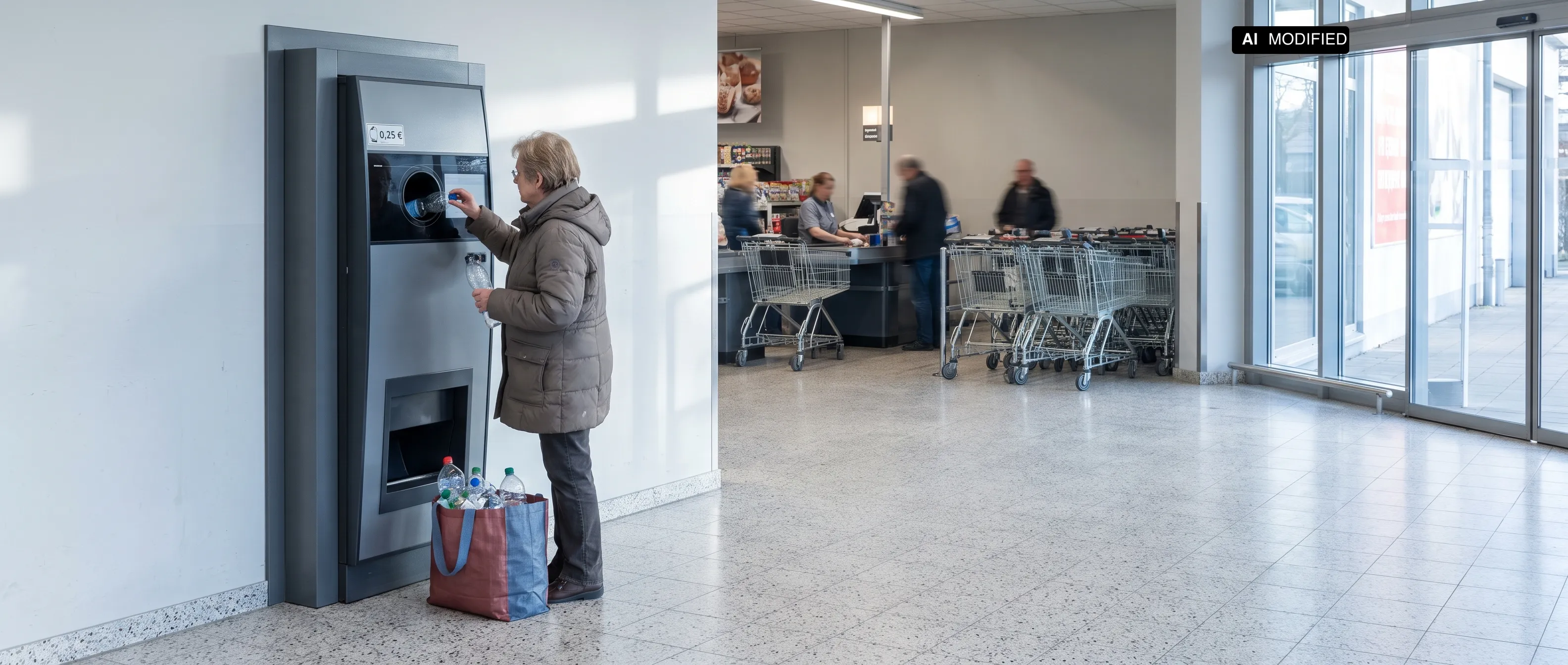
Deposit returns in retail: standalone unit or backroom system
 KI Modified
On this page
A standalone deposit return unit requires 0.80 square metres; a backroom system requires 5.5 to 8. Between these two figures lies the entire decision, and it falls not on throughput but on what exists behind the wall.
This guide compares four concrete units whose datasheets we evaluated for our test reports. All figures below come directly from the manufacturer; where data is unavailable, we state it.
Key points
- Standalone means 0.80 to 1.53 square metres in the sales area; backroom means 5.5 to 8 square metres behind it — plus service area, which no datasheet includes.
- Power supply is decisive: smaller units run single-phase at a standard socket; anything larger requires 400 volt three-phase supply.
- Only a backroom system accepts full cases, up to 21 cases per minute.
- Glass is mandatory if single-use glass is in the assortment: § 46 of the German Packaging Act Implementation Regulation (Verpackungsrecht-Durchführungsgesetz) lists it among materials subject to take-back. Beverage cartons in block, gable or cylindrical form are exempt.
- No manufacturer publishes prices for this equipment class. Anyone wishing to calculate returns needs a quotation.
The four units in figures
Standalone, compact: the Sielaff SiCompact ECO. 0.80 square metres footprint, single-phase 220 to 230 volt, maximum 1,500 watts, standby maximum 60 watts. Container recognition is a paid option here — without it, the unit is a compacting collection machine but without reliable deposit verification.
Standalone, large: the Sielaff SiCompact 2020. 1,350 by 1,880 by 1,130 millimetres, approximately 420 kilograms, 1.53 square metres. Up to 60 containers per minute. Camera-based 360-degree recognition with precision scales is standard. Connection: 400 volt three-phase, 3L/N/PE, 50 hertz, maximum 2,630 watts, standby 70 watts. Collection is in half-sized euro pallet roll containers. The XL version measures 1,880 by 1,880 by 1,480 millimetres at approximately 650 kilograms and maximum 4,000 watts, and additionally accepts reusable containers, glass, beverage cartons and cups with EAN codes.
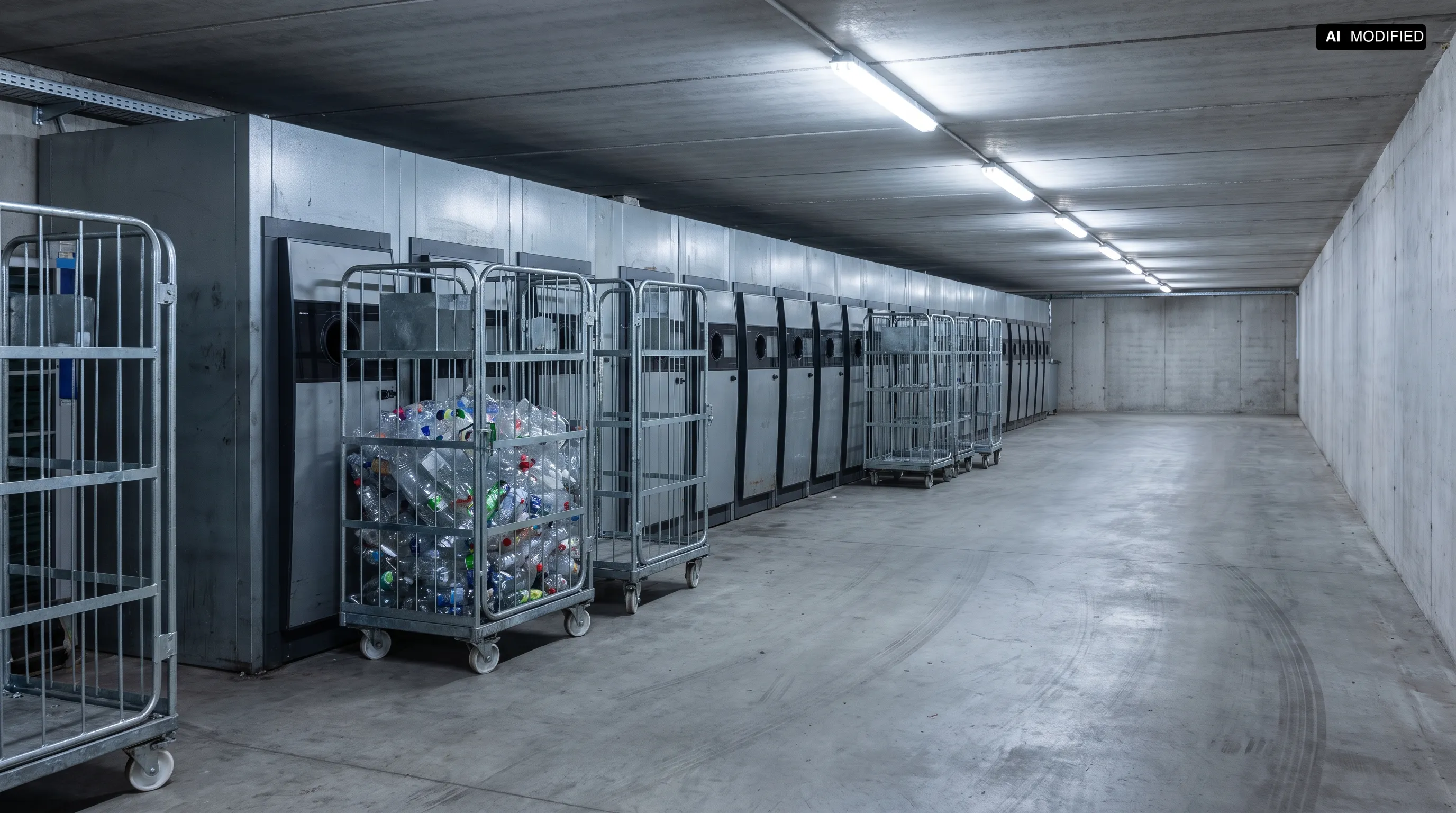
Backroom, compact: the TOMRA T9 with EasyPac. 1,150 by 4,800 by 1,800 to 1,940 millimetres, 5.5 square metres footprint, one to five collection cabinets. Each additional cabinet extends depth by 1,400 millimetres.
Backroom, large: the TOMRA T9 with MultiPac. 1,600 by 5,000 by 1,800 to 1,940 millimetres, 8 square metres, two to seven cabinets, each additional unit plus 1,000 millimetres depth. This version carries two return stations on a single backroom unit — two customers can return simultaneously.
Both TOMRA versions accept up to 60 containers and up to 21 cases per minute, the latter dependent on the BC model. TOMRA specifies collection capacity per container: up to 1,500 PET bottles compacted, up to 6,000 cans compacted, approximately 2,000 in a 50-to-50 mix in the mixed crusher, up to 400 glass bottles with explicit reference to a weight limitation. Electrically split: 400 volt three-phase at 16 amperes for the backroom; 230 volt single-phase at 10 amperes for the front unit.
Footprint not shown in the datasheet
The square metre figures are nominal values for the configuration shown. TOMRA explicitly states that service area is not included. For planning purposes: allow more space than the table indicates.
For standalone units, the footprint is sales area and therefore costly. For backroom systems, it is storage area and less expensive, but it must exist — and at a depth of 4.80 or 5.00 metres. This is the point where the decision is usually already made: without this space, installation is not possible.
A second value missing from all four datasheets and belonging on the clarification list: floor load capacity. At approximately 650 kilograms for the SiCompact 2020 XL plus filled roll containers, this is not a formality. TOMRA specifies no weight for the T9.
Power supply as a preliminary decision
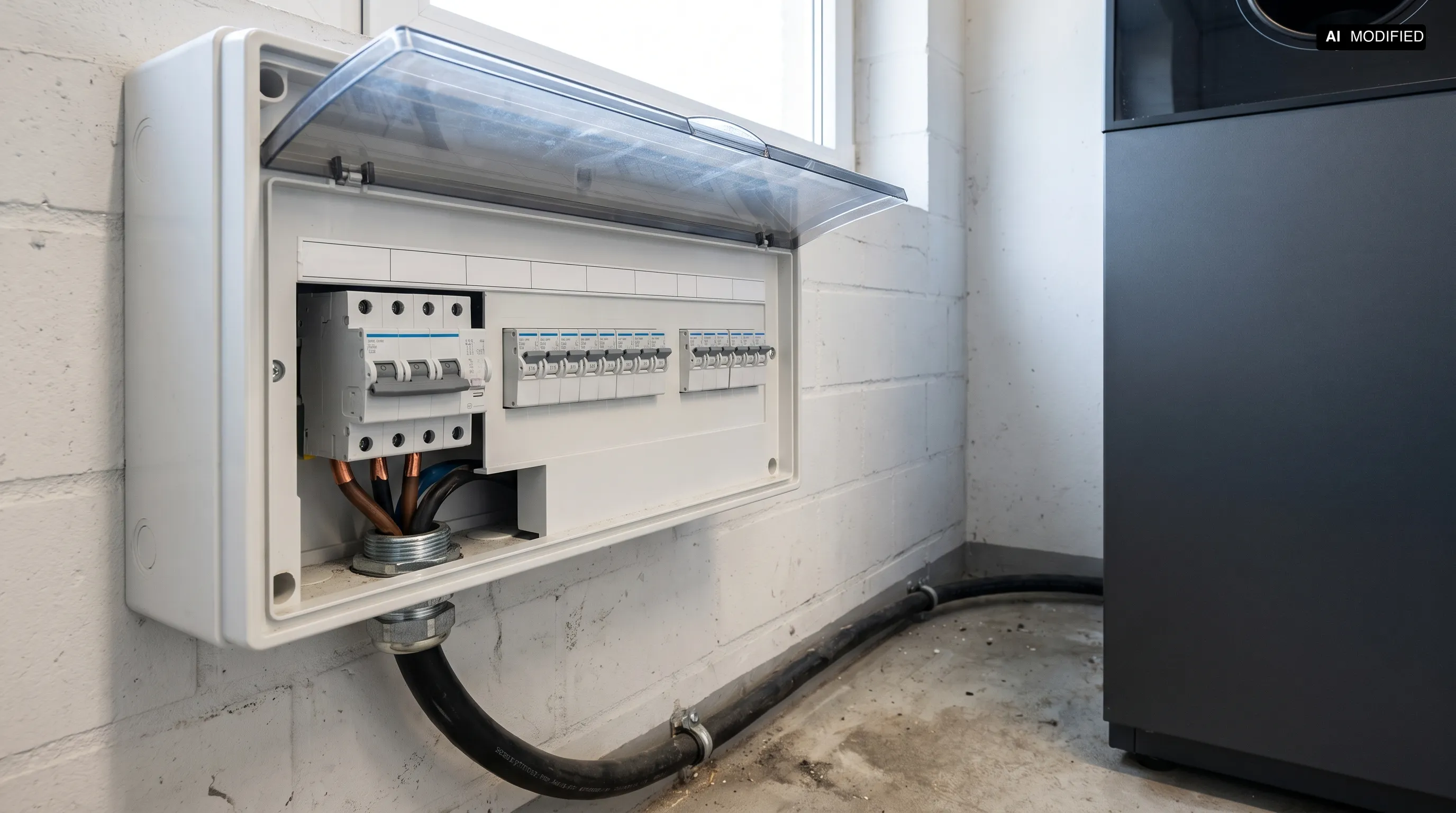
This equipment class separates cleanly here, and the consequence is a call to an electrician.
The SiCompact ECO runs single-phase at 220 to 230 volt and maximum 1,500 watts. For this, a standard outlet with its own breaker is sufficient.
Anything larger requires three-phase: the SiCompact 2020 at 400 volt and maximum 2,630 watts, the XL at up to 4,000 watts, the TOMRA T9 in the backroom at 400 volt and 16 amperes. A three-phase connection in an existing building is often more than a cable — it is a construction project.
This is why the first question is not "what throughput do we need" but "what is available at the wall". The answer determines the equipment class before any configuration questions are asked.
For consumption, calculation is only possible with Sielaff. 70 watts standby yields approximately 613 kilowatt-hours annually in continuous operation, at 29 to 34 cents per kilowatt-hour roughly EUR 180 to 210 — before a single container is accepted. For the ECO, standby is maximum 60 watts, thus approximately 525 kilowatt-hours. TOMRA publishes no power draw in watts, no standby value and no annual consumption in either datasheet; from 16 amperes at 400 volt only the circuit protection can be derived, not consumption.
What each unit accepts
This line often outweighs throughput in Germany.
The SiCompact 2020 in base configuration accepts single-use PET and cans — no glass, no reusables. Only the XL version accepts reusables, glass, beverage cartons and cups with EAN codes.
The TOMRA T9 accepts, per datasheet, cans, plastic bottles, glass bottles and cases, the cases dependent on the BC model. With the MultiPac, they additionally depend on tunnel length: the short variant accepts no cases, medium or long tunnel accepts them. The EasyPac datasheet contains no tunnel row; instead, orientation and one or two destinations per cabinet are specified.
Which fraction lands in which cabinet is determined on the T9 by cabinet configuration: PET crusher, can crusher, mixed crusher, glass crusher or glass drop. This is the actual planning phase, and a later change is retrofit, not adjustment.
For a full-range retailer taking back reusables and glass — which is standard — this means: the XL version, the BC model, or a second solution alongside.
What the law requires of the unit
The governing document is not the EU Regulation directly, but the German Packaging Act Implementation Regulation of 13 July 2026. Its § 46 sets the deposit at minimum EUR 0.25 including VAT per container, collected at all retail levels through to the end consumer. Return is free of charge, at the point of actual handover or in its immediate vicinity, during normal business hours. Deposit refund may not be given without return of the container.
The clause that decides equipment choice stands in subsection 2: Take-back obligation is limited to the material types glass, metal, paper, cardboard and cardboard as well as plastic, including all composite packaging that the retailer carries in its assortment. Glass is therefore not optional. A retailer selling single-use glass must take it back, and if this is to run through a unit, the base configuration of the standalone class is ruled out.
Two reliefs apply. Below 200 square metres of sales area, the obligation narrows to brands in the retailer's own assortment rather than all material types. And for sales from vending machines, it suffices to provide return options at reasonable proximity to the vending machine. The return unit does not need to stand next to the sales machine.
Exempt are containers under 0.1 and over 3.0 litres, beverage cartons in block, gable or cylindrical form, and a long list of beverages: sparkling wine, wine and wine-like beverages with at least 50 per cent share, products subject to alcohol tax except alcopops, alcoholic mixed beverages from 15 per cent, milk and milk mixed beverages from 50 per cent milk share, other drinkable milk products such as yoghurt and kefir, fruit juices and vegetable juices, fruit nectars without carbonation, and food for special medical purposes. Fruit juice is thus deposit-free; fruit nectar with carbonation is not, and this distinction runs parallel in any full-range retailer's assortment.
Additionally § 47, which has nothing to do with the unit but belongs to the same project: Single-use containers require signage at the point of sale bearing the character EINWEG in immediate proximity to the goods; reusable containers require MEHRWEG. Design and font size must match at least the price labelling.
The decision in four questions
- Is there a backroom with at least five metres depth behind the desired wall? If not, the question is settled: standalone.
- What is available at the wall? Without three-phase, only the compact standalone class is an option.
- Do we take back reusables, glass or cases? Then XL version, BC model, or two solutions.
- How bursty is the return flow? Up to 60 containers per minute is offered by the large standalone and both backroom versions; only the MultiPac allows two customers to return simultaneously.
Where price is absent everywhere
For none of the four units does the manufacturer publish a price, and we found no dealer with a reliable figure either — unlike beverage machines from the same brands, where several specialist dealers carry list prices. Return equipment of this size is project business with retail.
Six positions therefore belong separately in the quotation:
- Electrical installation, for backroom systems split between 400 volt for cabinets and 230 volt for the front unit.
- Footprint with service area, not the nominal footprint from the datasheet.
- Floor load capacity, especially for heavy versions.
- Configuration: number and setup of cabinets, tunnel length, orientation, discharge side.
- Integration with the point-of-sale system. A deposit receipt that is not accepted at your own checkout creates exactly the discussion the unit is meant to prevent.
- Service contract with response time. An idle return unit means manual processing at the checkout and costs labour time directly.
The benchmark for calculating is not unit revenue. The take-back obligation follows from § 46 of the Packaging Act Implementation Regulation and applies to the extent that a retailer itself carries deposit-subject single-use containers in its assortment — so the unit does not save costs, it replaces labour at the checkout. At 60 containers per minute, this leverage is substantial.
Frequently asked questions
- When is a backroom system worth it against a standalone unit?
- When three conditions align: large and bursty return flow, reusable cases in the assortment, and an available backroom with at least five metres depth. If one is missing, you pay for the system's strengths without using them. The footprint difference is substantial: 0.80 to 1.53 square metres standalone versus 5.5 to 8 in the backroom, each excluding service area.
- Is a standard outlet enough for a return unit?
- Only for the compact class. The Sielaff SiCompact ECO runs single-phase at 220 to 230 volt and maximum 1,500 watts. The SiCompact 2020 requires 400 volt three-phase at maximum 2,630 watts, the XL up to 4,000 watts, the TOMRA T9 in the backroom 400 volt at 16 amperes plus 230 volt for the front unit.
- Must a return unit accept glass?
- The retailer must, if single-use glass is in the assortment. § 46 subsection 2 of the Packaging Act Implementation Regulation explicitly lists glass among the material types subject to take-back, alongside metal, paper, cardboard and cardboard as well as plastic and composite packaging. Below 200 square metres of sales area, the obligation narrows to brands in the retailer's own assortment. Whether the unit accepts glass is therefore not purely a procurement question: to automate return processing, a unit with glass acceptance is needed — for the standalone class, only the XL version, and in the backroom a glass crusher or glass drop as cabinet configuration.
- How much power does such a unit use annually?
- Reliable calculation is only possible with Sielaff, and only via standby: 70 watts on the SiCompact 2020 yields approximately 613 kilowatt-hours per year, at 29 to 34 cents per kilowatt-hour roughly EUR 180 to 210. On the ECO it is maximum 60 watts, thus approximately 525 kilowatt-hours. Compaction comes on top and depends on volume. TOMRA publishes no power draw, no standby value and no annual consumption for the T9 — this figure must be requested before ordering.
- What does a return unit cost?
- We cannot answer that, and we therefore give no figure. For none of the four units compared here does the manufacturer publish a price, and we found no dealer with a reliable quotation. This equipment class is project business; price emerges with configuration.