
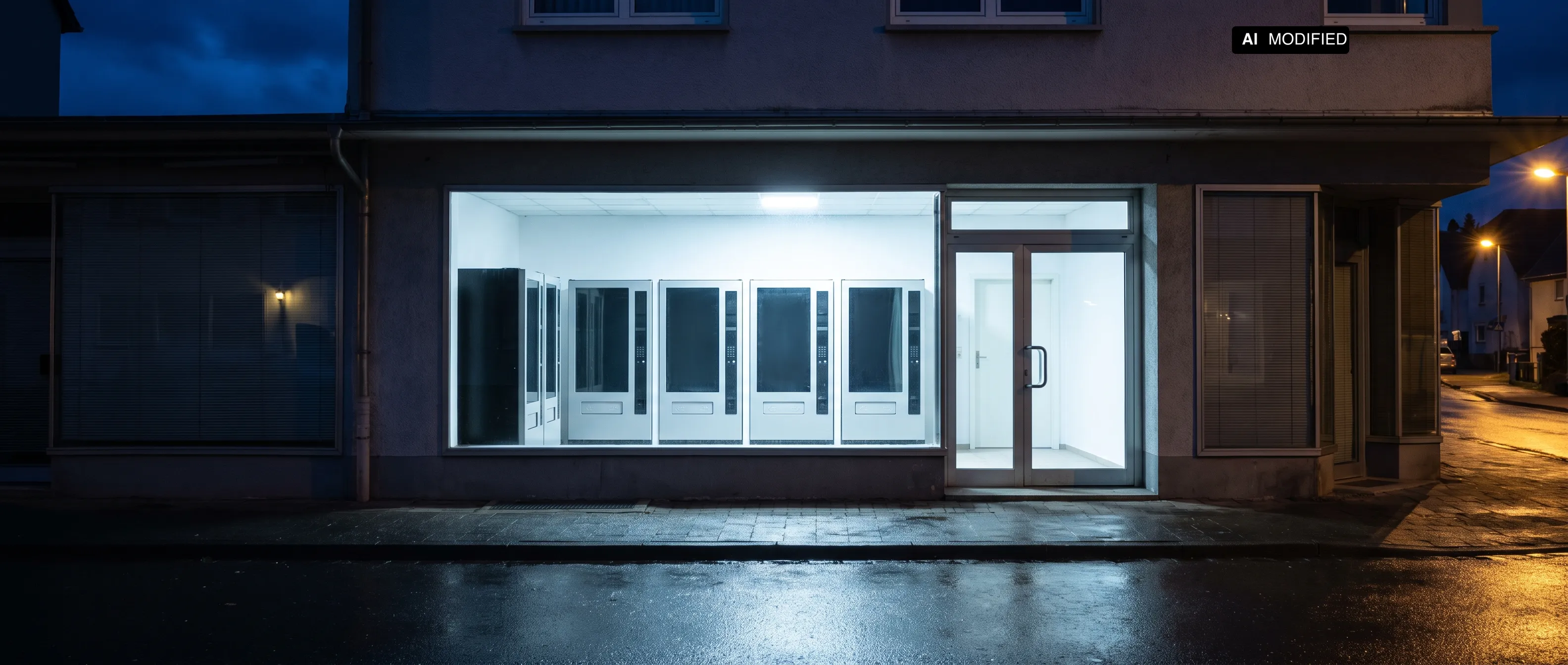
 KI Modified
Practice & Case Studies
Machine shops and retail opening hours: What courts decided in 2025
On this page
Whether an unmanned machine shop can be open on Sundays is no longer a federal question, but a question of sixteen state laws and a series of court decisions from 2025. The new opinion from the Bundestag Research Service on vending consolidates this case law, and it shows a picture that looks favorable for operators, but is not uniform across all states.
Key takeaways
- Product vending machines predominantly do not fall within the scope of state retail opening hours regulations. Since 2003 they have been entirely excluded from the federal Retail Closing Hours Act, and since the 2006 federalism reform, applicability must be measured against the respective state law.
- The Administrative Court of Appeal Lüneburg ruled in March 2025 that unmanned machine shops—that is, multiple coordinated vending machines in an enclosed space—also fall outside Lower Saxony's retail opening hours law.
- One level lower, the Administrative Court Osnabrück reached the opposite conclusion in January 2025. A Hamburg administrative court ruled against operators in 2023.
- In public space, a vending machine requires a special use permit under the state Street Law, plus a special use fee, usually scaled by area occupied.
- The industry association seeks changes to the Land Use Ordinance: "retail premises" should become "retail facilities" so vending machines are not treated as retail shops.
Court decisions from 2025
The opinion cites case law in a footnote, and this is the real news within it. Explicitly addressing North Rhine-Westphalia's retail opening hours law, the Administrative Court of Appeal Münster ruled by order of 12 February 2025, case number 4 B 976/24, that product vending machines are not covered. Addressing Lower Saxony's Act on Retail Opening and Sales Hours, the Administrative Court of Appeal Lüneburg followed on 13 March 2025 with order 7 ME 7/25, and it goes further: under this decision, so-called unmanned machine shops are also not within the scope—that is, multiple product vending machines coordinated by product assortment in an enclosed space.
This is the form factor that matters operationally. The cited proceedings were not about the single device on a building wall, but about this form factor: the walk-in space with multiple machines and coordinated inventory that looks like a retail shop.
That there was genuine dispute, not merely a settled matter, is shown by contrary rulings. The Administrative Court Osnabrück had ruled differently on 14 January 2025, case number 1 B 61/24. For Hamburg's retail opening hours law, the Administrative Court Hamburg reached a different conclusion on 3 November 2023, case number 7 E 3608/23 regarding unmanned machine shops. And the Hesse Administrative Court of Appeal left the question open for product vending machines by order of 22 December 2023, case number 8 B 77/22, but advocated for expansive application of the already broadly drafted scope of Hesse's law. This has been criticized in legal scholarship.
For practice this means: the two appellate court decisions from 2025 apply in North Rhine-Westphalia and Lower Saxony. They are not a nationwide clearance. Anyone planning an unmanned machine shop in Hesse or Hamburg operates against a different baseline, and the question is not definitively settled in either state.
Why federal law has nothing to say here anymore
The history explains why the situation is so fragmented. Since 1962, product vending machines were subject to a special regulation in the uniform federal Retail Closing Hours Act and could be used on all days throughout the day. In 2003 they were completely excluded from the scope of the Retail Closing Hours Act. With the 2006 federalism reform, retail closing hours law ceased to be a subject of concurrent federal legislation.
Since then the rule is: whether a machine or unmanned machine shop falls under retail opening hours law must be measured against the respective state law. An operator with locations in multiple states does not have a uniform legal situation but sixteen of them.
The second hurdle is in building code
Before the closing hours question comes whether the machine can stand there at all. The Land Use Ordinance permits in § 14 subsection 1 sentence 1, in addition to the facilities named in §§ 2 through 13, also subordinate ancillary facilities and equipment that serve the use purpose of real property or the development zone located there and do not contradict its character.
The commentary cited in the opinion divides this into two categories. Product vending machines that serve the use purpose of the building plot independently, particularly at the point of service, are ancillary facilities. Otherwise they are primary commercial facilities. In both cases only if planning law relevance is established in the individual case. And then comes the sentence on which many projects turn: a product vending machine does not serve, in the legal sense, the use purpose of certain development zones if the offered goods, as is usually the case, have no functional connection to the general purpose of a particular development zone. The commentary gives as example that cigarette consumption is not specifically residential zone-typical.
Whoever thus wants to install a machine in a general residential zone lands at § 4 subsection 2 of the Land Use Ordinance. Permitted there are: residential buildings, retail premises serving the area's supply, taverns and restaurants as well as non-disturbing craft operations, and facilities for religious, cultural, social, health and sporting purposes. The word machine does not appear. Whether a machine qualifies as a retail premise serving the area's supply is thus a matter of interpretation by the permitting authority.
State building law becomes even more varied. In Berlin, provisions for advertising structures under § 10 of the Building Code apply accordingly to vending machines. In Rhineland-Palatinate, the erection, construction, installation, attachment or alteration of product vending machines under § 62 subsection 1 number 8 letter e of the State Building Code requires no building permit at all.
And in public space comes a fee
If the machine is to stand in public space, a special use permit under the state Street Law is required; for Berlin the opinion cites § 11 of the Berlin Street Law. For this a special use fee under a state fee ordinance applies, as a rule scaled by the size of the space used. The responsible authority is a municipal office, in Berlin the district office.
The footprint is thus not merely a technical value from the data sheet, but a fee basis. Whoever chooses between a narrow and a wide device, in public space also chooses a fee tier.
What the industry wants changed
The reform proposals section of the opinion cites a position paper from an industry association. The central legal point is a word change in the Land Use Ordinance: the provision in § 4 subsection 2 number 2 could be interpreted so that machines are treated like retail shops. If instead of "retail premises" the term "retail facilities" or similar were used, with the provision that this also includes vending machines, product dispensing devices and automatic kiosks, this would in the association's view be helpful for projects that otherwise fail at this bureaucratic hurdle.
In the Bundestag lobbying register, the same association lists under concrete legislative proposals, among other things, uniform approval procedures and nationwide harmonized retail opening hours, avoidance of uncoordinated packaging taxes across different political levels, a reduction of reporting and documentation obligations, incentives for employee catering, tax deductions for staff meals, resumption of digitalization funds, support for modern mini-cafeterias, area-wide basic supply even in structurally weak regions, and adjustment of driving and transportation time regulations.
A political interest group further demands that retail opening hours law be changed so that fully automatic retail facilities such as smart stores and walk-in machines may be operated nationwide around the clock and also on Sundays and public holidays, provided no staff are on site and exclusively essential goods are offered. This is justified by legal uncertainty across states and unequal competitive conditions. Exactly the legal uncertainty that the conflicting orders from Osnabrück, Lüneburg, Hamburg and Kassel demonstrate.
What follows for planning
Three things are to be taken from the opinion for a concrete project. First: the retail opening hours question must be clarified under state law, and the 2025 position in North Rhine-Westphalia and Lower Saxony cannot be transferred to Hesse or Hamburg. Second: the building code classification as ancillary facility or primary commercial facility turns on the functional connection between product assortment and development zone, not on the device. A machine with basic supply in a residential zone stands argumentatively better than one with luxury goods. Third: in public space the area incurs ongoing costs, and the fee is based on its size.
Frequently asked questions
- Can vending machines be operated on Sundays?
- Predominantly yes, because as independent retail facilities they do not fall within the scope of state retail opening hours regulations. Federally they have been entirely excluded from the Retail Closing Hours Act since 2003, and since the 2006 federalism reform only state law decides. But it is binding only where courts have ruled.
- Does this also apply to unmanned machine shops with multiple machines?
- For Lower Saxony the Administrative Court of Appeal Lüneburg answered yes in March 2025, including multiple vending machines coordinated by product assortment in an enclosed space. A Hamburg administrative court ruled differently in 2023, and in Hesse the administrative court of appeal left the question open. There is no nationwide answer.
- Does a vending machine need a building permit?
- That depends on the state. In Rhineland-Palatinate, the installation of product vending machines under § 62 subsection 1 number 8 letter e of the State Building Code is expressly permit-free. In Berlin, provisions for advertising structures apply accordingly. Independently, the classification under the Land Use Ordinance as subordinate ancillary facility or primary commercial facility remains to be clarified.
- What does a location in public space cost?
- There is no flat rate. Required is a special use permit under the state Street Law, and the special use fee is set by a state fee ordinance, as a rule scaled by the size of space used. The responsible authority is the municipality, in Berlin the district office.
Go deeper: related guides
- Retrofit cashless payment to a vending machine: MDB 4.3, costs and selection criteriaFundamentals & Getting Started · 17 min read
- The Ideal Vending Machine Mix: Combining Hot Drinks, Snacks and WaterFundamentals & Getting Started · 14 min read
- Hygiene plan for hot drinks vending machines: cleaning, HACCP and recordsFundamentals & Getting Started · 14 min read