
Fundamentals & Getting Started
Hygiene plan for hot drinks vending machines: cleaning, HACCP and records
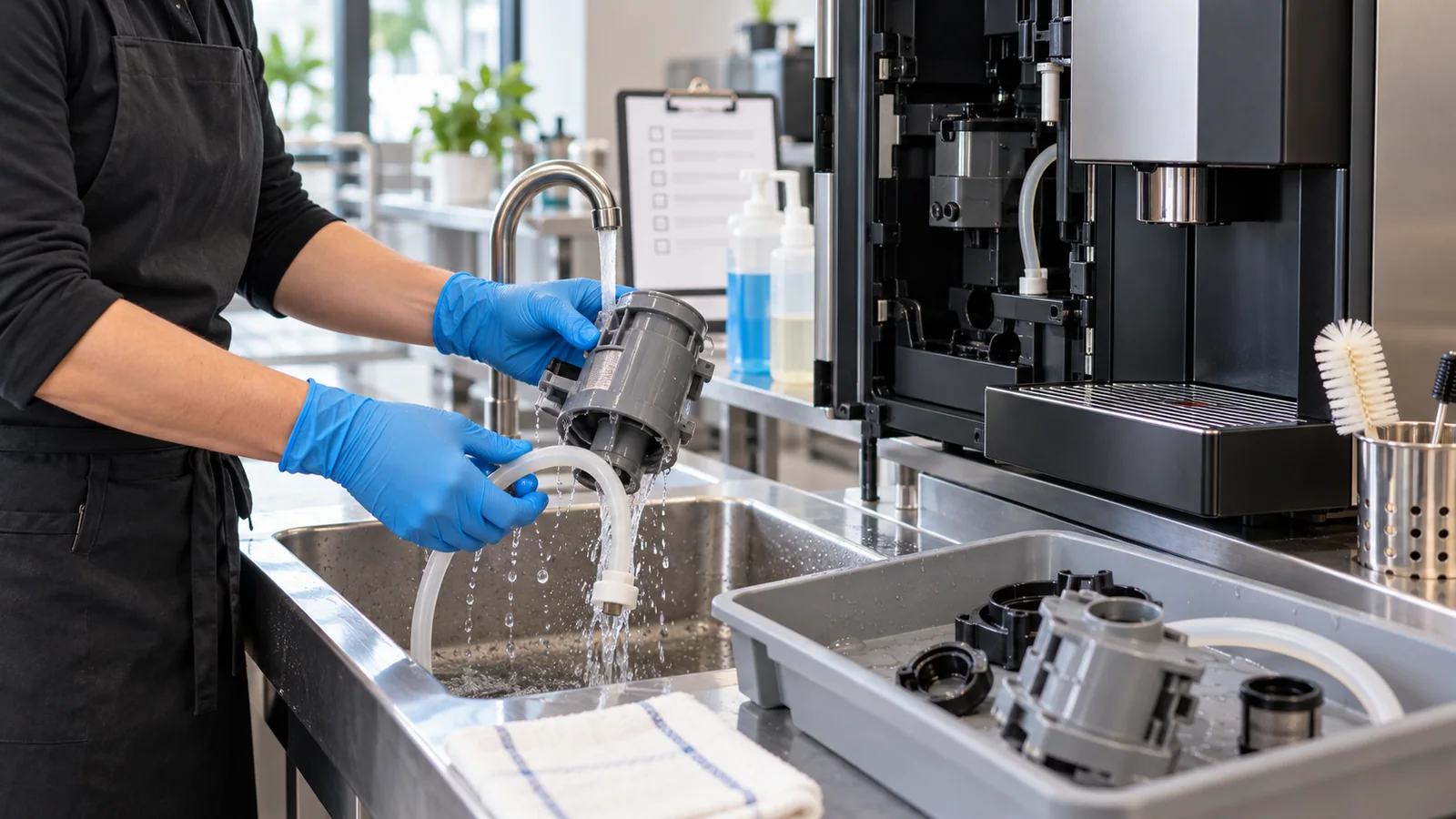 KI Modified
On this page
- What obligations apply to hot drinks vending machines?
- How is cleaning risk assessed in the HACCP system?
- What belongs in the daily, weekly and occasion-based plan?
- What records, allergen rules and corrective actions are required?
- What do DIN standards and guidance from authorities provide?
- Practical recommendations
- Conclusion
This article was created with AI assistance and checked automatically. Human review before publication is not documented.
There is no single statutory daily or weekly schedule for hot drinks vending machines that applies to every machine and location. The requirements are instead to ensure food safety, use appropriate HACCP-based procedures, clean effectively and disinfect where necessary, and set a frequency that prevents contamination. The operator must determine the specific frequency based on the machine type, recipes, ingredients, volume dispensed, location, periods of inactivity, manufacturer instructions and the results of in-house checks. This basic principle follows in particular from Regulation (EC) No 852/2004 on the hygiene of foodstuffs.
A robust hygiene plan is therefore not an arbitrary checklist with blanket instructions such as daily, weekly or monthly. For the specific machine, it describes which components, ingredients and processes are relevant, who carries out each task, which approved procedure applies, how completion is checked and what happens if something deviates from the plan. A machine with a milk system presents different risks from one that uses only water and soluble powder. Long periods of inactivity, heavy use, damp interior areas or visible drink residues may call for immediate cleaning or more frequent checks.
Operators should distinguish four levels. Food law defines obligations and safety objectives. The business’s HACCP analysis translates those objectives into specific hazards, controls and responses. The instructions for the particular vending machine specify permitted dismantling, rinsing and cleaning procedures. DIN standards and guidance from authorities can support the planning process, but they replace neither the law nor the machine-specific instructions. A hygiene plan is robust when every measure belongs to one of these levels and responsibilities and records are clearly defined.
What obligations apply to hot drinks vending machines?
Regulation (EC) No 852/2004 requires food businesses to have procedures based on HACCP principles. Food contact surfaces must be kept in good condition and be easy to clean and, where necessary, disinfect. For vending machines, Annex II, Chapter III expressly sets out requirements for their siting, design, cleanliness and maintenance. The machine must be operated in a way that prevents contamination. This applies not only to the visible front, but also to outlets, mixing chambers, beverage lines, powder channels, areas that contact milk, containers and other surfaces that come into contact with drinks or ingredients.
The regulation does not prescribe a universal calendar. It requires a frequency suited to preventing contamination. This means neither that the machine must automatically be fully dismantled every day nor that certain components may generally be cleaned only once a week or once a month. Such a frequency can be set for the business if it is supported by the hazard analysis, manufacturer instructions and inspection results.
Section 4 of the LMHV refers to relevant expertise for activities involving perishable foods. Annex 1 lists, among other topics, food law, in-house checks and traceability, hygienic handling and storage, and cleaning and disinfection. The requirements for a specific activity must be assessed in the context of the business. (LMHV, Section 4 and Annex 1) The hygiene plan must therefore specify which person or role is responsible for the machine, which work instruction applies, which products may be used and how deviations are handled.
Regulation (EC) No 178/2002 provides the general framework for food law. Traceability is particularly relevant to vending machine operations. Ingredients and deliveries must be documented so that the supplier and, where applicable, the next recipient can be identified. A cleaning plan alone does not meet this obligation if ingredients, batches or supply routes cannot be traced.
Voluntary references to standards should be distinguished from these legal obligations. A DIN standard is not a blanket statutory interval requirement. Nor does the existence of a standard mean that a particular vending machine is certified or that the operator must carry out a particular inspection at a fixed interval. The hygiene plan should therefore use separate columns for the legal requirement, the business’s own specification, the manufacturer’s instructions and technical guidance. This distinction prevents an internal planning decision from being mistakenly presented as a legal obligation.
How is cleaning risk assessed in the HACCP system?
The frequency is determined by risk, not by the calendar. For a machine using fresh milk or an integrated milk system, areas that contact milk, hoses, outlets and mixing areas should be considered separately. For powder-based machines, the main concerns are powder channels, dosing areas, mixing chambers and damp residues. Although a hot drink reaches an elevated temperature, this does not provide a blanket basis for approving dirty or poorly maintained contact surfaces. Cleaning and, where necessary, disinfection remain essential when needed to prevent contamination.
A high volume of drinks means more product cycles and greater strain on contact surfaces. Operators should therefore record not only daily volume, but also check for residues, clumping, moisture or unusual odours. A location serving many drinks in a short time may need different checkpoints from a machine with few servings that is left unattended for long periods. The number of drinks alone, however, is not a statutory threshold that automatically applies. It is an operational risk factor to be assessed alongside the recipe, design and observations.
Long periods of inactivity are also relevant. A machine that is not used over a weekend or during a business shutdown may have different conditions from one in continuous use. Before putting it back into service, the operator should check the designated contact surfaces, remaining contents, outlets, drip areas and ingredients. The machine-specific work instruction must specify what rinsing or cleaning is required before the machine can be released for use. A general online checklist must not replace this instruction.
Visible residues call for an immediate response. This includes drink residues, powder deposits, sticky areas, foreign objects, signs of pests or cleaning product residues. The operator should document the observation, disable the affected dispensing function if necessary, investigate the cause and only release it for use again after a controlled corrective action. Recurring deviations may indicate that the existing frequency, procedure, accessibility or machine design is inadequate.
The HACCP assessment should include at least the product, process step, potential hazard, existing control, responsible person, record and corrective action. For a milk area, the hazard may be residues or an inadequately cleaned line. For a powder channel, moisture and deposits may be relevant. For the water line, contamination, leaks or a condition outside the intended operating parameters may need to be checked. The assessment must be updated if the recipe, ingredients, water supply, location, volume dispensed or machine changes.
What belongs in the daily, weekly and occasion-based plan?
The daily or service plan should begin with a visual inspection. Check the machine, outlet, drip tray, user area and accessible food contact surfaces. Look for drink residues, powder deposits, foreign objects, signs of pests, unusual odours and cleaning product residues. Visible issues should not simply be wiped away; they must be assessed as deviations. The record should show whether cleaning was sufficient, a technical inspection was needed or the machine was taken out of service.
Check ingredients for the specified storage conditions, best-before or batch details, and visible packaging damage. Damaged packaging is not automatically a safety-related finding, but it must be assessed and documented. Check the water source, accessible pipes and connections for leaks, contamination and unusual odours. The hygiene plan should distinguish between checks that operating staff may carry out themselves and those that require a service technician.
Empty and clean designated collection, waste and residue containers in accordance with the current machine instructions. Use only procedures and products approved for the specific machine on contact surfaces. For each relevant component, the work plan should specify what is cleaned, which product is permitted, the applicable concentration, temperature and contact time, whether rinsing is required and how drying is carried out. If this information is missing, it must be added from the relevant manufacturer documentation or the business’s technical work instruction. An unverified standard value for time, temperature or concentration does not belong in the plan.
After the cleaning programme, carry out a visual and functional check. Confirm that no cleaning product residues are visible, the outlet works correctly and the drink is dispensed as intended. Document release only once the specified criteria have been met. If there is a malfunction, uncertainty about product safety, pest infestation or visible contamination, keep the machine out of service until the cause has been assessed and the corrective action completed.
Recurring tasks can be organised on a weekly or monthly schedule if that schedule is based on the hazard analysis. These may include cleaning removable beverage lines, mixing chambers, containers, outlets, seals, hoses and powder channels, where the manufacturer specifies such work. A management review can cover records, deviations, stocks of cleaning products, training status, maintenance and whether the hazard analysis is up to date. Here, monthly describes an operational schedule, not a general statutory deadline.
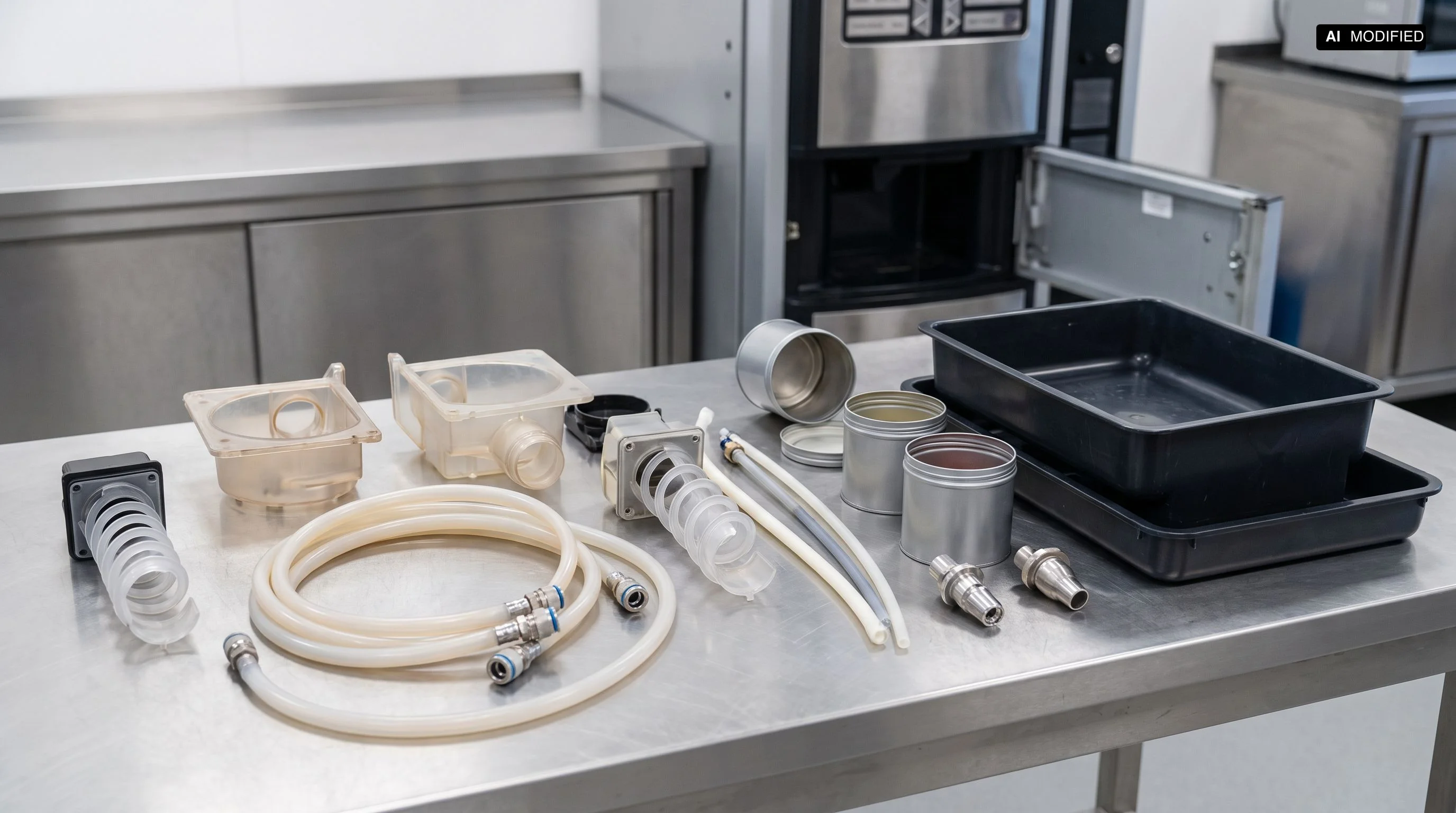
What records, allergen rules and corrective actions are required?
A cleaning record should include at least seven fields: machine or location, date, time, name or initials of the person carrying out the task, work performed, product used or manufacturer programme, deviation identified, corrective action and release. It is also useful to include fields for the components checked, batch numbers of ingredients used, the responsible person’s signature or digital confirmation, and a reference to the current work instruction. An unchecked box with no link to the machine, person or time is too weak for a robust in-house check.
Use the BVL information on food business operators’ obligations as guidance from the competent authority. The BVL report on the 2021 Federal Monitoring Plan states that the cleaning product manufacturer’s instructions on contact time, concentration and directions for use must be followed and taken into account in the cleaning plan. The report describes inspections in food businesses, not a specific vending machine test. The 2021 Federal Monitoring Plan report is an additional source of guidance from the competent authority on the use of cleaning and disinfecting products. It does not replace a machine-specific work instruction.
Traceability means recording deliveries and ingredients so their origin can be established. For powder, cocoa, milk ingredients or other recipe components, the delivery date, supplier and relevant batch information should be traceable to the location or machine. Records do not have to be kept on paper. However, they must be legible, easy to find and protected against ambiguity arising later.
Allergens belong in the hazard analysis. Regulation (EU) 2021/382 supplements the hygiene rules with requirements for allergen management and food safety culture. When a recipe changes, the operator must check which components have been in contact with allergenic substances and what cleaning is required before dispensing an allergen-free drink. Machines and containers used with allergenic substances must be cleaned and checked for visible residues before they are used for allergen-free foods. A simple rinse must not be described as sufficient allergen clearance across the board.
If there is contamination, a foreign object, signs of pests, cleaning product residues or uncertainty about recipe approval, stop dispensing. Describe the deviation, secure or discard the affected product or ingredient, investigate the cause and document the corrective action. Only then may a designated person release the machine for use. Repeated deviations trigger a review of the hygiene plan.
Section 43 of the IfSG relates to the activities specified in Section 42 of the IfSG. Whether information and record-keeping obligations apply to a particular role must be assessed based on the actual work performed; they do not automatically apply to all technical maintenance. (IfSG Section 43)
What do DIN standards and guidance from authorities provide?
DIN lists DIN 10516 under the title “Food hygiene – Cleaning and disinfection”. The published DIN information is not a substitute for the full text of the standard and does not establish a blanket statutory cleaning interval. (DIN information on DIN 10516)
DIN lists DIN EN 1672-2 as “Food processing machinery – General design principles – Part 2: Hygiene requirements”. The catalogue entry establishes the scope of the standard, not the conformity of a specific vending machine. (DIN standards catalogue)
References to standards and information from authorities supplement the law; they do not replace it. Regulation (EC) No 852/2004 sets the safety objective. HACCP documentation describes how the business implements it. The manufacturer’s documentation determines the permitted cleaning procedures for the specific machine. A DIN standard can help with drafting work instructions, assessing cleanability or selecting an inspection strategy. However, it must not be used to derive a general cleaning interval for all hot drinks vending machines.
The hygiene plan must be updated when circumstances change. A new location may have different dust, temperature, access or downtime conditions. A new recipe may introduce additional allergens or different powder and milk contact surfaces. A machine modification may change outlets, hose routes, containers or cleaning programmes. Recurring deviations are also grounds for a change, since they may show that the existing control is not effective enough.
The update should identify the version, date, responsible person and reason for the change. The previous version must not be left by mistake next to the current work instruction at the machine. After a change, affected staff must be informed about new steps, products, release criteria and lockout rules. Implementation is evidenced by an entry, training or documented acknowledgement.
Practical recommendations
Start by creating a machine list with location, model, recipes, milk or powder function, water source and responsible contact. Assign a current operating and cleaning instruction to each machine. Do not use instructions for another model if its components, programmes or approved products differ. Leave any unverified details on concentration, temperature, contact time or cleaning duration blank until an appropriate source is available.
Next, define the checkpoints. These include the outlet, drip tray, user area, mixing chamber, powder channel, milk contact area, ingredient containers, water connections and waste areas, where present on the specific machine. Mark which points are visually checked at every service visit and which tasks are scheduled on a recurring basis based on the hazard analysis. Use the term recurring where no generally applicable calendar interval can be established.
Set clear criteria for taking a machine out of service. Visible contamination, cleaning product residues, signs of pests, damaged product contact parts, an untraceable recipe or unclear release status must trigger an assessment. The machine may be released for use only once cleaning, technical inspection or ingredient checks have been completed and documented. Every deviation needs an assigned person and a traceable resolution.
Review the plan regularly against four questions: Are all records complete? Are deviations actually corrected? Are products, spare parts and personal protective equipment available? Do the recipes, location, volume dispensed and machine still match the hazard analysis? The answers should not be given verbally alone. A brief management entry with the date, result and action creates an auditable record.
Also distinguish responsibilities. Operating staff can carry out visual checks and approved routine tasks. Technical interventions, dismantling or changes to water and product systems may be performed only by people designated for that work under the business’s organisation. The hygiene plan should show at each step who checks, who corrects and who releases the machine for use.
Conclusion
A robust hygiene plan for hot drinks vending machines is not a copied, generic checklist with blanket daily, weekly and monthly deadlines. Food law requires safe processes, suitable HACCP procedures, contact surfaces that are cleanable and maintained, and a frequency that prevents contamination. Operators must determine how often each task is carried out based on risk, usage, recipe, periods of inactivity, machine technology, manufacturer instructions and in-house check results.
For day-to-day operations, visual checks, ingredient and water inspections, approved cleaning programmes, functional tests, allergen clearance and corrective actions must work together. Every record needs to identify the machine or location, time, person carrying out the task, activity and result. If there is contamination or uncertainty about product safety, taking the machine out of service matters more than completing every box on a form.
Standard titles and brief descriptions replace neither the business’s HACCP assessment nor the correct machine instructions. If a machine, location, recipe or cleaning procedure changes, the hygiene plan must be updated and the change documented. This turns a checklist into an auditable in-house control system.
Latest on this topic
- EUDR and coffee vending machines: what the EU Deforestation Regulation requires before it appliesMarket Analysis · October 13, 2026
- Commodity Monitor October 2026: Coffee eases, cocoa and sugar in focusMarket Analysis · October 13, 2026
- AI in Vending in 2026: Predictive Maintenance and Assortment Optimisation — How to Use the TechnologyMarket Analysis · October 2, 2026
More guides
 KI Modified
Retrofit cashless payment to a vending machine: MDB 4.3, costs and selection criteria
What do you need to retrofit a vending machine for cashless payment? This guide explains MDB 4.3, compatibility, terminal selection, installation, ongoing costs and typical checks, without making unsupported price promises.
 KI Modified
The Ideal Vending Machine Mix: Combining Hot Drinks, Snacks and Water
Which combination of hot drinks, snacks and water is right for an office, a public venue or a small site? This guide helps operators assess sales mix, site requirements, hygiene, refrigeration, replenishment and cashless payments.
 KI Modified
Calculating the Total Cost of a Vending Machine: TCO, Operating Costs and Payback
What is the total cost of a vending machine? This guide shows how to calculate acquisition, goods, electricity, payment, maintenance and location costs as TCO, and how three scenarios provide a realistic picture of payback.