
 KI Modified
Market Analysis
AI in Vending in 2026: Predictive Maintenance and Assortment Optimisation — How to Use the Technology
On this page
Since the EU AI Act entered into force in 2024 and the German vending market achieved record growth of 18.7% to €4.62 billion in revenue (2023 to 2024, source: German Vending Machine Industry Association (BDV), BDV Intern 01/2025), AI applications have been on the industry’s agenda. In 2026, three areas have moved beyond pilot operation: predictive maintenance, data-driven assortment optimisation and dynamic route planning. This article explains what works in practice, where the limits are and what is needed to get started.
Last updated: 2026-10-02
Predictive maintenance: identify failures before they happen
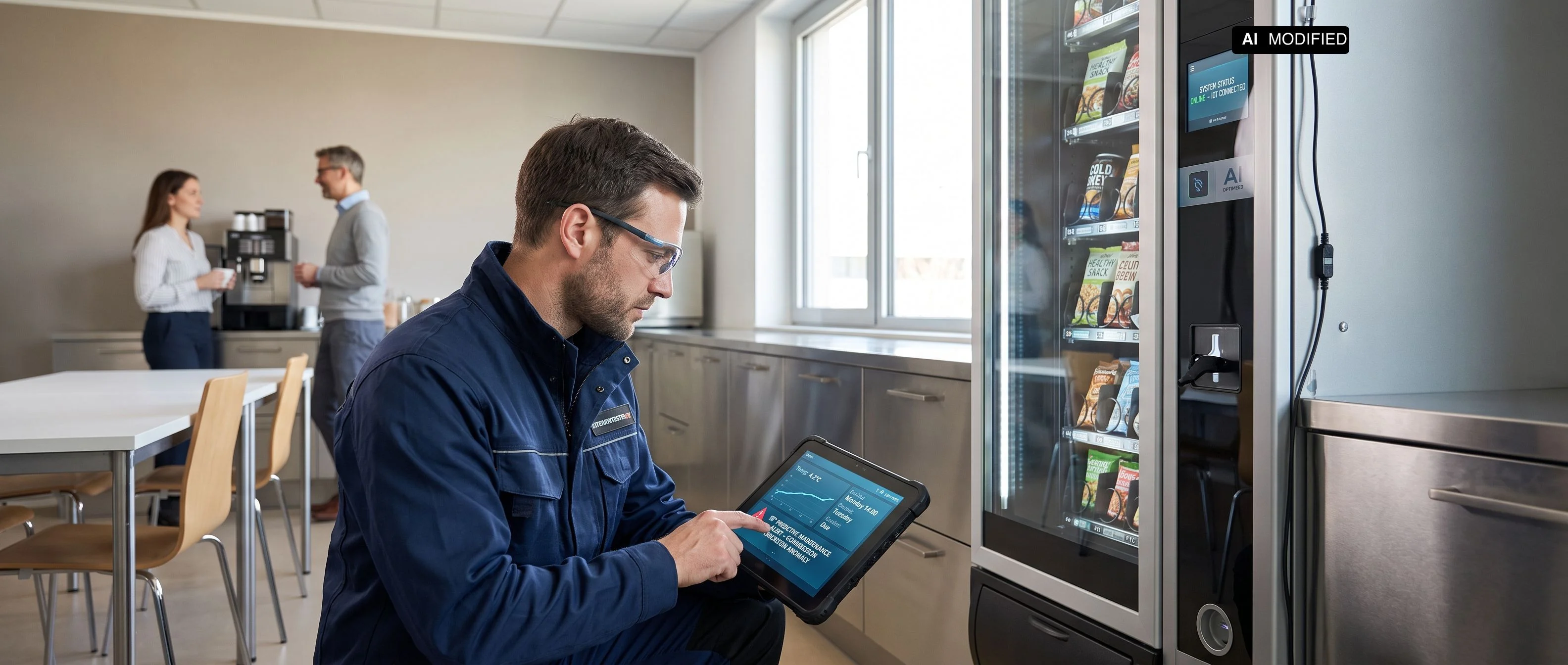
A fixed maintenance schedule that takes no account of a machine’s actual condition is the most costly pattern in vending operations. IoT sensors combined with machine-learning classification algorithms trigger service orders only when operating data indicates a specific impending fault.
In practice: Temperature readings from refrigerated machines are compared with historical patterns every hour. If the readings deviate from the pattern over several hours, the system detects cooling drift, according to TechBuzz Ireland “hours before the stock has to be condemned”. Banknote validators show a similar pattern: rising rejection rates are an early indicator that triggers a technician visit before the validator fails completely.
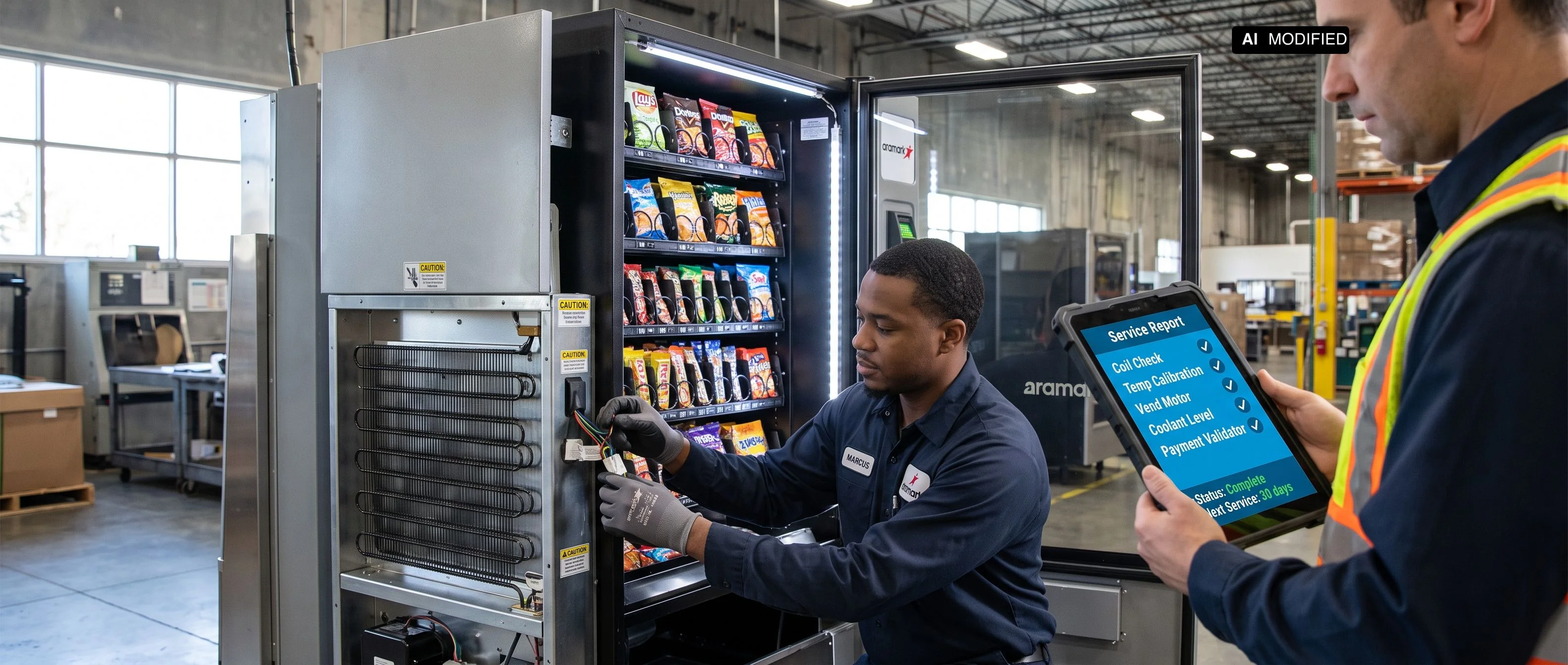
Aramark, one of North America’s largest food service providers, uses AI to detect machine failures early, resulting in faster response times and significantly less machine downtime. Red Hawk Vending (Atlanta, more than 100 machines) describes predictive restocking and demand forecasting as the strongest day-to-day operational benefit. Both cases are documented by Vending Times.
A research paper from Lamar University (arXiv, June 2025) shows that early fault detection and the reduction of redundant service visits are feasible in principle using a framework combining IoT sensors and ML classification. Important limitation: the results are based solely on simulated fault data. Their quantitative transferability to real-world fleets has not yet been verified.
The prerequisite is connected vending machines: EVA-DTS, MDB 4.x and Wi-Fi or 4G. Older machines without these interfaces cannot be integrated without hardware investment. The ROI horizon for fleet modernisation is 6 to 12 months and depends heavily on the existing fleet composition.
What does data-driven assortment optimisation deliver?

Weekly vend rankings combined with a contribution-per-slot analysis show within a few weeks which products generate a contribution margin at each location and which selections tie up slots. This does not replace market knowledge; it sharpens it with data.
Based on its 2024 market study, the German Vending Machine Industry Association publishes segmented planograms that also analyse non-purchases (BDV Intern 03/2024, pp. 36–37). A product that is frequently seen but rarely chosen takes up space without contributing to revenue. These non-purchase data are methodologically more valuable than sales figures alone because they reflect actual purchasing behaviour at the location.
Assortment trends in 2026: In the “Better-for-You” segment, protein snacks lead, with jerky accounting for 27% and protein bars for 18% (data: TechBuzz Ireland). Traditional confectionery remains the stable foundation, accounting for more than a third of vending revenue. Location-specific analysis remains crucial: what sells at an industrial site with shift work may call for a completely different selection in a co-working space.
At the platform level, systems such as Cantaloupe Seed and Nayax MoMa offer features for planogram recommendations and visual shelf recognition. Product-specific performance figures for these providers cannot be independently verified from public sources.
Dynamic route planning
Route planning based on a fixed weekly schedule ignores whether a machine actually needs servicing. Dynamic systems prioritise stops according to stockout risk, sales velocity, expiry dates and machine status. Technicians skip fully stocked machines and prioritise critical equipment.
The prerequisite is the same as for predictive maintenance: connectivity. The EVA Market Report 2025 documents that 85% of Europe’s pay-vending fleet is already equipped for cashless payment (58% in 2019). The connectivity infrastructure for AI-powered route optimisation continues to grow across Europe.
EU AI Act: what operators need to check now
The EU AI Act has been in force since 2024. Depending on their function, AI-powered systems in vending may be classified as general-purpose AI or high-risk AI. The BDV dedicated an article to the topic in BDV Intern 02/2025 (p. 34): “AI and the law: what the AI Act means for the vending industry”.
Operators using AI-powered behavioural analysis or dynamic price differentiation should have their systems checked for compliance obligations. The full text of the BDV article is not available; assigning specific vending use cases to the AI Act’s risk categories requires legal advice (not independently confirmed).
Five steps to AI-powered operations
Operators looking to introduce AI applications face the same basic question: which machines are actually providing data today?
Step 1: Inventory your telemetry. Machines that support EVA-DTS and MDB 4.x can be used with telemetry platforms straight away. Older machines require an individual assessment.
Step 2: Define a minimum standard for new machines. Include EVA-DTS and MDB 4.x as mandatory criteria in every new tender.
Step 3: Start a pilot with 10 to 20 machines. Three months of baseline data are needed to identify reliable patterns and calibrate false alarms.
Step 4: Use the pilot fleet to guide assortment optimisation. Run a contribution-per-slot analysis after the pilot phase; use BDV planograms as a reference.
Step 5: Roll out across the fleet only once ROI is demonstrated. First define which metrics will measure success: unplanned failures, lost sales due to out-of-stocks and travel costs per stop.
Operators with fewer than 50 machines should weigh platform costs against the expected benefits. The ROI horizon cannot be stated as a general figure: it depends on fleet composition, the existing maintenance regime and the actual failure rate.
Go deeper: related guides
- Cup cost at coffee machines: What a cup really costs the operatorEconomics & TCO · 14 min read
- Retrofit cashless payment to a vending machine: MDB 4.3, costs and selection criteriaFundamentals & Getting Started · 17 min read
- The Ideal Vending Machine Mix: Combining Hot Drinks, Snacks and WaterFundamentals & Getting Started · 14 min read
More news
 KI Modified
EUDR and coffee vending machines: what the EU Deforestation Regulation requires before it applies
Preparing for the EUDR affects coffee vending operators mainly through coffee products, supply chain evidence and business roles—not the machines themselves. This article explains the deadlines from 30 December 2026 and 30 June 2027, and outlines the data operators should start collecting now.
 KI Modified
Commodity Monitor October 2026: Coffee eases, cocoa and sugar in focus
The ICO coffee price fell by 8.7 per cent in September 2026 to 262.18 US cents per pound. The monitor puts the decline in context for vending procurement, presents Fairtrade cocoa minimum prices for Ghana and Côte d’Ivoire separately, and omits a sugar figure because no reliable primary source is available.
 KI Modified
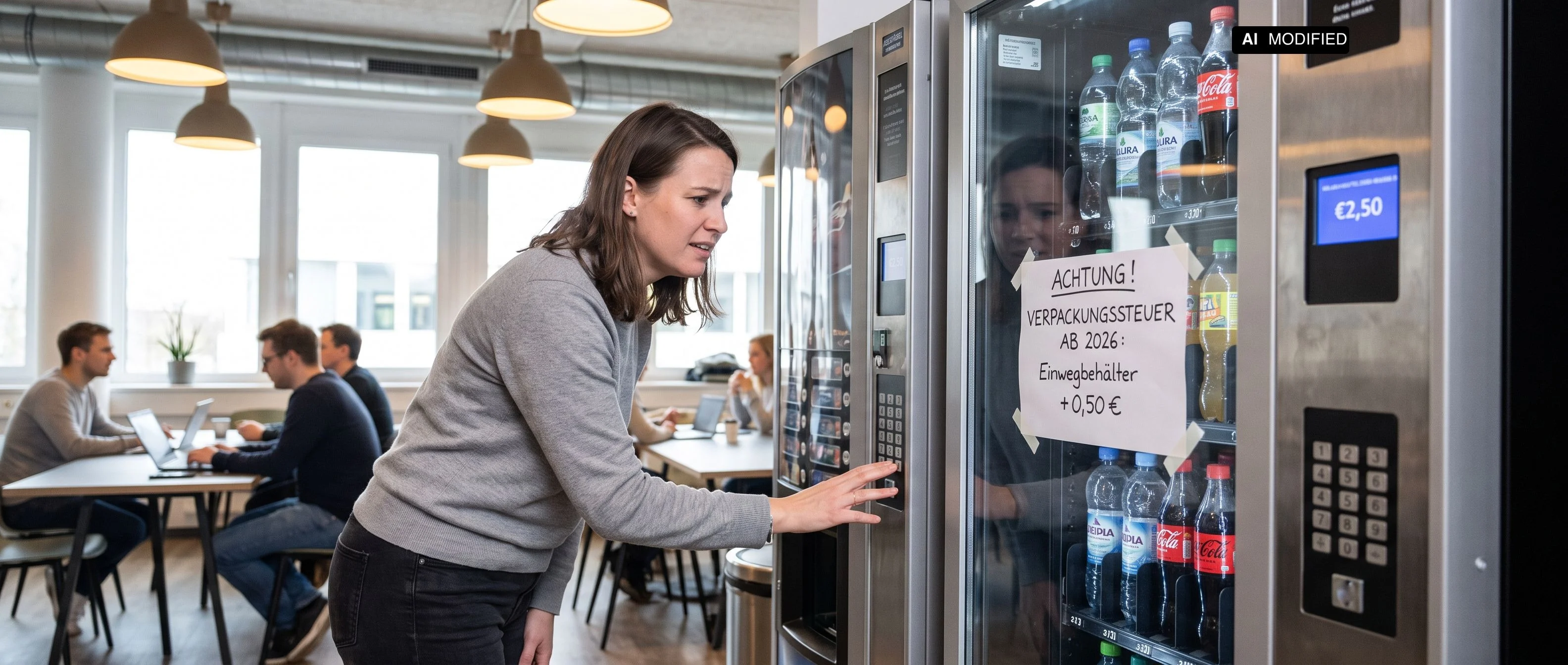
Packaging Tax 2026: Freiburg and Tübingen – where vending machines are getting more expensive
Since 1 January 2026, Freiburg has levied a packaging tax on single-use containers: 50 cents per cup, payable by the vending operator. Which machines are specifically affected, how much the tax adds per vend, and how the regulatory trend is developing across Germany.