
 KI Modified
Market Analysis
Packaging Tax 2026: Freiburg and Tübingen – where vending machines are getting more expensive
On this page
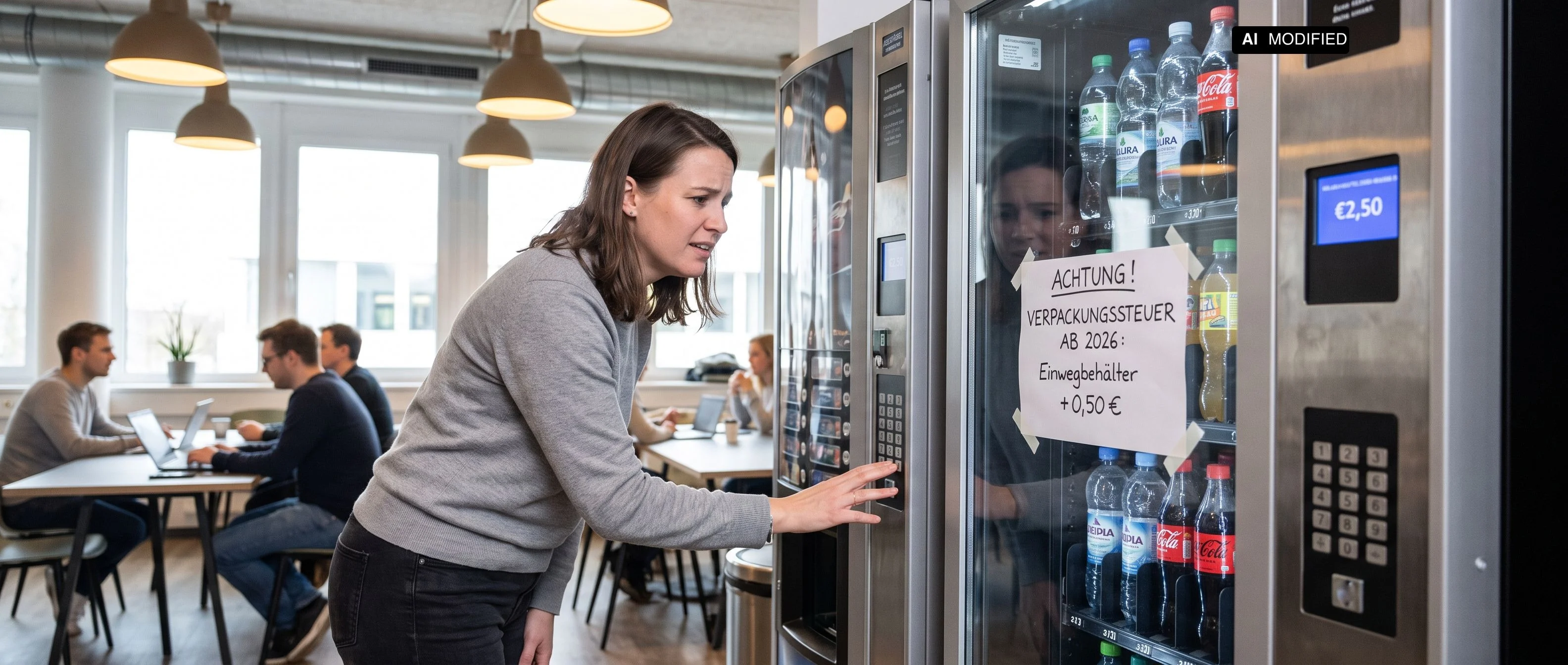
Since 1 January 2026, Freiburg im Breisgau has levied a municipal packaging tax on single-use containers and cutlery. This makes Freiburg the third major city in Baden-Württemberg to introduce such a levy, after Tübingen (since 2022) and Konstanz (since January 2025). For vending operators, the practical impact is 50 cents in tax per single-use cup dispensed, payable by the vending operator as the liable party, not by the business hosting the machine.
Tax rates in Freiburg and Tübingen: what applies where?
The rates in both cities are identical. Each single-use container or item of tableware is taxed at 50 cents; each item of single-use cutlery or drinking straw at least 10 cm long is taxed at 20 cents. Tübingen caps the tax at a maximum of 1.50 euros per individual meal. Whether Freiburg has adopted this cap can be determined from the City of Freiburg’s guidance notes, published by the city as guidance for taxpayers.
A key difference is the scope of the tax: Freiburg also taxes consumption on the premises. Anyone who buys a coffee from a vending machine and drinks it on the spot triggers the tax liability. Tübingen and Konstanz, by contrast, levy the tax only on takeaway sales. Freiburg’s rules therefore cover a broader range of workplace vending, where employees drink their coffee at their desks, than the Tübingen reference model.
Constitutional basis: legal certainty since the end of 2024
The municipal packaging tax has a secure legal basis. In May 2023, the Federal Administrative Court ruled that Tübingen’s model was lawful. On 27 November 2024 (judgment published on 22 January 2025), the Federal Constitutional Court confirmed that the tax is constitutional as a municipal excise tax under Article 105(2a) of the Basic Law. The NWB experts’ blog analyses the conditions under which municipal packaging taxes meet these constitutional requirements.
Municipalities in most federal states can therefore introduce comparable levies without facing further legal hurdles. Bavaria falls outside this framework: the state has prohibited municipalities from introducing packaging taxes at local level.
In all three cities, the liable party is the restaurant owner or retailer; in the vending context, this is the vending operator. The business hosting the machine is not directly liable. It remains unclear how the liability is assigned in conventional operating models where the operator and the premises owner are separate parties. The German Vending Association (BDV) has raised this issue in ongoing discussions with municipalities; a definitive legal clarification covering all vending-specific arrangements is still pending.
Which machines are specifically affected?
According to the BDV Market Study 2024, there are 621,000 vending machines in Germany. Drinks machines using single-use cups generate more than 60 percent of industry revenue. More than 80 percent of the machines affected by the tax are located at workplaces serving employees, rather than in public streets. The BDV’s argument that workplace vending is not conventional takeaway use therefore has statistical substance: the tax burden on vending falls mainly on company canteens and office coffee services.
The situation is particularly difficult for around 20,000 InCup machines (bag machines) in Germany. These machines dispense hot drinks in single-use cups and often cannot be converted to a reusable system without replacing the machine. For operators of these machines in Freiburg, Tübingen or Konstanz, switching to a machine that is not tied to a specific cup type is therefore a necessity, not an option.
What the tax means per vend
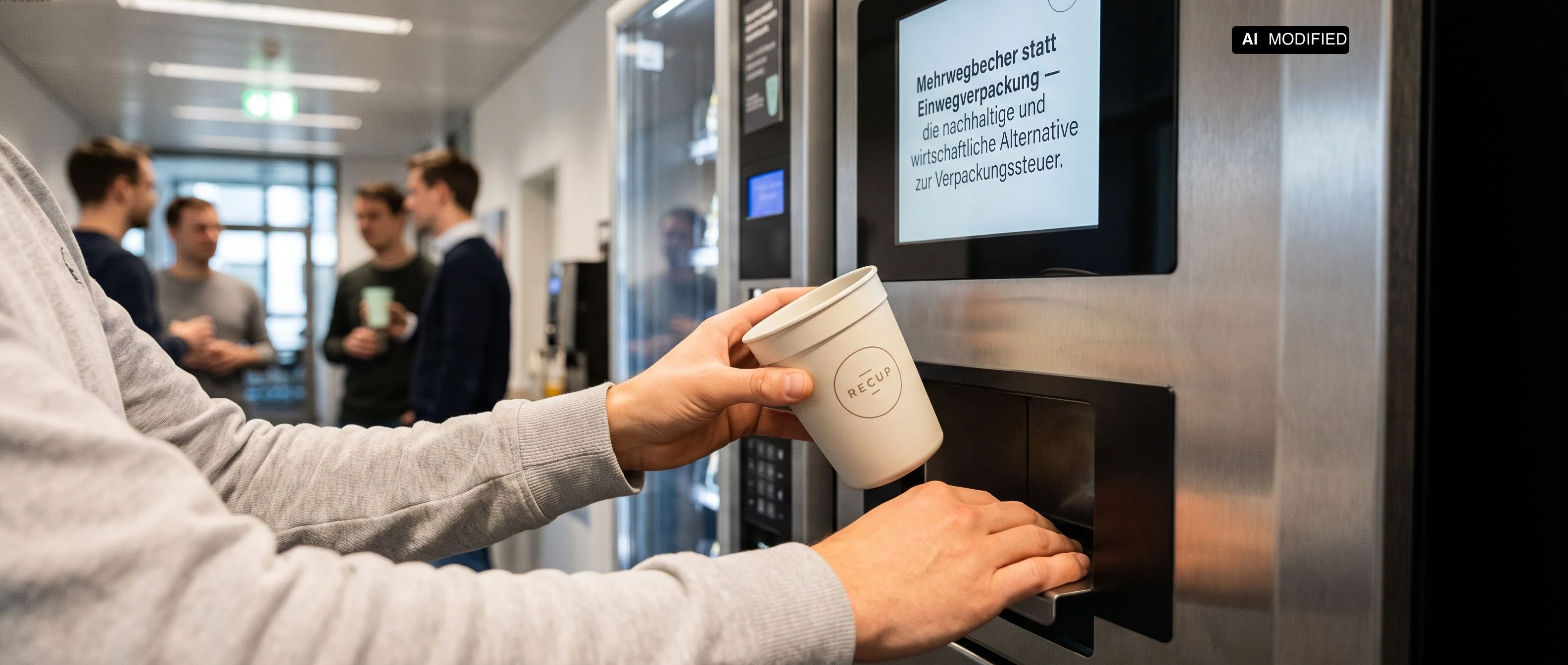
A 50-cent tax on a hot-drink cup adds 33 to 50 percent to the product price when the typical net selling price is 1.00 to 1.50 euros. If the operator does not pass on the tax—for example, for free coffee in a company canteen—the cost is borne directly as an operating expense.
Tübingen reported at least 692,000 euros in tax revenue from the levy for 2022. Freiburg forecasts revenue of 2.2 million euros for 2026. The difference is explained by Freiburg’s larger population, its stronger gastronomic attractions and the broader tax base resulting from on-premises consumption.
Alternatives and options for operators
Reusable systems are the only way to avoid the tax entirely. The BDV specifically identifies several options:
Reusable cup systems such as Recup or Rebowl: machines that dispense only reusable containers are not subject to the packaging tax. This requires the host site to be able to organise returns and cleaning.
Porcelain cups for fixed locations: technically feasible at closed sites with dishwashing facilities, such as company canteens with their own crockery cycle.
Deposit systems at vending machines: being trialled by individual manufacturers, but not yet widely available on the market.
Since 2025, the BDV has held discussions with affected municipalities and advocated exemptions for workplace vending. A petition submitted in February 2025 with 454 signatures was subsequently withdrawn. As of September 2026, no publicly known outcomes of these negotiations were available.
The nationwide trend: where might the tax come next?
Konstanz introduced the packaging tax in January 2025 and recorded 4.7 percent less litter in public spaces after nine months. That amounts to around 14 tonnes less packaging waste, equivalent to roughly one million fewer single-use cups. This measurable result strengthens the political case for the measure and is likely to encourage other municipalities to adopt it.
Potsdam has decided to introduce a packaging tax from 1 July 2026. Cologne, Bremen, Bonn, Heidelberg, Gießen and Trier are in the preparation phase. Around 120 cities are interested in the model. For operators with sites in multiple cities, this creates a fragmented regulatory landscape: different tax rates, different definitions of the taxable item and different interpretations of tax liability for workplace vending. When investing in new machines today, operators should check whether they can operate them tax-free in every municipality where they have sites over the next five years.
Last updated: 30 September 2026
Go deeper: related guides
- Cup cost at coffee machines: What a cup really costs the operatorEconomics & TCO · 14 min read
- Retrofit cashless payment to a vending machine: MDB 4.3, costs and selection criteriaFundamentals & Getting Started · 17 min read
- The Ideal Vending Machine Mix: Combining Hot Drinks, Snacks and WaterFundamentals & Getting Started · 14 min read
More news
 KI Modified
EUDR and coffee vending machines: what the EU Deforestation Regulation requires before it applies
Preparing for the EUDR affects coffee vending operators mainly through coffee products, supply chain evidence and business roles—not the machines themselves. This article explains the deadlines from 30 December 2026 and 30 June 2027, and outlines the data operators should start collecting now.
 KI Modified
Commodity Monitor October 2026: Coffee eases, cocoa and sugar in focus
The ICO coffee price fell by 8.7 per cent in September 2026 to 262.18 US cents per pound. The monitor puts the decline in context for vending procurement, presents Fairtrade cocoa minimum prices for Ghana and Côte d’Ivoire separately, and omits a sugar figure because no reliable primary source is available.
 KI Modified
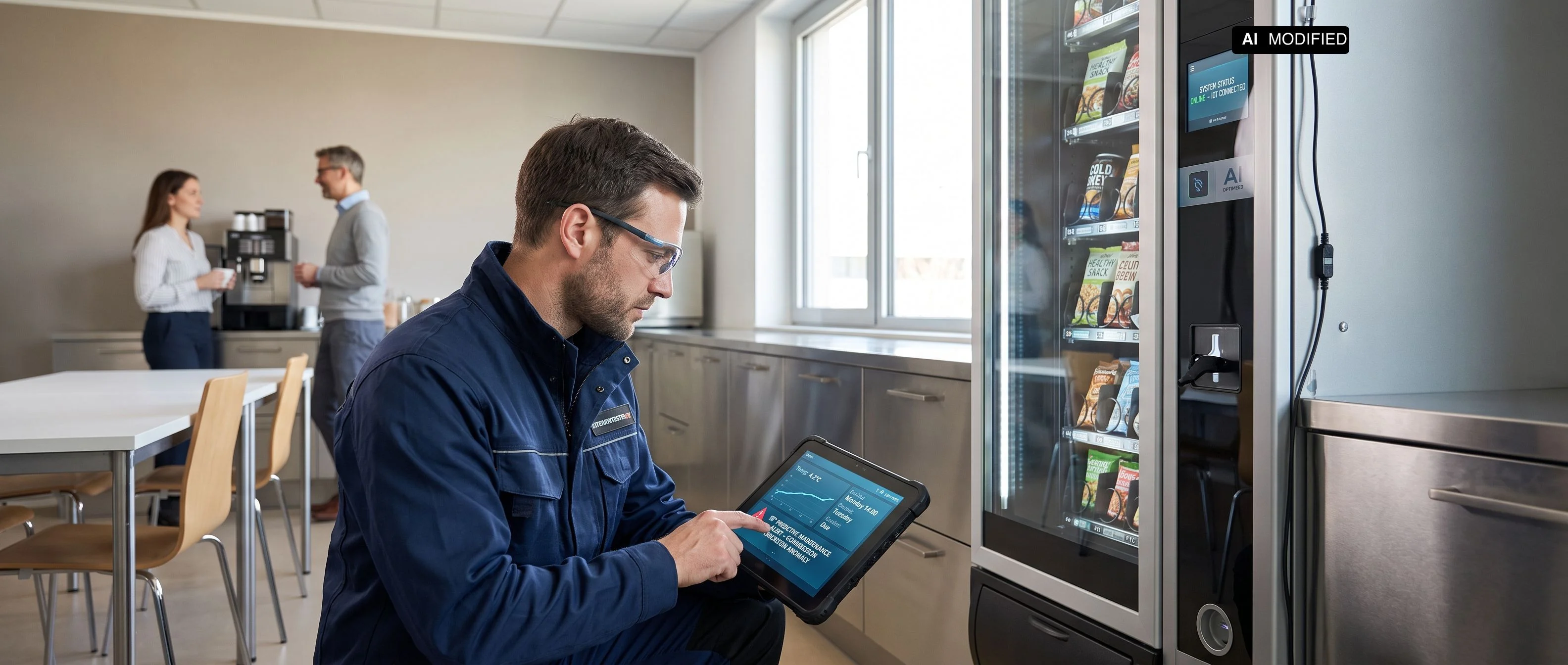
AI in Vending in 2026: Predictive Maintenance and Assortment Optimisation — How to Use the Technology
With 621,000 vending machines in Germany, revenue growth of 18.7% and the EU AI Act in force, AI applications in vending are no longer pilot projects in 2026. Find out which three areas are production-ready, what they deliver in practice and how to get started.