Skip to content
|Animo

Animo OptiBean XL Touch (V2)

8.6/ 10

Recommended

Data review — researched from sources, not physically tested. How we rate

Design & build8.2
Technology & features8.4
Operation & maintenance8.7
Capacity & range9.2
Value for money8.6
ca. 4,064 – 4,468 €

Guide prices net (excl. VAT), project prices may vary

  • Office, Hospitality / foodservice, Retail, Education, Healthcare, Airport
  • Counter unit
  • Indoor
  • Coins, Change giver

Eco label

ABCDE

Rated power consumption

2275 W

Power connection

220–240 V, 50–60 Hz, 2.275 W

Animo OptiBean XL Touch (V2)

Use cases

Where this machine fits, and where it does not.

Best fit

Office & Corporate

Suited to sites with 50 to 200 staff experiencing variable beverage demand.

Best fit

Hospital & Health

Appropriate for waiting areas and staff break rooms with rapid dispensing.

Conditional

Retail & Shopping

Application as coffee-to-go station at locations with consistent traffic flow.

Best fit

Universities & Education

Cafeteria sections or academic buildings with >80 daily beverage vends.

Conditional

Fitness & Leisure

Fast dispensing, though no cold-water supply is available.

Not suitable

Food Service

❌ No fresh-milk processing, thus less suitable for café operations.

Conditional

Petrol & Travel

Coin acceptance possible, however no fully integrated self-service cashless option.

Conditional

Hotel

For breakfast service with limited menu without guest-personalisation features.

Our rating in detail

Five public rating axes, weighted against the available evidence.

Design & build
8,2 / 10
Technology & features
8,4 / 10
Operation & maintenance
8,7 / 10
Capacity & range
9,2 / 10
Value for money
8,6 / 10

Our verdict

8.6Very good

The Animo OptiBean XL Touch delivers 120 cups per hour, a 1.5 kg bean hopper, and dual instant modules, targeting mid-sized offices, clinics, and educational facilities with approximately 50+ employees. Strengths include high throughput, flexibility for multiple hot beverages, and a freely programmable 7-inch touchscreen. The optional MDB interface enables coin payment and change dispensing but is not standard-fit; cashless payment requires an additional module. Milk supply relies on instant powder only, which sets taste limits in clinical and premium office settings. List price in 2024 ranged from €4,060–4,470 net—for the machine alone without base unit or options. In comparison, the OptiBean offers a robust stainless-steel brew group with Ditting ceramic grinder, though telemetry is available only as an option without remote configuration. Service intervals align with practical use, requiring a maintenance kit after >25,000 vends. For high-volume sites dispensing ≥80 beverages daily, the investment yields mid-term returns; operators prioritising fresh-milk capacity, app payment, or remote service support will find broader feature sets in competing models.

At a glance

Model
Animo OptiBean XL Touch (V2)
Manufacturer
Animo
Category
Hot Drink Machines
Price range
ca. 4,064 – 4,468 €
Overall score
8.6 / 10
Origin
Animo (NL)

Pros & cons

Pros

  • 1.5 kg bean hopper capacity for approximately 200 cups per fill
  • Up to 120 espresso cups per hour (120 ml in 25–30 sec.)
  • Hourly throughput 14 l, suited to >100-cups/day locations
  • Ditting ceramic grinder with 150,000-cup service life (manufacturer spec)
  • XL brew group processes 9.5–13.4 g coffee per vend
  • 7-inch touchscreen with freely programmable 24 beverages

Cons

  • Telemetry and cashless payment available only as options, no standard remote service
  • Milk system operates with powder only, no fresh-milk option
  • Discontinued model as of 2025, verify current availability before ordering
  • Espresso-unit maintenance kit required after >25,000 vends (service call)

Review

Design & Construction

409 mm width, 792 mm height, and 565 mm depth. The OptiBean XL Touch thus claims significantly more floor space than typical compact office machines, yet its rigid housing avoids appearing oversized. At 38 kg empty weight, it remains mobile enough for single-person relocation when clear access exists. The flat rear and centrally positioned filler caps suit wall-mounting close to the rear surface, though this requires the machine front to remain completely unobstructed. Critical consideration: despite solid construction from painted steel and clean edges, the front panel is moulded plastic-faced. Field experience with earlier models shows that reflections and fine scratches can develop under heavy use.

The adjustable cup platform spans 60 to 115 mm, with maximum dispensing height for to-go cups at 167 mm. The display dominates the user interface: a 7-inch touchscreen replaces all physical buttons. Per operating manual, it serves not only for beverage selection but displays promotional video, slideshows, and supplementary information during idle mode. 400 MB media storage is noted in the manual—marginally sized for many B2B applications, as full-HD video playback remains impractical. Menu navigation is entirely digital; initial setup and service access benefit from on-site technician training. Complex inputs such as recipe adjustment, telemetry, or payment module configuration operate exclusively through nested submenus. In vending environments with rotating operators, this quickly becomes a training overhead.

The machine body rests on an adequately dimensioned, anti-slip base. A fixed, level-surface mounting frame is mandatory per handbook. The manufacturer recommends against installation without such a frame. All service access points—bean hopper, instant modules, waste container, brew group—are reachable only via full front-door opening, presenting a genuine obstacle in confined spaces. When stocking XL modules with container extensions, floor footprint increases and stand stability becomes at risk. For sites below 60 daily vends, this configuration appears oversized and complicates access to all service elements.

Material specification gains distinction through the central stainless-steel boiler and ceramic grinder, yet door handles, flaps, and display trim remain conventional production-grade. No exposed fasteners, no unnecessary gaps, but operators accepting delivery should inspect for stable hinges and sound mechanical stops. A grind-adjustment dial hides behind a service door to prevent operator error. Independent field experience is absent; longevity and scratch resistance claims derive exclusively from manufacturer documentation.

Key weaknesses concern securing the front panel without special tools and limited flexibility in access height settings. For high-traffic locations with frequent operator changes, these are non-trivial concerns.
Technology & Functions

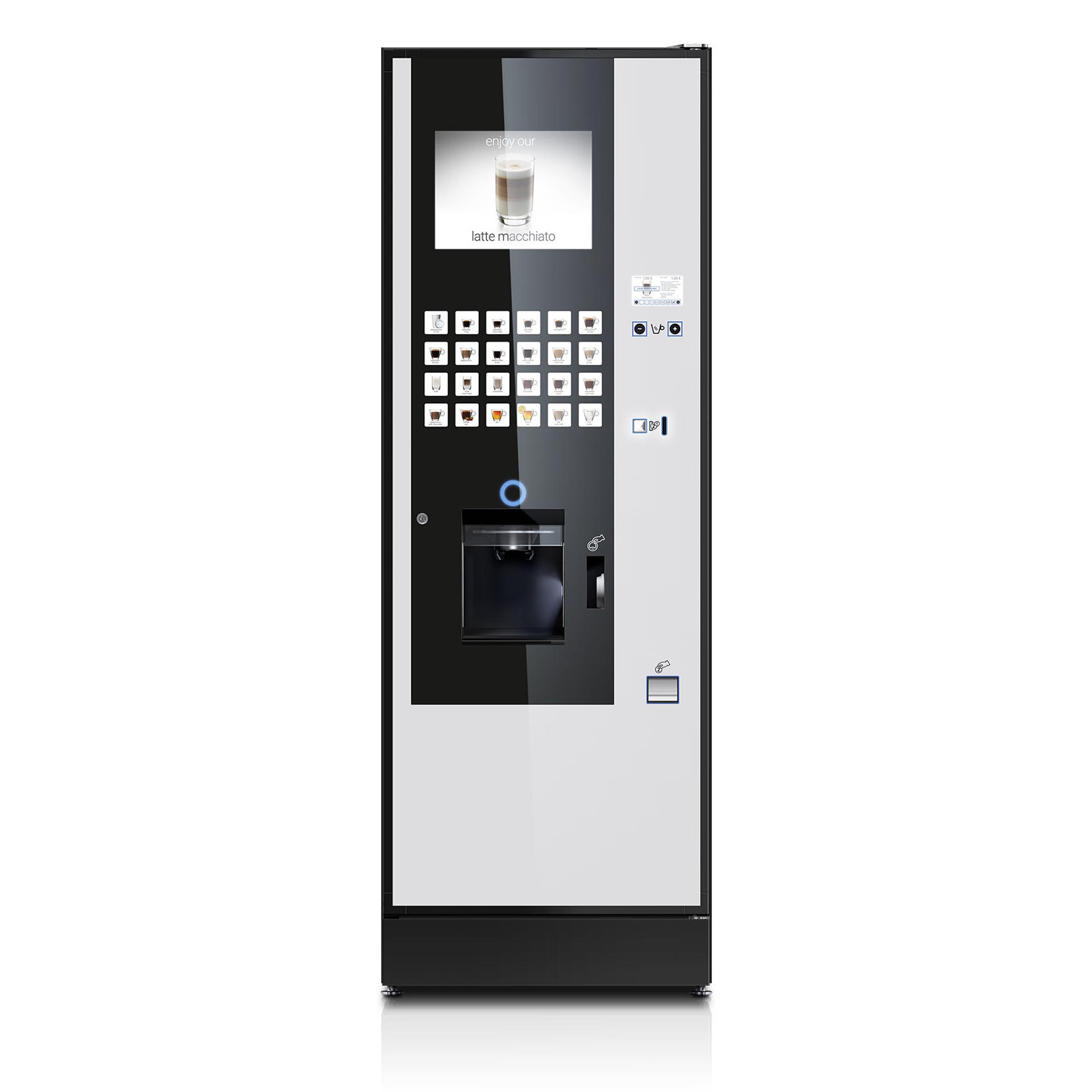
7-inch touchscreen, 24 direct-select beverages, individually assignable display buttons. The OptiBean XL Touch series builds its interface on a logically structured layout inherently designed for self-service in office settings or semi-public spaces. Product documentation explicitly references an MPEG-4 video player and up to 400 MB media storage for advertising or information displays in break areas. Operators can upload brand logos, slideshows, or usage guides to the display. However, interface scope is deliberately limited: external telemetry systems are prepared for integration but are not built-in—the official datasheet states only "prepared for telemetry" without standard equipment. Native IoT connectivity with automatic remote access is absent; remote monitoring or data retrieval via web dashboard must be separately purchased and externally configured. Routine machine interventions are limited to physical methods via USB drive or service menu, proving inefficient for chain operators managing dozens of units.

The brew section employs what is termed "reverse espresso brew" technology: an XL brew group processes 9.5–13.4 g coffee per vend, yielding beverage volumes of 150–230 ml. The grinding element uses a ceramic Ditting module, specified by the manufacturer for service life up to 150,000 cups. For high-volume operators such as university cafeterias or production facilities, this endurance rating carries relevance. Cleaning of the mixer and brew unit operates via menu-guided programs on the touchscreen but cannot be remotely triggered through external interfaces.

Payment systems connect via standard MDB protocol ("MDB ready" per brochure) and cover coin validators and change dispensers. Cashless solutions are provided as accessories and require retrofit by an authorised partner. The payment module can be activated within the device menu; change dispensing is configured by the operator during setup. A genuine advantage for multi-site operators would be standard telemetry with fault alerts and fill-level detection—both features are not factory-integrated per current product datasheet but require additional modules. Without such functions, oversight of fill levels, consumption, and faults remains dependent on manual checks and local configuration.

Beverage recipe customisation is available: strength, water volume, instant topping, and sugar can be individually calibrated per program. Tea selection, dual-vend, and instant coffee are configurable based on setup. The machine processes fresh beans and instant ingredients via separate containers; the factory-fitted configuration offers no fresh-milk solution. Cup sensing (cup detection) is optionally available but is not standard-fit per official datasheet.

Technology remains current to 2022/23 standards with no app control or cloud-based central management. For classical single-site operations with dedicated service personnel, the feature range suffices. Operators expecting fleet-capable real-time management, API data retrieval, or predictive maintenance from remote stations encounter genuine limitations. \(Sources: Animo OptiBean Touch – offizielles Produktdatenblatt, Animo OptiBean Touch – offizielle Broschüre, Animo OptiBean XL Touch – Original-Betriebsanleitung)

Capacity & Range

1,500 g bean capacity corresponds to approximately 200 standard cups per the manufacturer's claim. This figure assumes approximately 7.5 g per cup; the XL brew group doses 9.5 to 13.4 g per the same datasheet, yielding 112 to 158 cups per hopper fill. The bean container thus suits mid-range to large-scale operations if refill cycles are well planned. However, a single chamber constrains product variety. Operators requiring multiple bean selections have no secondary chamber; they must work within a single fill. Two instant containers at 1.6 litres capacity each expand the beverage palette to milk-based and cocoa drinks, with one container holding approximately 970 g topping powder (138 portions) and the other 1,000 g cocoa powder (60 portions). Recipe selection caps at a maximum of 24 freely programmable beverages, as documented in the current datasheet.

With hourly throughput of 120 cups at 120 ml—or 14 litres total—the XL configuration covers sustained demand in canteens, break lounges, or university catering. Throughput is designed for offices with approximately 80–100 staff or locations with high-traffic passing trade. Individual vends require 25–30 seconds per 120 ml cup per datasheet. During peak demand, simultaneous bean and instant beverage dispensing is technically provided, though the single boiler and Ditting ceramic grinder (manufacturer spec: 150,000-cup service life) limit concurrent operation.

The waste container accommodates approximately 130 coffee pucks plus rinse water. Daily emptying cycles are realistic if the site does not exceed nominal throughput. Multiple daily vends deplete waste and instant stocks faster than beans. Operators with higher demand can retrofit optional container extensions, expanding bean reserves by approximately 700 g per set—translating to 52 to 74 additional cups by the brew group's dosing—with a maximum of two such sets. This extension is not standard-fit and increases both machine height and refill reach. Not all locations can accommodate these add-ons, such as spaces with low-mounted cabinetry.

On the range side, factory configuration lists coffee, café crème, espresso, cappuccino, chocolate, and hot water. Further recipes such as tea, double espresso, or decaffeinated coffee depend on ingredient availability—a true multi-product system is absent. Combined requirements, such as separate bean and instant coffee choices, encounter single-container limits. For operators serving rotating clientele or seasonal product shifts, recipe management demands active oversight.

For small sites with fewer than 50 staff, capacity is oversized. Pure coffee stations without instant demand underutilise the XL model's capabilities. In multi-position scenarios, however, the unit justifies investment provided cleaning and restocking integrate into fixed routines. Usable beverages and dosing depend entirely on selected ingredient palette and cup measure—material constraints appear in recipe datasheets and operating manuals.

Source reference for all capacity and range details: Animo Product Datasheet pp. 1–2, Manufacturer pricing and brochure status 2024, Official Operating Manual pp. 27, 37.

Operation & Maintenance

Daily cleaning begins at the OptiBean XL Touch with removable assemblies: the coffee grounds container holds approximately 130 pucks per manufacturer specification and should be emptied on alert, ideally daily. Drip tray and grounds container require rinsing under running water once daily. Remove spilled powder residue from instant containers immediately, as moisture promotes caking. The brew group remains in-unit and receives care via automatic cleaning program. This is accessible within the touch menu in a few steps: the operator inserts a cleaning tablet, follows display prompts, and waits for program completion. The full cleaning cycle timeline is not precisely documented in the original manual; practical experience suggests the procedure including setup and execution requires approximately 10–15 minutes daily. Simple housekeeping such as disinfectant wipe-down of external surfaces and touchscreen completes faster.

Weekly maintenance encompasses removal and thorough cleaning of the milk powder mixer and instant circuit components. Powder lines, milk frothers, and mixer bowls require rinsing in lukewarm water. Coffee outlet and cup guide need brush treatment to remove residue. Ingredient containers (beans, topping, cocoa) are seldom fully emptied but should be inspected monthly for powder deposits and caking.

The machine requires a fixed water connection with 3/4-inch thread. Minimum service pressure per manufacturer is 2 bar and must be regularly verified. Water supply issues typically require technician involvement; maintenance intervals and possible spare-part costs are not publicly documented. A maintenance kit for the espresso unit is recommended per service manual after more than 25,000 vends; exact spare-part pricing is supplied by the Animo spare-parts list (for example, approximately €27 per kg for cleaner or descaler; see Animo Ersatzteilpreisliste 2025). Technician call-out fees and travel costs are unpublished and must be negotiated per service contract. Documented workshop costs are not available from open sources.

Cleaning agents carry professional branding: 100 OptiClean tablets cost €24 net at the checked retailer (€0.24 per tablet; Horeca.com – Animo OptiClean 100 Tabletten). In-house personnel can perform external disinfection and minor maintenance following guidance. Complex repairs—such as to brew group, boiler, or payment unit—should be undertaken by the authorised service network. Manufacturer documentation lists mixer, brew group, waste drawer, and drip tray as requiring scheduled cleaning. A central weakness: the manufacturer provides no published network of German-wide service stations for this model. During downtime, individual operators decide whether to call an independent vending technician or pursue original-equipment service.

Warnings and service intervals are accessible via the operating menu. The manual describes automatic reminder functions for cleaning, descaling, and maintenance. While cleaning and maintenance are largely automated, all solutions depend upon consistent use of certified products and trained personnel. Overlooking individual steps risks faults and taste degradation.

Performance & Energy

2,275 watts electrical power draw during operation, as documented in the official datasheet and current manufacturer price list. The machine operates with an insulated stainless-steel boiler, with its heating element separately rated at 1,800 W. Following start-up, the OptiBean XL Touch requires approximately 3 minutes to reach operating temperature per operating manual. During this warm-up phase, approximately 107 Wh of energy is consumed (source: operating manual, p. 29). Neither the manufacturer brochure nor datasheet provides standby consumption or explicit annual consumption figures. In energy-saving mode, the controller reduces boiler temperature by 5 °C every 30 minutes without beverage vends to lower power cost. Once a beverage is dispensed, the unit switches back to normal operation. A benchmark for typical annual electricity consumption cannot be determined without official test-standard values. While an EVA A+ energy label is mentioned, specific consumption assessment per 120 cups daily is absent from current documentation. Operators must gather their own consumption data under actual site conditions to build a sound projection.

Per manual guidance, sound pressure remains below 70 dB(A), consistent with comparable full-automatic machines of this size. Grinding and vend cycles generate brief higher noise; for an office corridor, this presents no material burden. In very quiet environments, acoustic perception may gain greater weight. Concrete measurement series or verifiable continuous-sound data are unavailable.

Nominal voltage is rated at 220–240 V, with safety margin for international power grids. During operation, both peak current values—for throughput and thermal demand—are system-side protected. Separate power draw for display and control electronics is not specified. The complete system requires the standard 16 A circuit connection. Sites with constrained electrical supply must verify this before installation.

Combining the available data, the OptiBean XL Touch's energy aspect ranks as market-standard, not explicitly power-efficient. Without precise data on daily standby duration and switching cycles, electricity-cost calculation remains coarse-grained. For energy-optimised canteens and locations with grid-source certification, a robust measurement over several weeks of trial operation is recommended. Power consumption falls within the range of comparably sized gastro-grade fully automatic machines and becomes proportionally less significant at locations exceeding 80 daily beverages than capital investment and maintenance do. The operator must independently assess how significant electricity consumption is relative to beverage output and remaining operating costs.

Sources / practical-reference documents: OptiBean Touch Datasheet pp. 2–3 (power, energy-saving mode), Manufacturer Brochure p. 13 (A+ label, boiler data), Operating Manual pp. 14, 28–30 (water pressure, power connection, sound pressure), Manufacturer Price List 2024 (machine overview), Animo Support Downloads (documentation).

Pricing & Operating Costs

Real market prices for the Animo OptiBean 3 XL Touch exceed €4,000 net per unit. Two relevant suppliers currently stock the machine between €4,064 and €4,468 net, as shown by Coffee Express and MaxGastro price lists. These amounts refer to new equipment without payment module or water filter. Bespoke configurations, installation, or transport incur additional charges; one supplier levies €295 net for initial setup. The manufacturer list price most recently stood at €5,585 net, with practical purchase price often 20% or more below that. Options such as coin changer, telemetry interface, or topping stock push costs substantially higher. Operators without fixed water connection must factor in tank solutions.

Over five years of continuous use, further costs accumulate. The manufacturer recommends specialised OptiClean tablets for cleaning, at €24 net per 100-tablet box. At daily cleaning and approximately 200 working days per year, tablets alone cost at least €24–36 annually. Larger employers with shift operations incur proportionally higher expenses. Spare-part pricing such as for machine cleaner or descaler is quoted at €27 gross per kilogram; actual consumption volumes are highly use-dependent. Wear items such as espresso-unit maintenance kit become due per manufacturer statement following 25,000 vends; total cost for parts and service is case-dependent and must be individually budgeted.

Energy demand per official datasheet is 2,275 W connected load. Average electricity consumption for 120 cups per hour is documented by the EVA A+ label without stating an absolute annual figure. Without verified manufacturer data on kWh or true electricity cost, multi-year actual consumption remains an open variable.

Example calculation: assuming 120 cups daily (worksite size approximately 50–80 staff) and five-year service life, capital investment runs €4,064 to €4,468 net, plus approximately €200 in cleaning supplies and at least €270–400 in maintenance and consumables, plus energy and possible financing costs. Without financing and in-house labour, this yields per-vend costs of 3.3 to 4.3 cents: €4,970 to €5,100 spread across 120,000 to 150,000 vends depending on 200 or 250 working days annually. Raw materials and downtime are excluded. Low utilisation slows payback.

Small sites with fewer than 40 staff pay the price for capability and throughput they scarcely use operationally. The machine targets mid-size to large offices, canteens, educational facilities, or high-traffic waiting areas, not retail or low-volume customer service. Cost drivers remain initial capital purchase plus ongoing cleaning and maintenance. Leasing models or service contracts are industry-standard offerings but must be separately requested and quoted in the specific case. Public data on typical repair costs or bundled annual inspection pricing is absent. Consequently, transparency on true total cost of ownership remains limited. All pricing and data reflect official manufacturer and retailer statements as of mid-2026 (Coffee Express, MaxGastro, Animo Export Price List 2024).

Technical data

All recorded data points at a glance.

Use & operations

Use cases / locations
Office, Hospitality / foodservice, Retail, Education, Healthcare, Airport
Installation type
Counter unit
Environment (indoor/outdoor)
Indoor

Payment & connectivity

Payment methods
Coins, Change giver
Payment interface protocol
MDB (Multi-Drop Bus)
Telemetry / remote monitoring
Optional (retrofit)
Connectivity
Ethernet/LAN, Wi‑Fi, Bluetooth

Technology

Sensors
Temperature sensor (HACCP), Door sensor / open detection, RFID tracking
UI / display type
Touchscreen

Heißgetränke

Milk system
Milk powder doser
Brewing technology
Combi (bean + instant)

Service & compliance

Price segment
Premium
HACCP compliance
Partial (logging option)

Abmessungen & Gewicht

Dimensions (W × H × D)
409 × 792 × 565
Weight (unpacked)
38 kg
Rated power consumption
2275 W
Power connection
220–240 V, 50–60 Hz, 2.275 W

Kaffee-Technik

Mains voltage
230 V
Drink menu size
24
Approx. daily capacity
160 Tassen/Tag
Espresso throughput
120 Tassen/h
Coffee dose range
9,5–13,4
Required water pressure
2–10
Water supply
Tank or mains
Heating system
Boiler

User reviews

Verified community reviews and clearly labelled external operator sources, separate from our 0–10 editorial score.

There are no confirmed community reviews for this model yet. You can submit your experience below.

Have experience with this machine?

Share your assessment. Your review helps other operators make purchasing decisions.

Share your experience with Animo OptiBean XL Touch (V2)

4 / 5

0/5000 characters (min. 100)

Only your first name and selected use case will be shown publicly.

Data review: AI-assisted research, editorially checkedLast checked: Redaktion AutomatenTests.deRating criteria documented transparently

Frequently asked questions about Animo OptiBean XL Touch (V2)

What beverages can this machine dispense?

Factory configuration allows up to 24 hot beverages, including coffee, espresso, cappuccino, caffè latte, chocolate, and hot water. With appropriate ingredients, tea, decaffeinated, and instant coffee are also possible.

How frequently must cleaning occur and what is the effort involved?

Daily cleaning includes brew group, mixer, drip tray, and waste container. Cleaning programs start via touchscreen; tablet changes and emptying total approximately 12–15 minutes daily.

What electrical and water connections are required?

The machine requires 230 V (2,275 W), a fixed 3/4-inch water connection, and minimum 2 bar service pressure at 5 l/min. Pump or tank solutions are available as accessories.

What is the purchase price and what are the running-cost expectations?

The OptiBean 3 XL Touch costs €4,064–4,468 net (2024, excluding options). Cleaning tablets run €0.24 net per unit; maintenance kit required after 25,000+ vends; service contract individually negotiated.

Is cashless payment or remote monitoring included as standard?

Standard equipment includes only coin payment with change as an option. Cashless payment and telemetry are optional only; remote service requires additional hardware.

Franke A400

Franke · Hot Drink Machines

Franke A400

8.3Very good

The Franke A400 positions itself as a fully automatic coffee machine for medium commercial locations requiring up to 100 cups daily. Its CleanMaster system shortens daily cleaning to approximately 9 minutes and reduces manual effort to a minimum—a core argument for offices with 30 to 100 staff, cafes and self-service hotels. The FoamMaster variant delivers barista-level milk foam without requiring specially trained personnel. Capacity remains stable for constant use below the 100-cup threshold; sustained throughput beyond this level stresses grinding mechanisms and brew groups, shortening their operational life. Drawbacks include high acquisition costs in full configuration (up to €10,500) and regular service expenses. The Franke A400 amortizes within several years at high-traffic sites, provided that cleaning effort, service intervals and repair outages are factored into total cost of ownership. For sites requiring 120+ cups daily, upgrading to the larger A600 is recommended.

ca. 4,500 – 10,550 €

Melitta Cafina XT7

Melitta · Hot Drink Machines

Melitta Cafina XT7

8.3Very good

The Melitta Cafina XT7 is engineered for dense output peaks, not for a small location with low volume. The manufacturer specifies approximately 250 cups per day and 176 individual espressos per hour. Two grinding units, TopFoam for 2 milk types, an 8.4-inch touchscreen, CIP cleaning and optional telemetry form a robust feature set for hotels, bakeries or large self-service areas. The trade-offs remain substantial: 300 × 715 × 580 mm, 60 kg, 400 V, maximum 5700 W and daily cleaning demand prepared infrastructure and clear responsibilities. At approximately €13,000–16,000 net for the reviewed configuration, the machine is capital-intensive. Those not regularly requiring the stated capacity purchase expensive reserve capacity. Those using it should calculate accessories, service scope, water treatment and installation work as a complete bill of materials before placing an order.

ca. 13,000 – 16,000 €

Necta Kalea Plus

Necta · Hot Drink Machines

Necta Kalea Plus

8.5Very good

200–250 beverages daily, fresh-milk system with automated cleaning and touch operation: The Necta Kalea Plus targets larger offices, canteens and breakfast areas in hotels and foodservice venues with 60 to approximately 150 staff or high-volume guests. Testing confirms the robust Z4000 brew group and modular architecture for beans, instant and milk; the telemetry-capable platform enables straightforward monitoring without add-on modules. Operators praise reliability (with consistent cleaning), rapid beverage dispensing and parts availability (German warehouse: 1–3 days). Weaknesses: daily milk-system cleaning (5–8 minutes, mandatory) cannot be skipped, and every 10,000 vends requires brew-group service—at maximum throughput, this means every 2–3 months. Acquisition cost ranges from €6,800 to €9,400 net; maintenance and consumables are material. For high-throughput sites with professional oversight, the model justifies itself through minimal downtime and predictable follow-on costs.

ca. 6,798 – 9,439 €

Franke A600

Franke · Hot Drink Machines

Franke A600

8.7Very good

The Franke A600 positions itself as a versatile fully automatic coffee machine for demanding offices, canteens and large sites with daily demand of up to 200 cups. Through its 10.4-inch touchscreen, modular brew groups and a powerful milk system, the machine is designed for both attended dispensing and pure self-service. Businesses with 60 to 200 employees particularly benefit from the high hourly throughput (e.g. 240 espressos/hour) and central fleet management via FrankeConnect. Weaknesses lie in non-publicly accessible purchase prices in Germany for the new generation and in the complexity of cleaning with IndividualMilk or CleanMaster variants. The investment pays off for locations with a broad hot beverage range, high dispensing frequency and digitalized administration. In used condition, a classic A600 is available from approximately 4,000 € net; for the current generation, German dealers do not quote list prices. The range stated here of approximately 9,700 to 10,800 € comes from two British dealers, applies to the classic A600 and has been converted at the ECB reference rate. Lower total cost of ownership results primarily through central control and reduced downtime during malfunctions or service.

ca. 8,500 – 10,809 €