Skip to content
|WMF· Professional Coffee Machines

WMF 1100 S

7.3/ 10

Recommended

Data review — researched from sources, not physically tested. How we rate

Design & build7.5
Technology & features7.5
Operation & maintenance8.2
Capacity & range6.5
Value for money7.0
ca. 3,495 – 4,873 €

Guide prices net (excl. VAT), project prices may vary

  • Office, Hospitality / foodservice
  • Counter unit
  • Indoor
  • Optional (retrofit)

Eco label

ABCDE

Rated power consumption

1900 W

Power connection

1 / N / PE

WMF 1100 S — Frontansicht · Quelle: assets.wmf-coffeemachines.com

6 photos · WMF 1100 S

Use cases

Where this machine fits, and where it does not.

Best fit

Office & Corporate

Suited to locations with 20–60 employees and up to 80 coffee servings daily.

Best fit

Hotel & Foodservice

Appropriate for reception desks or small breakfast buffets with moderate throughput.

Conditional

Cafeteria & Campus

Limited: 80 cups/day insufficient for cafeterias with 50+ regular users.

Conditional

Healthcare

Conditional: HACCP export via USB available, but no fresh-water system; hygiene concept must be clarified in writing.

Not suitable

Industrial & Manufacturing

❌ Not suitable: no protection against dust or moisture; indoor operation only to +35 °C maximum.

Conditional

Direct Sales & Farm Shops

Limited: weather-protected indoor only; 80 cups/day adequate for small on-site cafés.

Our rating in detail

Five public rating axes, weighted against the available evidence.

Design & build
7,5 / 10
Technology & features
7,5 / 10
Operation & maintenance
8,2 / 10
Capacity & range
6,5 / 10
Value for money
7,0 / 10

Our verdict

7.3Good

Up to 80 cups daily, 7-inch touchscreen display, and HACCP-capable cleaning protocols: the WMF 1100 S is a compact super-automatic espresso machine for offices with 20 to 60 employees. The unit measures 325 × 500 × 571 mm, weighs approx. 25.5 kg, and fits most kitchen counters without structural modification. The removable brewing unit processes a maximum of 15 g coffee grounds per brew and delivers consistent results; cleaning protocols can be exported via USB for HACCP documentation. Two operational limitations merit attention: the Basic Milk system draws milk via tube from an external cooler or milk carton, requiring more daily handling than an integrated refrigerated system. Additionally, WMF designates the 1100 S as discontinued—orderable only until 30.09.2026. New units cost €3,495 to €4,873 net depending on configuration; spread over five years, depreciation amounts to €699 to €975 annually, plus consumables and service charges. The machine suits operators seeking a low-maintenance office unit with HACCP documentation who do not operate high-throughput sites.

At a glance

Model
WMF 1100 S
Manufacturer
WMF
Category
Hot Drink Machines
Type
Bean-to-Cup
Price range
ca. 3,495 – 4,873 €
Overall score
7.3 / 10
Origin
WMF (DE)

Pros & cons

Pros

  • 7-inch touchscreen with vertical swiping for up to 8 beverage favourites: self-service without staff instruction.
  • Removable brewing unit with up to 15 g coffee grounds per cycle detaches without tools and simplifies cleaning.
  • Eco Mode reduces steam boiler temperature after 10 minutes idle; automatic shutdown configurable in 30-minute steps up to 180 minutes.
  • HACCP cleaning protocols exportable via USB: suitable for operations with documented hygiene requirements.

Cons

  • Grounds container holds only approximately 30 brews: may require emptying up to three times daily during peak demand.
  • Standby power consumption and annual energy consumption not published by WMF; external metering recommended for energy-conscious operations.
  • Discontinued model: orderable only until 30.09.2026; spare-parts availability after production end is not publicly confirmed.
  • Basic Milk draws via external tube: more daily handling and hygiene effort than machines with integrated refrigeration.

Review

How large is the WMF 1100 S, and where does it fit?

325 mm wide, 500 mm high, 571 mm deep: the WMF 1100 S is engineered for office kitchens and reception desks that cannot accommodate large-group machines. Net weight per official brochure is approx. 25.5 kg; depending on configuration variant, the operating manual specifies 24–28 kg.

For installation, the planning guidance recommends at least 50 mm clearance on each side, 60 mm to the rear, 200 mm overhead, and 800 mm work space in front. These clearances are prerequisites for air circulation and service access; falling short risks overheating and difficult maintenance. A fixed water connection is optional; without installation, the unit operates on the integrated 4.5 l water tank.

The 7-inch touchscreen supports vertical swiping between beverage favourites and is designed for unattended self-service operation. SteamJet warms cups with steam, which is noticeable for hot drinks in porcelain cups. The cup tray accommodates cups up to 100 mm height.

Bean hoppers are available in two sizes: the standard holds 550 g beans or 700 g powder; the extended holds 1,100 g beans or 2,200 g powder. For offices with peak-time demand, the larger hopper significantly reduces refill frequency. Which configuration is available must be specified in the quotation; dealers market different packages under the same model name.

Note on depth: the current brochure states 571 mm, while the operating manual and planning information cite 561 mm. For tight installation, verify the depth with the dealer using the order number.

The grounds container holds coffee grounds from approximately 30 brews per the operating manual. At 80 cups daily with pronounced peak times, it may need emptying two to three times per day. Operators should plan this into the service routine.

Optically, the unit is solidly finished without imitating the heavy tactile feel of high-pressure machines. The housing is typical of WMF's professional line at this price tier: functional and understated. For visible customer-facing locations, such as hotel lobbies, aesthetics may be a criterion in favour of higher-end WMF lines.
Technology & Features: What is inside the WMF 1100 S?

The removable brewing unit processes a maximum of 15 g coffee grounds per brew and can be withdrawn without tools. This simplifies daily cleaning and makes user-led maintenance realistic. The construction mirrors that of the 1000-S line and is documented as serviceable through WMF authorised dealers.

The Basic Milk system draws milk via tube from an external cooler, a separate milk container, or a milk carton (operating manual pages 34–35, manufacturer specification). Compared to machines with integrated refrigeration, this requires more space discipline and hygiene attention: the tube must be cleaned daily and replaced every 6 months at the latest. Those requiring integrated cooling must step up to the WMF 1500 S or 5000 S.

The 7-inch touchscreen displays beverage favourites with symbols; vertical swiping reveals additional options. A display lock is configurable for publicly accessible areas.

The rear USB slot supports multiple functions: import and export of recipes and beverage symbols, export of counters and HACCP protocols, data backup, and firmware updates. An optional Bluetooth stick plugs into this slot; the function must be enabled via software (operating manual page 80, manufacturer specification).

WMF CoffeeConnect is available as an optional telemetry platform. It connects machines, delivers machine data, and is stated to support process optimisation per the official brochure. Pricing and scope are negotiated on a project basis; no public price list exists.

Eco Mode lowers the steam boiler temperature 10 minutes after the last beverage is dispensed. Automatic shutdown is configurable in 30-minute increments from 30 to 180 minutes. Following Eco Mode activation, a milk-based drink requires approximately 15 seconds of heat-up time; black drinks are available immediately. The multiple-brew function dispenses up to 12 times the single dose with one press.

A built-in WLAN or Ethernet interface is not listed as standard equipment in the operating manual. Operators wishing to integrate machine data into a network without the optional Bluetooth stick must rely on CoffeeConnect or an external solution.

Capacity & Assortment: For how many users is the WMF 1100 S sufficient?

80 cups daily: WMF cites this figure as both the recommended daily output and maximum hourly output (manufacturer specification, brochure page 8). For offices with 20 to 40 employees and average consumption of 2 cups per person per day, the machine is adequate. Above 50 regular users or with pronounced peak demand—for example, 30 servings within 30 minutes—capacity becomes the limiting factor.

The 4.5 l water tank yields approximately 32 cups at 140 ml portions before refilling is required, if no fixed water connection is installed. For offices with more than 20 users, the fixed-water option is the more practical solution; installation effort is minimal in most office kitchens.

The grounds container holds coffee grounds from approximately 30 brews per the operating manual. During peak times, it may need emptying up to three times daily when the daily maximum is reached.

Standard beverage range: espresso, café crème, cappuccino, milky coffee, latte macchiato, milk foam, and hot water. The optional powder dispenser adds hot chocolate. The brochure references up to 8 beverage favourites on the display.

The multiple-brew function dispenses up to 12 times the set quantity with one press. This is practical for meeting rooms or carafes; the bean hopper depletes accordingly. The standard 550 g bean hopper permits approximately 55 servings at 10 g per cup without refilling; the extended 1,100 g hopper allows approximately 110 servings.

Per the HACCP chapter of the operating manual, 1 litre of milk yields approximately 20 cappuccinos, depending on settings. At 40 milk-based servings per day, 2 litres of milk must be stocked and refrigerated. The external milk handling requires dedicated fridge space in immediate proximity to the machine.

Cleaning & Operation: What daily management entails

The system cleaning cycle lasts approximately 10 minutes per the operating manual. Required are a WMF cleaning tablet (1.3 g) and a catch container with at least 3 l capacity. The machine prompts cleaning every 200 brews or every 6 days at the latest; after 250 brews or 7 days without cleaning, it locks operation entirely. System cleaning is therefore not optional.

The milk system must be cleaned daily after use. The milk frother and steam nozzle are cleaned manually after the system cleaning cycle. The milk tube must be replaced as needed, at the latest every 6 months (manufacturer specification, operating manual pages 34–35). Operators who do not document this schedule risk hygiene deficiencies. For HACCP-regulated operations, a written maintenance log is advisable.

The descaling programme lasts approximately 60 minutes. The operating manual describes two 0.75 l bottles of liquid descaler; the current WMF shop stocks 0.7 l bottles (€7.63 net). The exact container size should be clarified with WMF before proceeding. The descaling interval depends on water hardness, throughput, and the filter system employed.

Safety-relevant components must be inspected every 24 months without prior display prompt and replaced if necessary. This inspection requires a WMF service technician or an authorised workshop; the date should be actively maintained in the maintenance calendar.

The HACCP cleaning protocols can be exported via USB and archived for operational or regulatory proof. For operations in collective catering or healthcare, this is a documented advantage over machines without export capability.

OFFICE ROXX reported 10 minutes startup time and measured 5 minutes 12 seconds to the first 140 ml coffee from cold start (editorial test, July 2024). During normal operation on a warmed machine, extraction time was approximately 38 seconds for 140 ml café crème and roughly 25 seconds for espresso or cappuccino.

Performance & Energy: What the electrical supply must support

Rated power 1.9–2.3 kW at 220–240 V, 50/60 Hz, 1/N/PE: this figure derives from the operating manual, planning information, and official brochure. The range reflects configuration and heating load variability. WMF does not publish a separate standby power figure for the 1100 S; Eco Mode reduces steam boiler temperature and thus energy demand, but no exact standby wattage is publicly specified.

OFFICE ROXX measured approximately 75 dB(A) during grinding near the machine. The operating manual specifies a permissible continuous sound pressure level below 70 dB(A); the deviation reflects measurement position and grinder load. For office spaces requiring quiet near the machine, grinding noise is a consideration; 2–3 metres distance to the nearest workstation is recommended.

Extraction times per OFFICE ROXX editorial test on a warmed machine: approximately 38 seconds for 140 ml café crème, roughly 25 seconds for espresso or cappuccino. Cold start to first coffee: 5 minutes 12 seconds. Eco Mode extends the next milk drink by approximately 15 seconds of heat-up time; black drinks remain available immediately.

Permissible water supply pressure: 2 to 6 bar at a minimum flow of 2 l/min; maximum inlet temperature 35 °C. Outside these boundaries, pressure damage or insufficient extraction quality may occur. The permissible ambient operating range is +5 to +35 °C at a maximum of 80 per cent relative humidity without condensation.

WMF does not publish an annual total energy consumption figure for the 1100 S. For operational assessment, installation of a plug-in energy meter is advisable. Dealer listings claiming specific kWh/year figures for the 1100 S could not be independently verified.

For energy-conscious operations, Eco Mode offers practical relief during breaks and after-hours periods. Automatic shutdown in 30-minute steps up to a maximum of 180 minutes can be aligned with actual usage patterns. Machines remaining in continuous full-power operation consume noticeably more than models with active energy management.

Prices & Operating Costs: What the WMF 1100 S truly costs

New units range from €3,495.00 net (ZVN, office configuration with 1 grinder, Basic Milk, and water tank) to €4,873.11 net (Kaffee Online Kaufen, twin-topping configuration with extended bean hopper). The spread of approximately €1,378 reflects differing configurations. For a direct price comparison, identical order numbers must be matched.

WMF designates the 1100 S as discontinued; it is orderable only until 30.09.2026. New orders must be placed before this deadline, and production slots must be confirmed in advance. WMF has not publicly stated how long spare parts will remain available after production ends; enquiry with the manufacturer before purchase decision is recommended.

Consumables per the WMF online shop (all prices net): cleaning tablets 1.3 g, 100-pack €19.48 = approx. €0.19 per tablet and cleaning cycle. Speciality milk cleaning liquid, 1 litre: approx. €12.75. Liquid descaler, 0.7 l: €7.63 per bottle. WMF water filter 200, 4-pack: approx. €26.50 = €6.63 per filter. Maintenance set 2 (valves, hose clamps, connector, fuse): €287.00 gross = €241.18 net, materials excluding labour and travel.

TCO estimate for a reference operation (assumption: 240 operating days, 80 cups/day = 19,200 cups/year): depreciation over 5 years based on the lower threshold of €3,495 amounts to €699 annually = approx. €0.036 per cup. Cleaning materials: 96 cycles × €0.19 = approx. €18/year. Water filters at 2 replacements per year: 2 × €6.63 = approx. €13/year. Coffee, milk, and service contract costs are location-dependent and not included.

The service contract is calculated project-by-project on request by WMF. Labour and travel costs are not included in material prices. Refurbished units were occasionally available from specialists such as AVB for approximately €1,990 net; at the time of research, these were out of stock.

Technical data

All recorded data points at a glance.

Use & operations

Use cases / locations
Office, Hospitality / foodservice
Installation type
Counter unit
Environment (indoor/outdoor)
Indoor

Payment & connectivity

Telemetry / remote monitoring
Optional (retrofit)
Connectivity
Bluetooth

Technology

UI / display type
Touchscreen

Heißgetränke

Milk system
External chilled canister
Brewing technology
Bean-to-cup

Service & compliance

HACCP compliance
Fully HACCP-compliant

Abmessungen & Gewicht

Dimensions (W × H × D)
325 × 500 × 571
Weight (unpacked)
25.5 kg
Rated power consumption
1900 W
Power connection
1 / N / PE

Kaffee-Technik

Mains voltage
230 V
Approx. daily capacity
80 Tassen/Tag
Coffee dose range
max. 15
Required water pressure
2-6
Bean hopper
550 g
Water supply
Water tank

User reviews

Verified community reviews and clearly labelled external operator sources, separate from our 0–10 editorial score.

There are no confirmed community reviews for this model yet. You can submit your experience below.

Have experience with this machine?

Share your assessment. Your review helps other operators make purchasing decisions.

Share your experience with WMF 1100 S

4 / 5

0/5000 characters (min. 100)

Only your first name and selected use case will be shown publicly.

Useful Links and Documents

Further sources

  1. 1.WMF 1100 S, offizielle Produktseitewmf-coffeemachines.com/de_de/produkte/kaffeevollautomaten/wmf-1100-s/
  2. 2.WMF 1100 S, Spezifikationen und Downloadswmf-coffeemachines.com/de_de/produkte/kaffeevollautomaten/wmf-1100-s/spezifikationen/
  3. 3.WMF 1100 S, Kaufoptionen und Auslaufstatuswmf-coffeemachines.com/de_de/produkte/kaffeevollautomaten/wmf-1100-s/kaufoptionen/
  4. 4.WMF 1100 S OFFICE im offiziellen WMF-Shopshop.wmf-coffeemachines.com/de_de/wmf-1100-s-office
  5. 5.ZVN, WMF 1100 S OFFICE, Händlerangebotzvn-shop.de/WMF-1100-S-Office-Kaffeevollautomat/WMF1100SO
  6. 6.Kaffee Online Kaufen, WMF 1100 S Twin-Toppingkaffee-online-kaufen.com/products/wmf-1100s-kaffeevollautomat
  7. 7.AVB, WMF 1100 S Service-Neu (generalüberholt)avb-shop.com/products/wmf-1100s-kaffee-vollautomat-topping-o-choc-service-neu
  8. 8.Coffeefair, WMF 1100 S OFFICEcoffeefair.de/wmf-1100-s-office-schwarz-1-muehle-tank/a-58110
  9. 9.WMF Spezial-Reinigungstabletten Kaffee 1,3 g, 100 Stückshop.wmf-coffeemachines.com/de_de/special-cleaning-tablets-coffee-1-3g
  10. 10.WMF Spezial-Reinigungsflüssigkeit Milch 1 lshop.wmf-coffeemachines.com/de_de/spezial-flussigreiniger-milch
  11. 11.WMF Flüssigentkalker 0,7 lshop.wmf-coffeemachines.com/de_de/wmf-flussigentkalker
  12. 12.WMF Wasserfilter 200, 4er-Paketshop.wmf-coffeemachines.com/de_de/wmf-wasserfilter-200
  13. 13.Caffe Limes, Wartungsset 2 für WMF 1100 Scaffe-limes.de/wartungsset-2-wmf-1100s-schaerer-club/
  14. 14.Kaffee-Netz Forum, Betreibererfahrungen WMF 1100 Skaffee-netz.de/threads/wmf-1100s-service-wartung-2.168596/
  15. 15.OFFICE ROXX, WMF 1100 S OFFICE im Redaktionstest, Juli 2024office-roxx.de/2024/07/16/liebling-in-der-buerokueche-der-wmf-1100-s-office-im-redaktionstest/
Data review: AI-assisted research, editorially checkedLast checked: Redaktion AutomatenTests.deRating criteria documented transparently

Frequently asked questions about WMF 1100 S

How many people can the WMF 1100 S serve daily?

WMF specifies a recommended daily output of 80 cups, which also represents maximum hourly capacity. For offices with 20 to 40 employees averaging 2 cups per person per day, the machine is adequate. For more than 50 regular users or pronounced peak-time demand, consider a higher-capacity model.

How demanding is daily cleaning?

System cleaning takes approximately 10 minutes per the manual and is required every 200 brews or every 6 days at the latest; after 250 brews or 7 days, the machine locks operation. Each cycle requires one cleaning tablet (€0.19 net) and a 3 l catch container. The milk system must be cleaned separately each day after use.

What beverages does the WMF 1100 S prepare?

Standard range: espresso, café crème, cappuccino, milky coffee, latte macchiato, milk foam, and hot water. The optional twin-topping powder dispenser adds hot chocolate. The multiple-brew function allows dispensing up to 12 times the single dose with one press, useful for meeting-room carafes.

What are the operating costs of the WMF 1100 S?

New units cost €3,495 to €4,873 net depending on configuration. At 19,200 cups/year (80/day × 240 days), cleaning materials total approximately €18 annually (96 cycles × €0.19) and water filters approximately €13 (2 replacements × €6.63). The maintenance set 2 package costs €241.18 net; labour and travel are additional.

How is the WMF 1100 S networked?

Standard equipment includes a rear USB slot for recipe export, HACCP protocol export, and firmware updates. An optional Bluetooth stick inserts at this slot and is enabled via software (operating manual page 80). WMF CoffeeConnect is available as an optional cloud-telemetry solution. A built-in WLAN or Ethernet interface is not standard per the manual.

Franke A400

Franke · Hot Drink Machines

Franke A400

8.3Very good

The Franke A400 positions itself as a fully automatic coffee machine for medium commercial locations requiring up to 100 cups daily. Its CleanMaster system shortens daily cleaning to approximately 9 minutes and reduces manual effort to a minimum—a core argument for offices with 30 to 100 staff, cafes and self-service hotels. The FoamMaster variant delivers barista-level milk foam without requiring specially trained personnel. Capacity remains stable for constant use below the 100-cup threshold; sustained throughput beyond this level stresses grinding mechanisms and brew groups, shortening their operational life. Drawbacks include high acquisition costs in full configuration (up to €10,500) and regular service expenses. The Franke A400 amortizes within several years at high-traffic sites, provided that cleaning effort, service intervals and repair outages are factored into total cost of ownership. For sites requiring 120+ cups daily, upgrading to the larger A600 is recommended.

ca. 4,500 – 10,550 €

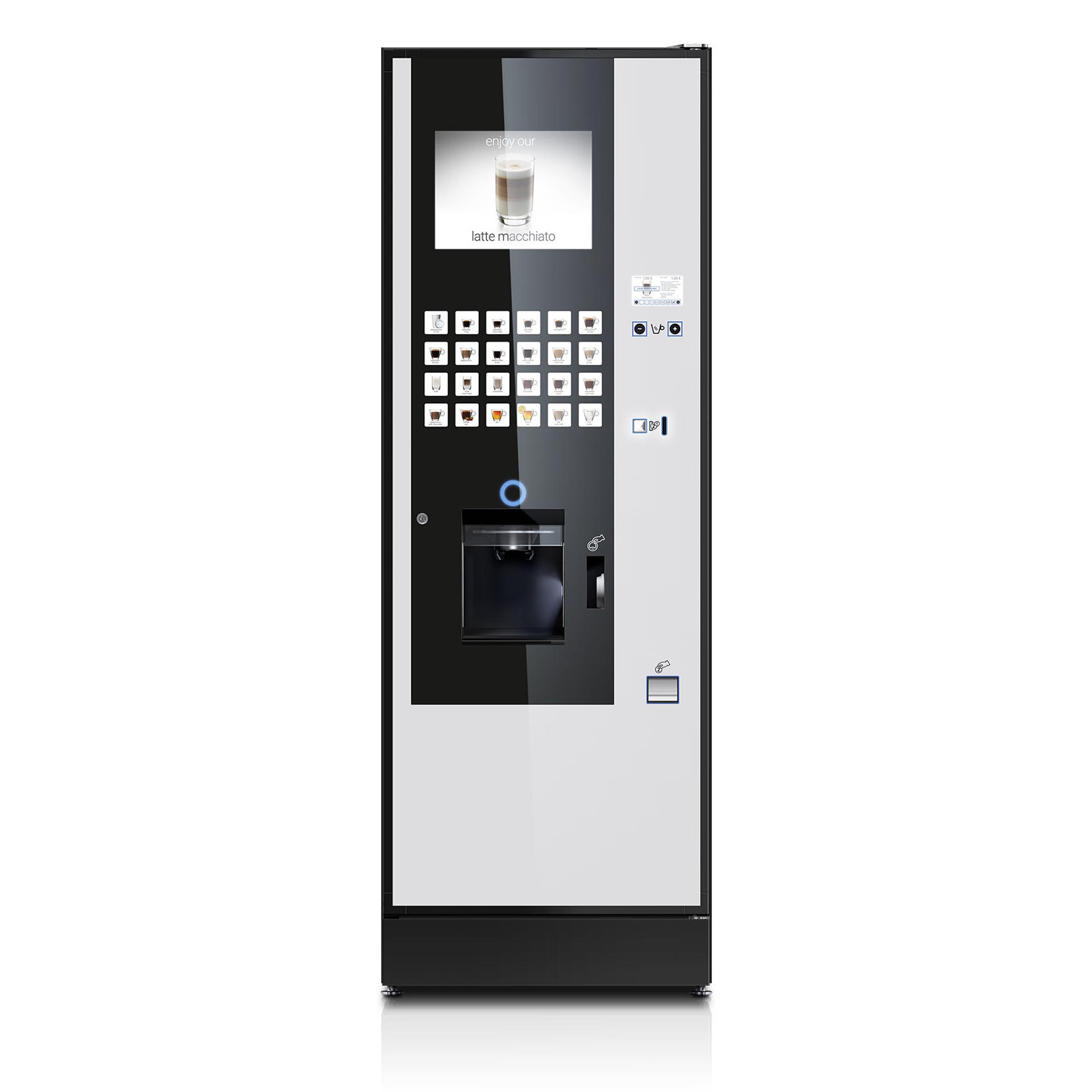
Melitta Cafina XT7

Melitta · Hot Drink Machines

Melitta Cafina XT7

8.3Very good

The Melitta Cafina XT7 is engineered for dense output peaks, not for a small location with low volume. The manufacturer specifies approximately 250 cups per day and 176 individual espressos per hour. Two grinding units, TopFoam for 2 milk types, an 8.4-inch touchscreen, CIP cleaning and optional telemetry form a robust feature set for hotels, bakeries or large self-service areas. The trade-offs remain substantial: 300 × 715 × 580 mm, 60 kg, 400 V, maximum 5700 W and daily cleaning demand prepared infrastructure and clear responsibilities. At approximately €13,000–16,000 net for the reviewed configuration, the machine is capital-intensive. Those not regularly requiring the stated capacity purchase expensive reserve capacity. Those using it should calculate accessories, service scope, water treatment and installation work as a complete bill of materials before placing an order.

ca. 13,000 – 16,000 €

No longer availableAnimo OptiBean XL Touch (V2)

Animo · Hot Drink Machines

Animo OptiBean XL Touch (V2)

8.6Very good

The Animo OptiBean XL Touch delivers 120 cups per hour, a 1.5 kg bean hopper, and dual instant modules, targeting mid-sized offices, clinics, and educational facilities with approximately 50+ employees. Strengths include high throughput, flexibility for multiple hot beverages, and a freely programmable 7-inch touchscreen. The optional MDB interface enables coin payment and change dispensing but is not standard-fit; cashless payment requires an additional module. Milk supply relies on instant powder only, which sets taste limits in clinical and premium office settings. List price in 2024 ranged from €4,060–4,470 net—for the machine alone without base unit or options. In comparison, the OptiBean offers a robust stainless-steel brew group with Ditting ceramic grinder, though telemetry is available only as an option without remote configuration. Service intervals align with practical use, requiring a maintenance kit after >25,000 vends. For high-volume sites dispensing ≥80 beverages daily, the investment yields mid-term returns; operators prioritising fresh-milk capacity, app payment, or remote service support will find broader feature sets in competing models.

ca. 4,064 – 4,468 €

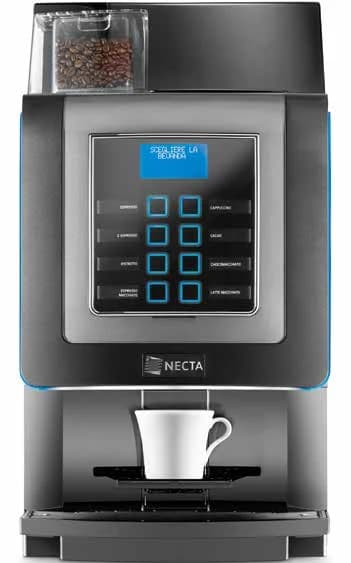
Necta Kalea Plus

Necta · Hot Drink Machines

Necta Kalea Plus

8.5Very good

200–250 beverages daily, fresh-milk system with automated cleaning and touch operation: The Necta Kalea Plus targets larger offices, canteens and breakfast areas in hotels and foodservice venues with 60 to approximately 150 staff or high-volume guests. Testing confirms the robust Z4000 brew group and modular architecture for beans, instant and milk; the telemetry-capable platform enables straightforward monitoring without add-on modules. Operators praise reliability (with consistent cleaning), rapid beverage dispensing and parts availability (German warehouse: 1–3 days). Weaknesses: daily milk-system cleaning (5–8 minutes, mandatory) cannot be skipped, and every 10,000 vends requires brew-group service—at maximum throughput, this means every 2–3 months. Acquisition cost ranges from €6,800 to €9,400 net; maintenance and consumables are material. For high-throughput sites with professional oversight, the model justifies itself through minimal downtime and predictable follow-on costs.

ca. 6,798 – 9,439 €