Skip to content
|Necta· Vending Machines (Evoca Group)

Necta Kalea Plus

8.5/ 10

Recommended

Data review — researched from sources, not physically tested. How we rate

Design & build8.3
Technology & features8.8
Operation & maintenance8.5
Capacity & range9.2
Value for money7.9
ca. 6,798 – 9,439 €

Guide prices net (excl. VAT), project prices may vary

  • Office, Hospitality / foodservice
  • Counter unit
  • Indoor
  • Coins

Eco label

ABCDE

Rated power consumption

3200 W

Power connection

230/240 V, 50/60 Hz, 15 A

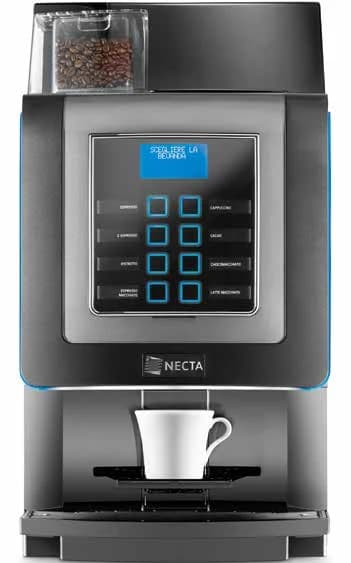
Necta Kalea Plus — Frontansicht · Quelle: kaffeevollautomaten.org

2 photos · Necta Kalea Plus

Use cases

Where this machine fits, and where it does not.

Best fit

Office 60–120 staff

150+ daily cup throughput and remote monitoring reduce care burden.

Best fit

Hotel & Foodservice

Fresh-milk cappuccino in 35 seconds, touchscreen self-service for guests.

Best fit

Canteen & Campus

Dual mills, rapid parts supply—minimizes downtime under peak load.

Conditional

Retail & Bakery

Compact for self-service zones, but daily cleaning and routine maintenance are mandatory.

Best fit

Hospital & Care

Automatic cleaning cycle meets hygiene standards.

Conditional

Catering & Lounge

Good for high-variety events, but verify peak power demand.

Not suitable

Factory & Workshop

❌ Dry indoor use only; no outdoor or humid deployment.

Our rating in detail

Five public rating axes, weighted against the available evidence.

Design & build
8,3 / 10
Technology & features
8,8 / 10
Operation & maintenance
8,5 / 10
Capacity & range
9,2 / 10
Value for money
7,9 / 10

Our verdict

8.5Very good

200–250 beverages daily, fresh-milk system with automated cleaning and touch operation: The Necta Kalea Plus targets larger offices, canteens and breakfast areas in hotels and foodservice venues with 60 to approximately 150 staff or high-volume guests. Testing confirms the robust Z4000 brew group and modular architecture for beans, instant and milk; the telemetry-capable platform enables straightforward monitoring without add-on modules. Operators praise reliability (with consistent cleaning), rapid beverage dispensing and parts availability (German warehouse: 1–3 days). Weaknesses: daily milk-system cleaning (5–8 minutes, mandatory) cannot be skipped, and every 10,000 vends requires brew-group service—at maximum throughput, this means every 2–3 months. Acquisition cost ranges from €6,800 to €9,400 net; maintenance and consumables are material. For high-throughput sites with professional oversight, the model justifies itself through minimal downtime and predictable follow-on costs.

At a glance

Model
Necta Kalea Plus
Manufacturer
Necta
Category
Hot Drink Machines
Type
Bean-to-Cup
Price range
ca. 6,798 – 9,439 €
Overall score
8.5 / 10
Origin
Necta (IT)

Pros & cons

Pros

  • Parts in Germany within 1–3 days (Kaffeetechnik-Shop.de, Liberty, Gerds-Coffeehome).
  • Z4000 brew platform: durable assembly rated to 10,000 vends between mandatory services.
  • Automatic milk-system cleaning cycle, 5–8 minutes, touch-guided operation without tools.
  • Daily output 200–250 beverages (manufacturer/trade), suited for high-traffic deployment without stalling.
  • Integrated WiFi & Bluetooth standard, real-time status without external telemetry box.
  • Dual mills enable simultaneous regular and decaf coffee, configuration selectable at purchase.

Cons

  • Boiler descaling reserved for technicians; no user interval or cost plan provided.
  • No factory cashless option, MDB coin module only per manual.
  • Used machines without documented service history carry risk (meter reset, wear items, locked state).
  • Brew-group maintenance required every 10,000 vends—at 150 cups/day, roughly every 2–3 months.

Review

Design & Build

368 mm width, 586 mm depth and 783 mm height per current manufacturer specifications for the Kalea Plus. Unlike many foodservice coffee machines, the unit stays well under one metre height; at 47 kg, however, it enters the category where single-person installation is not feasible. When the door opens, plan for 854 mm depth. Airflow requires minimum 40 mm clearance from the wall per spec—often overlooked in fitted cabinetry. Placement is strictly limited to dry indoor environments between 2 and 32 °C; outdoor stations or open foyers are ruled out, a common constraint for office and HoReCa ranges.

Notable is the control concept: a 7-inch touchscreen per German datasheet, tactile input across all functions. Beverage selection uses either ten direct-select buttons per screen or scrolling; screen count is undocumented as unlimited. Outlet height adjustment spans 75 to 170 mm, accommodating espresso cups and tall coffee mugs alike. Custom backgrounds and icons can be configured by the operator—automated voice prompts or gesture sensing are not documented.

Where add-on modules are planned, space must be allocated for optional refrigeration units and rolling undercabinets. For optional refrigerators, the manufacturer specifies 190 or 290 mm width. The option to mount the unit on mobile undercabinets of 700 or 1,000 mm width clearly targets flexible deployment or sites requiring cleaning access beneath the machine. A typical value-add in high-traffic offices with dedicated service staff.

Outer material quality remains open from datasheet review alone. Manufacturer specs emphasize technical build diagrams over cosmetic renderings. Visual inspection at delivery is therefore advised before acceptance, especially for bulk orders. Visible plastic components at the button panel or dispenser outlet represent typical wear risk in hospitality, though published experience reports from the review period remain sparse.

Operating weight and required maintenance clearance to sides and front determine real-world deployment: attempting to recess the machine into a cavity risks constraints during brew-group maintenance or milk-canister replacement. Product imagery shows black and silver finishes, with colour choice having no technical bearing. In summary, the Kalea Plus demands site survey before installation, particularly in confined spaces—operators often underestimate setup effort and service access requirements.
Technology & Functions

Two grinders with self-adjusting grind settings, each holding up to 1.2 kg bean capacity. The mills draw on the Z4000 brewing platform deployed across the Evoca Group, dispensing 7–14 g per brew cycle (ref. Necta, Datasheet 2024, p. 4). Powder preparation covers chocolate (1.8 kg), milk powder (0.75 kg) or instant barley (0.5 kg), depending on ordered configuration. Dual-bean plus instant-module operation eliminates peak-hour bottlenecks common to single-grinder setups at high-volume sites. Menu flexibility is confined to the hardware configuration at purchase—no runtime reconfiguration available.

The 7-inch touchscreen renders clearly and supports custom backgrounds and menu layout per manufacturer documentation (Datasheet 2024, p. 3). For shifting user populations such as hotel guests in breakfast areas, this guards against operator error. Beverage selection remains hardware-limited: only fitted product hoppers appear as available selections. Dispense height is electronically controlled, spanning 75 to 170 mm (German Datasheet L543D0, p. 3), restricting deployment at niche sites like grab-coffee services requiring oversized cups.

Milk delivery employs Necta's Milk PerFoamer system, sourcing fresh milk from external refrigeration units with separate temperature control. Connection to external refrigerators is mandatory; no built-in cooling exists (Datasheet 2024, p. 2, 4). Fresh-milk dispensing succeeds or fails entirely with this peripheral. A lockout function blocks milk delivery after shift-end if cleaning has not occurred—operator errors are thus trapped at the machine, though incomplete cleaning cycles remain unguarded.

Connectivity ships standard as WiFi and Bluetooth, documented in both datasheet and user manual. Telemetry is used for remote service alerting; complex remote steering or configuration changes over the internet are not implemented per available sources (Datasheet 2024, p. 4, German Datasheet L543D0, p. 2). Analogue logging, full-automatic inventory capture or alarm functions are absent. For operators without in-house support, this means: no complete remote operation, but at least status reporting and baseline data for service visits.

Payment is restricted to an optional MDB board with coin module and change-dispensing function (Original Manual H5035EN01, p. 65, 68–70, 88). Card or mobile payment are not factory options. Retrofit of cashless solutions remains the operator's responsibility and requires cost outlays plus mandatory coordination with equipment partners on protocol and interface grounds.

Boiler architecture: the Plus configuration operates one or two 800 cc stainless steel flow-heaters. Mixed-mode operation (coffee, hot water, milk) is possible; steam draw in the fresh-milk variant is explicitly documented as a special case with elevated standby power demand (Original Manual, p. 45). The brew group rests on a commercial piston-cylinder heat system and demands—unlike many foodservice machines—complete service every six months; sensing and fault alerts trigger the interval.

No proprietary features stand out. Rotary pump, touch interface and milk system have circulated in the Evoca lineup for years. The incoming operator receives proven technology, not disruptive innovation. Integration into building systems or legacy point-of-sale tills is subject to strict preconditions.

Capacity & Assortment

Two bean hoppers at 1.2 kg each—for many operators, this sets the ceiling. Capacity supports roughly 200 beverages daily per the official German datasheet; current international manufacturer specs cite comparable hopper and output figures without explicit cup count. Chocolate powder holds 1.8 kg per 2024 datasheet; barley instant allows 0.5 kg, milk powder up to 0.75 kg. The machine targets sites with sustained high demand, not typical office coffee setups for ten staff. Throughput under 100 cups pushes capital and fixed costs upward without benefit.

Whether office corridor, hotel breakfast area or canteen alcove: configurations scale freely between one and two espresso mills (ES), one or two instant containers (IN) and fresh-milk system. This is a purchase-time programming exercise, not a runtime operator function. Touchscreen menu logic permits ten direct selections per page with undocumented unlimited pages per German manufacturer spec. Distinct beverages—coffee, cappuccino, chocolate, espresso, optional barley coffee—deploy across near-arbitrary assortment breadth.

Daily output is widely specified by the manufacturer as 200 cups; distributor sites sometimes cite 250 cups/day without primary source reference. Operator accounts report realistic throughputs of 90 to 150 beverages per machine in office routine without stress. Dual-bean and instant configurations are mandatory at higher demand. The limiting factor often becomes fresh-milk refrigerator refill cycles and brew-group service intervals. By 150–180 cups/day, technically mandated maintenance engages every 2–3 months. At venues with sudden guest surges—breakfast hotels between 6:30 and 9:30 am—pre-service verification of all hoppers and grounds bin reserves is essential.

Small sites and decentralized branches are oversized by the Kalea Plus. The breadth of drink recipes and heavy fresh-milk focus justify investment only at meaningful utilization thresholds. Parallel regular and decaf coffee delivery via dual-mill configuration genuinely offers two bean types concurrently. The constraint: no reliable published volumes for filter coffee or cups exceeding 270 ml from either manufacturer or operators.

Bean-coffee plus instant-module combinations enable hybrid specialities; drink customization is bounded by programmed variants. Simple selection sequences are possible; spontaneous modifications such as swapping bean origin mid-dispensing are not available. Mid-tier large machines reveal: 200-cup/day capacity is the operative mark for operations of 60–120 staff, hotel breakfasts and small canteens. Single offices or sites below 30 daily drinks lack economic justification, leaving assortment potential untapped.

Operation & Maintenance

Daily mandatory routine: the automatic milk-system cleaning cycle runs after hours, requiring 5 to 8 minutes per manual. Insert cleaning tablet; the system executes autonomously. Without this step, the display blocks all milk beverages for the next day. Drip tray emptying and grounds bin removal belong to end-of-shift, as does outlet-area wiping. Manufacturer quotes 8 minutes total for complete daily cleaning, with milk-system work dominant. Above 100 milk drinks daily, Necta recommends running the program twice. Weekly, mixer and milk tubing warrant manual disassembly and sanitizing (roughly 20 minutes per manual).

Brew group and seals demand more attention than many peers. After each shift, the display prompts the brew-group wash (powder tablet plus rinse cycle). This is mandatory; skip it and coffee dispensing locks. Z4000 brew-group service falls due every 10,000 vends or six months, whichever comes first (see Manual p. 28–29). At 150 cups daily, service is thus due every 2–3 months. Seal-kit pricing ranges 5–15 EUR per spare-parts retailer; a complete replacement brew group stands at roughly 475–601 EUR plus labour (Gerds-Coffeehome.de).

Typical wear items like flow-meter sensors are individually stocked at approximately 94 EUR (Kaffeetechnik-Shop.de), with turnaround typically 1–3 working days. Self-service on these tasks saves the technician callout of roughly 80–120 EUR per visit. In practice, this is only economical with in-house workshop capacity or under service-contract arrangement. Deeper interventions like boiler descaling and hydraulic repairs are technician-reserved per manual; precise hourly rates and maintenance contract pricing are not publicly disclosed by Evoca or authorized partners such as ATW-Technik (atwtechnik.de/evoca-kundendienst/). No public fixed-price offering exists; operators must negotiate individually.

Service coverage is dense. Kalea Plus parts stock in Germany from at least three major distributors (Liberty Vertriebs GmbH, Gerds-Coffeehome.de, Kaffeetechnik-Shop.de) with typical 1–3 day lead times (Libertyshop.de). The Z4000 platform shares components across other Necta and Wittenborg lines, reducing downtime when standard parts suffice. Technician-only work is required for heating-system or boiler-descaling interventions.

Any missed mandatory cleaning triggers immediate menu lockouts. Flow-meter and "brew-group cleaning" faults are the most frequently cited error messages in operator forums (Kaffee-Netz). One operator documents concrete surcharge costs on same-day parts purchase plus quick recovery after replacement.

Used-machine buyers should demand clear maintenance records. Undocumented service history or aged password protection carry risk of unplanned downtime and extra technician costs. A maintenance contract is strongly recommended for mid to high throughput sites, since unscheduled service visits otherwise rapidly exceed budget.

Power & Energy

3,200 W peak draw. The Kalea Plus clearly sits in the high-power class for office and foodservice machines. The manufacturer specifies exactly 3,200 W peak at full load (source: Evoca Group Technical Datasheet 2024, p. 4), requiring a 230/240 V circuit at 15 A minimum. Single-phase, but not typical office-outlet consumption—operators must verify electrical supply and circuit protection. Beyond the scope of small tea kitchens.

Standby draw is differentiated in the user guide: espresso-only variant consumes 1,171 Wh per 24 hours; the Plus configuration with steam reaches roughly 2,400 Wh (source: Evoca Manual H5035EN01, p. 31). This translates to annual consumption of approximately 428 kWh (espresso only) to 876 kWh (espresso plus steam) on a full-day standby basis. Operators using Deep Sleep mode can schedule windows with reduced water temperature to cut standby loss; no concrete savings values are published. Cold-start warm-up to operating temperature requires 63 Wh for the standard configuration and 173.7 Wh including steam boiler. Time-to-ready in seconds or minutes is absent from the datasheet—operators must test per installation.

No sound-pressure data appears in any published primary document. Operator reports and forum posts remain silent on noise. Sensitive areas such as libraries or executive suites require pre-deployment trial.

Energy efficiency rating is not disclosed. Ecodesign metrics are entirely absent. Given 3,200 W connection rating, integration into building energy-monitoring workflows is advisable. At 200–250 daily outputs realistic for this model, the high base consumption spreads across many drinks. Under 60 daily cups in small operations, energy cost per beverage becomes significantly higher than at high-volume sites. Calculation must account for total context: power tariff, operating hours and actual utilization.

Direct-cooled milk systems and auxiliary refrigerators draw additional current. Datasheet figures do not address this. Heavy cleaning cycles or extended idle periods demand on-site empirical data—no published benchmarks exist from the maker. Operational deployment requires advance consultation with electrical specialists.

Price & Operating Costs

Net prices for the Necta Kalea Plus range 6,798.32 to 9,439.20 EUR by current quotes from Munich Coffee Company and ECM SanRemo. The black variant prices near 7,201 EUR net. Used display stock pieces trade below this, though service records and meter readings remain uncertain. Lease or instalment schemes exist in market at 150–250 EUR monthly on 3–5 year terms; all terms require individual negotiation. Not included in purchase price: refrigerator, installation, maintenance, water filter and consumables. Buyers should define all options pre-order and confirm in writing (see Munich Coffee Company – Kalea Plus 2 Mühlen + 1 Instant and ECM SanRemo – Kalea Plus 2ES + IN FM).

Sample 5-year total-cost calculation, 150 daily cups (37,500/year): Purchase price (midrange): ~8,120 EUR net. Installation/water filter/initial training: flat 800 EUR. Brew-group maintenance every 10,000 vends or 6 months: minimum 5–15 EUR seal-kit plus technician (~80–120 EUR hourly, frequency at 150 cups/day roughly every 2–3 months, details Kaffee-Netz – Kalea Plus Volumenzähler). Milk-system and brew-group cleaning tablets: 0.26 to 0.60 EUR/unit (current gross pricing hotcoffee.de). Replacement parts such as flow meter (~94 EUR/unit), brew group (475–601 EUR; Gerds-Coffeehome.de – Ersatzteile Necta Kalea Plus verifizierte Preise). Power draw (3,200 W peak, espresso standby 1,171 Wh/24 h, espresso + steam 2,400 Wh/24 h per manual, Evoca Kalea/Kalea Plus Originalanleitung – Seitenansicht). At assumed 13 cents/kWh and realistic usage, annual energy cost runs roughly 111–228 EUR.

Over five years, operator-only costs (excluding beans, milk and unplanned service) quickly total 10,000–13,500 EUR. This yields 13–18 cents fixed cost per drink for machine operation and maintenance alone, depending on utilization intensity. Raw materials such as beans and milk add individually per venue, café or hotel standard.

Drivers of running cost are cyclical maintenance (brew group, valves, seals), milk-system cleaning programs and quality-sensitive parts like flow meters. Boiler descaling falls outside user scope and generates unbudgeted technician charges. Used-machine purchases without maintenance documentation carry risk. After 5 years and 200,000 vends, unserviced machines may exit economic operation. Low-throughput deployment multiplies per-cup cost disproportionately. This calculation reflects 2026 baseline; spare-parts pricing may spike (all pricing and details: Munich Coffee Company – Kalea Plus 2 Mühlen + 1 Instant, ECM SanRemo – Kalea Plus 2ES + IN FM, Gerds-Coffeehome.de – Ersatzteile Necta Kalea Plus verifizierte Preise, Kaffee-Netz – Kalea Plus Volumenzähler).

Technical data

All recorded data points at a glance.

Use & operations

Use cases / locations
Office, Hospitality / foodservice
Installation type
Counter unit
Environment (indoor/outdoor)
Indoor

Payment & connectivity

Payment methods
Coins
Payment interface protocol
MDB (Multi-Drop Bus)
Telemetry / remote monitoring
Basic (sales/faults)
Connectivity
Wi‑Fi, Bluetooth

Technology

UI / display type
Touchscreen

Heißgetränke

Milk system
External chilled canister
Brewing technology
Combi (bean + instant)

Abmessungen & Gewicht

Dimensions (W × H × D)
368 × 783 × 586
Weight (unpacked)
47 kg
Rated power consumption
3200 W
Power connection
230/240 V, 50/60 Hz, 15 A

Kaffee-Technik

Mains voltage
230 V
Drink menu size
40
Approx. daily capacity
200 Tassen/Tag
Coffee dose range
7–14
Required water pressure
1,2–8,5
Pump pressure
20 bar
Bean hopper
2 × 1,2 kg
Heating system
Boiler

User reviews

Verified community reviews and clearly labelled external operator sources, separate from our 0–10 editorial score.

There are no confirmed community reviews for this model yet. You can submit your experience below.

Have experience with this machine?

Share your assessment. Your review helps other operators make purchasing decisions.

Share your experience with Necta Kalea Plus

4 / 5

0/5000 characters (min. 100)

Only your first name and selected use case will be shown publicly.

Useful Links and Documents

Further sources

  1. 1.Evoca Kalea/Kalea Plus Originalanleitung – Seitenansichtmanualslib.com/manual/2097612/Evoca-Kalea.html
  2. 2.Evoca Store – Kalea Plus Technical Manualstore.evocagroup.com/product/kalea-plus-technical-manual/01t7U000000pIJoQAM
  3. 3.Evoca Store – Kalea Plusstore.evocagroup.com/product/kalea-plus/01tSX000000dHbCYAU
  4. 4.Necta Pure Zone kitnecta.evocagroup.com/en/news-media/necta-news/news/necta-presents-new-pure-zone-kit-practical-and-immediately-effective
  5. 5.Evoca Group – Nectaevocagroup.com/en/our-brands/necta
  6. 6.Munich Coffee Company – Kalea Plus 2 Mühlen + 1 Instantmcc.ag/necta-kalea-plus-2-muehlen--1-instant
  7. 7.Munich Coffee Company – Kalea Plus Blackmcc.ag/necta-kalea-plus-black-2-muehlen--1-instant
  8. 8.ECM SanRemo – Kalea Plus 2ES + IN FMecmshop.de/p/necta-kalea-plus-2es-in-fm-festwasser-mit-heisswasserlanze
  9. 9.All4Vending – Kalea Plus ES + 2 INall4vending.de/product-ger-12722-Necta-Kalea-Plus-ES-2-IN-Festwasser-mit-Heisswasserlanze.html
  10. 10.Macatec – Kalea Plus Ausstellungsstückmacatec.com/produkt/necta-kalea-plus-vollautomat-mit-2-kaffeemuehlen/
  11. 11.Kaffee-Netz – Kalea Plus Volumenzählerkaffee-netz.de/threads/kalea-plus-volumenzaehler.153727/
  12. 12.Gerds-Coffeehome.de – Ersatzteile Necta Kalea Plus (verifizierte Preise)gerds-coffeehome.de/EVOCA/Necta-Kalea-Plus/
  13. 13.Kaffeetechnik-Shop.de – Volumenzähler Necta 94 EUR, 1–3 Tage Lieferzeitkaffeetechnik-shop.de/Ersatzteile/Ersatzteile-Gastromaschinen/Ersatzteile-Necta/
  14. 14.ATW-Technik – EVOCA-autorisierter Kundendienst Deutschlandatwtechnik.de/evoca-kundendienst/
  15. 15.Necta YouTube – Kalea Plus Daily Usage & Cleaningyoutube.com/watch?v=FmPDP0dot3c
  16. 16.Caffia Coffee Group – Necta Kalea Plus Bean To Cup And Fresh Milk (UK Distributor)caffia.com/product/necta-kalea-plus-coffee-machine/
  17. 17.hotcoffee.dehotcoffee.de/de/evoca-reinigungstabletten-gaggia-necta-wittenborg-962962-962962
Data review: AI-assisted research, editorially checkedLast checked: Redaktion AutomatenTests.deRating criteria documented transparently

Frequently asked questions about Necta Kalea Plus

What does a Necta Kalea Plus cost new?

Depending on configuration, 6,798 EUR to 9,439 EUR net (refrigerator, beans and installation separate). Used units start around 4,000 EUR; include maintenance and consumables in budget planning.

How often does the Kalea Plus brew group need servicing?

Per manufacturer, every 10,000 vends or six months maximum. At 150 daily cups, technician service with seal replacement is due roughly every 2–3 months (material 5–15 EUR, labour 80–120 EUR).

Is the cleaning program time-consuming?

Automatic milk-system cleaning runs 5–8 minutes daily after shutdown including tablet insertion and rinse. Budget additional time for drip tray and grounds bin. Weekly: mixer and tubing manual clean (~20 min).

Does the Kalea Plus accept contactless or card payment?

Factory spec covers MDB coin module only per manual; no standard cashless option. External card terminal retrofit is possible but adds cost and requires equipment-partner coordination.

Which sites are unsuitable for the Kalea Plus?

Outdoor or damp environments are ruled out by spec (dry indoors only, 2–32 °C). Irregular low-volume usage (under ~60 daily cups) becomes uneconomical due to service intervals and capital.

Franke A400

Franke · Hot Drink Machines

Franke A400

8.3Very good

The Franke A400 positions itself as a fully automatic coffee machine for medium commercial locations requiring up to 100 cups daily. Its CleanMaster system shortens daily cleaning to approximately 9 minutes and reduces manual effort to a minimum—a core argument for offices with 30 to 100 staff, cafes and self-service hotels. The FoamMaster variant delivers barista-level milk foam without requiring specially trained personnel. Capacity remains stable for constant use below the 100-cup threshold; sustained throughput beyond this level stresses grinding mechanisms and brew groups, shortening their operational life. Drawbacks include high acquisition costs in full configuration (up to €10,500) and regular service expenses. The Franke A400 amortizes within several years at high-traffic sites, provided that cleaning effort, service intervals and repair outages are factored into total cost of ownership. For sites requiring 120+ cups daily, upgrading to the larger A600 is recommended.

ca. 4,500 – 10,550 €

Melitta Cafina XT7

Melitta · Hot Drink Machines

Melitta Cafina XT7

8.3Very good

The Melitta Cafina XT7 is engineered for dense output peaks, not for a small location with low volume. The manufacturer specifies approximately 250 cups per day and 176 individual espressos per hour. Two grinding units, TopFoam for 2 milk types, an 8.4-inch touchscreen, CIP cleaning and optional telemetry form a robust feature set for hotels, bakeries or large self-service areas. The trade-offs remain substantial: 300 × 715 × 580 mm, 60 kg, 400 V, maximum 5700 W and daily cleaning demand prepared infrastructure and clear responsibilities. At approximately €13,000–16,000 net for the reviewed configuration, the machine is capital-intensive. Those not regularly requiring the stated capacity purchase expensive reserve capacity. Those using it should calculate accessories, service scope, water treatment and installation work as a complete bill of materials before placing an order.

ca. 13,000 – 16,000 €

No longer availableAnimo OptiBean XL Touch (V2)

Animo · Hot Drink Machines

Animo OptiBean XL Touch (V2)

8.6Very good

The Animo OptiBean XL Touch delivers 120 cups per hour, a 1.5 kg bean hopper, and dual instant modules, targeting mid-sized offices, clinics, and educational facilities with approximately 50+ employees. Strengths include high throughput, flexibility for multiple hot beverages, and a freely programmable 7-inch touchscreen. The optional MDB interface enables coin payment and change dispensing but is not standard-fit; cashless payment requires an additional module. Milk supply relies on instant powder only, which sets taste limits in clinical and premium office settings. List price in 2024 ranged from €4,060–4,470 net—for the machine alone without base unit or options. In comparison, the OptiBean offers a robust stainless-steel brew group with Ditting ceramic grinder, though telemetry is available only as an option without remote configuration. Service intervals align with practical use, requiring a maintenance kit after >25,000 vends. For high-volume sites dispensing ≥80 beverages daily, the investment yields mid-term returns; operators prioritising fresh-milk capacity, app payment, or remote service support will find broader feature sets in competing models.

ca. 4,064 – 4,468 €

Franke A600

Franke · Hot Drink Machines

Franke A600

8.7Very good

The Franke A600 positions itself as a versatile fully automatic coffee machine for demanding offices, canteens and large sites with daily demand of up to 200 cups. Through its 10.4-inch touchscreen, modular brew groups and a powerful milk system, the machine is designed for both attended dispensing and pure self-service. Businesses with 60 to 200 employees particularly benefit from the high hourly throughput (e.g. 240 espressos/hour) and central fleet management via FrankeConnect. Weaknesses lie in non-publicly accessible purchase prices in Germany for the new generation and in the complexity of cleaning with IndividualMilk or CleanMaster variants. The investment pays off for locations with a broad hot beverage range, high dispensing frequency and digitalized administration. In used condition, a classic A600 is available from approximately 4,000 € net; for the current generation, German dealers do not quote list prices. The range stated here of approximately 9,700 to 10,800 € comes from two British dealers, applies to the classic A600 and has been converted at the ECB reference rate. Lower total cost of ownership results primarily through central control and reduced downtime during malfunctions or service.

ca. 8,500 – 10,809 €