Design & Construction
At 350 mm width, 774 mm height and 650 mm depth, the Melitta Cafina C35 occupies significantly less floor space than many large fully automatic machines, yet remains a substantial unit. The empty weight of approximately 60 kg without the milk cooler demands a load-bearing surface—the work surface must support a minimum load of 100 kg according to the manufacturer. Users of the optional 4 l milk cooler must allow an additional 150 mm width: device and cooler together occupy roughly half a metre in width. The surrounding area requires 180 mm clearance above to allow the bean hopper to be refilled. Examination of the construction reveals: the machine is consistently engineered for professional environments such as hospitality, catering or corporate canteens and is less suitable for portable placement.
The exterior uses primarily metal and robust polymers. Materials and fasteners are built for extended continuous operation. Compared to lower-cost fully automatic machines, the workmanship appears less playful but functional. Notable: the four levelling feet beneath the C35 can be adjusted to compensate for floor differences up to 76 mm. This eases installation on uneven surfaces, but is unlikely to be fully utilized in many existing cafeterias. Maintenance and service access were clearly considered in the design: the manual explicitly requires positioning the device so that service technicians have unrestricted access to all sides. Those integrating the machine into a counter or furniture installation must account for this during planning.
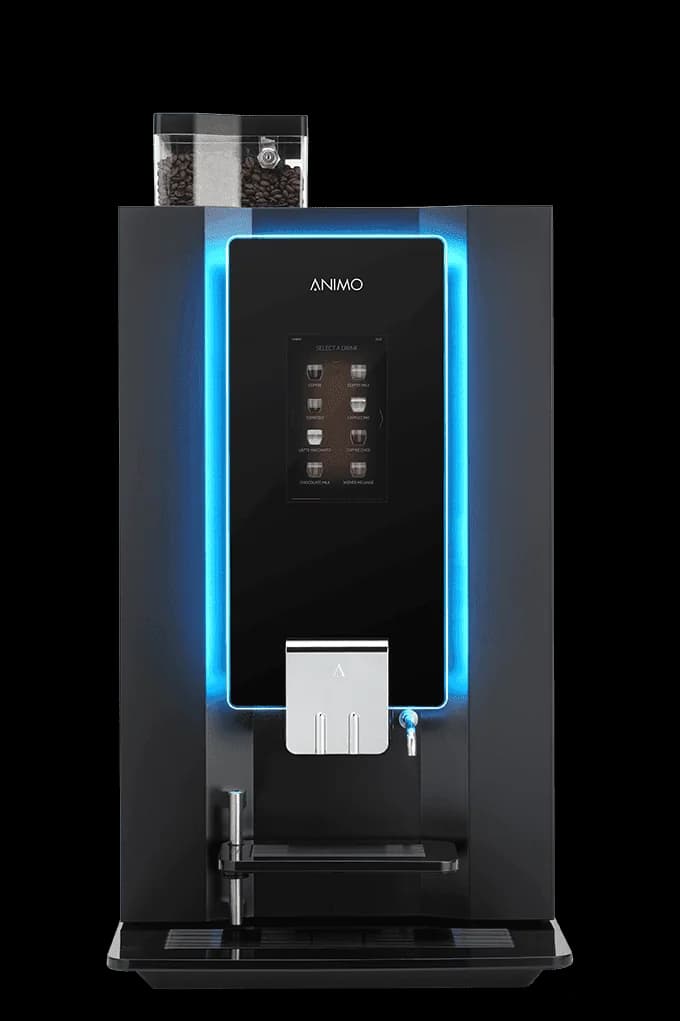
The touchscreen TFT colour display is centrally recessed into the front and is standard according to the brochure. Up to ten beverages can be directly tapped on each screen page, with additional products organized across multiple pages. Unlike some HMI solutions, no button press or dial is required. This reduces wear parts but assumes staff or guests are comfortable with touchscreen operation. Display programmability is highlighted in the documentation: operators can integrate custom beverage pages, price lists and service messages. A USB port on the machine allows modification and updating of the user interface—while not essential for purely analogue locations without IT connectivity, it makes sense for larger systems with changing product assortments.
Internal material quality is difficult to assess without device inspection, but manufacturer specifications reference stainless steel grinding discs and low-wear drives. The entire construction reflects the goal of operating several years without significant repairs. However, a residual risk remains for smaller deployment sites: the form factor and required infrastructure (400 V connection, 16 A, fixed location, access on all sides) make the C35 unattractive for flexible locations or changing installation positions. On cramped counters or in tight break rooms, size, connection and maintenance access are not straightforward.
The clearly segmented front, few operating elements and the ability to freely position the display and service access primarily serve professional operators who must minimize service time and downtime risk. Those who value quick visibility of fill levels, clearly traceable button assignment and straightforward access will find a capable, though not fault-forgiving work machine here. Shortcomings in ergonomics for infrequently changing staff or spontaneous user configuration remain—the concept prioritizes continuous operation over ease of use. All figures and facts cited are based on manufacturer specifications and original operating manuals and brochures from 2010 onwards (cf. Cafina c35 Original Operating Instructions EN; Melitta c35 Prospekt DE, 04/2010).