Skip to content
|WMF· Professional Coffee Machines

WMF 1500 S+

8.0/ 10

Recommended

Data review — researched from sources, not physically tested. How we rate

Design & build7.8
Technology & features9.0
Operation & maintenance8.5
Capacity & range7.5
Value for money7.0
ca. 9,490 – 10,167 €

Guide prices net (excl. VAT), project prices may vary

  • Office, Hotel, Healthcare
  • Tabletop
  • Indoor
  • Closed-loop card/key, Contactless (NFC), Mobile wallet (Apple/Google Pay), QR code

Eco label

ABCDE

Energieklasse

C

WMF 1500 S+ — Frontansicht · Quelle: assets.wmf-coffeemachines.com

6 photos · WMF 1500 S+

Use cases

Where this machine fits, and where it does not.

Best fit

Office 50–200 persons

80–130 cups/day cover mid-size employee populations without capacity constraints.

Best fit

Canteen & Campus

Dynamic Milk and 10-inch touchscreen reduce training effort for changing staff.

Best fit

Hotel & Hospitality

Operation below 70 dB(A) and cold-foam capability suit upmarket restaurant and breakfast environments.

Conditional

Petrol station & Convenience

Suitable for 24/7 operation, but a maintenance contract with guaranteed response time is recommended.

Conditional

Pharmacy & Medical practice

HACCP protocol exportable via USB; AutoClean facilitates hygiene documentation for teams up to approximately 30 persons.

Not suitable

Industrial kitchen 300+ persons

❌ 180 cups/day insufficient for high throughput requirements; WMF 5000 S+ or dual-machine setup recommended.

Our rating in detail

Five public rating axes, weighted against the available evidence.

Design & build
7,8 / 10
Technology & features
9,0 / 10
Operation & maintenance
8,5 / 10
Capacity & range
7,5 / 10
Value for money
7,0 / 10

Our verdict

8.0Very good

180 cups daily, a 10-inch colour display, and three selectable milk systems: the WMF 1500 S+ positions itself in the upper segment of commercial tabletop machines for locations with 50 to 200 employees. The key differentiator is Dynamic Milk, which delivers four hot foam consistencies, three cold foam variations, and cold foam without modification or system changeover (manufacturer specification, brochure p. 2). With the optional AutoClean, daily cleaning effort drops to approximately 5 minutes. CoffeeConnect is included as standard according to the current WMF brochure and enables remote access to machine data. Acquisition cost ranges from EUR 9,635 to EUR 10,167 net depending on configuration (August 2026). Operators should plan for two factors: the manufacturer's specification of 180 cups daily applies only without cleaning pauses; in office operation with morning and lunch-time peaks, 80 to 130 cups daily is the realistic planning figure. Additionally, a documented software malfunction exists in which the display reverts to text view; restart resolves the issue. For mid-size office locations and upmarket hospitality operations with professional service requirements, the 1500 S+ offers a solid cost-benefit profile.

At a glance

Model
WMF 1500 S+
Manufacturer
WMF
Category
Hot Drink Machines
Type
Bean-to-Cup
Price range
ca. 9,490 – 10,167 €
Overall score
8.0 / 10
Origin
WMF (DE)

Pros & cons

Pros

  • AutoClean automatically dispenses cleaning agent; daily manual effort reduces to emptying the drip tray and wiping the outlet, approximately 5 minutes.
  • Dynamic Milk delivers four hot foam consistencies, three cold foam variations, and cold foam without modification or system changeover (manufacturer specification, brochure p. 2).
  • Spare parts (brew group seal kits from EUR 15) available from German specialist retailers with 2 to 5 working days' delivery; WMF service network comprehensive across DACH.
  • CoffeeConnect standard: beverage counters, fill levels, and error codes retrievable via web dashboard without on-site inspection.
  • Noise level below 70 dB(A) according to operating manual; acoustically acceptable in busy office and restaurant environments.

Cons

  • Acquisition cost EUR 9,635 to EUR 10,167 net (August 2026) in the upper office segment; Dynamic Milk and AutoClean increase price relative to base configurations further.
  • Documented software malfunction: display reverts to text view after error; restart resolves the issue, permanent solution via software update not confirmed.
  • 180 cups daily achievable only without cleaning pauses; for office operation, 80 to 130 cups is the realistic planning figure.

Review

Design & Build: Compact Tabletop Unit with 10-Inch Touch Display

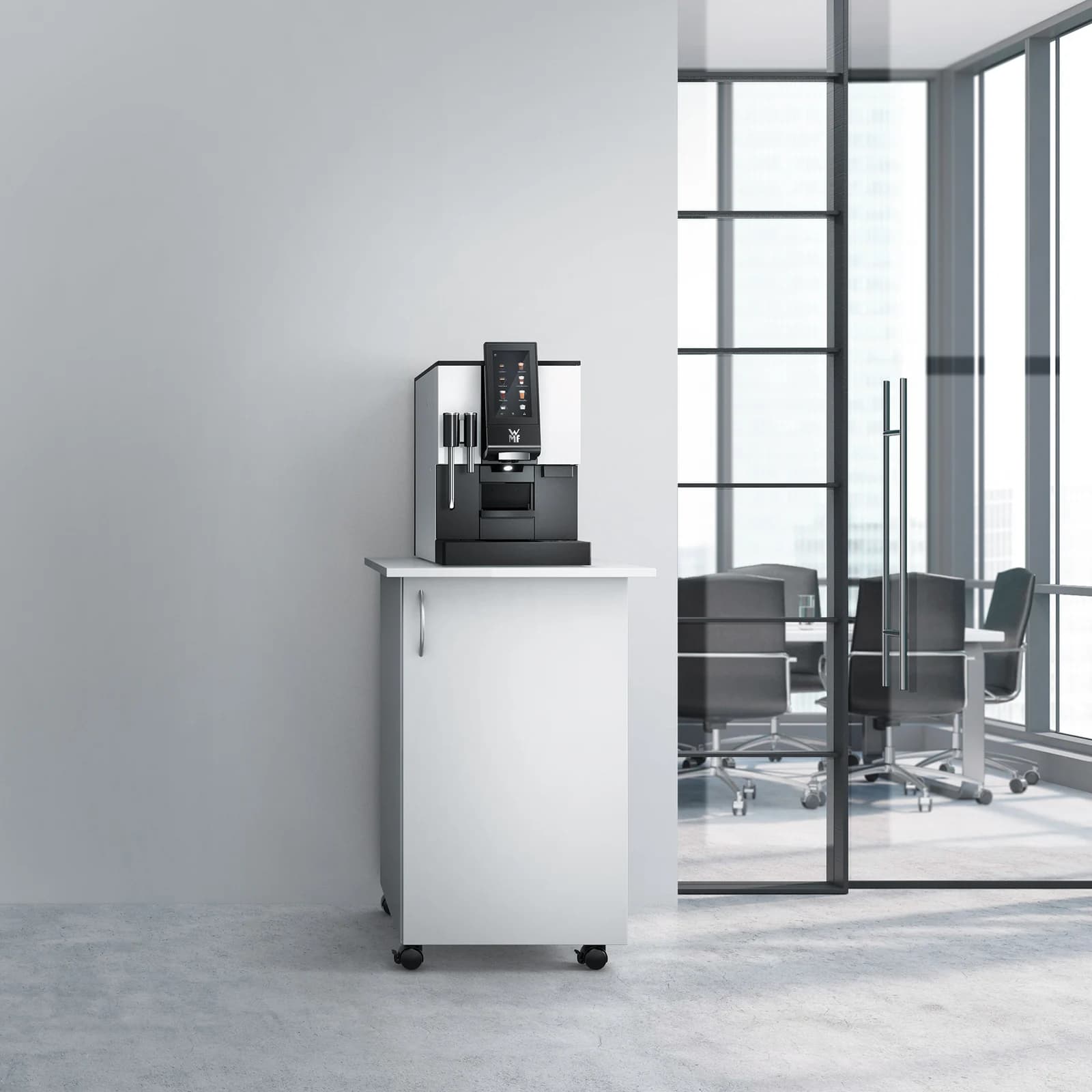
325 mm wide, 716 mm high, 590 mm deep: the WMF 1500 S+ is designed for counters and service areas in office kitchens, canteens, and hotel restaurants. Empty weight ranges from 32 to 36 kg depending on configuration; a second person is advisable for initial installation. The housing follows the commercial WMF design line with straight lines, rounded edges, and matte metallic finish.

Centrally positioned on the front is the colour 10-inch touchscreen display. It displays graphical beverage buttons as well as all settings access points. Administrators can configure visible beverage buttons, assign access permissions, and divide the machine into user profiles. Those managing different cost centres can enable or disable beverage categories separately.

Bean hoppers are located on top of the machine: left and right, approximately 1,100 g each; an optional centre hopper approximately 700 g. An optional lockable powder hopper holds approximately 2,000 g for instant coffee or cocoa. Locking reduces unauthorised access in shared areas.

Minimum clearances according to the operating manual: 50 mm on the sides and rear for ventilation and accessibility; at least 200 mm clearance above the bean hoppers for filling. The installation surface should be at least 850 mm above floor level; the work area in front of the machine at least 800 mm. These requirements are readily achievable in typical office kitchens and canteens.

The connection options are practical: the 4.5-litre water tank covers locations without mains water connection; with mains water, daily refilling is no longer needed. Both variants fit the same housing. The power connection requires 220 to 240 V, 50/60 Hz, single-phase (1/N/PE), which corresponds to a standard Schuko installation with 16 A circuit breaker. No three-phase power required.

The brew chamber holds 15 g, sufficient for double espresso and large café crème portions. The cup rack is height-adjustable for cup sizes from espresso to latte macchiato. The optional cup sensor automatically detects cup size and adjusts the outlet position; this reduces splashing with small espresso cups. Overall, the design is timeless and functional, with no distinctive visual differentiation from other WMF commercial machines of this generation.
How Capable Is the WMF 1500 S+ Milk System?

Dynamic Milk is the technological centrepiece of this product line. The system produces four different hot milk foam consistencies, three cold milk foam variations, as well as hot and cold milk without modification or system changeover (manufacturer specification, brochure p. 2, not independently verified in field testing). In combination with the optional 2-milk solution, two milk types or plant-based alternatives can be offered simultaneously. For offices with growing demand for oat milk cappuccino, this is direct added value.

Dynamic Coffee Assist monitors brew flow in real time and automatically corrects grind size and coffee quantity for deviations (manufacturer specification, brochure p. 4). Bean variety changes or humidity fluctuations require manual adjustments at the grinder less frequently.

CoffeeConnect is included as standard according to the current WMF brochure. The platform transmits beverage counters, fill levels, cleaning status, and error codes to a web-based dashboard. For fleet operators with multiple machines, this enables central overview without on-site inspection. Connection is via Wi-Fi; a wired LAN option is not mentioned in published documentation.

AutoClean is available as an option. The system automatically dispenses cleaning agent for coffee and milk systems and starts the cleaning cycle on command or automatically in the evening. For locations with changing service staff, this is a relevant operational advantage.

Additional optional expansions: Cup Sensor (three modes: dispensing lock without cup, automatic outlet positioning, size-dependent beverage display), Fresh Filtered Coffee (filters espresso and café crème of oils and sediments), syrup station (up to four syrups, fruit purées, or spirits with three dosage quantities each). These options must be configured at order time and cannot be retrofitted later without a technician.

Brew temperature and brew pressure are adjustable in the machine; WMF does not provide public standard values in the documentation. The grinder comprises ceramic discs; type and diameter are not specified in published documentation. During the annual inspection, the technician checks the grinder condition and adjusts as needed.

Payment systems and telemetry protocols (MDB, EVA-DTS): No specific protocol versions for external cashier connections are mentioned in public documentation. Operators planning external payment integration should clarify this directly with WMF or an authorised dealer.

Capacity: What Does 180 Cups Daily Really Deliver?

180 cups daily is WMF's manufacturer specification. This figure applies with continuous use without cleaning pauses, thus under conditions that rarely occur in office operation. In typical office rhythms with morning peak (7 to 9 a.m.) and post-lunch demand spike (12 to 2 p.m.), 80 to 130 cups daily is the realistic planning figure. This difference is not a machine deficiency, but rather the natural result of operational pauses, cleaning intervals, and demand curves.

For an office with 100 employees and consumption of 1.2 to 1.5 cups per person daily, this totals 120 to 150 cups. The 1500 S+ covers this demand comfortably without capacity constraints. Only at 200 persons with 1.5 cups daily, totalling 300 cups, would a WMF 5000 S+ or a second machine be more suitable.

The bean hoppers left and right hold approximately 1,100 g each; the optional centre hopper approximately 700 g. At 8 to 10 g coffee grounds per dispensing and 100 cups daily, one fill suffices for a full operating day without refilling. With intensive breakfast periods of 50 dispensings in quick succession, reserve remains in the afternoon.

The operator chooses the water supply: the 4.5-litre tank covers approximately 30 to 40 water-intensive dispensings before refilling is required. With mains connection, this step is permanently eliminated. For carbonate hardness above 5 °dKH, the operating manual requires an upstream WMF water filter 200 (EUR 26.50 net).

The brew chamber holds 15 g and enables double espresso without compromise. Beverage range: espresso, café crème, cappuccino, coffee with milk, latte macchiato, milk foam, hot water. With Dynamic Milk, hot and cold milk as well as cold foam are added. The optional chocolate module adds hot chocolate and mocha to the range without a second machine.

The optional powder hopper with approximately 2,000 g capacity enables instant beverages such as tea or herbal infusions. For canteens requiring a broad range from a single compact machine, the combinability of these options is the relevant planning point.

Cleaning and Maintenance in Daily Operation

Approximately 5 minutes daily: this summarises cleaning requirements with AutoClean enabled. The cleaning cycle starts automatically in the evening or on command, automatically dispenses cleaning agent and takes approximately 2 to 3 minutes. Staff must empty the drip tray and grounds container and wipe the milk outlet externally.

Without AutoClean, daily effort increases significantly: the milk system must be manually sanitised after the last milk beverage of the day. The HACCP cleaning procedure prescribes this. The operating manual contains a dedicated HACCP chapter; the protocol can be exported via USB, which is relevant for quality documentation in hospital or industrial kitchen environments.

Weekly maintenance adds 15 minutes: Remove milk tubing and soak in cleaning solution for 10 to 15 minutes (no tools required), wipe the brew group shaft, check powder hopper for residual moisture.

Descaling intervals depend on water hardness. The machine displays descaling requirement on screen. With hard tap water and no filtration, this may occur after approximately 3 months; with WMF water filter and soft water, 6 months or longer may pass between cycles. The process runs automatically after insertion of WMF liquid descaler (0.7-litre bottle, EUR 7.63 net).

Service technician maintenance: WMF recommends annual inspection. During this, seals and O-rings of the brew group are checked and replaced, the grinder is adjusted and all safety-relevant parameters verified. In practice, a WMF-certified technician service call with full maintenance typically costs EUR 250 to EUR 400 (estimate based on forum reports for WMF commercial machines on the same service platform).

Spare parts are readily available from German specialist retailers: brew group seal kits from EUR 15 to EUR 50 at Caffe-Limes and kaffeevollautomat-gebraucht.de. Delivery times in Germany: 2 to 5 working days. WMF offers maintenance contracts with 5- or 7-year terms with contractually defined response times and monthly instalments. List prices are not public; inquiry directly with WMF dealer is required.

Power Consumption, Noise Level, and Connection Requirements

Rated power: 2.75 to 3.25 kW according to the operating manual (print page 129), 2.75 to 3.5 kW according to current brochure. The differing upper limit is not explained in published documentation. For circuit protection planning: use the higher figure (3.5 kW). A Schuko socket with 16 A circuit breaker is sufficient; a dedicated circuit for the machine is recommended for this power class.

Continuous sound pressure level at the workplace is below 70 dB(A) according to the operating manual. Normal conversation is approximately 60 dB(A); a quiet office approximately 40 dB(A). The machine is thus acoustically acceptable in busy office environments, restaurant areas, and canteens. Grinding noise during dispensing is barely noticeable in typical ambient noise.

Eco mode: 10 minutes after the last beverage dispensing, the machine automatically lowers the steam boiler temperature. Automatic shutdown can be set to 30, 60, 90, 120, 150, or 180 minutes, which is adaptable to individual office opening hours. From the lowered eco mode, milk beverages require approximately 15 seconds warm-up time.

WMF does not provide an absolute standby consumption figure in any public document. No energy label for this machine was found in researched sources. For precise annual consumption, socket measurement during actual operation is recommended.

Water connection: flow pressure must be between 2 and 6 bar (measured at 2 l/min). For values above 6 bar, a pressure reducer must be installed upstream according to the operating manual. For mains water and carbonate hardness above 5 °dKH, a WMF water filter 200 is mandated.

Operating temperature: +5 to +35 °C, maximum 80 % relative humidity without condensation. Indoor use only; outdoor installation is not permitted according to the operating manual. For petrol station interiors without air conditioning, the upper limit of +35 °C during high summer is a relevant planning consideration.

Rough calculation for a 100-person location with 120 cups daily and 220 operating days: At approximately 40 % operational load and 8 operating hours, daily consumption is approximately 2 to 3 kWh. This equates to approximately 440 to 660 kWh annually, thus approximately EUR 88 to EUR 132 in electricity costs at EUR 0.20/kWh. Not a manufacturer-measured figure.

What Is the 5-Year Total Cost of Ownership?

Four current new machine offers (August 2026) show a net price range of EUR 9,635 to EUR 10,167:

Coffeefair Easy Milk: EUR 11,465.95 gross / 1.19 = EUR 9,635 net.

Sterling Exclusive Easy Milk: EUR 11,469.01 gross / 1.19 = EUR 9,638 net.

Kaffee Online Kaufen Basic Milk: EUR 11,899.00 gross / 1.19 = EUR 9,999 net.

Kaffee Online Kaufen Easy Milk: EUR 12,099.00 gross / 1.19 = EUR 10,167 net.

The price range primarily reflects the milk system and optional packages such as AutoClean. Configurations with Dynamic Milk and 2-milk solution are higher; transparent list prices for these are not public. Fully refurbished machines are available from AVB-Shop from approximately EUR 3,200 net. Leasing starts at approximately EUR 168 monthly according to Kaffeetechnik24 for the entry configuration.

Running costs with WMF original products (August 2026): Coffee cleaning tablets 1.3 g: EUR 19.48 net per 100 pieces. Milk system cleaner for AutoClean: EUR 24.48 net per 2-litre bottle. Liquid descaler: EUR 7.63 net per 0.7-litre bottle. Water filter 200 (tank version): EUR 26.50 net. Consumables total approximately EUR 60 to EUR 90 annually at 100 cups daily and 220 operating days.

Coffee beans: At 8 g per dispensing and 22,000 cups annually, approximately 176 kg of green coffee are consumed. Budget roast (approximately EUR 8/kg) yields EUR 1,408 annually, approximately EUR 0.06 per cup. Premium roast (approximately EUR 18/kg) yields EUR 3,168, approximately EUR 0.14 per cup.

Service costs: annual inspection EUR 250 to EUR 400; grinder overhaul every 2 to 4 years EUR 200 to EUR 400; brew group seal kit every 12 to 24 months EUR 15 to EUR 50. Over 5 years, maintenance costs including spare parts are approximately EUR 1,800 to EUR 3,000.

Five-year total cost of ownership (example: 22,000 cups/year, budget roast): Acquisition approximately EUR 9,635 plus beans EUR 7,040 plus cleaning consumables approximately EUR 450 plus maintenance EUR 2,400 totals approximately EUR 19,525, corresponding to approximately EUR 0.18 per cup. With premium roast, the per-cup cost rises to approximately EUR 0.29. A WMF maintenance contract spreads inspection costs over monthly instalments; list prices are not public and should be requested directly from the dealer.

Technical data

All recorded data points at a glance.

Use & operations

Use cases / locations
Office, Hotel, Healthcare
Installation type
Tabletop
Environment (indoor/outdoor)
Indoor

Payment & connectivity

Payment methods
Closed-loop card/key, Contactless (NFC), Mobile wallet (Apple/Google Pay), QR code
Payment interface protocol
MDB (Multi-Drop Bus)
Payment features
Offline mode / store&forward, Refunds, Remote price updates
Telemetry / remote monitoring
Full (sales+stock+remote)
Connectivity
Ethernet/LAN, Wi‑Fi, Cellular 4G/LTE

Technology

Sensors
Cup sensor, Bean level, Flow meter
UI / display type
Touchscreen

Service & compliance

Age verification
Not required
Price segment
Premium

User reviews

Verified community reviews and clearly labelled external operator sources, separate from our 0–10 editorial score.

There are no confirmed community reviews for this model yet. You can submit your experience below.

Have experience with this machine?

Share your assessment. Your review helps other operators make purchasing decisions.

Share your experience with WMF 1500 S+

4 / 5

0/5000 characters (min. 100)

Only your first name and selected use case will be shown publicly.

Useful Links and Documents

Further sources

  1. 1.WMF 1500 S+ – offizielle Produktseite DEwmf-coffeemachines.com/de_de/produkte/kaffeevollautomaten/wmf-1500-s-plus/
  2. 2.WMF 1500 S+ – Spezifikationen und Downloadswmf-coffeemachines.com/de_de/produkte/kaffeevollautomaten/wmf-1500-s-plus/spezifikationen/
  3. 3.WMF 1500 S+ Produktseite ENwmf-coffeemachines.com/en_us/products/fully-automatic-coffee-machines/wmf-1500-s-plus/
  4. 4.Coffeefair – WMF 1500 S+ Wassertank Basic Milkcoffeefair.de/wmf-kaffeevollautomat-1500-s-mit-wassertank-2-muehlen-basic-milk-mit-choc-topping-modul-basicsteam-sondermodell-1/a-57544
  5. 5.Coffeefair – WMF 1500 S+ Festwasser Easy Milkcoffeefair.de/wmf-kaffeevollautomat-1500-s-mit-festwasseranschluss-2-muehlen-easy-milk-mit-choc-topping-modul-basicsteam-sondermodell-3/a-57546
  6. 6.Idealo – WMF 1500 S+ Preisvergleichidealo.de/preisvergleich/OffersOfProduct/201301021_-1500-s-wmf.html
  7. 7.Sterling Exclusive – WMF 1500 S+ Easy Milksterlingexclusive.com/products/wmf-1500-s-2-muehlen-1-pulverdosierer-0319205100
  8. 8.Kaffee Online Kaufen – WMF 1500 S+ Basic Milkkaffee-online-kaufen.com/products/wmf-1500-s-festwasser-2-muhlen-basic-milk-basic-steam
  9. 9.Kaffee Online Kaufen – WMF 1500 S+ Easy Milkkaffee-online-kaufen.com/products/wmf-kaffeevollautomat-1500-s-festwasser-2-mhlen
  10. 10.Kaffeetechnik24 – WMF 1500 S+ Easy Milk, Leasingkaffeetechnik24.de/shop/wmf-professional/wmf-1500-s-festwasser-mit-2-muehlen-und-schokopulver-mit-easy-milk-kaufen-oder-leasen/
  11. 11.WMF Shop – Reinigungstabletten Kaffee 1,3 g, 100 Stück, 19,48 EUR nettoshop.wmf-coffeemachines.com/de_de/special-cleaning-tablets-coffee-1-3g
  12. 12.WMF Shop – Milchsystemreiniger AutoClean 2 l, 24,48 EUR nettoshop.wmf-coffeemachines.com/de_de/wmf-milchsystemreiniger-fur-autoclean
  13. 13.WMF Shop – Flüssigentkalker 0,7 l, 7,63 EUR nettoshop.wmf-coffeemachines.com/de_de/wmf-flussigentkalker
  14. 14.WMF Shop – Wasserfilter 200, 26,50 EUR nettoshop.wmf-coffeemachines.com/catalog/product/view/id/27/s/wmf-wasserfilter-200/
  15. 15.Caffe Limes – Ersatzteile Brühgruppe WMF 1500Scaffe-limes.de/zubehoer-ersatzteile/ersatzteile-kaffeevollautomaten/wmf/wmf-1500s/bruehgruppe/
  16. 16.AVB – generalüberholte WMF 1500 S+ Basic Milkavb-shop.com/products/wmf-1500s-plus-kaffee-vollautomat-service-neu
Data review: AI-assisted research, editorially checkedLast checked: Redaktion AutomatenTests.deRating criteria documented transparently

Frequently asked questions about WMF 1500 S+

How often must the WMF 1500 S+ milk unit be cleaned?

Daily: the AutoClean cycle starts automatically after operating hours and takes approximately 2 to 3 minutes. Without AutoClean, the milk system must be manually sanitised after the last milk beverage of the day per HACCP procedure. Weekly: remove milk tubing and soak in cleaning solution for 10 to 15 minutes, no tools required. For more than 100 milk beverages daily, running the daily cleaning cycle twice is recommended.

How realistic is the manufacturer's specification of 180 cups per day?

The 180 cups apply with continuous use without cleaning pauses. In office operation with typical morning peaks (7 to 9 a.m.) and post-lunch period (12 to 2 p.m.), 80 to 130 cups daily is the more realistic planning figure. An office with 100 persons at 1.2 cups per person totals 120 cups, which the 1500 S+ handles comfortably. For canteens and hotels with continuous operation, the manufacturer's specification is achievable.

What is the cost of an annual inspection for the WMF 1500 S+?

A WMF-certified technician service call with full maintenance, seal kits, and adjustment typically costs EUR 250 to EUR 400 (estimate based on forum reports for WMF commercial machines on the same service platform; WMF's own list prices are not public). WMF offers maintenance contracts with 5- or 7-year terms that spread inspection costs over monthly instalments and define response times contractually.

Does the WMF 1500 S+ support two different milk types simultaneously?

Yes, with the optional 2-milk solution and Dynamic Milk, two different milk types or plant-based alternatives can be offered simultaneously (manufacturer specification, brochure p. 2, not independently verified in field testing). This is relevant for locations with mixed populations requiring both animal and plant-based milk for speciality beverages. Configuration must be specified at order time.

Can the WMF 1500 S+ be monitored remotely?

CoffeeConnect is included as standard according to the current WMF brochure and transmits beverage counters, fill levels, cleaning status, and error codes to a web-based dashboard. For fleet operators with multiple machines, this enables central overview without on-site inspection. Connection is via Wi-Fi; a wired LAN option is not mentioned in published documentation and should be clarified with WMF.

Franke A400

Franke · Hot Drink Machines

Franke A400

8.3Very good

The Franke A400 positions itself as a fully automatic coffee machine for medium commercial locations requiring up to 100 cups daily. Its CleanMaster system shortens daily cleaning to approximately 9 minutes and reduces manual effort to a minimum—a core argument for offices with 30 to 100 staff, cafes and self-service hotels. The FoamMaster variant delivers barista-level milk foam without requiring specially trained personnel. Capacity remains stable for constant use below the 100-cup threshold; sustained throughput beyond this level stresses grinding mechanisms and brew groups, shortening their operational life. Drawbacks include high acquisition costs in full configuration (up to €10,500) and regular service expenses. The Franke A400 amortizes within several years at high-traffic sites, provided that cleaning effort, service intervals and repair outages are factored into total cost of ownership. For sites requiring 120+ cups daily, upgrading to the larger A600 is recommended.

ca. 4,500 – 10,550 €

Melitta Cafina XT7

Melitta · Hot Drink Machines

Melitta Cafina XT7

8.3Very good

The Melitta Cafina XT7 is engineered for dense output peaks, not for a small location with low volume. The manufacturer specifies approximately 250 cups per day and 176 individual espressos per hour. Two grinding units, TopFoam for 2 milk types, an 8.4-inch touchscreen, CIP cleaning and optional telemetry form a robust feature set for hotels, bakeries or large self-service areas. The trade-offs remain substantial: 300 × 715 × 580 mm, 60 kg, 400 V, maximum 5700 W and daily cleaning demand prepared infrastructure and clear responsibilities. At approximately €13,000–16,000 net for the reviewed configuration, the machine is capital-intensive. Those not regularly requiring the stated capacity purchase expensive reserve capacity. Those using it should calculate accessories, service scope, water treatment and installation work as a complete bill of materials before placing an order.

ca. 13,000 – 16,000 €

No longer availableAnimo OptiBean XL Touch (V2)

Animo · Hot Drink Machines

Animo OptiBean XL Touch (V2)

8.6Very good

The Animo OptiBean XL Touch delivers 120 cups per hour, a 1.5 kg bean hopper, and dual instant modules, targeting mid-sized offices, clinics, and educational facilities with approximately 50+ employees. Strengths include high throughput, flexibility for multiple hot beverages, and a freely programmable 7-inch touchscreen. The optional MDB interface enables coin payment and change dispensing but is not standard-fit; cashless payment requires an additional module. Milk supply relies on instant powder only, which sets taste limits in clinical and premium office settings. List price in 2024 ranged from €4,060–4,470 net—for the machine alone without base unit or options. In comparison, the OptiBean offers a robust stainless-steel brew group with Ditting ceramic grinder, though telemetry is available only as an option without remote configuration. Service intervals align with practical use, requiring a maintenance kit after >25,000 vends. For high-volume sites dispensing ≥80 beverages daily, the investment yields mid-term returns; operators prioritising fresh-milk capacity, app payment, or remote service support will find broader feature sets in competing models.

ca. 4,064 – 4,468 €

Necta Kalea Plus

Necta · Hot Drink Machines

Necta Kalea Plus

8.5Very good

200–250 beverages daily, fresh-milk system with automated cleaning and touch operation: The Necta Kalea Plus targets larger offices, canteens and breakfast areas in hotels and foodservice venues with 60 to approximately 150 staff or high-volume guests. Testing confirms the robust Z4000 brew group and modular architecture for beans, instant and milk; the telemetry-capable platform enables straightforward monitoring without add-on modules. Operators praise reliability (with consistent cleaning), rapid beverage dispensing and parts availability (German warehouse: 1–3 days). Weaknesses: daily milk-system cleaning (5–8 minutes, mandatory) cannot be skipped, and every 10,000 vends requires brew-group service—at maximum throughput, this means every 2–3 months. Acquisition cost ranges from €6,800 to €9,400 net; maintenance and consumables are material. For high-throughput sites with professional oversight, the model justifies itself through minimal downtime and predictable follow-on costs.

ca. 6,798 – 9,439 €