Skip to content
WMF· Professional Coffee Machines

WMF 5000 S+

8.5/ 10

Recommended

Data review — researched from sources, not physically tested. How we rate

Design & build8.5
Technology & features9.2
Operation & maintenance8.9
Capacity & range8.8
Value for money7.0
from €12,250

Guide prices net (excl. VAT), project prices may vary

  • Office, Hospitality / foodservice, Hotel, Retail
  • Tabletop
  • Indoor
  • Coins, Closed-loop card/key, EMV chip & PIN card, Contactless (NFC), Mobile wallet (Apple/Google Pay), QR code

Eco label

ABCDE

Energy class

B

6 photos · WMF 5000 S+

Use cases

Where this machine fits, and where it does not.

Best fit

Office 80–200 employees

Up to 250 cups/day, CoffeeConnect and AutoClean reduce administrative effort to under 15 minutes daily.

Best fit

Hotel & gastronomy

MultiMilk for 4 milk varieties and parallel dispensing cover breakfast peaks at hotels with up to 120 rooms.

Best fit

Multi-site operators

CoffeeConnect aggregates device and performance data for all locations in one dashboard; tour planning and remote diagnostics become more efficient.

Best fit

Canteen & campus up to 200 people

48 programmable beverages and 250 cups/day suffice for medium-sized canteens; above 300 cups/day check WMF 8000-series line.

Not suitable

Small office under 30 employees

❌ Appliance and acquisition cost are economically oversized for under 50 cups/day; cheaper WMF 1000-series models suffice.

Our rating in detail

Five public rating axes, weighted against the available evidence.

Design & build
8.5 / 10
Technology & features
9.2 / 10
Operation & maintenance
8.9 / 10
Capacity & range
8.8 / 10
Value for money
7.0 / 10

Our verdict

8.5Very good

Two hardened steel grinders, a 10-inch colour touchscreen and WMF CoffeeConnect as standard: the WMF 5000 S+ is aimed at office locations with 80 to 200 employees, hotel breakfast operations with up to 120 rooms and multi-site vending operators. WMF specifies 250 cups/day as recommended daily capacity; distributors such as Kaapi Machines recommend 180-200 cups/day as a sustainable continuous operating figure. On the plus side are AutoClean with automatic cleaning granule dispensing and integrated HACCP logging, MultiMilk for up to four milk and plant-based drink varieties simultaneously, and CoffeeConnect with remote diagnostics and fill-level alerts. Two lockable bean hoppers of 1,100 g each permit two coffee varieties without reconfiguration. Two limitations are purchase-critical: the new price stands at €12,250–12,550 net, noticeably above comparably equipped competitors in the professional OCS segment. WMF service times are variable according to forum reports; operators without in-house technicians should secure a maintenance contract with SLA in writing before purchase. For locations with assured service access and more than 80 cups/day, the 5000 S+ is a long-term economical choice.

At a glance

Model
WMF 5000 S+
Manufacturer
WMF
Category
Hot Drink Machines
Type
Bean-to-Cup
Price range
from €12,250
Overall score
8.5 / 10
Origin
WMF (DE)

Pros & cons

Pros

  • AutoClean dispenses cleaning granules fully automatically; HACCP cleaning log is retained in device memory and is retrievable via CoffeeConnect.
  • WMF CoffeeConnect integrated as standard: fill-level alerts, maintenance logging and remote diagnostics via Bluetooth (manufacturer specification, WMF product page).
  • Dual grinder (2 lockable hoppers, 1,100 g each) permits simultaneous operation with two bean varieties without reconfiguration.
  • Parallel coffee and hot water dispensing meaningfully reduces waiting times during peak operation.
  • MultiMilk: up to four milk and plant-based drink varieties connectable simultaneously, switchable without reconfiguration between whole milk, oat milk, soy and almond (manufacturer specification).

Cons

  • New price €12,250–12,550 net lies noticeably above comparably equipped competitors in the professional OCS segment.
  • At more than 100 milk beverages/day, the milk system rinse programme must be run twice daily.
  • WMF service times variable: forum reports of multi-month waiting times for maintenance appointments (kaffee-welt.net; general, not 5000 S+-specific).

Review

Design & build: compact professional counter appliance with boiler technology

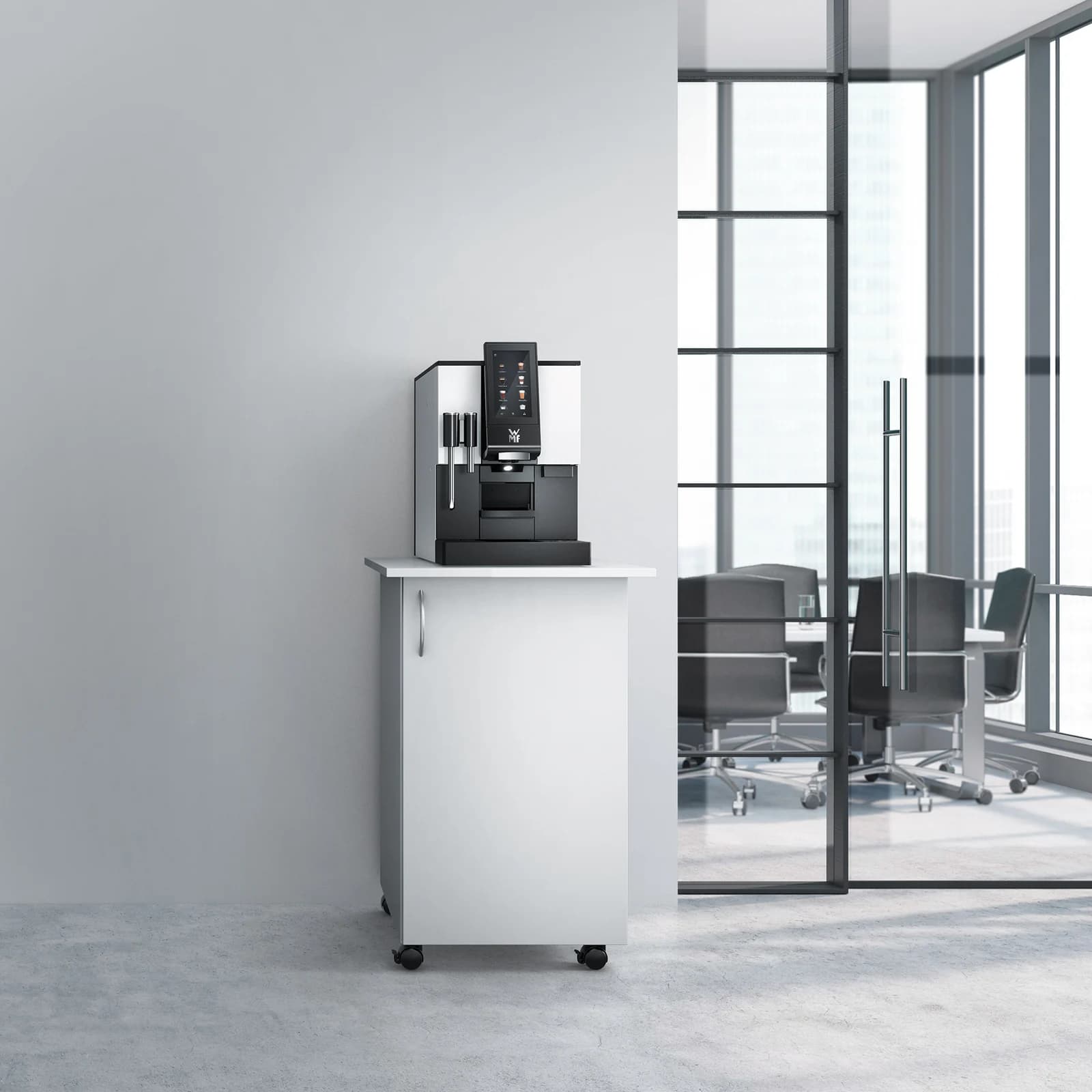
325 mm wide, 590 mm deep, 716 mm high (400 V version) and weighing 37 kg: the WMF 5000 S+ is narrow enough for most gastro counters and office kitchenettes, but requires a fixed water connection with 2–6 bar flow pressure. The 230 V standard variant measures 706 mm in height according to ZVN Shop and weighs approximately 35 kg; the ten millimetre difference is accounted for by the heavier boiler configuration of the 400 V version. Those selecting the 400 V power version must secure a three-phase connection (3/N/PE, 380–415 V) at the installation point. Installation of a three-phase connection point where none exists incurs electrician costs that must be factored in before comparing purchase prices of both variants.

The housing is throughout brushed stainless steel. Front and lid panels withstand coffee splatter and daily wiping water; the side service flap opens without tools and provides access to the brew group and maintenance components. Both bean hoppers at 1,100 g each sit lockably on the appliance, protecting against unauthorised top-up with inferior beans in office environments with open kitchen areas. For operations under hygiene regulations (e.g. clinic, pharmacy), the lockable access is an additional compliance argument.

The 10-inch colour touchscreen responds capacitively, enabling fluid menu navigation and intuitive self-service. For operations where service staff wear latex disposable gloves (bakeries, clinics), touchscreen responsiveness should be confirmed in a live test beforehand, as capacitive displays may respond unreliably with latex gloves.

The infinitely variable dispensing height ranges from 74 to 179 mm (standard) or 66 to 169 mm with Easy-Milk unit. This range covers espresso cups (6–8 cm), cappuccino bowls, latte macchiato glasses and standard 0.4-litre takeaway cups without reconfiguration. The Easy-Milk version reduces maximum dispensing height by 10 mm; for operations offering large thermal cups, the standard version is the better choice.

The boiler construction (derived from Caffe-Limes spare parts taxonomy; not explicitly designated as boiler by manufacturer) provides stable brew temperatures even at 8–10 consecutive vends during peak operation. Thermoblock appliances show measurable temperature fluctuations in this scenario.

Drip tray capacity and grounds bin capacity are not specified in any publicly available source. At 150 cups/day, plan for emptying the drip tray once to twice daily. WMF specialist dealers provide product-specific capacity figures on request.
Technology & functions: CoffeeConnect, MultiMilk and AutoClean in detail

Two high-performance grinders of hardened steel mill both bean hoppers independently. This permits two coffee specialities with different bean varieties to be offered simultaneously: a strong espresso blend alongside a mild coffee blend for filter coffee drinkers. The maximum coffee quantity per vend is 19 g (distributor specification, Coffeefair), covering double espressos and robust lungo variants. Burr diameter and burr geometry are not specified in any available source.

WMF CoffeeConnect is integrated as standard (manufacturer specification, WMF product page). The platform transmits device and performance data via Bluetooth. According to WMF, the following are retrievable: fill levels of both bean hoppers and milk system, cleaning status, maintenance interval reminders and operating counters. Remote configuration of beverage parameters is possible via the dashboard; whether this is usable without technician access codes is not publicly specified and should be clarified with WMF in advance.

The MultiMilk system allows simultaneous connection of up to four milk or plant-based drink containers (manufacturer specification, WMF product page). Whole milk, oat milk, soy drink and almond drink can thus stand simultaneously in the range without reconfiguration. The appliance does not actively cool milk; external cooling of containers is operator responsibility and is mandatory under HACCP requirements.

Up to 48 beverages can be programmed (distributor specification, Coffeefair). Four syrup stations for flavoured variants are integrable. The choc topping module for chocolate and cocoa powder (2,000 g powder container) is as standard or retrofit-capable depending on configuration variant. Chilled Coffee is available as a feature (ETM Testmagazin); technical details are not fully specified publicly.

AutoClean dispenses cleaning granules automatically into the coffee system and launches the cleaning programme on demand or by schedule (manufacturer specification, WMF product page). Manual measurement of cleaning agent is unnecessary. The HACCP cleaning log is retained in device memory and is retrievable via CoffeeConnect. Whether a PDF export for food control authorities is available without additional charge is not publicly disclosed.

Payment options: As an OCS/B2B appliance, the WMF 5000 S+ in standard configuration is supplied without integrated coin validator or card terminal. For publicly accessible self-service areas, an external payment terminal is necessary. An MDB interface is not explicitly confirmed in any available source for this model; the integration capability of external terminals should be clarified with WMF before purchase. For pure OCS environments (office, hotel, canteen), this is not a disadvantage.

Capacity & range: 250 cups/day as upper limit, 180–200 as sustainable continuous operating figure

WMF specifies 250 cups/day as recommended daily capacity (manufacturer specification, confirmed multiple times by distributors). Distributor Kaapi Machines recommends 180–200 cups/day as a sustainable continuous operating figure; this aligns with general practice that appliance wear and cleaning effort increase disproportionately during continuous operation near the manufacturer limit.

For location dimensioning: an office with 100 employees and an average of 2 cups/person/day totals 200 cups/day, which is in the comfortable operating range of the 5000 S+. At 150 employees (300 cups/day at equal usage rate), a second appliance or a WMF 8000-series model is recommended. For hotels: 250 cups/day covers roughly the breakfast operation of 120 rooms (assumption: 2 cups per breakfast guest at 100% occupancy).

Hourly output according to Coffeefair (single source, low confidence): 144 single espresso vends/hour or 220 double espresso vends/hour; hot water output up to 280 cups/hour (56 litres/hour). These values are not confirmed by a second independent source and should be regarded as rough guidance.

The range comprises up to 48 programmable beverages. In normal operation, operators configure 15–25 variants: espresso, lungo, cappuccino, latte macchiato, hot water, tea infusion and flavoured variants via the syrup station. MultiMilk support for four milk and plant-based varieties permits differentiated offerings for locations with diverse consumption habits.

Bean hopper capacity: 2 × 1,100 g (lockable), total 2,200 g. At average consumption of approximately 8 g beans per beverage and 150 cups/day, hoppers are empty after approximately 275 beverages, meaning refilling every 1–2 days. The powder container for cocoa and chocolate powder holds 2,000 g.

The dispensing height of maximum 179 mm (standard, without Easy Milk) covers standard thermal cups up to approximately 10 cm height. For locations offering larger reusable cups (e.g. 0.5-litre sports bottles), dispensing height should be checked in advance.

Via parallel coffee and hot water dispensing, two concurrent vends can be handled simultaneously, meaningfully easing peak operation during peak times (office rush 09:00–09:30, hotel breakfast 07:00–09:00).

Operation & maintenance: AutoClean, spare parts availability and service times

The AutoClean system launches on demand or by scheduled programme: it independently dispenses cleaning granules into the coffee system, flushes brew group and outlet, and records the log in device memory (manufacturer specification, WMF product page; procedure detailed according to ManualsLib DE). Daily cleaning time: approximately 12 minutes including milk system rinse programme, wiping of outlet and drip tray and emptying the drip tray (estimate based on AutoClean description and appliance class; no verified minute-by-minute log from operator source available). Weekly, approximately 20 minutes is needed for manual cleaning of steam head and milk hose. At more than 100 milk beverages/day, the milk system rinse programme should be run twice daily.

Descaling occurs automatically; the interval is approximately every 3 months during normal operation (Tchibo Coffee Service Portal, appliance class). Milk system components, including the steam pitcher, must be cleaned manually weekly.

Spare parts provision is well-established for a professional appliance in this price range: 189 parts are listed at Parts Town (USA); in Germany, Caffe Limes and kaffeevollautomat-gebraucht.de deliver within 1–3 working days. Typical wear and repair costs from verified dealer sources:

HD50 brew chamber complete: approximately €295–345, due every 3–5 years at 150–200 cups/day.

HD brewer complete (replacement unit): approximately €1,200–1,390, on total failure or after 5–8 years.

Mixer with temperature sensor: approximately €390–436, every 2–4 years with intensive milk beverage use.

Milk pump: approximately €220–260, every 3–5 years.

Brew group seals: under €15 per O-ring set; at 150–200 cups/day to be replaced every 18–24 months.

WMF states more than 320 own service technicians in DACH (manufacturer specification). In a forum thread on kaffee-welt.net, users report variable to multi-month waiting times for WMF maintenance appointments; the thread is general and not specific to the 5000 S+ model. Operators without in-house maintenance capacity should check actual response time of their regional WMF service partner before purchase and secure an SLA in writing.

For HACCP documentation: the AutoClean cleaning log is retrievable via CoffeeConnect. Whether export as PDF for food control authorities is available without additional charge is not publicly specified; this should be clarified with WMF.

Performance & energy: 1.55 kWh daily energy loss, noise below 70 dB(A)

Rated power standard version (220–240 V, 1/N/PE): 2,750–3,250 W. Power version (380–415 V, 3/N/PE): 8,410–9,960 W. The higher power consumption of the power version is explained by the larger three-phase boiler; for office installations with single-phase connection, the standard version is the right choice. Standby power consumption is not disclosed in any publicly available source; direct efficiency comparison with competing appliances via the standby value is therefore not possible.

Energy loss according to DIN 18873-2 is 1.55 kWh/day for the 400 V version (dealer specification Coffeefair; not independently confirmed for the 230 V version). DIN 18873-2 measures standby energy loss under standard conditions, not total consumption during operation. At 250 operating days/year, this yields standby consumption of approximately 388 kWh/year. Total annual consumption including all vends is higher; a complete annual consumption figure is not publicly specified.

Converted per vend: 1,550 Wh daily energy loss divided by 250 cups/day yields 6.2 Wh per cup from standby operation alone. This value is partial; actual energy input per vend including grinding, brew phase and milk frothing is higher and cannot be quantified without full measurement.

Heat-up time from cold start is not disclosed in any available source. For locations with very short operating windows (e.g. 2-hour conference rooms or trade show appearances), this value should be requested from WMF in advance, as a cold boiler requires several minutes to reach operating temperature.

Noise level: maximum 70 dB(A) according to product data (Coffeefair, ManualsLib confirmed). This corresponds to the level of normal speech from one metre distance. In open office landscaping, the grinding operation (typically 15–20 seconds) is clearly audible but is rarely perceived as permanently disruptive in practice. For very noise-sensitive environments such as libraries or medical surgeries, a trial setup is recommended.

Operating temperature: 5–35 °C ambient temperature (ManualsLib, Coffeefair). The appliance is exclusively designed for indoor use; an IP protection class is not disclosed. Installation in non-air-conditioned rooms with summer temperatures exceeding 35 °C does not comply with permitted operating conditions.

The DIN 18873-2 figure of 1.55 kWh/day positions the appliance in the middle range of professional coffee fully automatic machines in this size class. Energy-saving modes and automatic shutdown times are standard for this appliance class; specific time values for the WMF 5000 S+ are not publicly documented.

Prices & operating costs: purchase price, leasing and TCO calculation

New price for the 230 V standard version: €12,250 net (special price) to €12,550 net (regular price) at ZVN Shop (as of 2026-08-12). The 400 V power version is offered by Coffeefair exclusively as a rental and leasing model: from €201/month net at 60-month term (as of 2026-08-12). Second-hand market: WMF 5000 S+ models from the 2020s are found on Maschinensucher and Kleinanzeigen for approximately €3,500–5,000; the range reflects manufacturing year, operating hours and condition of the brewer.

Maintenance contract: a reliable market price for WMF service contracts in Germany is not publicly specified; this should be clarified contractually. For the appliance class of professional OCS coffee fully automatic machines, all-inclusive service contracts (including wear parts, technician call-outs, cleaning agent) are industry-standard between €80 and approximately €200/month; whether WMF terms fall within this range is not publicly confirmed.

TCO example for 150 cups/day, 250 operating days/year, 7-year service life:

Depreciation: approximately €12,250 / 7 = €1,750/year.

Coffee raw material (premium Arabica approximately €22/kg, 8 g/cup): 150 cups × 8 g × €0.022/g × 250 days = approximately €6,600/year. With budget Robusta (approximately €9/kg): €2,700/year.

Energy (standby operation per DIN value): 1.55 kWh/day × approximately €0.35/kWh × 250 days = €136/year. Total consumption including operation is higher; complete energy costs cannot be quantified due to lack of public measurement data.

Wear and repair without maintenance contract (estimate): brew group seals every 18 months approximately €50; mixer every 3 years approximately €415; milk pump every 4 years approximately €240; over 7 years approximately €200–400/year.

Total costs depending on bean choice: approximately €8,700–9,000/year (premium Arabica) or approximately €4,800–5,100/year (budget Robusta). At 37,500 cups/year (150/day × 250 days), this yields a base cost of approximately €0.13–0.24/cup from depreciation and raw materials alone. With maintenance and energy: approximately €0.25–0.40/cup as a realistic range for this appliance type.

The new price of above approximately €12,000 lies noticeably above comparably equipped competitors in the professional OCS segment. For operators who actually exploit CoffeeConnect telemetry, MultiMilk and AutoClean, the price premium is justified over the total service life. For locations offering only one milk variety or not requiring CoffeeConnect, cheaper models offer better value for money.

Technical data

All recorded data points at a glance.

Use & operations

Use cases / locations
Office, Hospitality / foodservice, Hotel, Retail
Installation type
Tabletop
Environment (indoor/outdoor)
Indoor

Payment & connectivity

Payment methods
Coins, Closed-loop card/key, EMV chip & PIN card, Contactless (NFC), Mobile wallet (Apple/Google Pay), QR code
Payment interface protocol
MDB (Multi-Drop Bus)
Payment features
Offline mode / store&forward, Remote price updates, Receipts
Telemetry / remote monitoring
Full (sales+stock+remote)
Connectivity
Ethernet/LAN, Wi‑Fi

Technology

Sensors
Flow meter, Temperature sensor (HACCP)
UI / display type
Touchscreen

Hot beverages

Milk system
Dual-milk (powder + fresh)
Brewing technology
Bean-to-cup

Service & compliance

Age verification
Not required
Price segment
Premium
HACCP compliance
Fully HACCP-compliant

User reviews

Verified community reviews and clearly labelled external operator sources, separate from our 0–10 editorial score.

There are no confirmed community reviews for this model yet. You can submit your experience below.

Have experience with this machine?

Share your assessment. Your review helps other operators make purchasing decisions.

Share your experience with WMF 5000 S+

4 / 5

0/5000 characters (min. 100)

Only your first name and selected use case will be shown publicly.

Useful Links and Documents

Further sources

  1. 1.WMF 5000 S+ Offizielle Produktseite (EN) — wmf-coffeemachines.com/en_com/products/fully-automatic-coffee-machines/wmf-5000-s-plus/
  2. 2.WMF 5000 S+ Specs Page (EN) — wmf-coffeemachines.com/en_com/products/fully-automatic-coffee-machines/wmf-5000-s-plus/specs/
  3. 3.ZVN Shop – WMF 5000 S+ (230 V Standard, Preis 12.250 EUR netto) — zvn-shop.de/kaffeewelt/kaffeemaschinen/kaffeevollautomaten/365/wmf-5000-s-kaffeevollautomat
  4. 4.Coffeefair – WMF 5000 S+ Easy Milk 400 V (Specs, Leasing ab 201 EUR/Monat) — coffeefair.de/wmf-kaffeevollautomat-5000-s-2-muehlen-easy-milk-ohne-choc-topping-modul-400v/a-57486
  5. 5.WMF 5000 S+ Betriebsanleitung – ManualsLib (EN-Spiegel) — manualslib.com/manual/2171173/Wmf-5000-SPlus.html
  6. 6.WMF 5000 S Betriebsanleitung – ManualsLib (DE-Spiegel) — manualslib.de/manual/126024/Wmf-5000S.html
  7. 7.Parts Town – WMF 5000 S+ Ersatzteilkatalog (189 Teile) — partstown.com/m/wmf/5000s-plus
  8. 8.Caffè Limes – Ersatzteile WMF 5000/8000 S (DE) — caffe-limes.de/zubehoer-ersatzteile/ersatzteile-kaffeevollautomaten/wmf/wmf-5000-8000s/
  9. 9.Caffè Limes – Brühgruppen-Ersatzteile WMF 5000 S/8000 S (Preise verifiziert) — caffe-limes.de/zubehoer-ersatzteile/ersatzteile-kaffeevollautomaten/wmf/wmf-5000-8000s/bruehgruppe/
  10. 10.kaffeevollautomat-gebraucht.de – WMF 5000S+ Ersatzteilkatalog (182 Artikel) — kaffeevollautomat-gebraucht.de/Ersatzteile/WMF-Kaffeemaschine/WMF-5000S-5000S/
  11. 11.Maschinensucher.de – WMF 5000 S+ Gebrauchtmarkt (ab ca. 3.800 EUR) — maschinensucher.de/mss/kaffeevollautomat
  12. 12.Kleinanzeigen.de – WMF 5000 S Gebrauchtangebote — kleinanzeigen.de/s-haushaltsgeraete/wmf-5000-s/k0c176
  13. 13.ETM Testmagazin – WMF 5000 S+ Chilled-Coffee-Feature (Produktnews) — etm-testmagazin.de/news/kaffeevollautomat-wmf-5000-s/
  14. 14.Kaffee-Welt Forum – Variable WMF-Servicezeiten (allgemeine Nutzerdiskussion) — kaffee-welt.net/index.php/Thread/4102-Laaaaangsamer-WMF-Service/
  15. 15.Tchibo Coffee Service – WMF 5000 S Soforthilfe und Wartungshinweise — tchibo-coffeeservice-team.de/soforthilfe/wmf-5000s/
Data review: AI-assisted source analysis, no hands-on test by usLast checked: VendingTests.com editorial teamRating criteria documented transparently

Frequently asked questions about WMF 5000 S+

How often must the milk unit of the WMF 5000 S+ be cleaned?

Daily: launch milk system rinse programme via maintenance menu (approximately 5 minutes, fully automatic). At more than 100 milk beverages/day, run the programme twice daily. Weekly: manually clean steam head and milk hose (approximately 10–15 minutes, no tools required). The AutoClean system handles coffee system cleaning with cleaning granules fully automatically and logs the procedure for HACCP documentation.

Is WMF CoffeeConnect worthwhile for a single location?

From approximately 80–100 cups/day, CoffeeConnect is meaningfully valuable: fill-level warnings for both bean hoppers prevent bottlenecks, maintenance intervals are automatically documented (HACCP-compliant), and remote diagnostics can reduce unplanned technician call-outs. WMF supplies CoffeeConnect basic functions at no additional charge with the appliance; whether advanced dashboard functions are chargeable should be clarified contractually.

What does a brewer failure cost in spare parts provision?

Individual O-rings and seals cost under €15. The complete HD50 brew chamber is approximately €295–345; a complete replacement brewing unit approximately €1,200–1,390 (dealer prices kaffeevollautomat-gebraucht.de, Caffe Limes). Caffe Limes delivers within 1–3 working days to Germany. At 150–200 cups/day, brew group seals are experienced to require replacement every 18–24 months.

How high is energy consumption per cup?

Energy loss per DIN 18873-2 is 1.55 kWh/day for the 400 V version (dealer specification Coffeefair; not independently confirmed for the 230 V version). Calculated per 250 cups/day, this yields 6.2 Wh per cup from standby operation alone. Total consumption per vend is higher as grinding, brew phase and milk frothing require additional energy; a full annual consumption figure is not publicly specified.

Purchase or leasing: what makes sense for a single appliance?

At purchase (€12,250 net, 230 V, ZVN Shop) and 7-year service life, pure depreciation is approximately €1,750/year. Leasing from €201/month (60 months, 400 V version, Coffeefair) is approximately €2,412/year and is the more flexible choice with constrained capital budget. For operations with stable locations and long planning horizons, purchase at the given prices is typically more economical.

WMF 1100 S

WMF · Hot Drink Machines

WMF 1100 S

7.3Good

Up to 80 cups daily, 7-inch touchscreen display, and HACCP-capable cleaning protocols: the WMF 1100 S is a compact super-automatic espresso machine for offices with 20 to 60 employees. The unit measures 325 × 500 × 571 mm, weighs approx. 25.5 kg, and fits most kitchen counters without structural modification. The removable brewing unit processes a maximum of 15 g coffee grounds per brew and delivers consistent results; cleaning protocols can be exported via USB for HACCP documentation. Two operational limitations merit attention: the Basic Milk system draws milk via tube from an external cooler or milk carton, requiring more daily handling than an integrated refrigerated system. Additionally, WMF designates the 1100 S as discontinued—orderable only until 30.09.2026. New units cost €3,495 to €4,873 net depending on configuration; spread over five years, depreciation amounts to €699 to €975 annually, plus consumables and service charges. The machine suits operators seeking a low-maintenance office unit with HACCP documentation who do not operate high-throughput sites.

approx. €3,495 – €4,873

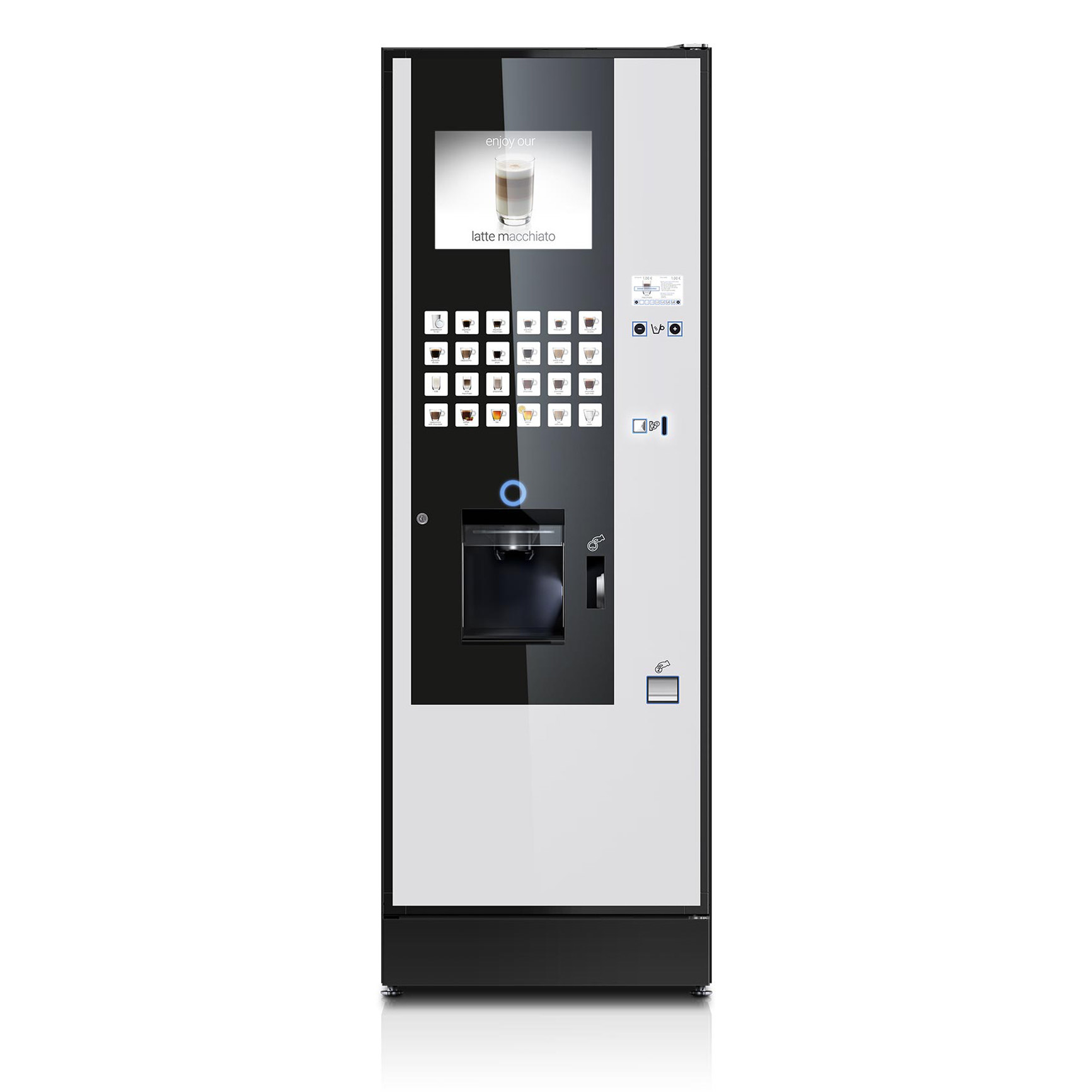
Rhea Luce Zero

Rheavendors · Hot Drink Machines

Rhea Luce Zero

7.2Good

The luce zero is a ladder with five rungs, and its strength is that the footprint remains constant across all tiers: 640 × 1,830 × 705 mm, regardless of specification. The purchasing decision hinges on a clear breaking point. Between zero.1 and zero.2, power doubles from 1,600 to 3,200 watts, cup dispensing stations increase from one to two, grinders from one to up to two, and only here does the Varitherm induction system become available—for which Rheavendors claims 85 percent energy savings versus a boiler. Practically speaking: the smaller tiers operate at approximately 7 amperes on a standard outlet; the larger ones require 14 amperes and a dedicated circuit. The documentation is the weak point—weight, water connection, cup capacity, daily and hourly throughput, and any maintenance specifications are not publicly available.

On request

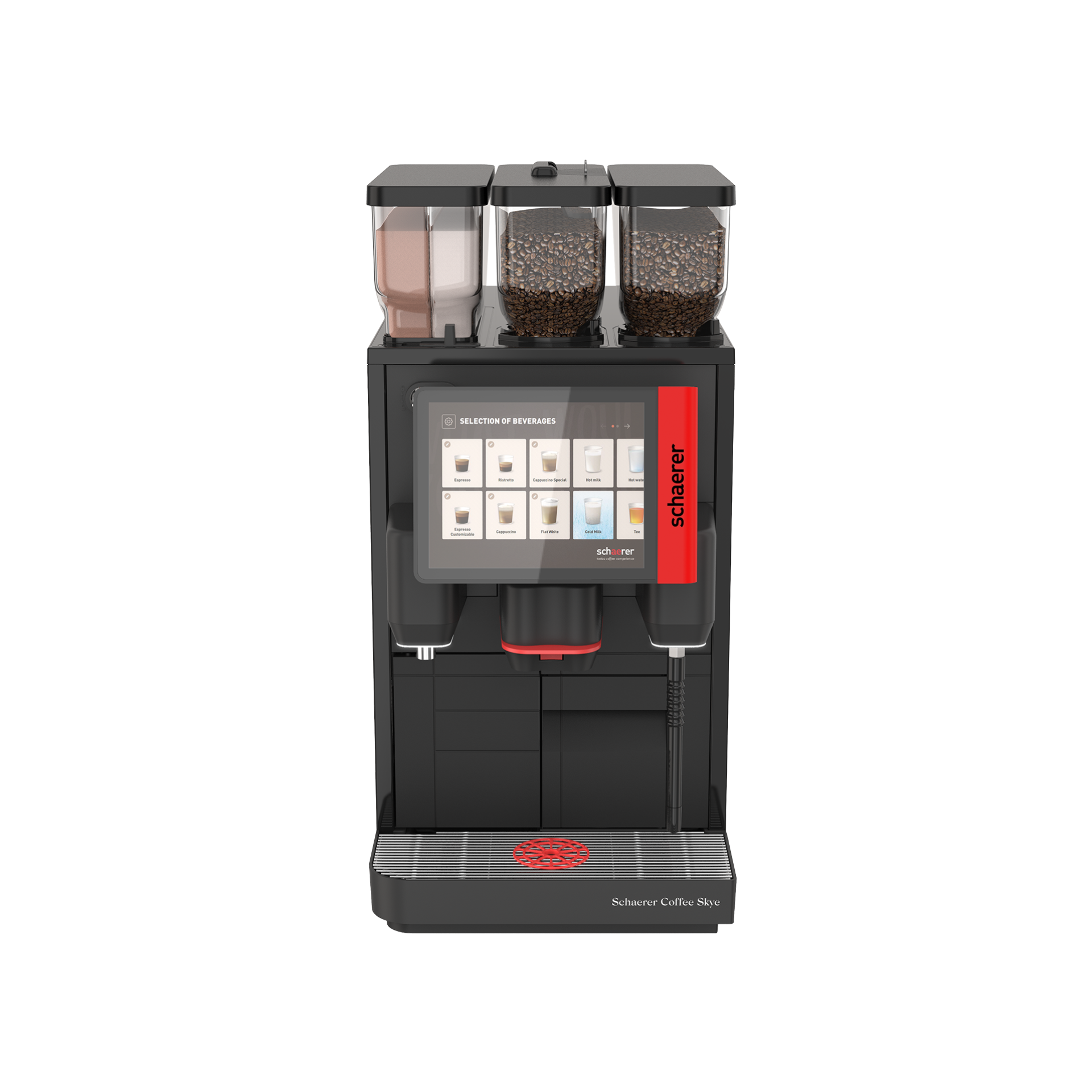
Schaerer Coffee Skye

Schaerer · Hot Drink Machines

Schaerer Coffee Skye

8.5Very good

Compact premium fully automatic coffee machine from Swiss heritage brand Schaerer, designed for mid-volume locations up to approximately 180 cups/day: video-capable 8-inch touchdisplay with three operation modes, BestFoam milk system for hot and cold specialty beverages, and CoffeeLink telemetry. As a countertop unit with internal tank or mains water connection options, the Skye remains flexibly deployable — its capacity is deliberately sized for mid-volume locations, not high-volume operations.

from €7,670

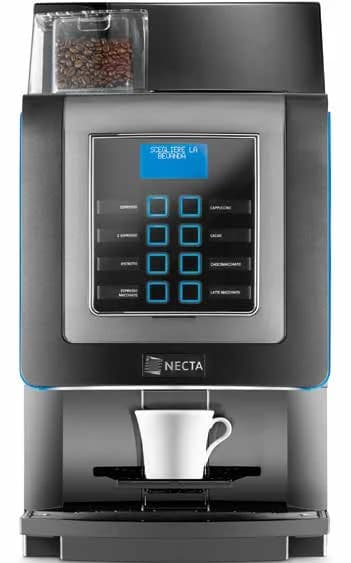
Necta Koro Max

Necta · Hot Drink Machines

Necta Koro Max

6.8Good

330 mm cabinet width, genuine espresso brewer (Z3000 L, maximum 12 g dose) and eight beverage options including chocolate: the Necta Koro Max Prime by Evoca (Varese, IT) is designed for offices with 30 to 80 employees and small food-service locations with moderate daily demand up to approximately 50 vends. Mains-fed variant from approximately €3,105 net (All4Vending DE); tank version up to €4,429 net (NL market). Two structural limitations: milk capability is restricted to powder, with no fresh-milk system. Telemetry and remote service are absent, as this device predates the 2020 product generation. Door opening for refilling triggers a complete device restart. Service infrastructure across the DACH region is sparse; spare parts arrive via specialist retailers with 3 to 10 days lead time. For office locations without high-throughput demands and with in-house cleaning staff, the device is a solid offering. Locations with more than 80 vends daily or requiring digital service interfaces should evaluate current OCS models with connectivity.

approx. €3,105 – €4,429