Skip to content
BWT· Wassertechnologie & Dispenser

BWT AQA drink Pro 20

7.3/ 10

Recommended

Data review — researched from sources, not physically tested. How we rate

Design & build7.8
Technology & features7.8
Operation & maintenance6.8
Capacity & range7.0
Value for money6.9
approx. €2,800 – €4,200

Guide prices net (excl. VAT), project prices may vary

  • Office, Education, Hospitality / foodservice
  • Counter unit
  • Indoor
  • Other

Eco label

ABCDE

Rated power consumption

230 W

Power connection

220-240 V / 50 Hz

BWT AQA drink Pro 20

Use cases

Where this machine fits.

Suitable

Offices and reception areas

Regular dispensing of cold drinking water at a fixed connection point.

Suitable

Facilities with reusable container schemes

Still and carbonated water available from one station.

Suitable

Operators with hygiene protocols

Filter, cleaning and service can be organised as binding procedures.

Our rating in detail

Five public rating axes, weighted against the available evidence.

Design & build
7.8 / 10
Technology & features
7.8 / 10
Operation & maintenance
6.8 / 10
Capacity & range
7.0 / 10
Value for money
6.9 / 10

Our verdict

7.3Good

The BWT AQA drink Pro 20 CAS is a mains-fed water dispenser for cold still and cold carbonated water. The datasheet specifies 20 litres per hour for this CAS variant, 4 to 12 degrees Celsius for cold water, 230 W, 23 x 39 x 36 cm and 18 kg. Performance figures for hot water from the HCS and HCA variants do not apply to the CAS rating. For offices, reception areas and facilities with regular water demand, the compact dispenser module can be a suitable choice. Before installation, water and CO2 connection, pressure, filter, cleaning, spare parts and service must be clarified. Operation is not maintenance-free. Our verdict is positive for a fixed indoor location with clear hygiene protocols in place. Operators requiring hot water should specify a dedicated variant and not derive requirements from a combined datasheet.

At a glance

Model
BWT AQA drink Pro 20
Manufacturer
BWT
Category
Water Dispensers
Type
POU Water Dispensers
Price range
approx. €2,800 – €4,200
Overall score
7.3 / 10
Origin
BWT (AT)

Pros & cons

Pros

  • 20 l/h cold water capacity per datasheet
  • Still and carbonated water
  • Compact dispenser form factor
  • Technical connection values documented

Cons

  • Total cost heavily dependent on installation and service
  • CAS variant not for hot water evaluation
  • Hygiene and filter process is operator responsibility
  • Water and CO2 connection required

Review

Classification: AQA drink Pro 20 CAS

The BWT AQA drink Pro 20 CAS is a mains-fed water dispenser for cold still water and cold carbonated water. The CAS variant is not automatically a hot water dispenser. This is the central correction to earlier documentation: the datasheet lists several variants together, but performance values must not be transferred between CAS, HCS and HCA.

BWT specifies for the CAS configuration a capacity of 20 litres per hour for cold still water or carbonated water. The stated temperature range for cold water is 4 to 12 degrees Celsius. In an office or reception area this is sufficient for regular single-user draw-offs; for high peak-load usage the actual consumption curve must be verified with the supplier.

The target market is organisations wanting to provide drinking water centrally and reduce bottled or containerised water. The AQA drink Pro 20 CAS is not a small countertop water filter for the kitchen, but an installation with water connection, CO2 supply and its own site planning requirements. An optional base unit increases usable working height, but is not part of the device itself.

For the evaluation, hygiene is also decisive. Mains-fed water dispensers combine drinking water, cooling, outlet, internal pipework and possibly filtration. The operator therefore needs a documented cleaning and filter protocol. An attractive front panel or integrated UV module neither replaces the operating instructions nor regular checks.

Our verdict: The AQA drink Pro 20 CAS is a sound solution for cold still and carbonated water at a fixed indoor location. The rating is positive only if connection, CO2, hygiene and service are clarified in advance. Operators requiring hot water must specify a dedicated HCS or HCA variant separately.

Technical data and connection

The BWT datasheet specifies 230 W total power for the CAS variant. Device dimensions are given as 23 x 39 x 36 cm, with a net weight of 18 kg. The order is width, height and depth. These values apply to the dispenser module; a base unit of 23 x 80 x 36 cm changes the overall installation height.

Connection is to 220 to 240 V and 50 Hz. BWT specifies a water connection of 1/4 inch and a CO2 connection of 1/4 inch. Recommended water pressure is 3 bar, with a maximum of 5 bar. For CO2, 3.5 bar is recommended and 4 bar specified as maximum. Pressure regulators, pipework routing and shut-off valves are part of the installation planning.

These figures are technical boundary conditions, not a guarantee of performance at every location. Water quality, supply line, ambient temperature, usage pattern and CO2 supply all influence operation. Before installation, a qualified technician should verify that existing connections are suitable and whether a water cut-off and appropriate drainage are required.

The datasheet also specifies an 11 W UV lamp. This describes a documented component of the equipment, but does not alone determine overall hygiene quality. The operator must clarify which filter and UV components are included in the specific order, how they are monitored and which spare parts are available.

The technical specification is clearly documented for a professional water station. The information error arises more from combining several variants into one line. We therefore evaluate only CAS data and mark values from other variants explicitly as variant information. This makes comparison less striking, but more reliable.

Water quality, filtration and hygiene

The AQA drink Pro 20 CAS dispenses treated mains water. Which filtration or mineralisation stage is used depends on water analysis and the ordered system. BWT describes different water solutions; no standard magnesium value or uniform filter service life for every operation can be derived from this.

This is precisely why commissioning should begin with water analysis or at least documented hardness determination. Filter cartridge selection must match water hardness, consumption and desired water type. Changing the filter at an arbitrarily chosen monthly interval would be poor practice. What matters are capacity, flow rate, measurement and the specifications of the specific system.

The operator needs a hygiene plan for the device. It should cover daily visual and function checks, defined cleaning tasks, filter replacement, CO2 checks and documentation of any deviations. If the dispenser is installed in a canteen, waiting area or educational facility, responsibilities and access control must also be defined.

BWT presents variants with different water types in the datasheet. Hot water values, heating power or temperatures from HCS and HCA must therefore not be read as CAS performance. This separation is important for procurement and operation: an operator expecting hot water would order the wrong product with the CAS variant.

The water station can function hygienically well if installation, cleaning and documentation are taken seriously. It is not a maintenance-free piece of furniture. Our recommendation is to commission the hygiene and service concept together with the quotation and document responsibility for filter, UV component, outlet and emergency shut-off in writing.

Operation, use and service

For users, operation is straightforward: select water type, position vessel and start dispensing. Experience quality depends more on working height, splash protection, signage and cleanliness than on a long feature list. A base unit can make ergonomic sense but requires its own cleaning, ventilation and secure positioning.

Installation should allow service and cleaning without rearrangement. Water and CO2 lines must be protected, shut-offs accessible and electrical connections arranged in dry locations. In high-traffic areas, consider how spills are drained and whether drainage or a catch tray is needed.

Running costs cannot be generalised from the product page to cover filter or CO2 intervals for every location. Consumption depends on litres dispensed, carbonation level, bottle size, water hardness and usage pattern. A consumption forecast is more useful than previous blanket claims that a CO2 bottle will always last several months.

b.CONNECT is offered as an optional connection. This can help with service and condition monitoring, but is not proof that every CAS unit comes with online capability as standard. Before ordering, clarify system, data scope, SIM or network, costs and data protection with the supplier.

In a service event, short response times and clear spare parts availability count. The operator should know who responds to leaks, cooling failure, CO2 problems or filter alerts. Commissioning with simulated faults is recommended. Only when these processes work is the water dispenser more than an optically attractive dispensing device in everyday use.

Price, application and conclusion

BWT does not publish a complete end-user price including installation and operation for the AQA drink Pro 20 CAS on every product page. As an editorial market estimate, we place the dispenser module in a professional configuration at approximately EUR 2,800 to 4,200 net. This is not a BWT price list. Base unit, filter, CO2, installation, maintenance and water connection can change total costs.

Proper economic calculation begins with litres and usage days. Include purchase or lease, installation, filters and CO2, electricity, cleaning, service, internal labour and possible downtime. Comparison with bottled water is only fair if procurement, storage, disposal and transport are counted on both sides.

The AQA drink Pro 20 CAS suits offices, reception areas and facilities with regular demand for cold still and carbonated water. Less suitable for changing locations without fixed water connection, outdoor areas or operations needing hot water capability. In such cases a different variant must be evaluated.

Strengths are the compact dispenser form factor, documented cold water capacity and the option to dispense still and carbonated water from one station. Weaknesses are the additional connection and hygiene logistics, plus variant confusion in combined datasheets. A purchase decision without a water, CO2 and service plan would be unnecessarily risky.

Our conclusion: the BWT AQA drink Pro 20 CAS can be a clean, professional drinking water solution if the application really is cold still and cold carbonated. The CAS variant should not be mixed with hot water options. Operators clarifying water analysis, hygiene plan, connections, spare parts supply and total cost in writing in advance gain a reliable decision basis.

### Handover protocol for the CAS variant

At handover the CAS variant should be documented separately from hot water options. The protocol should include model and serial status, cold water capacity, water and CO2 connection, pressure settings, filter type, UV component, temperature range and position of shut-offs. Several dispensings of still and carbonated water are then tested. The operator also documents drip behaviour, catch tray, noise, cleaning access and behaviour after water or power interruption. These points make the installation verifiable in everyday use. They also prevent later service issues from being incorrectly treated as pure user questions.

### Total cost calculated per litre

When comparing with bottled water, reframe the calculation per litre rather than device price alone. Include expected daily consumption, costs of water treatment, filters and CO2, electricity, cleaning, service and labour. For carbonated water, CO2 consumption depends on volume dispensed and desired carbonation; a fixed monthly figure without metering would not be sound. With low usage, maintenance and standby costs may outweigh electricity. With high usage, verify whether documented capacity matches peak load. The calculation then remains transparent and can be updated after the first month of operation.

### Document hygiene responsibility

Installation should conclude with a short responsibility matrix. One person or contractor takes daily visual inspection, another schedules filters and cleaning, and the service partner handles technical faults. Each task needs a schedule, proof and escalation for deviations. This applies even with UV lamp or telemetry present. Technology can support controls but does not replace the decision of when to clean an outlet, change a filter or temporarily disable a station. A signed handover protocol prevents this responsibility being lost between operator and installer.

### What must be clarified before ordering

Before ordering, a checklist should include model variant, water type, expected litres per day, CO2 supply, filter capacity, power connection, base unit, cleaning and service partner. For the CAS variant it is especially important that cold still and cold carbonated water actually suffice. If users expect hot water, the specification must allow for a different variant. This simple clarification prevents the most common error with combined product data: transferring a correct number from a different device variant to the ordered model.


Technical data

All recorded data points at a glance.

Use & operations

Use cases / locations
Office, Education, Hospitality / foodservice
Installation type
Counter unit
Environment (indoor/outdoor)
Indoor

Payment & connectivity

Payment interface protocol
Other
Telemetry / remote monitoring
Full (sales+stock+remote)
Connectivity
Ethernet/LAN, Wi‑Fi

Technology

Sensors
Temperature, Filter level
UI / display type
Touchscreen

Cooling

Cooling
Chilled
Temperature range
4-12 °C
Still water
Yes
Sparkling options
Sparkling
Hot water
No
CO2 carbonation
Yes

Service & compliance

Age verification
Not required
Price segment
Mid-range

Dimensions & weight

Dimensions (W × H × D)
230 x 390 x 360
Weight (unpacked)
18 kg
Rated power consumption
230 W
Power connection
220-240 V / 50 Hz
Connection type
water 1/4 inch; CO2 1/4 inch

Coffee technology

Water filter
variant-dependent

User reviews

Verified community reviews and clearly labelled external operator sources, separate from our 0–10 editorial score.

There are no confirmed community reviews for this model yet. You can submit your experience below.

Have experience with this machine?

Share your assessment. Your review helps other operators make purchasing decisions.

Share your experience with BWT AQA drink Pro 20

4 / 5

0/5000 characters (min. 100)

Only your first name and selected use case will be shown publicly.

Data review: AI-assisted source analysis, no hands-on test by usLast checked: VendingTests.com editorial teamRating criteria documented transparently

Frequently asked questions about BWT AQA drink Pro 20

What locations is this device suitable for?

That depends on the specific variant and stated application. The editorial classification covers indoor locations with predictable demand; outdoor or special operations must be specified separately.

Which technical data are substantiated?

The dimensions, performance and connection values cited in the report come from the linked manufacturer documentation. Variant values are explicitly marked in the text as configuration-dependent.

What does the device cost?

The report gives an editorial net estimate from comparison quotations. This is not a complete manufacturer price list; delivery, configuration, installation and service may incur additional charges.

What payment systems are available?

Payment methods and telemetry vary by model and configuration. Before ordering, terminals, fees, data connection and billing should be stated in writing in the quotation.

How much maintenance should be planned?

Refilling, cleaning, function checks and service belong in a fixed operator process. Binding intervals and response times must come from the quotation or service agreement.

BWT Mira

BWT · Water Dispensers

BWT Mira

8.0Very good

The BWT Mira is a compact POU tabletop device with BWT's signature Mg²⁺ enrichment — the single feature that noticeably shifts tap water flavour towards spring water. For offices up to 20 persons, it is the most compact solution in the BWT portfolio; full-service rental models from 45 EUR/month make entry straightforward.

from €1,290

BWT AQA drink Pro 20

BWT · Water Dispensers

BWT AQA drink Pro 20

7.4Good

The BWT AQA drink Pro 20 is a narrow, well-documented water dispenser for approximately 20 users. At 230 millimetres wide, it fits into gaps where no refrigerator would go, and the base cabinet solves four operational issues at once: filter space, CO2 space, an approximately 3-litre waste water tank with fill-level sensor, and an integrated cup dispenser. The key point to understand before ordering is the variant logic: each model delivers exactly three of four water options. CAS has no hot water, HCS has no ambient-temperature still water, HCA has no carbonation. This comes alongside a maintenance plan that creates in-house workload: weekly cleaning by a trained person, daily wiping of the dispensing area, half-yearly disinfection, filter replacement and UV lamp replacement by qualified staff. BWT does not publish a list price.

On request

Blupura BLU2GO

Blupura · Water Dispensers

Blupura BLU2GO

7.9Good

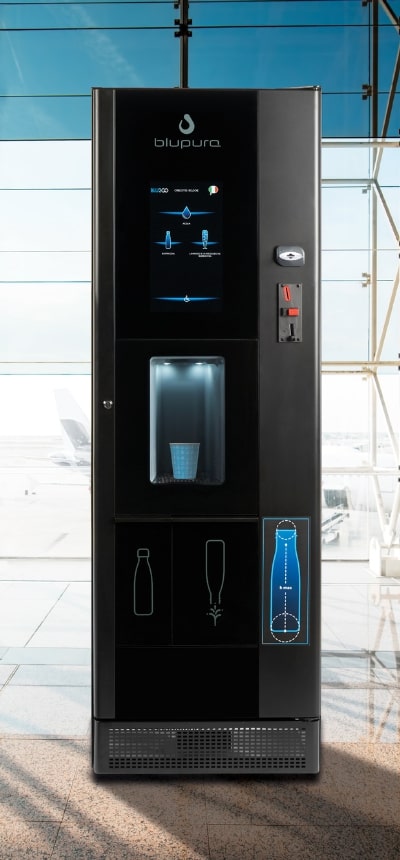
The Blupura Blu2Go combines chilled still and sparkling water with an integrated reusable bottle dispensing system. According to the manufacturer and datasheet, it delivers up to 60 litres per hour, dispenses 170-millilitre portions and stores up to 40 bottles of 500 millilitres each. This version is aimed primarily at public indoor spaces, universities, factories, larger offices and transport locations with around 100 to 500 employees or visitors per day. Bottle cleaning includes a pre-wash with filtered water, ozone cleaning and a rinse with filtered water. Its main drawbacks are its large footprint of 615 × 1,850 × 735 millimetres and its 181-kilogram weight in the base version. The published net price ranges from €11,334 to €13,361. A reliable ROI therefore depends on daily dispensing volumes, selling price, water connection, CO2 consumption and the number of single-use bottles avoided. With low usage, the investment is difficult to recoup. With steady footfall, the combination of sales, reusable bottle logistics and bottle cleaning may make economic sense.

approx. €11,334 – €13,361

BRITA Vivreau Top Pro

BRITA · Water Dispensers

BRITA Vivreau Top Pro

8.1Very good

Mains-fed water dispenser for 10 to 60 users, four water formats, refrigerant R290 — from approximately 2,815 euros net. The hygiene technology is standard and the reason to purchase this unit; filter consumption and commissioning are reasons for careful examination.

from €2,800