
Quality & Certifications
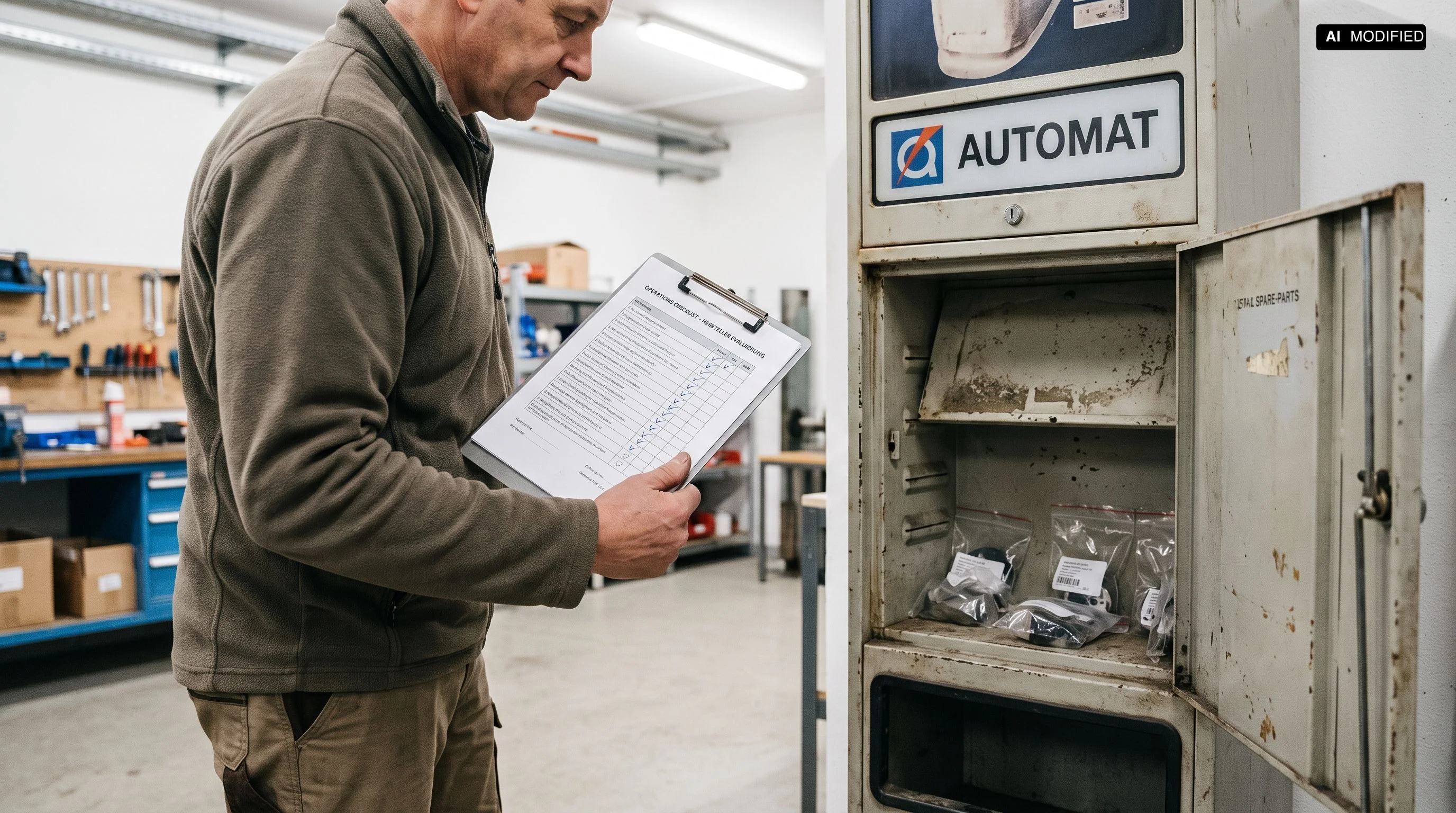
Evaluating Manufacturers the Right Way: Operator Procurement Checklist
 KI Modified
On this page
- Key Takeaways
- Why Manufacturer Matters More than Model
- Quality Seals and Association Memberships That Really Matter
- BDV Quality Seal: It Certifies Operations, Not Necessarily Manufacturing
- EVA: Standards Rather Than Consumer Seals
- Additional Certifications: ISO 9001, ISO 22000, IFS
- Technical Standards as Purchase Criteria: MDB 4.3 and EVA-DTS
- CE Marking and Product Safety: Mandatory, Not Optional
- Contract Checklist: What You Must Agree in Writing with the Manufacturer
- Red Flags: Warning Signs in Manufacturer Evaluation
- What a Manufacturer Change Really Costs: Three Scenarios Modelled
- The Checklist for Printing
Key Takeaways
- The manufacturer matters more than the model. A vending machine typically remains in the field for ten to fifteen years, whereas the current model usually stays in the manufacturer's catalogue for only five to eight years. What counts is not how the device looks today, but whether the manufacturer will still supply spare parts and service in year ten.
- BDV membership and BDV quality seal are real signals – but with different meanings. The BDV quality seal primarily certifies vending operators and service providers on quality, hygiene and management, not a manufacturer's production standards. For pure manufacturers and suppliers, BDV membership itself is the more meaningful signal.
- Technical standards determine future-proofing. If the machine supports MDB 4.3 for payment systems and EVA-DTS for data export, it can integrate into your existing point-of-sale, telemetry and cashless infrastructure. Without these, any retrofit becomes expensive or fails entirely.
- CE marking is mandatory, not optional. Vending machines are electrical equipment under the Low Voltage Directive 2014/35/EU; the relevant product standard is EN 60335-2-75. No device should be installed without a deliverable EU Declaration of Conformity.
- Spare-parts supply is a matter for negotiation, not an automatic right. Germany has no general statutory obligation for long-term spare-parts supply beyond standard warranty. Industry practice is around ten years after a product line ends – you must agree this contractually, not assume it in silence.
Why Manufacturer Matters More than Model
When searching for a new vending machine, most operators compare features first: compartment layout, display size or price per slot. This is understandable, but it answers the wrong question. A vending machine is a capital asset with a service life that regularly outlasts the manufacturer's product cycles: ten to fifteen years in the field is typical practice, while individual product lines often exit the catalogue after just five to eight years.
This means: by year six or seven, the machine you buy today will no longer appear in the manufacturer's current catalogue. What counts then is not the model, but the company behind it – does it still hold spare-parts stock or can it have them manufactured, is trained service staff still available, does the company still exist in the market at all? A manufacturer that fails financially or exits the German market within a few years turns even the cheapest machine into a liability case: displays, cooling units, payment modules and control boards are proprietary at most manufacturers and cannot be replaced with universal parts.
This is precisely why manufacturer evaluation – not model selection – should be the first step in your procurement process. The sections below show the concrete, verifiable criteria you can use to assess this.
Quality Seals and Association Memberships That Really Matter
BDV Quality Seal: It Certifies Operations, Not Necessarily Manufacturing
The Bundesverband der Deutschen Vending-Automatenwirtschaft (BDV), with around 440 members including manufacturers of beverage and food vending machines, vending operators and food producers, is Germany's central trade association. It awards the BDV quality seal, which the association itself describes as "the vending industry's certification": the assessment covers quality, hygiene and management, based on ISO 9001 methodology plus sector-specific criteria.
What is important for manufacturer evaluation is the seal's precise scope: the assessment examines operational infrastructure like warehousing areas, workshops, sanitary facilities and vehicle fleet, plus documentation for traceability, supplier evaluation and cleaning records. This is fundamentally the description of a vending operator – a service provider with its own vehicle fleet and service organisation – not a pure manufacturing plant for vending technology. The certification is valid for three years and is awarded through an independent on-site audit.
For procurement, this means concretely: if you are evaluating a manufacturer that also operates machines itself, the BDV quality seal is a strong, verifiable signal – ask for it actively. For a pure manufacturer or importer without its own vending operation, the simple BDV membership is more relevant, though a weaker indicator: it shows at least that the company commits to industry structures and technical exchange in Germany.
EVA: Standards Rather Than Consumer Seals
At European level, the European Vending and Coffee Service Association (EVA) is the umbrella organisation where national associations such as the BDV and numerous manufacturers and suppliers are represented as direct corporate members. According to activities published on vending-europe.eu, EVA's focus is not on a consumer-facing quality seal like the BDV's, but on technical standards, advocacy toward the EU and market data. For manufacturer evaluation, the EVA's technical specifications are most relevant (see next section) – a manufacturer's membership in the EVA or one of its national associations is nonetheless an indicator of at least minimum market engagement and interest in shared standards rather than closed proprietary solutions.
Additional Certifications: ISO 9001, ISO 22000, IFS
Two further certification families deserve attention if the manufacturer also produces food-contact components or supplies fresh products directly:
- ISO 9001 (Quality Management Systems) is the general foundation on which the BDV quality seal is also built – an ISO-9001-certified manufacturer at least maintains documented, auditable processes.
- ISO 22000 and IFS Food (International Featured Standards) are specific food-safety standards particularly relevant for suppliers of fresh-food machines, fully automatic coffee systems or packaged snacks. IFS Food is recognised by the GFSI (Global Food Safety Initiative) and is certified by organisations including TÜV Rheinland and TÜV SÜD.
A note for those trying to classify refrigerated machines technically: the European standard for commercial refrigerated sales cabinets, DIN EN ISO 23953, explicitly excludes vending machines with cooling function from its scope. For beverage and snack machines with refrigeration, the product safety standard EN 60335-2-75 applies instead (see CE Marking section below) – a detail that frequently gets confused in tender documentation.
Technical Standards as Purchase Criteria: MDB 4.3 and EVA-DTS
Beyond quality seals and memberships, there are two technical standards that directly determine whether an operator faces extra effort or headaches on any given day – regardless of how reputable the manufacturer appears otherwise.
MDB (Multi-Drop Bus / Internal Communication Protocol), currently at version 4.3, governs communication between the machine controller and peripheral devices such as coin and banknote validators, card readers and mobile payment solutions. MDB 4.3 extended its predecessor especially with remote-vend functions for app-based payments without button presses on the machine. If a machine does not support current MDB, retrofitting a new payment terminal – for example a modern card-payment solution – is often possible only through workarounds or not at all.
EVA-DTS (European Vending Association Data Transfer Standard), currently at version 6.2.2, defines the format in which sales and event data from the machine and payment system are transmitted to PC-based settlement and management systems. In practice, this determines whether your telemetry or point-of-sale software reads revenues, stock levels and faults automatically, or whether staff must manually record figures on site.
Both standards are maintained by the EVA and are available free of charge to industry participants after registration. For manufacturer evaluation, this means: explicitly ask about the supported MDB and EVA-DTS versions – and have this confirmed in writing (datasheet, technical manual), not just as a verbal commitment. A manufacturer offering only a closed, proprietary protocol will lock you into their – usually more expensive – add-on devices over the long term.
CE Marking and Product Safety: Mandatory, Not Optional
Vending machines are electrically powered devices and fall under the Low Voltage Directive 2014/35/EU, which applies to electrical equipment rated between 50 and 1,000 volts AC. The specific product standard for commercial vending and dispensing equipment – from hot-beverage through snack to refrigerated machines – is EN 60335-2-75 (in Germany designated DIN EN 60335-2-75 / VDE 0700-75), which addresses electrical safety as well as hygiene aspects.
For procurement, this means two very concrete checkpoints:
- Supply of the EU Declaration of Conformity. The manufacturer must issue a Declaration of Conformity for each machine and retain the original for at least ten years after production end. If a supplier refuses to provide this or cannot produce it, this is an exclusion criterion – not just a formality, but your liability risk as the operator if a non-conforming device causes damage.
- Verifiable technical documentation. This includes circuit diagrams, spare-parts catalogues and test certificates. Without these, any subsequent repair by a third-party service provider is difficult or impossible, even if spare parts were theoretically available.
For food vending machines, EU Hygiene Regulation (EC) No. 852/2004 applies additionally: it obliges anyone placing food in commerce – including you, the machine operator – to establish a HACCP plan with hazard analysis, critical control points and documentation. This primarily affects you as the operator, not the manufacturer; however, a good manufacturer actively supports you, for example through validated temperature protocols, easily cleanable materials and documented cleaning intervals in the user manual.
Contract Checklist: What You Must Agree in Writing with the Manufacturer
Verbal promises are worthless in dispute. The following points belong in the supply or framework agreement, not just in the sales conversation:
- Spare-parts availability with timeline. Industry-standard contract clauses for spare-parts supply commit to maintaining stock for around ten years after a product line ends, including retention of the manufacturing tools necessary for this. Such a commitment does not exist automatically – it must be explicitly agreed, as Germany has no general statutory obligation beyond standard warranty.
- Service response time (SLA). Defined time windows for acknowledgement (e.g. 24 hours) and for on-site attendance or replacement machine (e.g. 48–72 hours), graded by urgency.
- Warranty terms in detail. Not just duration (typically one to two years in practice), but what is concretely covered: labour, travel, wear parts, software updates.
- Training. Instruction for your own service staff on first delivery and at each relevant model change, ideally with documentation or certification.
- Fallback in case of manufacturer failure. What happens to spare-parts commitments if the manufacturer becomes insolvent or exits the market? Will design documentation or manufacturing tools be held by a trustee or third-party service provider – similar to a software escrow clause?
- Reference customers. At least one or two existing customers in Germany or the EU who are actually reachable on request – not merely listed in a reference document.
Red Flags: Warning Signs in Manufacturer Evaluation
Certain signals should immediately raise concerns in any manufacturer assessment:
- No deliverable EU Declaration of Conformity or evasions when you ask.
- Only verbal spare-parts commitments with no timeframe or contractual clause.
- No European spare-parts warehouse – only ordering with multi-week lead times from overseas.
- No support for open standards like MDB or EVA-DTS, only a closed proprietary system.
- No verifiable reference customers in the German or European market.
- Steep discounts for advance payment on larger fleet orders, coupled with pressure for quick signature – a pattern among suppliers for whom short-term cash flow matters more than long-term customer relationships.
- Business address and contact person change frequently or are unreachable at the address shown in the imprint.
None of these signals alone proves a manufacturer is unreliable. In combination – for example missing EU Declaration plus no reference customers plus advance-payment pressure – they are a clear reason to postpone purchase or evaluate a second supplier.
What a Manufacturer Change Really Costs: Three Scenarios Modelled
How expensive a weak spare-parts commitment actually becomes can be shown using a simple model. The following figures are a worked example using assumed, transparently stated values – not an industry-wide survey – which you should replace with your own revenue and downtime figures per location.
Assume: a beverage and snack machine generates an average of 25 euro daily revenue at a 40% margin (= 10 euro daily contribution). We also factor in a standard technician callout at 80 euro per visit.
Scenario A – no spare-parts commitment: A faulty proprietary component (e.g. control board) must be imported from overseas. Realistic downtime: 21 days. Calculation: 21 days × 10 euro lost contribution = 210 euro, plus two technician visits (diagnosis + installation) at 80 euro each = 160 euro. Total damage: 370 euro per incident, plus the risk that the location partner terminates the placement agreement if the machine sits empty for three weeks.
Scenario B – standard commitment without SLA: The manufacturer holds spare parts but names no binding delivery timeframe. Realistic downtime: 7 days. Calculation: 7 days × 10 euro = 70 euro, plus two technician visits = 160 euro. Total damage: 230 euro per incident.
Scenario C – contractually fixed supply with SLA and EU warehouse: Spare-parts commitment for ten years, contractually agreed 48-hour response time, spare part from EU warehouse. Calculation: 2 days × 10 euro = 20 euro, plus two technician visits = 160 euro. Total damage: 180 euro per incident.
The difference between Scenario A and Scenario C is 190 euro per fault. For a medium-sized fleet of, say, 40 machines and assuming two component-related faults per machine per year, this yields a model calculation of around 15,200 euro difference annually (40 × 2 × 190 euro) – from spare-parts clause quality alone, not counting lost revenue from disgruntled location partners terminating placement agreements. The exact amount depends on your actual daily revenues, fault rates and location contracts; but the model shows that a binding spare-parts clause pays for itself even at modest fault rates.
The Checklist for Printing
Summarise manufacturer evaluation before signing in a one-page tick-list: BDV membership and – for manufacturers with their own vending operation – BDV quality seal verified and proof requested · EVA membership or national association membership confirmed · supported MDB and EVA-DTS versions confirmed in writing · EU Declaration of Conformity original received · technical documentation (circuit diagrams, spare-parts catalogues) fully delivered · spare-parts availability contractually fixed with specific time window · Service SLA with response times agreed in writing · warranty terms in detail (duration, scope, exclusions) reviewed · training plan for your own staff agreed · at least one reachable reference customer in Germany or the EU contacted · fallback procedure for manufacturer insolvency clarified. Print these eleven points, tick each one off in every manufacturer discussion – and do not sign a framework agreement if more than two points remain open.
Latest on this topic
- EU deposit obligation until 2029: Why 2026 is the reference yearCompliance & News · September 14, 2026
- Packaging tax Freiburg 2026: 50 cents per cup – also for vending machinesCompliance & News · September 6, 2026
- Cyber Resilience Act from 11 September 2026: What it means for connected vending machinesCompliance & News · August 17, 2026