
 KI Modified
Compliance & News
Packaging tax Freiburg 2026: 50 cents per cup – also for vending machines
On this page
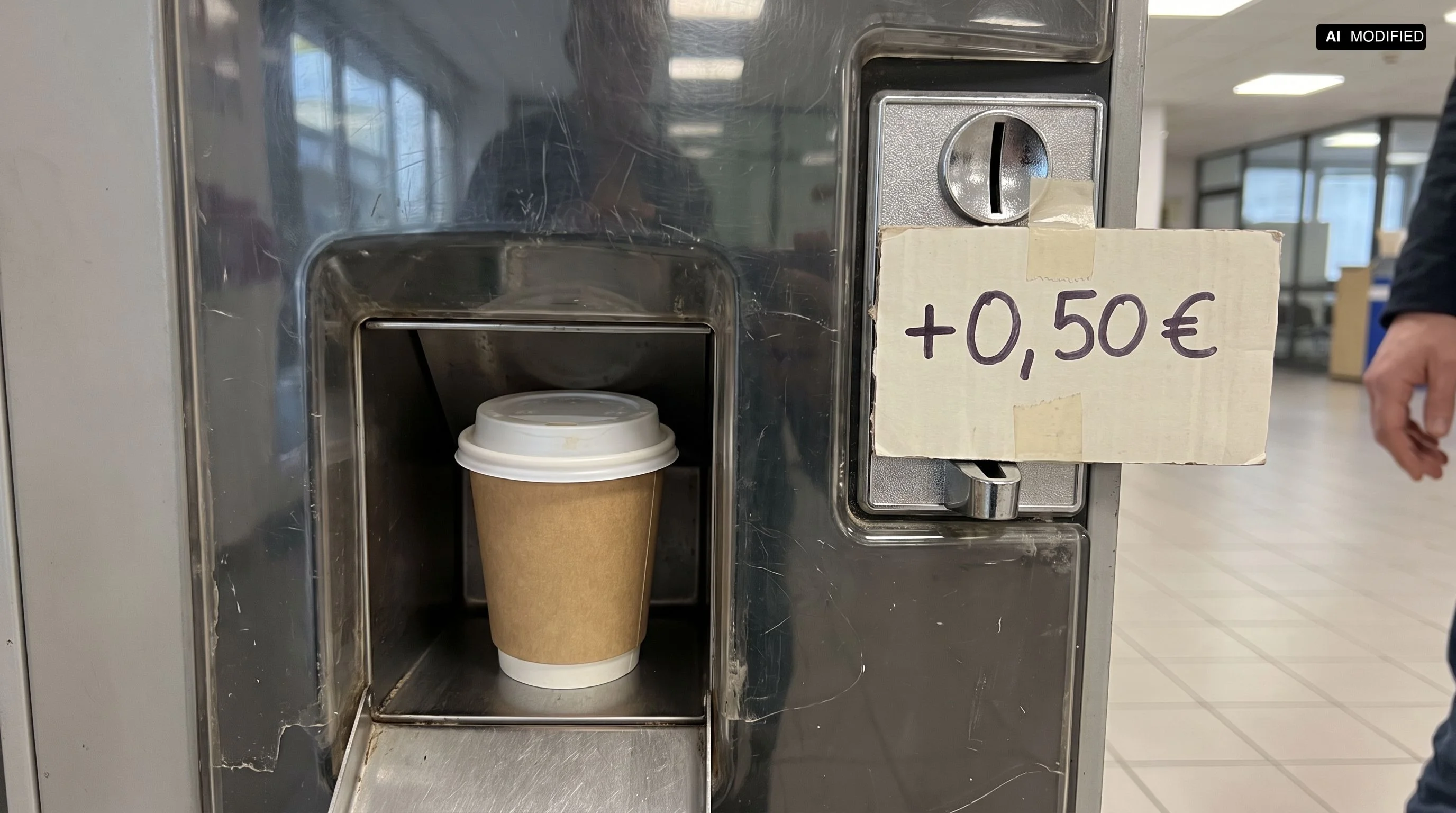
From 1 January 2026, every single-use cup, every single-use tableware item and every single-use cutlery set sold for immediate consumption in Freiburg will be subject to tax: the city will then levy 0.50 euros per single-use beverage cup or tableware item and 0.20 euros per single-use cutlery set – rates that the city council has already passed on 6 May 2025 with 26 of 49 votes. Following Tübingen (since 2022) and Konstanz (since 1 January 2025), Freiburg thus becomes the third university city in Baden-Württemberg to adopt the so-called Tübingen model of a municipal packaging tax. For operators of coffee, snack and vending machines, this is more than a footnote for the food service industry: the city has for the first time explicitly clarified in its official interpretation guidance how the tax also applies to vending machines – and the answer is essentially: just as it does at a retail counter.
What applies from January 2026
According to the ordinance (section 2), all non-reusable single-use packaging and all single-use tableware and cutlery for "immediate consumption on-site or as take-away food or beverages" are subject to tax – from coffee in a paper cup to a salad bowl with dressing and cutlery. Exemptions include napkins, edible packaging such as waffle cones, reusable deposit systems, delivery service packaging and miniature packaging up to 25 g/25 ml and cutlery items up to 10 cm (Source: Interpretation guidance for the packaging tax ordinance, sections 2 and 4). Background: approximately 52 percent of daily Freiburg street waste (approximately 5.1 tonnes per day) is packaging waste according to the city; the administration expects annual additional revenue of approximately 2.2 million euros.
Freiburg's special rule for vending machines
Unlike some municipal packaging taxes, where it remains unclear whether vending machine sales are even covered, Freiburg directly addresses this topic in section 3.7 of its interpretation guidance. Principle: "Sales from vending machines are subject to the general classification criteria for taxation" – there is thus neither a flat exemption nor a special rate for vending machines. The administration distinguishes specifically:
- Beverages from vending machines: If chilled or heated beverages such as coffee or tea are dispensed in non-sealed single-use cups (with or without a lid), the city assumes "based on temperature and lack of shelf stability" immediate consumption – the 0.50 euros per cup become due. Beverages in sealed cans or bottles, by contrast, are mostly already subject to statutory single-use deposits and are thus tax-exempt.
- Food from vending machines: Hot soup from a vending machine is explicitly named as a taxable example. Tightly packaged, shelf-stable goods such as chocolate bars, crisps or shelf-stable salami are not taxed because immediate consumption is not assumed.
(Source: Interpretation guidance, sections 3.4.3 and 3.7.1–3.7.2). For practical purposes: a full-automatic coffee vending machine with single-use cups is treated tax-wise like a bakery counter, while a snack vending machine with sealed goods is not – regardless of the fact that no staff are involved at either location.
Who pays – operator or customer?
According to section 3 of the ordinance, the taxpayer is clearly "the final seller of food or beverages" – in the case of a vending machine, this means the operating company, not the person at the machine. The interpretation guidance also makes clear that the tax may be recovered through the selling price (section 3 of the ordinance, section 4.1). Operators are thus permitted to factor in the 50 or 20 cents – visible for example at McDonald's in Freiburg: a customer reported to chilli:freiburg of 7.11 euros in disclosed packaging tax on an order totaling 51.96 euros, approximately 13.7 percent of the order value (7.11 € ÷ 51.96 € ≈ 0.137). At a vending machine site, this also quickly adds up: with an assumed dispensing of 100 single-use cups per day – an example calculation, not an industry benchmark – this would result in 50 euros in tax daily (100 × 0.50 €) or approximately 1,500 euros per month (× 30 days).
Practical problem – reporting without a cash register interface
It remains unclear how operators without a cash register or counter interface should determine the exact number of taxable cups. The ordinance provides no vending machine-specific simplification for this – verified against the complete, 16-page interpretation guidance. The general rules apply: the tax period is the calendar year, the tax return is due by 30 January of the following year (or semi-annually upon request), and operators must retain "records, receipts and documents on goods purchased and goods sold" for four calendar years (sections 6–7). Invoices for the purchase of single-use packaging are explicitly also acceptable evidence – for a vending machine without sales data analysis, this would mean that the number of single-use cups purchased forms the basis of the tax return. This is a reasonable interpretation of the ordinance, but not a practice specifically confirmed by the city for vending machines (not independently verified). If an operator does not file properly, the city may estimate the tax liability (section 6, subsection 5); violations can be punished as an administrative offense with a fine (section 10). The inspection authority is moreover linked in the ordinance text to the "business premises of the food service establishment" (section 9) – whether this applies to an unmanned vending machine site is not answered by the documents.
Tübingen as a model – and a legal dispute that is now settled
Freiburg adopts the model of the university city of Tübingen, which since 1 January 2022 has been the first municipality nationwide to levy such a tax. The path to this was long marked by legal uncertainty: the Administrative Court of Baden-Württemberg initially declared the Tübingen ordinance invalid in March 2022, but the Federal Administrative Court confirmed its fundamental legality in May 2023. A Tübingen McDonald's franchisee then took the case to the Federal Constitutional Court and objected to, among other things, a lack of "local nexus" of the tax as well as an infringement on freedom of occupation. In a ruling of 27 November 2024 (case no. 1 BvR 1726/23), published on 22 January 2025, the First Senate dismissed the constitutional complaint: the tax is a permissible local consumption tax under article 105, subsection 2a of the German Basic Law, because take-away goods are typically still consumed within the municipality. The ruling is final and no longer subject to appeal.
For vending machine operators in Freiburg, this means: the constitutional legal reasoning behind the Tübingen model is now settled at the highest court level. Whether the Freiburg ordinance itself will ever be legally challenged cannot be inferred from this – we are not currently aware of such a proceeding. We did not find a vending machine clause comparable to Freiburg's section 3.7 in the Tübingen documents we examined (ordinance summaries, standard response from the city of Tübingen); whether Tübingen addresses this topic elsewhere could not be conclusively determined here. For those wanting to delve deeper into who actually bears the cost of single-use packaging at the coffee vending machine in such a model, more information can be found in the automatentests.de guide "Single-use plastic tax at the coffee vending machine: who really pays it".
Resistance locally – criticism, workarounds and city support
As previously in Tübingen, resistance is also emerging in Freiburg from the food service industry – documented primarily for traditional restaurants, vending machine operators are not explicitly mentioned in it. According to chilli:freiburg, bakery owner Wolfgang Pfeifle called the council resolution "a complete catastrophe", DEHOGA district chair Doris Hertweck warned of additional burden for businesses that "are struggling to survive", and industry associations feared, according to the same report, customer declines of up to 30 percent – a projection, not a measured figure (not independently verified). Workarounds also came to light: a pastry chef trimmed wooden forks to under 10 cm in a widely circulated video; other establishments gave away packaging "free" or used the tax-exempt delivery service rule. By way of comparison, chilli:freiburg pointed to neighboring Konstanz, which has been taxing equally since early 2025 and has reported 14 tonnes less waste and approximately one million fewer single-use cups – a figure for Konstanz, not for Freiburg.
The city responds with a reusable system (according to its own account, unique nationwide) comprising pickup, washing and return of deposit crockery, subsidies for dishwashers, and free consultation. Providers such as the Göttingen company FairCup are already courting Freiburg establishments and calculate that a café using 200 single-use cups daily could theoretically save 100 euros in tax per day or approximately 3,000 euros per month if it switched entirely to reusable products (example calculation: approx. 200 × 0.50 € = approx. 100 € per day, extrapolated to 30 days approximately 3,000 €). For vending machine operators, switching to reusable products is likely to be more technically demanding than for a service counter, as it requires return and cleaning logistics at an unmanned site. The city names return vending machines for reusable cups as a medium-term perspective, but currently offers no concrete solution for traditional sales vending machines.
Go deeper: related guides
- Reusable cups at coffee vending machines: what §60 VerpackDG requires from the deviceLegal & Compliance · 11 min read
- Accessibility at vending machines: what the BFSG requires — and what it doesn'tLegal & Compliance · 11 min read
- Single-use plastic levy on coffee vending machines: Who really pays itLegal & Compliance · 14 min read
More news
EU deposit obligation until 2029: Why 2026 is the reference year
Article 50 of the EU Packaging and Packaging Waste Regulation requires a separate collection rate of 90 per cent by 1 January 2029, and deposit and take-back systems to achieve it. The exemption depends on the rate for calendar year 2026 — and glass and beverage cartons are only a best-efforts obligation.
 KI Modified
Cyber Resilience Act from 11 September 2026: What it means for connected vending machines
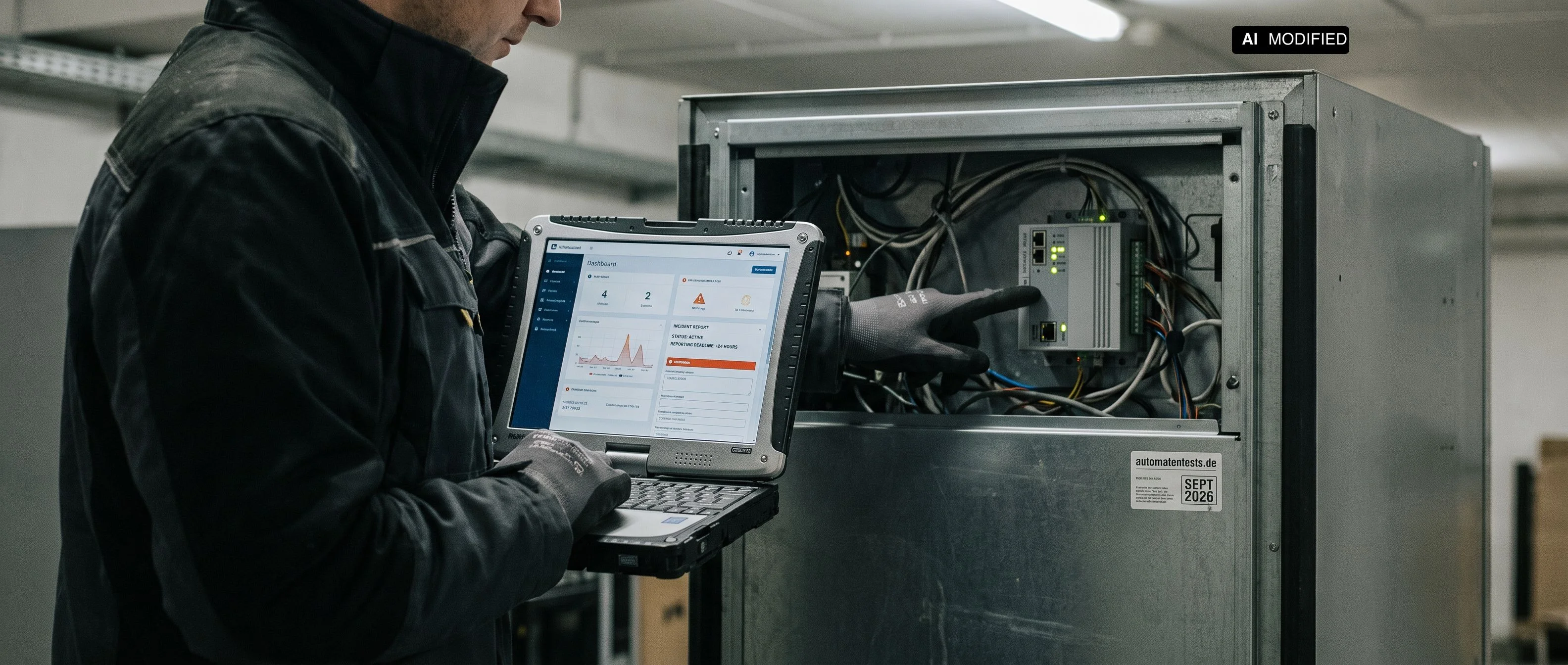
From 11 September 2026, the notification obligations of the Cyber Resilience Act apply. What this means for connected vending machines in the installed base — and what it does not.
 KI Modified
EUDR from 30 December 2026: What the Deforestation Regulation means for coffee in vending machines
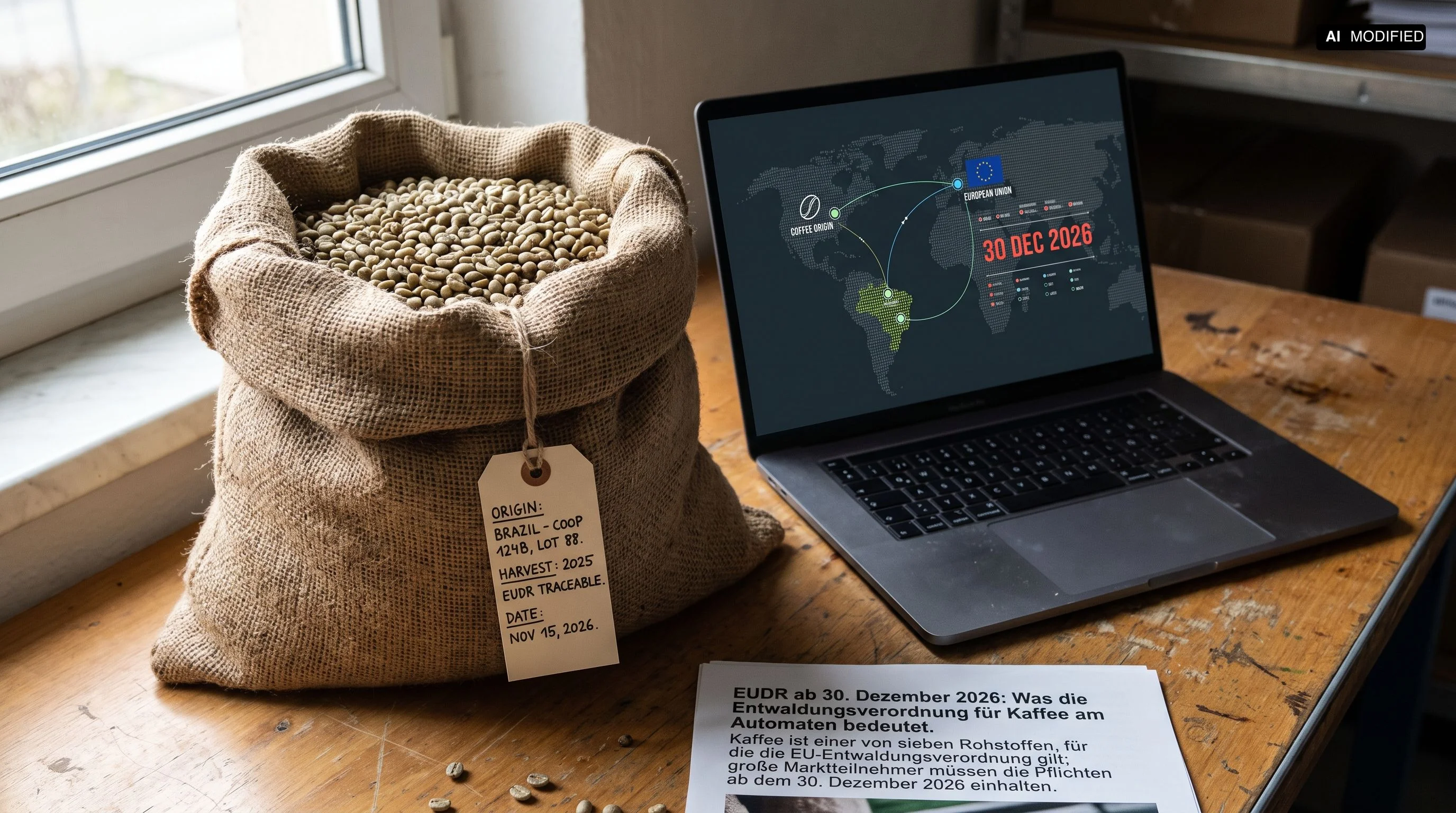
The EU Deforestation Regulation takes effect on 30 December 2026 for coffee too. What vending machine operators need from their suppliers and what they don't need to do themselves.