
Legal & Compliance
Reusable cups at coffee vending machines: what §60 VerpackDG requires from the device
 KI Modified
On this page
Operators of publicly accessible coffee vending machines that dispense and fill a cup on-site must also offer the same beverage in a reusable container at no higher price and no worse conditions. For vending machine distribution, §61 subsection 2 of the Packaging (Amendment) Act permits a simpler approach: it is sufficient to offer customers the option to fill their own reusable container. This transforms a legal question into a device question. Whether a personal cup fits under the outlet determines whether this route is viable at all.
The essentials in brief
- The obligation applies to final retailers of single-use beverage cups that are filled on-site. Vending machines in workplaces for employee supply only, if not publicly accessible, are exempt.
- For vending machine distribution, the offer to fill a customer-supplied cup fully satisfies the obligation.
- The price for the reusable option must not be higher. This pricing rule also applies to customer-supplied cups.
- Liability for damage from filling third-party containers is limited to intent and gross negligence.
- The critical technical measurement is the usable height between cup rest and outlet. It ranges from 90 millimetres cup rest to 185 millimetres adjustable outlet, and many datasheets omit it entirely.
Who the obligation applies to and who it doesn't
§60 subsection 1 sentence 1 requires final retailers of single-use plastic food containers and single-use beverage cups that are filled on-site to also offer the goods contained in them in reusable containers at the point of service. Sentence 2 explicitly includes closures and lids. A coffee machine that dispenses a cup and then fills it therefore falls under the scope, since the filling occurs on-site.
Sentence 3 is the rule most frequently breached in practice: the sales unit comprising goods and reusable container must not be offered at a higher price or under worse conditions than the same goods in a single-use container. A surcharge for the reusable cup is therefore not permitted. A deposit is not a surcharge; a handling fee would be one.
Sentence 4 contains the exemption, and it is narrower than it first appears. Sentences 1 and 2 do not apply to vending machines in workplaces for employee supply that are not publicly accessible. Both conditions must be met together. A device in an office corridor behind access control falls outside the scope. A device in the same building's foyer, where visitors also approach it, falls within the scope. Clinic entrances, university buildings, railway stations, public cafeterias, service area waiting rooms: all publicly accessible, all covered.
The pathway the law opens for vending machines
§61 bears the heading "Relief provisions for small businesses and vending machines." Subsection 1 applies to businesses with no more than five employees and no more than 80 square metres of sales floor, with part-time staff counted as 0.5 for up to 20 hours weekly and 0.75 for up to 30 hours. For vending machine operation, subsection 2 is relevant, and it imposes no size condition: for vending machine distribution, the obligation may also be fulfilled by offering end consumers the option to fill goods into reusable containers supplied by them.
This is the practical approach. It requires no cup deposit system, no return station, no rinsing infrastructure. It requires that customers can place their cup under the outlet and that a sign informs them.
Three related rules apply. Subsection 2 sentence 2 makes the pricing rule from §60 subsection 1 sentence 3 correspondingly applicable, so a customer-supplied cup must also not be served at a higher price or under worse conditions. Subsection 3 limits liability to end consumers and third parties for damage from filling supplied containers to intent and gross negligence. And subsection 4 makes the notice mandatory: whoever uses the relief provision must inform customers through clearly visible and legible information signs at the point of sale.
A detail often overlooked appears in §60 subsection 3: operators providing reusable containers need only accept returns of those they themselves placed into circulation in the territory. Operators using the vending machine relief and dispensing no reusable cups of their own have no return obligation in this regard.
The measurement where it fails
Operators choosing the customer-supplied cup route rely on a dimension rarely supplied in datasheets: the usable height between cup rest and outlet. Four examples from four manufacturer documents show the range.
Schaerer Coffee Soul states the value most clearly. Its outlet adjusts manually from 65 to 185 millimetres, and a touchless outlet that adapts automatically to cup size is available as an option. 185 millimetres accommodates any standard reusable cup. The device measures 330 by 732 by 576 millimetres, weighs approximately 55 kilograms empty, and is rated at 250 cups per day as recommended use and under 180 cups per hour.
Franke A600 describes its outlet as an automatically height-adjustable combination outlet and lists a cup sensor, but names no maximum cup height in millimetres. Instead, an accessory line is revealing: elevated feet at 100 millimetres. Precisely this is the measure taken when cups no longer fit under the outlet, and that the manufacturer offers it as an option says more about practice than any brochure line. For comparison: the A600 measures 340 by 750 by 600 millimetres, weighs approximately 38 kilograms empty, and operates depending on configuration at 230 volts single-phase at 2.4 kilowatts and 16 amperes, or 380 volts three-phase at 6.3 kilowatts and 16 amperes.
The stand-alone machine with its own cup dispenser calculates differently. For the Rheavendors rhTT1.vho, Rheavendors specifies a cup rest of 90 millimetres and a dispensing range of 165 millimetres, the cup station itself is described at 165 millimetres height and can be equipped with two optional sensors to detect varying cup heights. The product page says nothing about customer-supplied cups. For the laRhea V+ doppio&cup, by contrast, it is explicit: the device accepts small, medium and large cups up to 300 cubic centimetres, and customer-supplied cups are named.
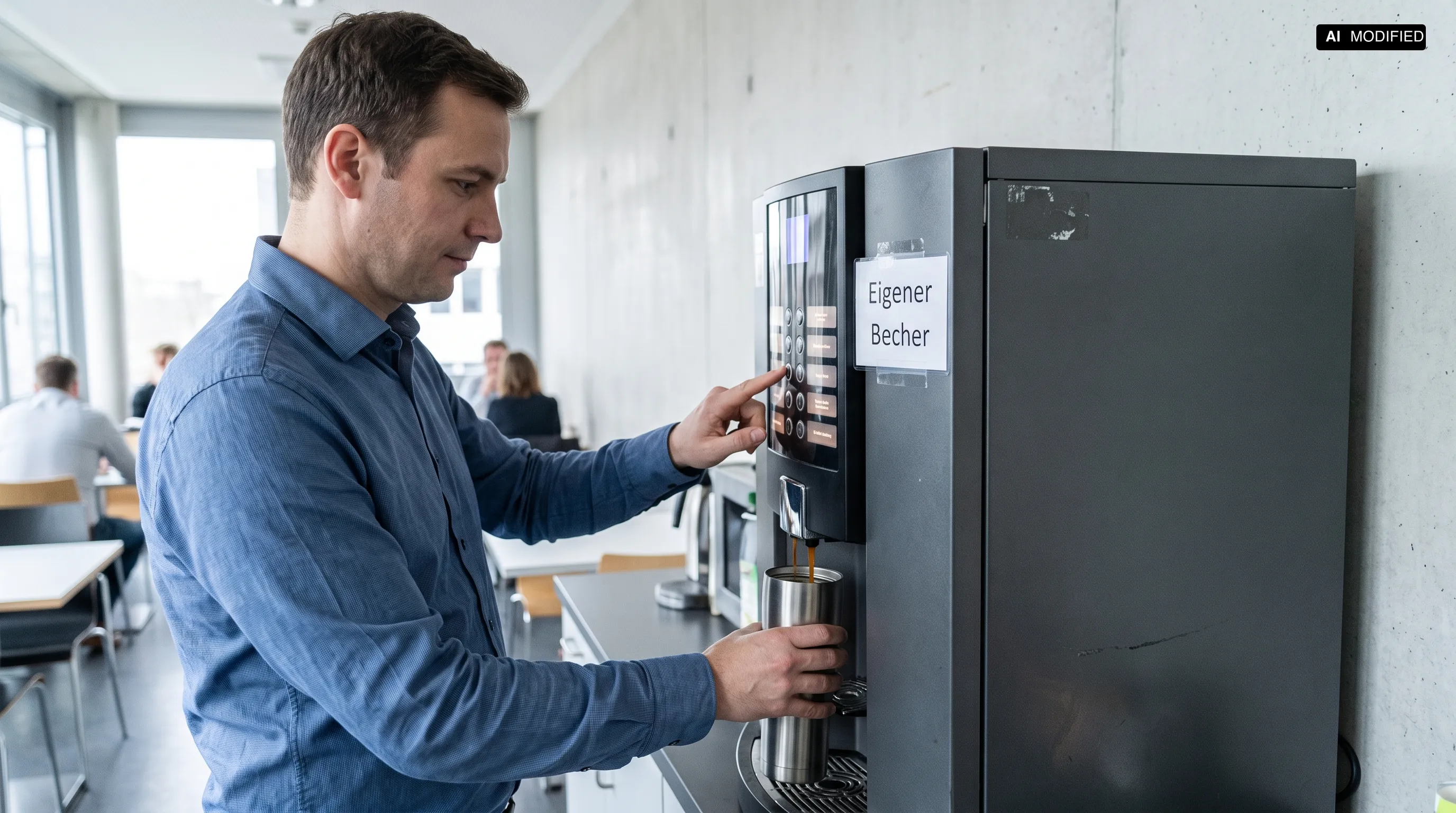
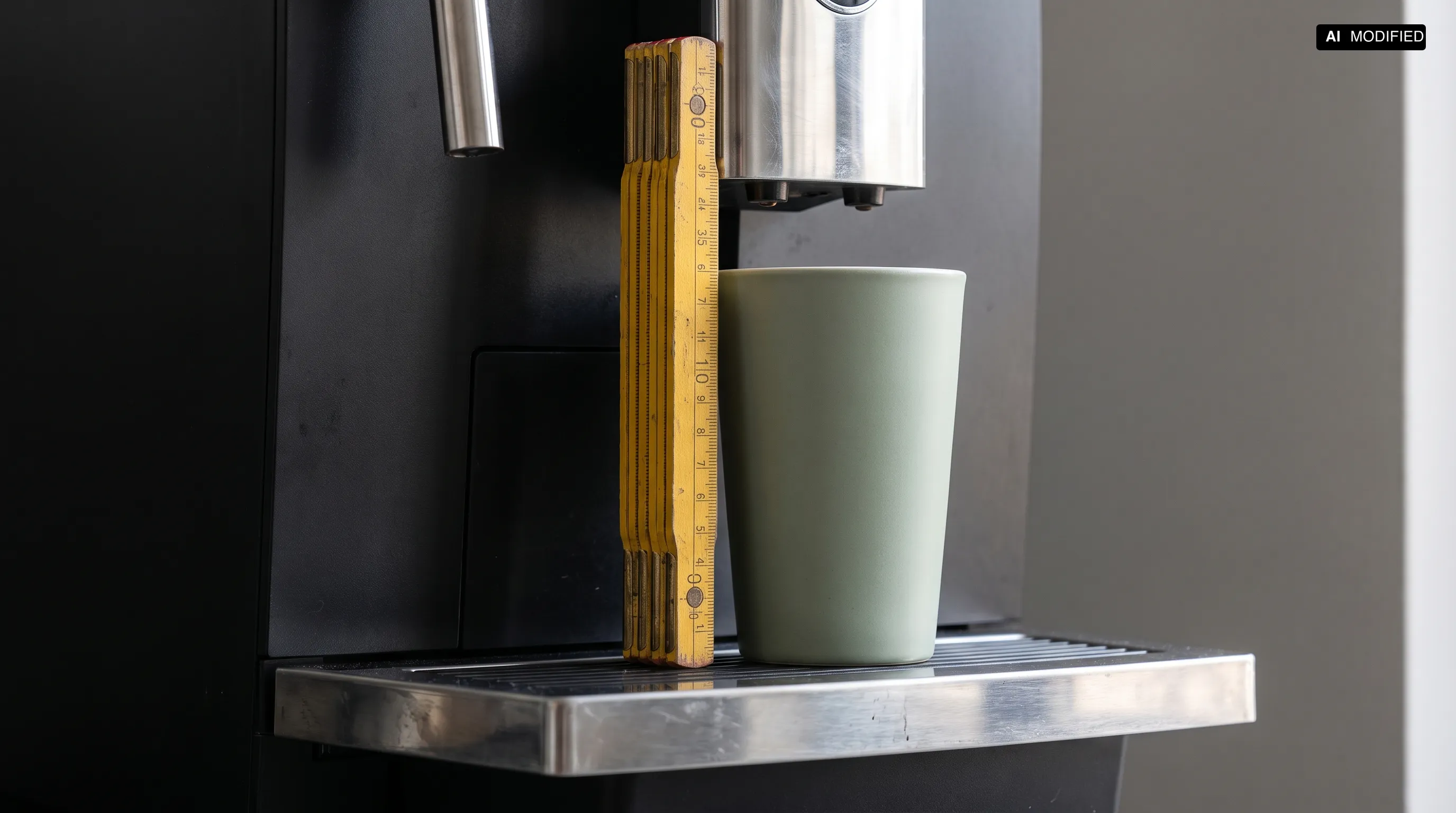
The comparison value on the other side is missing. The Recup product page lists wash cycles and material properties, but no cup heights or diameters. Operators wanting to verify whether the cup actually circulating at their location will fit have no choice but to measure: place cup, position outlet at full extension, note clearance. This is a fifteen-minute task and replaces an assumption that becomes expensive in complaint cases.
What else attaches to the device
With stand-alone machines, the cup comes from the device. Accepting a customer-supplied cup requires the ability to suppress cup dispensing for that transaction, otherwise a cup falls into the customer's container. This is not a mechanical question but a user interface question, and it belongs in the supplier requirements list: a selection option without cup dispensing, visible in the user flow and not hidden in service menus.
The sensors that assist are explicitly described as optional by Rheavendors, not standard equipment. Operators who do not order them rely on customers following the procedure correctly. This works at an office location with regular users; at a railway station, less so.
The outlet itself is the third point. A customer-supplied cup is placed by hand under the outlet, and the tighter the clearance, the more likely the cup rim touches the dispensing tube. This is precisely where the touchless outlet that Schaerer offers as an option is not a comfort feature but a hygiene feature. Operators working without it need a cleaning cycle for the outlet zone that accounts for contact with foreign containers.
What the notice sign must accomplish
Two notice obligations exist, and they are regularly confused. §60 subsection 2 sentence 1 applies to the standard pathway with own reusable offerings: the final retailer must inform customers at the point of sale through clearly visible and legible information signs of the option to obtain goods in reusable containers. §61 subsection 4 sentence 1 applies to the vending machine pathway: operators using the relief provision must inform customers of the option to fill customer-supplied containers. With remote delivery, the notice replaces the sign in the display media used.
A third, entirely separate obligation appears in §47. It concerns not the filled cup but pre-filled beverage containers in the assortment: single-use requires a sign displaying the symbol EINWEG in immediate proximity to the goods, reusable one displaying MEHRWEG, and both must match the price display in size and font. A combination machine with bottles and cans next to the coffee outlet therefore requires both.
The framework appears in §66. A missing or incorrect notice under §60 subsection 2, §61 subsection 4, or §47 is an administrative offense under subsection 1 number 26. Failure to offer the goods in reusable packaging is number 28; offering at a higher price is number 29. All three fall into the lowest penalty category under subsection 3, up to ten thousand euros. The authority designated under state law is responsible.
No transition periods apply. §68 addresses system participation and registration but mentions §60 and §61 nowhere. Both therefore apply as of the date the old Packaging Act was repealed.
Why the obligation is also a lever
The single-use cup costs not only in purchase but additionally in disposal. The reusable cup and the customer-supplied cup do not. Operators reading §60 only as a requirement overlook that every transaction shifting to a customer-supplied cup eliminates two cost positions at once. How large the effect is at one's own location depends on cup price and disposal costs and requires a separate calculation, but the direction is clear.
The checklist before procurement
- Is the installation location publicly accessible? If yes, §60 applies regardless of who pays the invoice.
- What is the usable height between cup rest and outlet, in millimetres and in the most restrictive outlet position?
- How tall is the cup actually circulating at the location? Measure it yourself; do not trust the cup system's brochure specification.
- Can the device's cup dispensing be suppressed for a transaction, and is this choice visible in the user flow?
- Is a sensor for varying cup heights standard equipment or optional, and was it ordered?
- Is the outlet touchless, or must the cleaning cycle account for contact with foreign containers?
- Is the notice sign per §61 subsection 4 mounted on the device, visible and legible?
- Is price equality actually reflected in the point-of-sale system and the price display on the device?
Frequently asked questions
- Does the reusable cup obligation apply to the office building vending machine?
- Only if it is publicly accessible. §60 subsection 1 sentence 4 exempts vending machines in workplaces for employee supply that are not publicly accessible. Both features must be present together. Once visitors, patients or customers can reach the device, the exemption disappears, even if employees are the primary users.
- Must I as an operator purchase my own reusable cups?
- No. §61 subsection 2 permits fulfilling the obligation solely by offering customers the option to fill their own reusable container. For vending machine distribution, this is not tied to any business size requirement. Operators choosing this route need no deposit system and, per §60 subsection 3, must accept returns only of reusable containers they themselves placed into circulation.
- May I charge a different price for a customer-supplied cup?
- Not higher. §61 subsection 2 sentence 2 makes the pricing rule from §60 subsection 1 sentence 3 correspondingly applicable, which prohibits a higher price and worse conditions than the same goods in a single-use cup. A discount is permitted but not required. A surcharge for the special case is the error captured in number 29 of the penalty catalog.
- Who is liable if a customer-supplied cup overflows or breaks?
- The final retailer is liable to end consumers and third parties for damage from filling customer-supplied containers only for intent and gross negligence. This is stated in §61 subsection 3 and is why this pathway is economically viable for operators. The limitation does not excuse a non-functioning device; it excuses the condition of a foreign container.
- What outlet height do I need?
- That depends on the cup, and the value rarely appears in both sets of documentation. The range on the device side extends from 90 millimetres cup rest and 165 millimetres dispensing range on the Rheavendors rhTT1.vho to a manually adjustable 65 to 185 millimetres outlet on the Schaerer Coffee Soul. The Franke A600 names no maximum cup height but offers elevated feet at 100 millimetres as an option. On the cup side, Recup publishes no dimensions on its product page. Therefore, the only option is to measure with the cup at your own location on the device.
Latest on this topic
- EU deposit obligation until 2029: Why 2026 is the reference yearCompliance & News · September 14, 2026
- Packaging tax Freiburg 2026: 50 cents per cup – also for vending machinesCompliance & News · September 6, 2026
- Cyber Resilience Act from 11 September 2026: What it means for connected vending machinesCompliance & News · August 17, 2026
More guides
 KI Modified
Accessibility at vending machines: what the BFSG requires — and what it doesn't
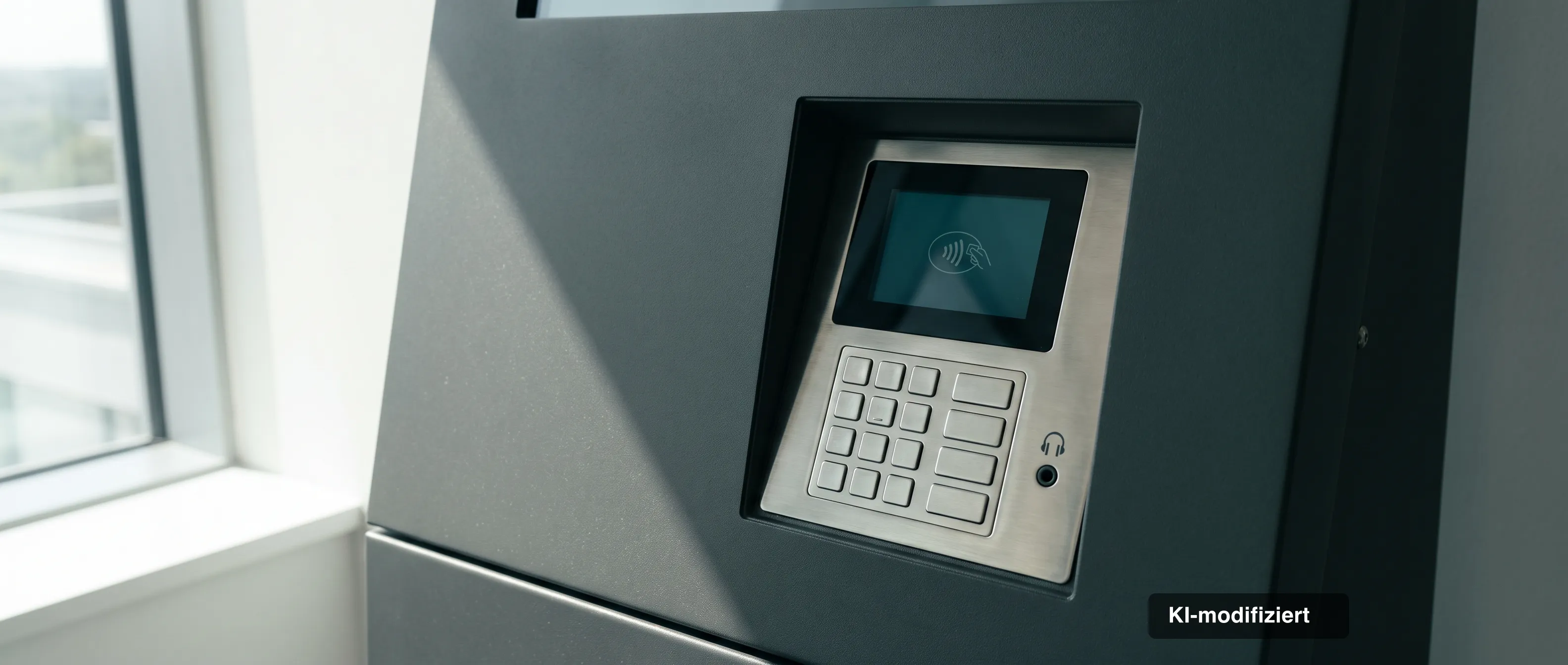
A coffee machine, snack machine, deposit return machine and parcel locker are not covered products under the Accessibility Enhancement Act (BFSG) — but the card payment terminal inside is. What § 1 section 2 number 2 exhaustively lists, which six requirements the regulation places on self-service terminals, and why the frequently cited deadline of 2040 does not appear in the law this way.
 KI Modified
Single-use plastic levy on coffee vending machines: Who really pays it
Who pays the single-use plastic levy on coffee vending machines, what it costs per cup, and which deadlines apply in 2026 and 2027. With calculation for three locations.