
 KI Modified
Market Analysis
BFSG in Vending: Which Vending Machines Must Be Accessible – Now Mandatory
On this page
As of 28 June 2025, the Barrier-Free Strengthening Act (BFSG) is mandatory. The Act transposes EU Directive 2019/882 (European Accessibility Act) into German law and covers a broad range of products and digital services. In the vending industry, the deadline has triggered significant uncertainty: must snack, beverage and coffee machines now be accessible?
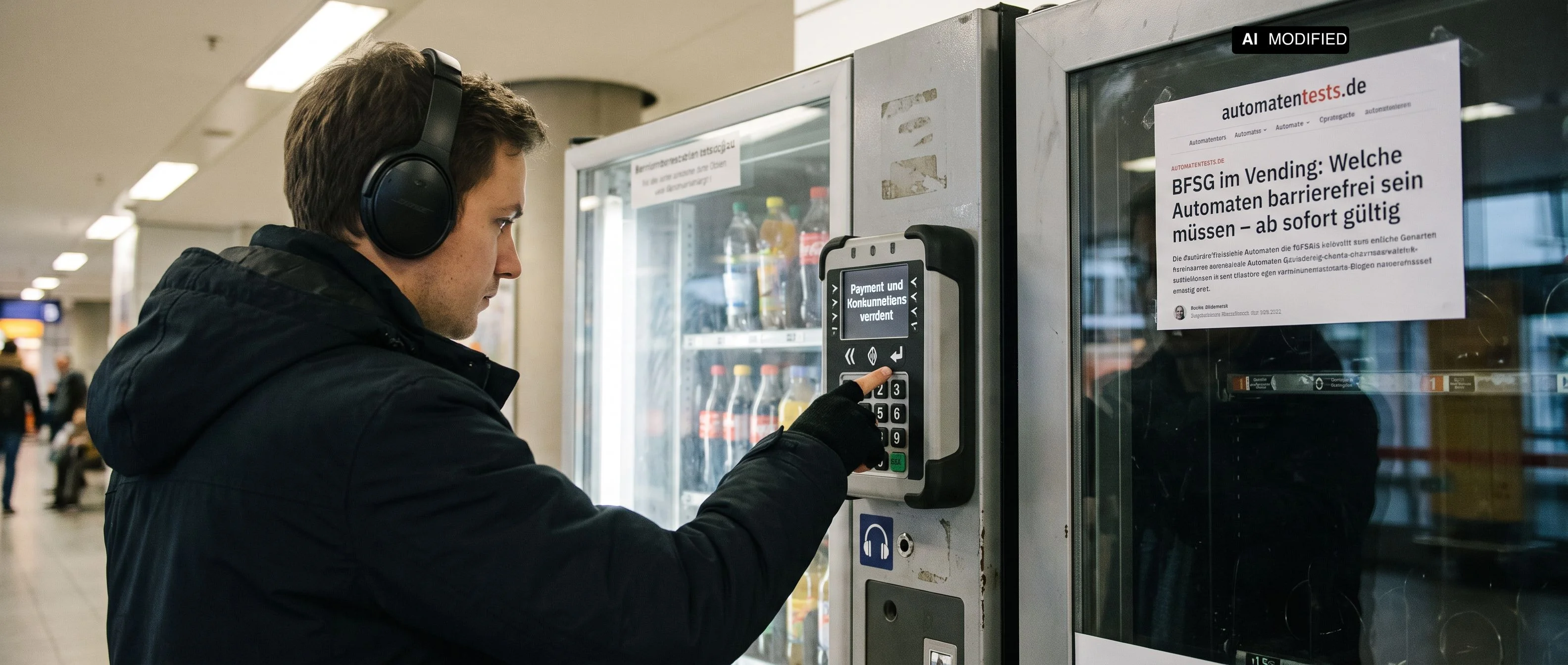
The answer is no—the machines themselves are not subject to the law. However, what does apply immediately affects operators directly: payment terminals placed on the market for the first time as of 28 June 2025 must meet BFSGV requirements. In 2025, 47 per cent of all payments on German vending machines were made by card, with cash dropping to 41 per cent for the first time (Allensbach Study 2025, published by Initiative Deutsche Zahlungssysteme / BDV). Any operator retrofitting or replacing a cashless terminal today must use a BFSG-compliant device.
What Does and Does Not Fall Under the BFSG?
The Barrier-Free Strengthening Act explicitly names payment terminals in § 1 para. 2 no. 3 as covered products. ATMs, ticket vending machines and check-in terminals are also on the list. Vending machines as such are not covered: according to the interpretation of the Federal Association of the German Vending Machine Industry (BDV) and terminal manufacturer CCV, they do not qualify as "self-service terminals" under § 2 no. 25 BFSG. The Federal Accessibility Portal confirms this distinction: typical self-service terminals are ATMs, ticket and check-in terminals. Vending devices are not mentioned.
For operators, this creates the following breakdown:
- Affects operators directly: payment terminals on vending machines newly acquired or installed after 28 June 2025
- Affects operators with digital offerings: pre-order apps and online shops with purchase functionality (WCAG 2.1 AA)
- Not affected: the vending machine itself (beverage, snack, coffee, water)
- Not affected: purely informational websites without ordering or purchase functionality
Of approximately 621,000 German vending machines (BDV Vending Market Study 2024), an estimated 290,000 accept card payment (BDV estimate, single source, low confidence). Each of these terminals, whether replaced now or at its next renewal, is subject to BFSG requirements.
Technical Requirements for Accessible Payment Terminals
1,895 words of mandatory specification can be distilled into seven core requirements from § 7 BFSGV:
- Speech output with adjustable volume and speed
- Headphone jack for single-user operation
- Tactile markings on buttons (tactile identification of numeric keypad)
- High contrast and adjustable font size on display
- Adjustable response times (no hard timeout)
- Reach height between 38 and 122 cm above the floor
- Maximum operating force of 22.2 Newton
Technical compliance is demonstrated via harmonised standard EN 301549:2022-06. Manufacturers have their devices tested to this standard and then issue a declaration of conformity.
A concrete example from vending practice: FEIG ELECTRONIC had its cVEND contactless terminal independently certified as BFSG/EAA-compliant by TÜV SÜD in April 2026. The terminal is designed for unattended use on vending machines, public transport, EV charging stations and parking machines, demonstrating that industry-specific solutions are available. For other common terminal manufacturers in the vending sector (Nayax, CPI, JCM), no public certification evidence was found in the research (as of September 2026, not independently verified).
Transition Rules: New versus Existing Terminals
The BFSG distinguishes sharply between new and already-installed equipment.
New terminals: As of 28 June 2025, every terminal placed on the market for the first time must be BFSG-compliant at the point of sale. This applies without exception, as confirmed by stores+shops and Ingenico.
Existing terminals: § 38 BFSG grants a transition period of up to 20 years from the date of first market placement. A terminal installed in 2023 is thus legally protected until 2043. Worldline confirms this 20-year grace period for existing installations.
The two perspectives are not mutually exclusive: according to stores+shops, market surveillance will intensify from 2030 onwards. Authorities typically focus on new products, not legacy stock. The legal deadline and practical expectations thus create a clear picture: whoever buys today buys BFSG-compliant; whoever installed in 2024 is legally protected, but should plan 2030 as the horizon for their next terminal refresh cycle.
Apps and Websites: When Operators Are Affected
Not only hardware falls under the BFSG. Operators running a pre-order app or online shop must comply with WCAG 2.1 AA. The Federal Centre for Accessibility confirms this requirement for digital services with purchase functionality. Purely informational websites without ordering capability remain outside the BFSG scope according to BDV interpretation (BDV Internal 03/2024).
In practice, this means: if you operate an app pre-order system or web shop for vending products, you need a WCAG 2.1 AA audit and a published accessibility statement. A product overview page without shopping cart is not yet affected.
Fines and Cease-and-Desist Risk
§ 34 BFSG provides for fines of up to EUR 100,000 (Menold Bezler). Market surveillance authorities act proportionately but may actively pursue violations.
More dangerous for most operators is the civil law risk. The Competition Central Office classifies BFSG violations in terminals as violations of the Act Against Unfair Competition (UWG), opening the door to cease-and-desist letters from competitors and trade associations. According to axes4, cease-and-desist proceedings have increased since the deadline.
Micro-enterprises (fewer than 10 employees, revenue below EUR 2 million annually) are exempted from the BFSG for services. Whether vending operators qualify as service providers under this exemption is not legally settled, as Menold Bezler notes. For terminal manufacturers, the exemption does not apply to products.
Checklist: What Operators Should Do Now
- Inventory terminals: document the installation date and model of each payment terminal. Request the market-placement date from your supplier to know the 20-year grace period.
- New purchases: order only BFSG-compliant terminals. Require a declaration of conformity to EN 301549:2022-06 before ordering.
- Apps and online shops: have WCAG 2.1 AA audited and publish an accessibility statement on your platform.
- Purely informational websites: no action required for now, provided no purchase functionality is integrated.
- Legal questions: the Frankfurt Main Chamber of Industry and Commerce offers specific BFSG compliance advice for businesses.
The key principle: the next terminal you replace is the first one where compliance must be verified at purchase. Failure to check now risks intensified market surveillance and civil cease-and-desist letters from 2030 onwards.
Go deeper: related guides
- Cup cost at coffee machines: What a cup really costs the operatorEconomics & TCO · 14 min read
- Retrofit cashless payment to a vending machine: MDB 4.3, costs and selection criteriaFundamentals & Getting Started · 17 min read
- The Ideal Vending Machine Mix: Combining Hot Drinks, Snacks and WaterFundamentals & Getting Started · 14 min read
More news
 KI Modified
EUDR and coffee vending machines: what the EU Deforestation Regulation requires before it applies
Preparing for the EUDR affects coffee vending operators mainly through coffee products, supply chain evidence and business roles—not the machines themselves. This article explains the deadlines from 30 December 2026 and 30 June 2027, and outlines the data operators should start collecting now.
 KI Modified
Commodity Monitor October 2026: Coffee eases, cocoa and sugar in focus
The ICO coffee price fell by 8.7 per cent in September 2026 to 262.18 US cents per pound. The monitor puts the decline in context for vending procurement, presents Fairtrade cocoa minimum prices for Ghana and Côte d’Ivoire separately, and omits a sugar figure because no reliable primary source is available.
 KI Modified
AI in Vending in 2026: Predictive Maintenance and Assortment Optimisation — How to Use the Technology
With 621,000 vending machines in Germany, revenue growth of 18.7% and the EU AI Act in force, AI applications in vending are no longer pilot projects in 2026. Find out which three areas are production-ready, what they deliver in practice and how to get started.