
 KI Modified
Market Analysis
Ecodesign EU 2024: Energy label mandate for all vending machines − what manufacturers and buyers must know now
On this page
Since 1 September 2023, no refrigerated vending machine with an Energy Efficiency Index (EEI) above 80 may be placed on the EU market. This is not the announcement of a future obligation, but existing law: Regulation (EU) 2019/2024 entered into force on 1 March 2021, the second prohibition stage has applied since September 2023. Operators who purchase a refrigerated machine today without checking either the energy label or EEI value risk acquiring a machine that has been placed on the market illegally.
48 TWh of annual electricity savings by 2030 is what the EU Commission estimates as the savings potential of the regulation, equivalent to the annual consumption of approximately five million German households. Regulation (EU) 2019/2024 provides the legal basis for ecodesign minimum requirements; the supporting Delegated Regulation (EU) 2019/2018 governs the A–G energy label.
What is covered, what is not?
A common market misconception: Regulation 2019/2024 applies only to refrigerated machines with a direct sales function. Fully automatic coffee machines, bean-to-cup machines and hot beverage machines are explicitly excluded. There is no mandatory EU energy label for them under this regulation; the voluntary EVA EMP 3.1b continues to apply as the reference protocol, as the EU Commission confirms in its overview.
Clearly covered:
- Refrigerated beverage machines (cans, bottles, juice)
- Snack and combo machines with cooling zone
- Beverage coolers and coolers with direct sales
Those who exclusively distribute or operate fully automatic coffee machines are not affected by 2019/2024. Those who operate refrigerated combo machines must now take action.
Timeline: Three dates that matter
1 July 2019: The EVA (European Vending & Coffee Service Association) withdraws its voluntary Energy Measurement Protocol for refrigerated machines. Since then, EN 50597 (globally: IEC 63252) is the binding measurement standard. Older EMP measurements for refrigerated machines are no longer valid.
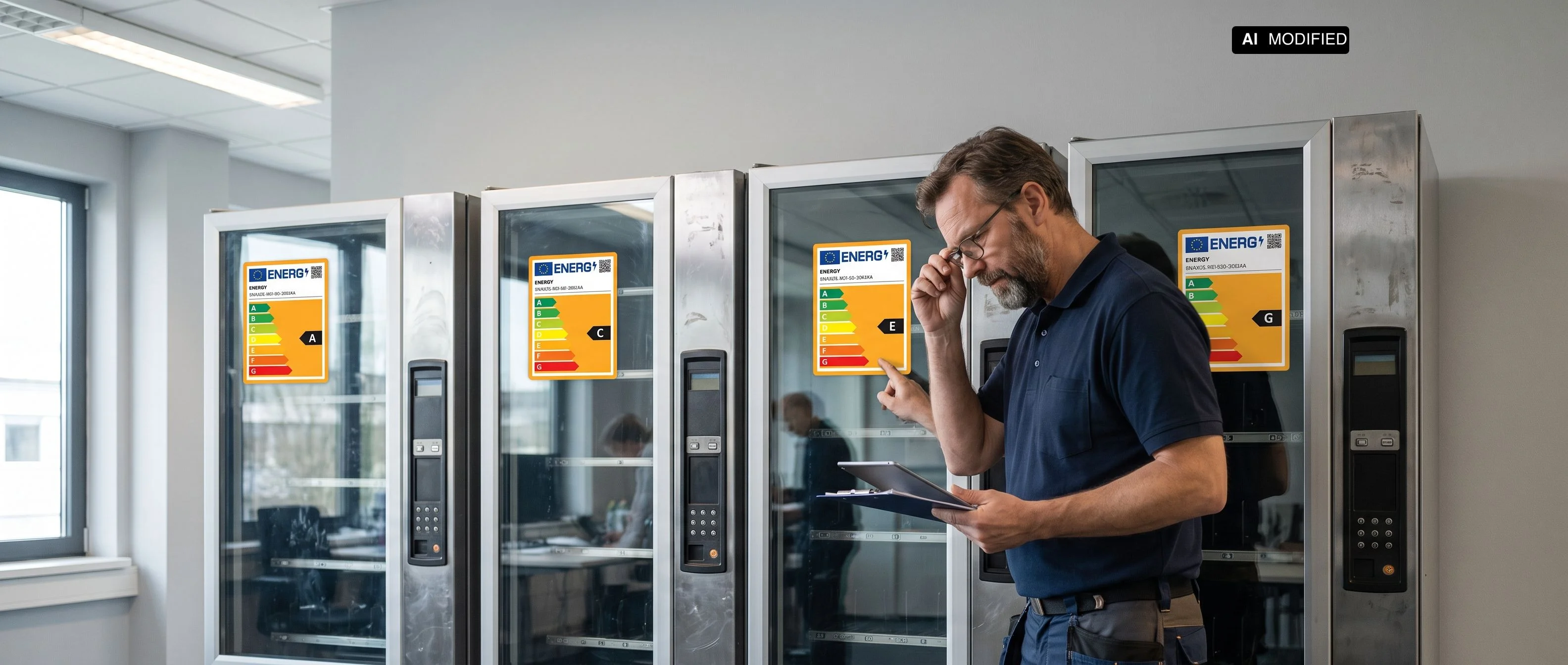
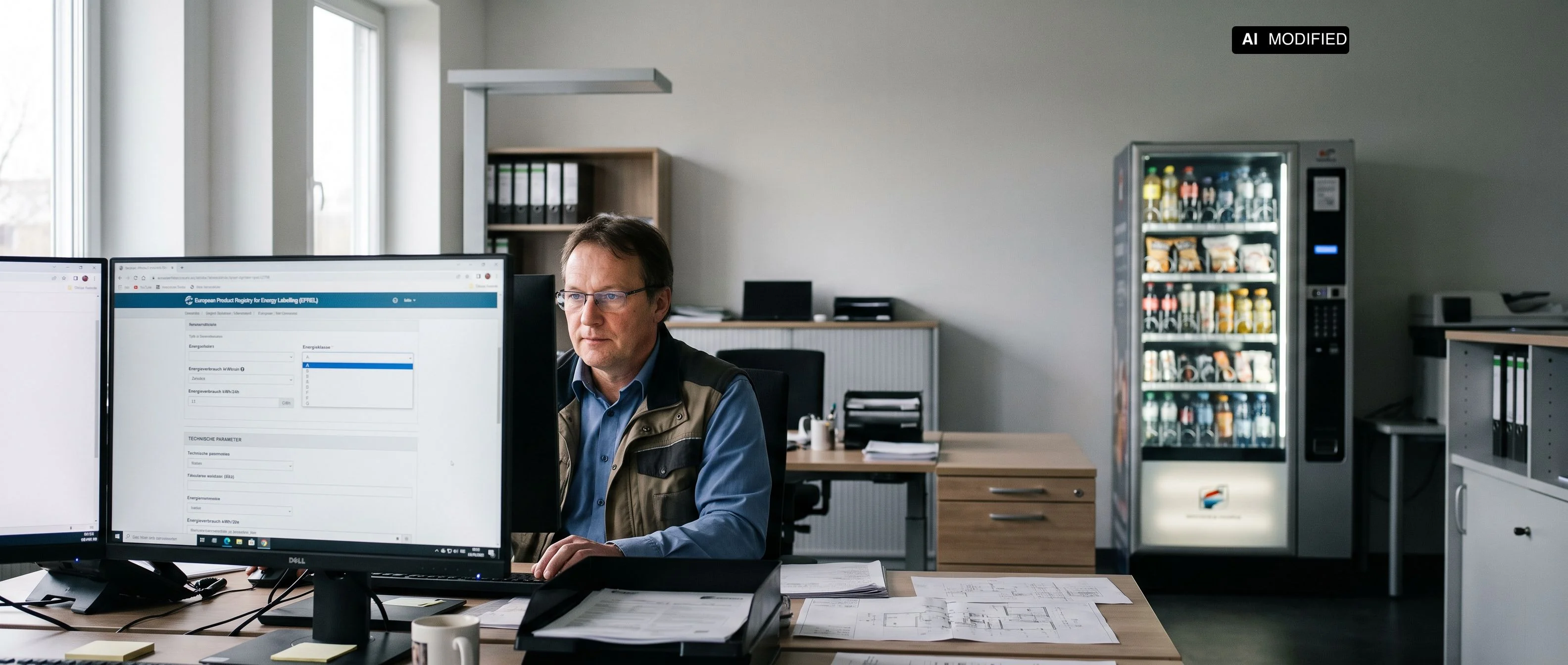
1 March 2021: Both regulations apply EU-wide. EEI limit: ≤ 100. The A–G energy label becomes mandatory for sale of any refrigerated machine. At the same time, every model must be registered in the EU database EPREL before market introduction, including energy class and kWh/24h consumption value.
1 September 2023: EEI limit tightens: ≤ 80. Refrigerated drum and carousel machines remain exempt for now, as these achieve worse values by design and a separate timeline applies. For all other designs: EEI above 80 is a trading ban.
The new A–G label: no more A+
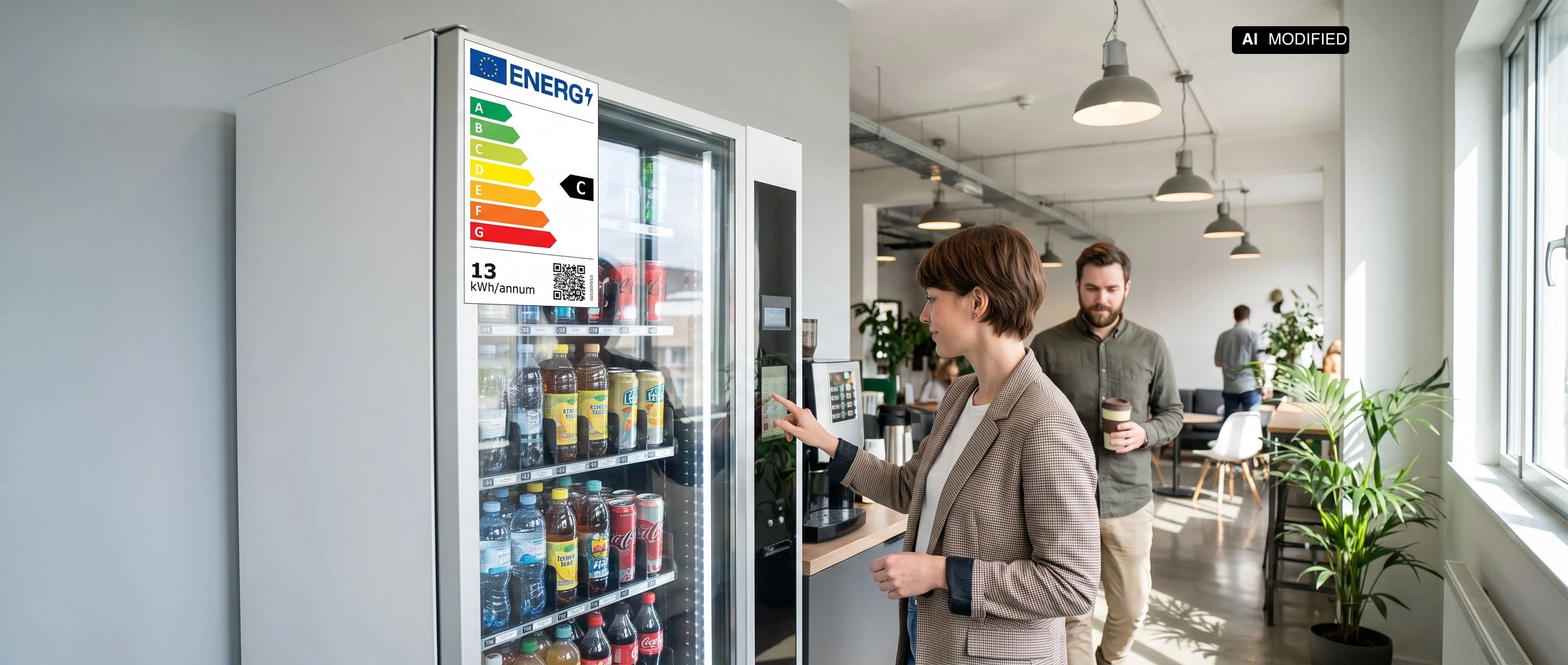
The A–G scale completely replaces the earlier A+/A++/A+++ scheme. A machine displaying an 'A+' label is mislabelled and violates the regulation. The EU deliberately calibrates new label scales so that no machine reaches classes A or B at market launch. This creates innovation headroom for approximately ten years. At launch in 2021, the best refrigerated machines could achieve class C at most, as the EVA documents in its Q&A on the regulation. Closed can and bottle machines performed better than glass-door machines. Drum machines initially ended up at G, which justified the temporary exemption.
Six obligations for manufacturers and distributors
Anyone placing a refrigerated machine with direct sales function on the EU market bears six obligations:
- EPREL registration: Every model must be entered in the EU database EPREL before market introduction, with energy class, kWh/24h consumption and technical parameters.
- CE marking and issue an EU declaration of conformity.
- Energy label affixed physically to the machine. For online sales, a QR code linking to the label applies.
- Technical documentation created and retained for conformity assessment.
- Spare parts obligation: Spare parts must be available within 15 days of order.
- Product data sheet providing all performance parameters.
Violations lie with the distributor, not automatically with the buyer. However, this does not change the fact that an operator with a non-compliant machine in inventory bears a compliance risk as soon as regulatory authorities conduct inspections.
Three steps for operators when purchasing machines
Existing machines in operation do not need to be replaced immediately: there is no usage ban for existing equipment. The risk is borne by the distributor who sells a non-compliant machine. Machines with EEI above 80 nevertheless lose their resale value. Ongoing energy costs are real, even if they do not appear in the purchase price.
When purchasing new refrigerated machines:
- Require the A–G label on the machine. Accept no A+, no alternative certificate.
- Obtain the EEI value from the product data sheet or directly from EPREL and verify EEI ≤ 80.
- Topten EU lists compliant machines with climate-friendly refrigerant for the European market, all with verified energy classes.
Market context: 621,000 machines, 32 per cent affected
Around 621,000 vending machines are in operation in Germany (BDV market study 2024). Of these, 47 per cent are fully automatic coffee machines, which are not covered by 2019/2024. Cold beverage, snack and combo machines with cooling account for around 32 per cent of the European installed base, as documented in the EVA market report 2025. Market revenue Germany 2024: EUR 3.37 billion in product sales, an increase of 18.7 per cent compared to 2023. In a growing market, the requirement affects a large and increasing base of new purchases.
Outlook: ESPR 2024 and what comes next
On 18 July 2024, the new Ecodesign for Sustainable Products Regulation (ESPR, 2024/1781) entered into force. In the long term, it replaces the old Ecodesign Framework Directive 2009/125/EG. New requirements cover the Digital Product Passport, stricter requirements for durability, repairability and recyclability. Existing Regulation 2019/2024 remains valid until specific delegated acts under the ESPR framework replace it. When this will occur for vending machines is not yet determined (as of September 2026, not independently confirmed).
Manufacturers who invest today in R290-based refrigeration technology and compliant energy efficiency reduce the risk of further retrofit when delegated acts under the ESPR framework establish concrete requirements. Regulation 2019/2024 is one step in a longer regulatory chain, not the last.
Last updated: September 2026
Go deeper: related guides
- Cup cost at coffee machines: What a cup really costs the operatorEconomics & TCO · 14 min read
- Retrofit cashless payment to a vending machine: MDB 4.3, costs and selection criteriaFundamentals & Getting Started · 17 min read
- The Ideal Vending Machine Mix: Combining Hot Drinks, Snacks and WaterFundamentals & Getting Started · 14 min read
More news
 KI Modified
EUDR and coffee vending machines: what the EU Deforestation Regulation requires before it applies
Preparing for the EUDR affects coffee vending operators mainly through coffee products, supply chain evidence and business roles—not the machines themselves. This article explains the deadlines from 30 December 2026 and 30 June 2027, and outlines the data operators should start collecting now.
 KI Modified
Commodity Monitor October 2026: Coffee eases, cocoa and sugar in focus
The ICO coffee price fell by 8.7 per cent in September 2026 to 262.18 US cents per pound. The monitor puts the decline in context for vending procurement, presents Fairtrade cocoa minimum prices for Ghana and Côte d’Ivoire separately, and omits a sugar figure because no reliable primary source is available.
 KI Modified
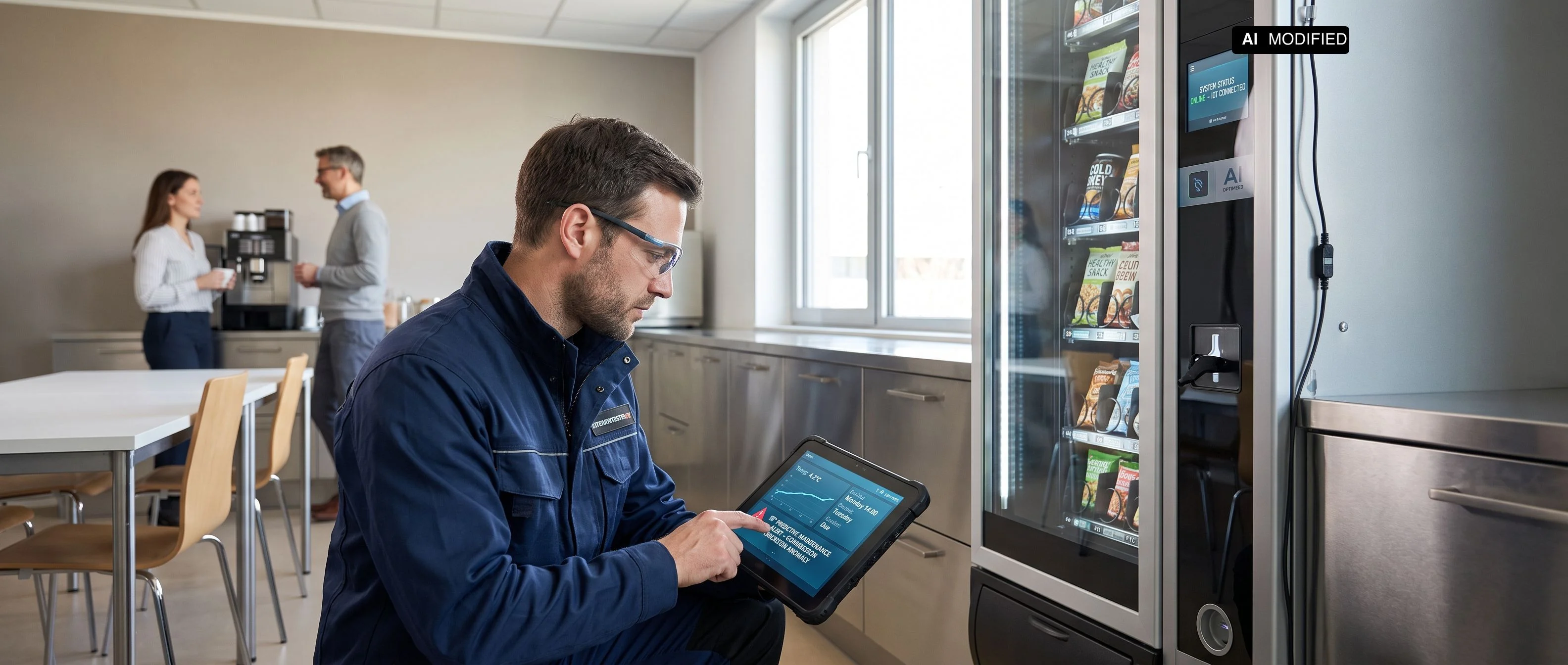
AI in Vending in 2026: Predictive Maintenance and Assortment Optimisation — How to Use the Technology
With 621,000 vending machines in Germany, revenue growth of 18.7% and the EU AI Act in force, AI applications in vending are no longer pilot projects in 2026. Find out which three areas are production-ready, what they deliver in practice and how to get started.