
 KI Modified
Market Analysis
Single-Use Plastics Fund: Levy rates due for review at year-end
On this page
Single-Use Plastics Fund: Levy rates due for review at year-end
The rate at which vending machine operators pay into the single-use plastics fund is not permanent. Section 14, subsection 3 of the Single-Use Plastics Fund Act requires that levy rates be regularly reviewed at least every three years and adjusted as needed. They were established through regulation that the Environment Ministry was required to issue by 31 December 2023 under subsection 1 of the same provision. The first three-year review period thus concludes at the end of this year.
The law was most recently amended on 13 July 2026 through Article 5 of the law in Federal Law Gazette 2026 I Number 207. Anyone using the 2024 version has an outdated text.
What applies today
The Single-Use Plastics Fund Regulation specifies in Section 2 an amount in euros per kilogram of product mass for each product category. For beverage cups, it is 1.236 euros. For comparison, food containers are listed at 0.177 euros, non-deposit beverage containers at 0.181 euros, and deposit beverage containers at 0.001 euros.
The cup is thus the most expensive of these four categories—nearly seven times the rate for non-deposit beverage containers and more than a thousand times the rate for deposit beverage containers. For an operator dispensing coffee in single-use cups, this is the position that affects them.
Converted to a standard vending machine cup of 4.00 grams, this amounts to 0.49 cents per cup. A location with 100 cups per day puts 146.00 kilograms of cup material into circulation annually and pays 180.46 euros in levies.
Why the review is not a blank check
The adjustment does not follow budget availability. Section 14, subsection 2 ties the determination to four principles: the cost-recovery principle, the cost overrun prohibition, the cost efficiency principle, and the transparency principle. The rate is intended to cover exactly the costs that the fund actually reimburses—no more and no less.
This means the direction of the adjustment depends on an empirical question: How much have the eligible municipalities actually drawn down in the first years, and how much has been collected? If payments are below revenue, the cost overrun prohibition supports a reduction. If they exceed revenue, the cost-recovery principle requires an increase.
The ministry is advised by the Single-Use Plastics Commission, which Section 24 of the law establishes. Its role is explicitly stated there: It advises on the review and adjustment of levy rates under Section 14, subsection 3.
What this means for your own cost calculation
The levy depends linearly on mass and linearly on the rate. Those who know their annual kilograms can calculate the effect of any rate change themselves, without waiting for guidance.
For a location with 100 cups per day and 146.00 kilograms per year, every 10 percent change in the rate means a change of 18.05 euros per year. At 200 cups per day, it is 36.09 euros. Measured against the other line items in a cup cost calculation, this is a small amount—but it is calculable, and that is the point.
The real preparation is therefore not legal but accounting: Know the mass of your cups in grams, and know how many units you dispense per year. You need both numbers anyway for the annual report that Section 11, subsection 1 requires by 15 May. Those who have them need only multiplication for any future rate change, not consultation.
The further timeline
Beyond the rate review, there is a second deadline in the law. Section 28 requires the Federal Government to evaluate the effectiveness of the regulations with respect to achieving the goals by 31 December 2027. This is the more fundamental review: It asks not about the level of the rate, but about whether the instrument works as a whole.
The point system by which funds are distributed to those entitled to reimbursement is also subject to the same three-year rule—Section 23, subsection 4 requires exactly the same regular review at least every three years.
New as of this year is also a group that was previously unaffected: Manufacturers of fireworks who commenced their activity before 1 January 2026 must register with the Federal Environment Agency by 31 December 2026; their first data report is due by 15 May 2028. For vending machine operators, this changes nothing, but it shows that the circle of those obligated to pay is expanding, not shrinking.
What to do now
Three things, all three manageable without outside help:
- Replace your copy of the law with the current version from 13 July 2026 if you are using a saved copy
- Find your annual mass in kilograms from your last report and place it next to the rate of 1.236 euros
- Plan your report for 15 May of next year now, regardless of whether the rate changes
Should the regulation be amended, the new figure will appear in the same place: Section 2 of the Single-Use Plastics Fund Regulation. We will update the change here as soon as it appears in the Federal Law Gazette.
Status: 10 September 2026. All regulations reviewed in full text at gesetze-im-internet.de; the levy rates come from Section 2 of the regulation in the version retrieved. Whether and how the rates will be adjusted was not published as of the reference date—this article names the deadline and the binding principles, not an outcome.
Go deeper: related guides
- Cup cost at coffee machines: What a cup really costs the operatorEconomics & TCO · 14 min read
- Retrofit cashless payment to a vending machine: MDB 4.3, costs and selection criteriaFundamentals & Getting Started · 17 min read
- The Ideal Vending Machine Mix: Combining Hot Drinks, Snacks and WaterFundamentals & Getting Started · 14 min read
More news
 KI Modified
EUDR and coffee vending machines: what the EU Deforestation Regulation requires before it applies
Preparing for the EUDR affects coffee vending operators mainly through coffee products, supply chain evidence and business roles—not the machines themselves. This article explains the deadlines from 30 December 2026 and 30 June 2027, and outlines the data operators should start collecting now.
 KI Modified
Commodity Monitor October 2026: Coffee eases, cocoa and sugar in focus
The ICO coffee price fell by 8.7 per cent in September 2026 to 262.18 US cents per pound. The monitor puts the decline in context for vending procurement, presents Fairtrade cocoa minimum prices for Ghana and Côte d’Ivoire separately, and omits a sugar figure because no reliable primary source is available.
 KI Modified
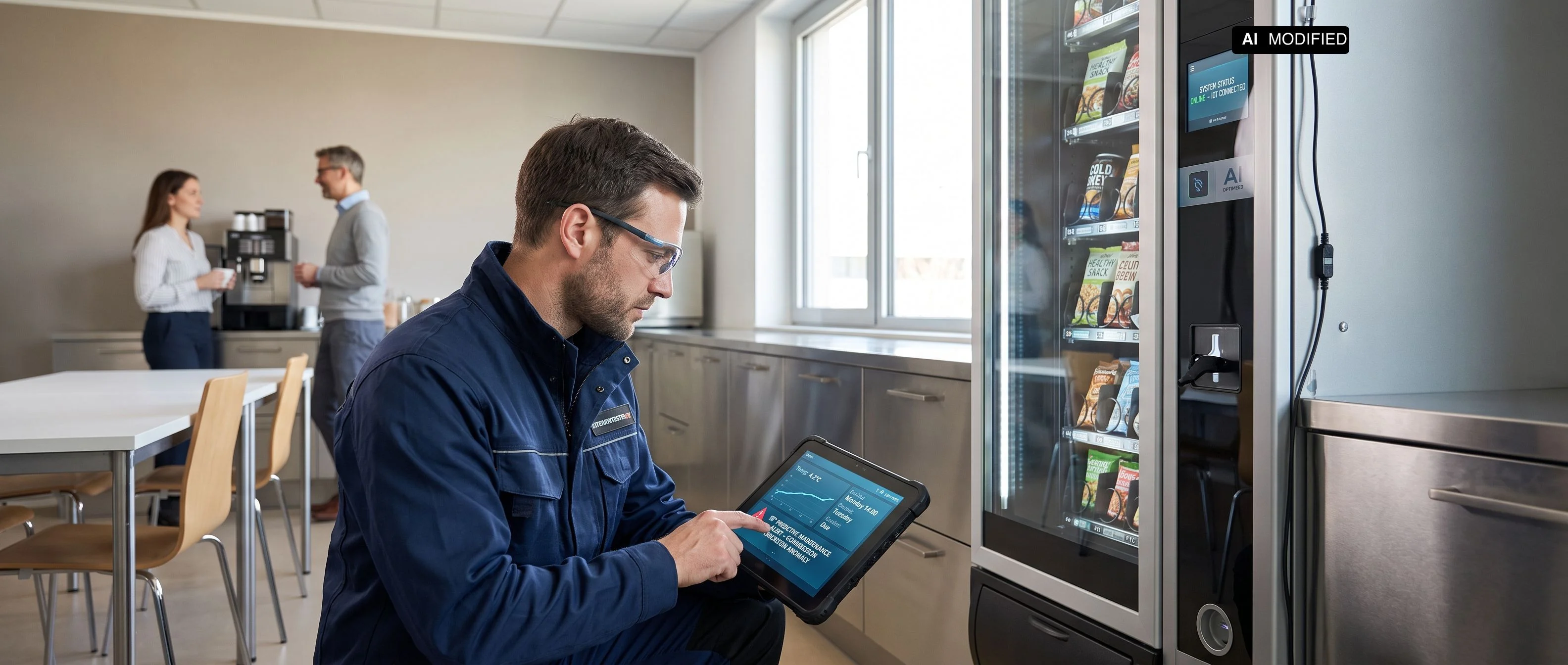
AI in Vending in 2026: Predictive Maintenance and Assortment Optimisation — How to Use the Technology
With 621,000 vending machines in Germany, revenue growth of 18.7% and the EU AI Act in force, AI applications in vending are no longer pilot projects in 2026. Find out which three areas are production-ready, what they deliver in practice and how to get started.