
 AI MODIFIED
Market Analysis
PPWR and Germany’s Packaging Rules: What Vending Operators Should Check
On this page
This article was created with AI assistance and checked automatically. A human review before publication is not documented.
PPWR and Germany’s Packaging Rules: What Vending Operators Should Check
As of 24 October 2026, vending operators in Germany need to consider two related changes: the EU Packaging and Packaging Waste Regulation (PPWR) has begun to apply, and Germany’s current VerpackDG took effect on 12 August 2026, replacing the previous Verpackungsgesetz. The PPWR applies in phases, so its provisions do not all start on the same date. For vending operators, the immediate practical question is narrower: whether the reusable-offer duties in VerpackDG §§ 60–61 apply to a particular machine, product and sales setting.
Those duties concern specified single-use plastic food containers and single-use beverage cups filled with goods by the end distributor. The law also provides a specific employee-supply exception for qualifying vending machines installed in a business and not accessible to the public. Where the duty applies, operators should check the statutory route for vending, which includes offering to fill customer-provided reusable containers, and the associated information notice. The details depend on the statutory conditions; a machine’s presence at a workplace alone does not establish that the exception applies. This article summarizes the cited official materials for operational orientation. It is not legal advice and does not determine whether a specific machine or product is covered.
What changed on 12 August 2026?
The key date for operators is 12 August 2026. The Federal Environment Ministry states that the PPWR and Germany’s current VerpackDG took effect on that date, and that the new German law replaced the previous Verpackungsgesetz. The ministry’s legislation information page confirms the start date and replacement. These changes sit alongside one another: the EU regulation has its own phased application, while the German law provides the national framework relevant to the reusable-offer duties discussed here. (Federal Environment Ministry: announcement on the rules taking effect; Federal Environment Ministry: legislation information)
The European Commission describes PPWR application as phased from 12 August 2026. That means operators should not assume that every requirement in the regulation became applicable on that date. The date marks the beginning of application, not a claim that all PPWR obligations started simultaneously. The Commission’s timeline is useful for understanding that distinction; operators should check the specific provision and its applicable date when assessing a particular obligation. (European Commission: PPWR application timeline)
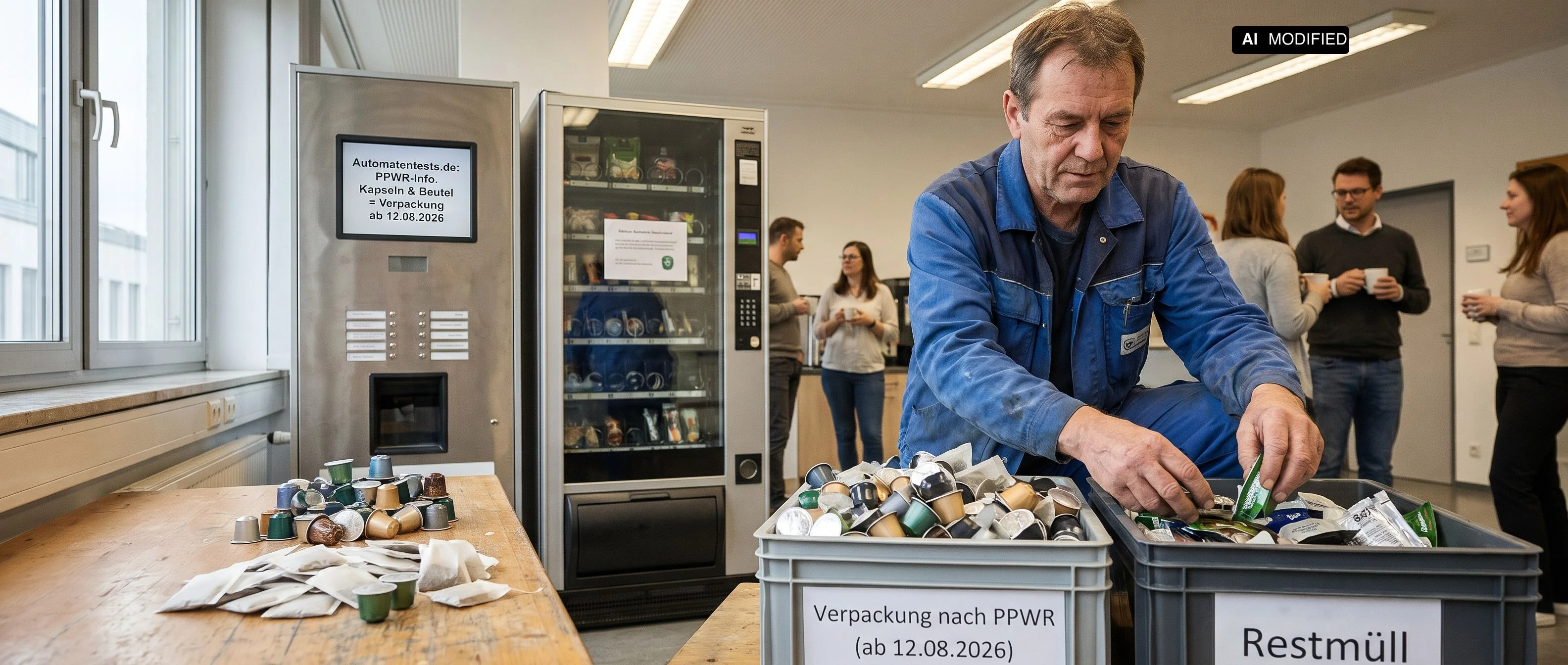
For the German reusable-offer rules, the current statutory text is the relevant reference. VerpackDG §§ 60–61 set out the scope, the vending-related route and related information requirements. The Umweltbundesamt also identifies a PPWR-related packaging change from 12 August 2026: specified tea and coffee bags and certain single-portion units used in machines, including coffee capsules, count as packaging under the PPWR. This is a packaging classification point; it does not by itself establish that the reusable-offer duty in §60 applies to those products. (Umweltbundesamt: packaging questions and answers)
Operators should therefore keep two questions separate in their records: which PPWR provisions apply to the packaging and when, and whether the specific German reusable-offer duty applies to the products and sales setting at a machine. The date is the same starting point, but the rules and conditions are not interchangeable.
When does the reusable-offer duty apply to vending?
VerpackDG §60(1) covers end distributors of specified single-use plastic food containers and single-use beverage cups when the end distributor fills them with goods. The duty concerns offering reusable alternatives. For covered sales, those alternatives may not be priced higher or offered on worse terms; the provision also addresses cup lids and closures. The statutory wording and scope should be checked directly before applying the rule to a product or sales arrangement. (VerpackDG §60)
The law includes a narrow exception for vending-machine sales: the machine must be installed in a business, must not be accessible to the public, and must serve employee supply. All of those conditions matter. A machine being on business premises does not, by itself, establish that it is non-public or that it serves employee supply. Likewise, the exception should not be extended to machines accessible to visitors or other members of the public without checking the statutory conditions. The exception is set out in the final sentence of §60(1). (VerpackDG §60)
Section 60(2) provides an information notice duty for end distributors who are covered by §60(1). The notice is part of the statutory framework and should be considered alongside the offer itself. The relevant question for an operator is first whether the end distributor and sale fall within §60(1), including whether the vending exception applies. If the exception does not apply, the operator should then assess the applicable reusable offer and information duties under the current text.
A vending machine can sell many product types and use different packaging formats. The available sources establish the categories and conditions described above, but they do not classify every product or machine configuration. Operators should document the actual packaging and how goods are supplied, then compare those facts with §60. Where the classification or application is uncertain, the statute and qualified advice are the appropriate next references; a general description of a machine as “workplace vending” is not enough to resolve the legal test.

How can vending operators meet the duty?
VerpackDG §61(2) provides a vending-specific route for end distributors using vending machines: they may fulfil the §60(1) duty by offering to fill customer-provided reusable containers. This route is explicitly tied to the duty in §60(1); operators should first establish that the duty applies and then assess whether this route fits their operation. The provision does not mean that every vending machine must accept any container under all circumstances. (VerpackDG §61)
The law also requires clearly visible and legible information signs for end distributors using the facilitation in §61(1) or §61(2). It does not prescribe a specific mounting point. Operators should therefore check whether the notice can be seen and read in the relevant customer interaction with the machine, while avoiding an unsupported assumption that the statute mandates one exact position. The applicable statutory wording is the basis for the notice check. (VerpackDG §61)
Section 61(3) addresses liability for damage caused when filling customer reusable containers. It limits liability to cases of intent and gross negligence. That is the statutory limit identified in the source; it should not be paraphrased as a general waiver of responsibility or treated as resolving every possible dispute about a filling process. Operators should keep the operational procedure consistent with the legal route they rely on and ensure that staff or service partners understand the intended handling.
A practical review can follow the legal sequence. First, determine whether §60(1) applies to the end distributor, product and packaging. Second, check whether the employee-supply exception applies to the machine. If not, assess the §61(2) customer-container route and the notice requirement in §61(4). Keep the applicable statutory text with the review record so that any decision can be traced to the conditions actually used. The German Bundestag Research Services paper discusses vending and points to ministry guidance, but it was completed on 11 February 2026 and is not a substitute for the current statute. (German Bundestag Research Services paper on vending)
What should operators check now?
Use a machine-by-machine review rather than applying a single label to an entire site. Record the machine’s location and access conditions: is it installed in a business, is it accessible to the public, and does it serve employee supply? Those are the conditions for the specific vending exception in §60(1). If the facts do not support all of them, do not assume the exception applies. (VerpackDG §60)
Next, inventory the products and packaging relevant to the sales. Identify whether the products are supplied in specified single-use plastic food containers or single-use beverage cups filled with goods by the end distributor, since those are the categories described in §60(1). Separately note PPWR packaging classifications. The Umweltbundesamt identifies specified tea and coffee bags and certain machine-use single-portion units, including coffee capsules, as packaging under the PPWR from 12 August 2026. That fact should not be treated as proof, on its own, that §60’s reusable-offer duty applies. (Umweltbundesamt: packaging questions and answers)
If the reusable-offer duty applies, document the route used. For vending, §61(2) allows the end distributor to meet the §60(1) duty by offering to fill customer-provided reusable containers. Check the required information notice: under §61(4), it must be clearly visible and legible. The statute does not prescribe a particular mounting point, so record how the operator assessed visibility and legibility at the machine. (VerpackDG §61)
Finally, put the date and legal version into the review record. Both the PPWR and Germany’s current VerpackDG took effect on 12 August 2026, while the Commission says PPWR requirements apply in phases. Record which provision is being assessed, rather than treating that date as the start of every PPWR rule. Revisit the assessment when machine access, products, packaging or operating arrangements change. These checks organize the cited requirements; they do not replace a case-specific legal assessment.
Conclusion
For vending operators, the main operational task is to determine whether the reusable-offer duty applies to each relevant sale and whether the employee-only vending exception fits the machine’s actual setting. VerpackDG §60 covers specified single-use plastic food containers and beverage cups filled by the end distributor, sets terms for reusable alternatives, and includes a narrow exception for machines installed in a business, inaccessible to the public and serving employee supply. Section 61 provides a vending route based on offering to fill customer-provided reusable containers, together with a clearly visible and legible notice when the specified facilitation is used.
The PPWR and Germany’s current VerpackDG took effect on 12 August 2026, but the PPWR applies in phases. Operators should distinguish packaging classification under the PPWR from the conditions governing the German reusable-offer duty. A documented review of access, employee supply, products, packaging, container handling and signage gives the operator a traceable basis for follow-up. The cited sources do not settle every machine-specific question, so uncertain cases require review against the current statutory text.
Editorial disclosure: This article was prepared with AI assistance from the cited official sources. It is an informational summary, not legal advice.
Go deeper: related guides
- Cup cost at coffee machines: What a cup really costs the operatorEconomics & TCO · 14 min read
- Retrofit cashless payment to a vending machine: MDB 4.3, costs and selection criteriaFundamentals & Getting Started · 17 min read
- The Ideal Vending Machine Mix: Combining Hot Drinks, Snacks and WaterFundamentals & Getting Started · 14 min read
More news
EUDR and coffee vending machines: what the EU Deforestation Regulation requires before it applies
Preparing for the EUDR affects coffee vending operators mainly through coffee products, supply chain evidence and business roles—not the machines themselves. This article explains the deadlines from 30 December 2026 and 30 June 2027, and outlines the data operators should start collecting now.
Commodity Monitor October 2026: Coffee eases, cocoa and sugar in focus
The ICO coffee price fell by 8.7 per cent in September 2026 to 262.18 US cents per pound. The monitor puts the decline in context for vending procurement, presents Fairtrade cocoa minimum prices for Ghana and Côte d’Ivoire separately, and omits a sugar figure because no reliable primary source is available.
AI in Vending in 2026: Predictive Maintenance and Assortment Optimisation — How to Use the Technology
With 621,000 vending machines in Germany, revenue growth of 18.7% and the EU AI Act in force, AI applications in vending are no longer pilot projects in 2026. Find out which three areas are production-ready, what they deliver in practice and how to get started.