
 KI Modified
Market Analysis
EWKFondsG 2024: Single-Use Plastics Fund — Reporting Obligations, Penalties & Implementation Guide
On this page
- From 2024: The Levy Obligation — What Operators Must Know Now
- Who is a "Manufacturer" Under the EWKFondsG?
- Which Products Fall Under the Act?
- Levy Rates Under the EWKFondsV
- Reporting Obligations: Deadlines, Process, Nil Reports
- Registration Deadlines and Distribution Ban
- Penalties: Up to €100,000 in Fines
- DIVID and LUCID: Two Systems, Two Obligations
- What This Means for the Vending Industry
- Checklist: Implementation in Six Steps
From 2024: The Levy Obligation — What Operators Must Know Now
Since 1 January 2024, the Single-Use Plastics Fund Act (EWKFondsG) requires manufacturers of certain single-use plastic products to register with the Federal Environment Agency, file annual quantity reports and pay a statutory levy. Missing deadlines risks penalties up to €100,000 and a distribution ban. The legislation implements EU Directive 2019/904/EU on Single-Use Plastics into German national law and is administered by the Federal Environment Agency (UBA) via the DIVID platform.
Last updated: 2026-09-24
Who is a "Manufacturer" Under the EWKFondsG?
A manufacturer is any person who first places single-use plastic products (SUP products) on the market commercially in Germany. The FAQ of the Federal Environment Ministry identifies three core groups:
- Importers who source SUP products directly from abroad and first supply them in Germany
- Producers who manufacture SUP products themselves and place them in circulation in Germany
- Operators who import goods directly from abroad without using a German intermediary
Vending operators who purchase cups and packaging from German suppliers are not manufacturers under the EWKFondsG according to Federal Environment Ministry guidance. The registration and levy obligation rests with the domestic first supplier. Exception: anyone importing cups or packaging directly from abroad becomes a manufacturer themselves and must register. Since the boundary between domestic purchase and direct import can be fluid in practice, the Central Association of German Trades (ZDH) recommends individual review for mixed models.
Which Products Fall Under the Act?
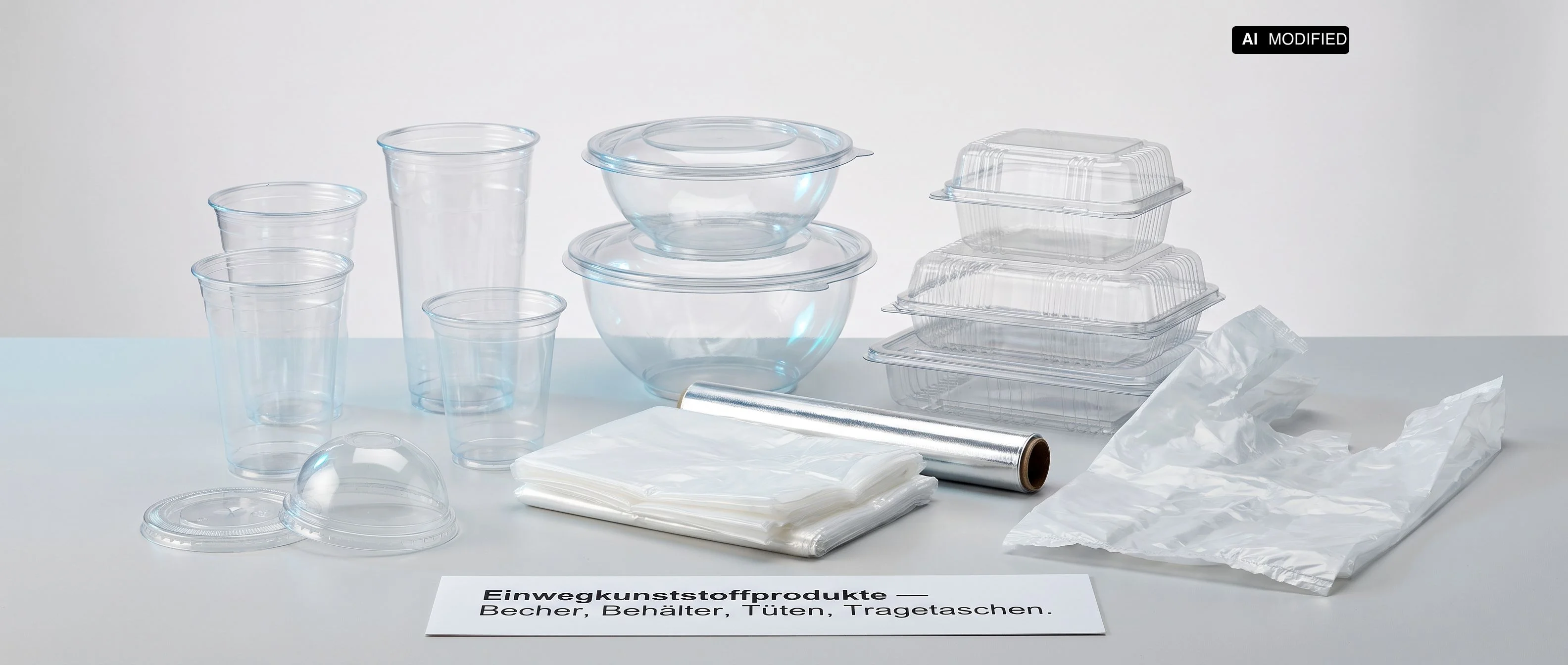
The EWKFondsG covers a statutory defined list:
- Single-use plastic beverage cups (including lids)
- Plastic food containers (e.g. salad bowls, snack boxes)
- Bags and film packaging
- Lightweight plastic carrier bags
- Wet wipes
- Balloons
- Tobacco products with plastic filters
For vending operators, the focus is the single-use coffee cup: as a single-use plastic beverage cup, the levy rate is €1.24 per kilogram. For an example calculation we assume 12 grams per cup (0.4 l paper cup with plastic coating); the actual weight is on the cup supplier’s data sheet. With 10,000 cups dispensed per year, the reportable mass is around 120 kg and the levy approximately €149 net. This is not an existential issue for a single site, but for operators running dozens of locations, the amount accumulates quickly.
Levy Rates Under the EWKFondsV
The Single-Use Plastics Fund Ordinance (EWKFondsV) sets levy rates per kilogram based on quantities actually placed on the market in the previous year:
| Product Category | Levy Rate |
|---|---|
| Beverage cups (including lids) | €1.24/kg |
| Food containers | €0.18/kg |
| Bags and film packaging | €0.88/kg |
| Lightweight carrier bags | €3.80/kg |
| Balloons | €4.34/kg |
| Tobacco filters | €8.97/kg |
These rates have applied since the act came into force. A first review is scheduled by end of 2026; whether and to what extent adjustments will follow is not yet publicly quantified. Source: Federal Environment Ministry FAQ and ecopv compliance guide.
Reporting Obligations: Deadlines, Process, Nil Reports
Registered manufacturers file annually by 15 May the quantities placed on the market in the preceding year via the DIVID platform (www.einwegkunststofffonds.de). Reported are product type and mass in kilograms, broken down by product category. The first report for 2024 had to be submitted by 15 May 2025.
Three points often overlooked in practice:
Nil quantities are reportable. If you placed no SUP products on the market in the relevant year, you must still file a nil report. This obligation does not automatically lapse due to inactivity.
UBA estimates if no report filed. If you do not file, the Federal Environment Agency estimates the quantity at its discretion. Experience shows such estimates tend to be disadvantageous to the affected party.
Expert review required above 100 kg. Anyone placing more than 100 kg per product category on the market must have the quantity report reviewed by a registered expert (accountant, tax advisor or equivalent). Below this threshold, the review obligation does not apply. Whether the 100 kg threshold applies per product category or across all categories is not unambiguously documented in the sources reviewed: in case of doubt, calculate per category.
Registration Deadlines and Distribution Ban
€100,000 penalty and distribution ban: these sanctions presuppose that a registration obligation exists at all. The act recognizes two start dates:
- New manufacturers (from 01.01.2024): immediate registration on DIVID upon commencement of business
- Existing businesses (active before 01.01.2024): registration deadline was 31.12.2024
Since 1 January 2025, a distribution ban applies to unregistered manufacturers. Anyone who missed the deadline and continues to place SUP products on the market acts unlawfully. The UBA can prohibit distribution and have goods seized. Re-registration remains advisable to limit further damage. Source: IHK Chemnitz.
Penalties: Up to €100,000 in Fines
The EWKFondsG provides tiered sanctions. According to Menold Bezler Attorneys and Händlerbund:
- Fines up to €100,000 for breaches of registration, reporting or payment obligations
- Default surcharges for late levy payment (exact schedule not publicly quantified)
- Distribution ban for unregistered manufacturers (in force since 01.01.2025)
- Seizure of non-conforming goods
The €100,000 fine range positions the EWKFondsG on par with breaches of the Packaging Act. Whether formal errors in quantity reporting carry the same penalty range as complete failure to register is not yet publicly documented.
DIVID and LUCID: Two Systems, Two Obligations
Registration with LUCID is free of charge according to the Central Agency Packaging Register, while the DIVID levy is charged per kilogram: both obligations can apply to the same operator. DIVID and LUCID are not the same system.
LUCID (Packaging Act / VerpackG): registration and system participation for packaging. Operated by the Foundation Central Registry for Packaging. Anyone placing packaging in circulation pays into the dual system.
DIVID (EWKFondsG / UBA): registration, quantity reporting and levy payment for single-use plastic products. Finances municipal cleaning costs for public spaces, water bodies and awareness campaigns.
Registration with LUCID does not replace DIVID registration. The UBA clarifies the distinction on its EWKFonds page.
What This Means for the Vending Industry
The Federal Association of German Vending Machine Operators (BDV) tracked the legislative process and documented the topic in BDV Intern (02/2022, 02/2023, 02/2024, 02/2025). For machine operators, three concrete scenarios apply:
Standard case — purchasing cups from German supplier: The supplier is the manufacturer under the EWKFondsG. The operator carries no separate registration obligation but bears the levy rate indirectly through purchase price.
Direct import from abroad: The operator becomes the manufacturer and carries all registration, reporting and payment obligations. Anyone sourcing cups directly from the Netherlands or Poland, for example, falls into this category.
Reusables duty parallel: since 1 January 2023, anyone who sells food or drinks in single-use plastic food containers or single-use cups that are filled on site must also offer a reusable alternative (§ 33 VerpackG). For vending machines, § 34(2) VerpackG provides a relief: operators can also meet the duty by offering to fill the product into reusable containers brought by the customer, and must point this out clearly (§ 34(3)). This obligation runs independently of the EWKFondsG and is not a substitute for registration.
Checklist: Implementation in Six Steps
- Clarify manufacturer status. Direct import from abroad = manufacturer. Purchase from German supplier = not a manufacturer under Federal Environment Ministry guidance. Legal review recommended for mixed models or uncertainty.
- Register on DIVID. Platform: www.einwegkunststofffonds.de. For existing businesses, the deadline was 31.12.2024; re-registration remains advisable to avoid the distribution ban.
- Establish quantity documentation. Capture type and kg quantity of all SUP products placed on the market, itemized by category, on an ongoing basis.
- File annually by 15 May. Submit prior-year quantities on DIVID. Do not forget nil reports, even if inactive.
- Expert review above 100 kg. If exceeding the 100 kg threshold per product category, engage a registered expert before filing the report.
- Check LUCID obligations separately. DIVID registration does not replace LUCID registration for products subject to packaging law.
*Sources and transparency: this article is based on publicly available statutory text, government FAQs and association publications (as of September 2026). Individual legal questions should be clarified with a specialist attorney or chamber of commerce.*
Go deeper: related guides
- Cup cost at coffee machines: What a cup really costs the operatorEconomics & TCO · 14 min read
- Retrofit cashless payment to a vending machine: MDB 4.3, costs and selection criteriaFundamentals & Getting Started · 17 min read
- The Ideal Vending Machine Mix: Combining Hot Drinks, Snacks and WaterFundamentals & Getting Started · 14 min read
More news
 KI Modified
EUDR and coffee vending machines: what the EU Deforestation Regulation requires before it applies
Preparing for the EUDR affects coffee vending operators mainly through coffee products, supply chain evidence and business roles—not the machines themselves. This article explains the deadlines from 30 December 2026 and 30 June 2027, and outlines the data operators should start collecting now.
 KI Modified
Commodity Monitor October 2026: Coffee eases, cocoa and sugar in focus
The ICO coffee price fell by 8.7 per cent in September 2026 to 262.18 US cents per pound. The monitor puts the decline in context for vending procurement, presents Fairtrade cocoa minimum prices for Ghana and Côte d’Ivoire separately, and omits a sugar figure because no reliable primary source is available.
 KI Modified
AI in Vending in 2026: Predictive Maintenance and Assortment Optimisation — How to Use the Technology
With 621,000 vending machines in Germany, revenue growth of 18.7% and the EU AI Act in force, AI applications in vending are no longer pilot projects in 2026. Find out which three areas are production-ready, what they deliver in practice and how to get started.