
 KI Modified
Market Analysis
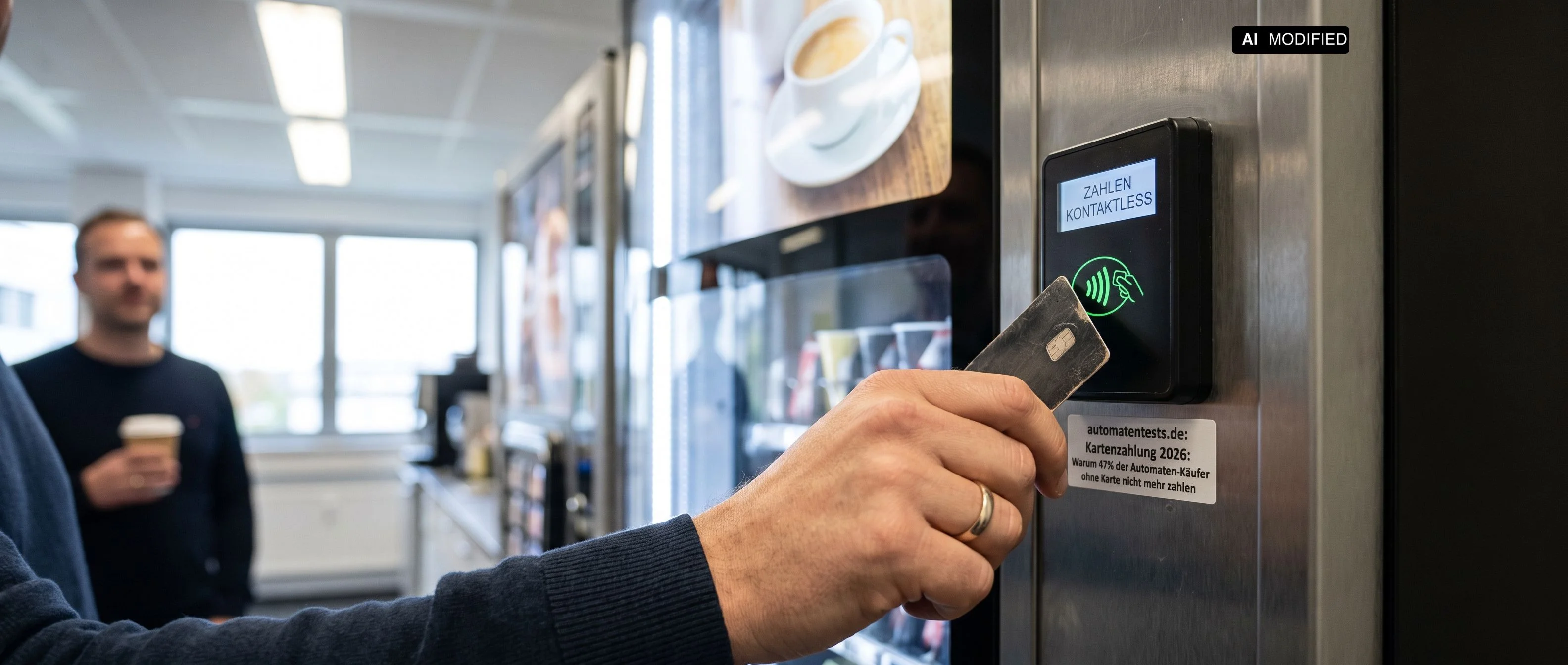
Card Payment 2026: Why 47% of Vending Machine Buyers No Longer Pay Without a Card
On this page
47 percent of Germans paid for their last purchase with a card, only 41 percent with cash: This is the result of the IDZ-Allensbach Study 2025, published on 23 October 2025 by the Initiative Deutsche Zahlungssysteme e.V. Since measurement began in 2006, this is the first time card payment has surpassed cash. In 2024, the shares were still 44 percent card and 48 percent cash; the decline of seven percentage points for cash within one year is the strongest in the study's history.
For vending operators, this is no longer a trend forecast but present reality. The Bundesverband der Deutschen Vending-Automatenwirtschaft (BDV) draws a direct conclusion from the Allensbach data: whoever accepts only coins and banknotes at the vending machine cuts themselves off from roughly 50 percent of all customers willing to pay.
What the 47-Percent Figure Actually Measures
The Allensbach Study asks about the last purchase, not about lasting preferences or self-assessments. This makes the figure more precise than surveys on general payment willingness: it reflects real purchasing situations that respondents had in the days and weeks before the interview.
In parallel, the EHI Retail Institute published its Study on Payment Systems in Retail 2025. In the panel of 499 companies covering 55.3 percent of German retail sales, the card share of revenue was already 63.5 percent. Girocard alone: 41.5 percent. Cash: 33.8 percent of revenue, but still 54.6 percent of transactions. This difference is explained by very small amounts, which are paid in cash more frequently. For vending machines, where many purchases fall in the very small-amount range, this effect is particularly pronounced.
European Vending: From 42% to 15% Cash-Only in Five Years
The European Vending & Coffee Service Association (EVA) documents the structural shift in its Market Report 2025 (data from 2024): 85 percent of the European pay-vend fleet is now equipped with cashless payment, compared to 58 percent in 2019. The share of cash-only machines fell from 42 percent to 15 percent.
Of the machines equipped with cashless payment, 65 percent operate in open-site mode (girocard, credit card, NFC, app) and 35 percent in closed-site mode (corporate card, RFID). The operator market segment—representing roughly 76 percent of the approximately 621,000 German vending machines (BDV Market Study 2024)—is directly affected by this shift, not just the public place segment.
A specific figure for Germany is not available in public sources. The 85-percent figure applies to Europe as a whole and is likely to vary regionally. A Nayax analysis of cashless-equipped UK machines shows where a market tends when terminals are available: up to 80 percent of all transactions cashless, 57 percent of those via mobile phone. Due to Nayax bias and UK context, this figure is not directly transferable to Germany (not independently verified for the German market).
Mobile Payment: What 25 Percent Means
25 percent of Germans paid via smartphone or smartwatch in 2025. In 2022 it was about 12 percent, a doubling in three years. Among those under 30, the share is 42 percent, just below traditional card payment at 45 percent. In a few years, this age group will form the main buyer group at machines in universities, fitness centers, and modern office locations.
The EHI Institute confirms the trend for stationary retail: mobile payment accounted for 12.9 percent of cashless payments in 2024 (2019: 7.5 percent). For machines, this presents a technical point: a current NFC terminal with girocard and credit card acceptance automatically accepts Apple Pay, Google Pay and girocard wallets. Mobile payment support is not a separate implementation issue with modern terminal equipment.
Girocard: Foundation Until 2030
Among holders of multiple payment cards, 52 percent prefer girocard as their primary payment method. Credit cards follow with 15 percent. 77 percent of respondents expect girocard to remain Germany's most-used payment method through 2030.
For operators retrofitting or procuring terminals, this is directly relevant: a terminal without girocard acceptance excludes the majority of card-using customers. The requirements (acquirer agreement, technical specification) are not publicly specified and must be negotiated with the terminal or payment service provider.
At the same time, European payment systems are gaining support: 60 percent of respondents consider European offerings such as girocard and wero important, 15 percentage points more than 2022. 69 percent see independence from US providers (Visa, Mastercard, PayPal) as an advantage. Wero, the European real-time payment system of the European Payments Initiative (EPI), is still rarely deployed at German machines; for operators with long-term planning, it is worth monitoring adoption development from 2027 onwards.
What Operators Should Check Now
Three checkpoints from current study data:
Determine your own equipment rate: What share of your installed base is still cash-only? 15 percent is the European benchmark. Anything above that indicates concrete retrofit need.
Ensure girocard acceptance: Not every NFC solution accepts girocard without a separate acquirer agreement. Transaction fees and technical minimum requirements must be clarified contractually.
Prioritize locations by age structure: 42 percent of those under 30 already pay via mobile. Universities, fitness centers, clinics with young nursing staff, and co-working spaces benefit earlier from retrofit than classic industrial canteens with older workforces.
Technical fundamentals, cost structure, and break-even calculations for card terminals at machines are described in detail in the guide to card payment on this website.
Go deeper: related guides
- Cup cost at coffee machines: What a cup really costs the operatorEconomics & TCO · 14 min read
- Retrofit cashless payment to a vending machine: MDB 4.3, costs and selection criteriaFundamentals & Getting Started · 17 min read
- The Ideal Vending Machine Mix: Combining Hot Drinks, Snacks and WaterFundamentals & Getting Started · 14 min read
More news
 KI Modified
EUDR and coffee vending machines: what the EU Deforestation Regulation requires before it applies
Preparing for the EUDR affects coffee vending operators mainly through coffee products, supply chain evidence and business roles—not the machines themselves. This article explains the deadlines from 30 December 2026 and 30 June 2027, and outlines the data operators should start collecting now.
 KI Modified
Commodity Monitor October 2026: Coffee eases, cocoa and sugar in focus
The ICO coffee price fell by 8.7 per cent in September 2026 to 262.18 US cents per pound. The monitor puts the decline in context for vending procurement, presents Fairtrade cocoa minimum prices for Ghana and Côte d’Ivoire separately, and omits a sugar figure because no reliable primary source is available.
 KI Modified
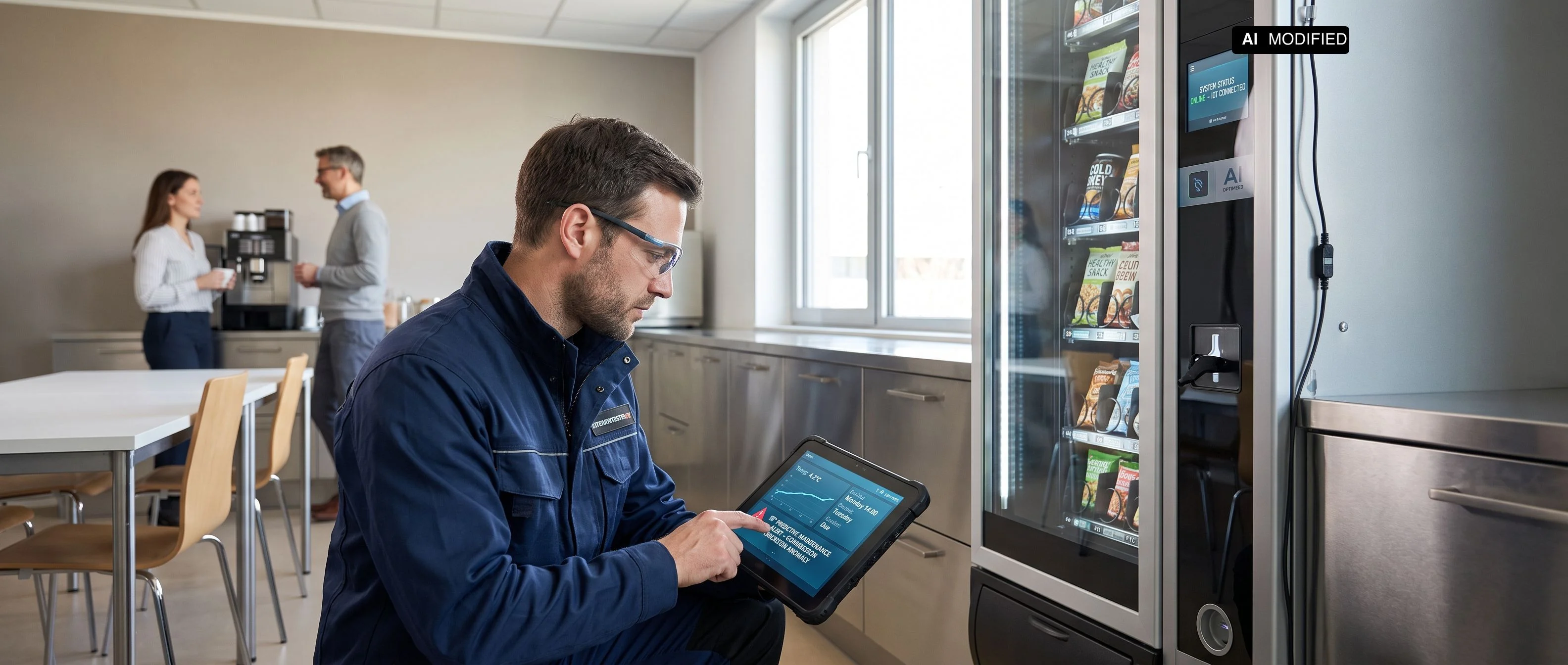
AI in Vending in 2026: Predictive Maintenance and Assortment Optimisation — How to Use the Technology
With 621,000 vending machines in Germany, revenue growth of 18.7% and the EU AI Act in force, AI applications in vending are no longer pilot projects in 2026. Find out which three areas are production-ready, what they deliver in practice and how to get started.