
 KI Modified
Market Analysis
AI in Vending 2026: 5 concrete use cases for operators – from predictive maintenance to assortment optimisation
On this page
- 1. Predictive Maintenance: fewer technicians, less downtime
- 2. Assortment optimisation: what sells in machine 47 doesn't sell in machine 12
- 3. Dynamic pricing: time of day and payment method as levers
- 4. Inventory management and routing: less diesel, less spoilage
- 5. Anomaly detection and fraud protection: attack on every third machine
- EU AI Act: compliance obligations in system selection
- Three prerequisites determine the right starting point
At EVEX 2025 in Split (September 2025, 300 participants from 34 countries), Vendon and Coges presented integrated telemetry systems that predict maintenance needs before a machine fails. The EVA Market Report 2025 shows the volume at stake: Europe's approximately 4.5 million machines generated around 21.8 billion euros in product revenue in 2024, with 85 percent of that through cashless systems. Unplanned outages and suboptimal assortment are no longer acceptable cost factors in this market.
Five AI use cases are proven today in operator environments and deliver measurable results.
1. Predictive Maintenance: fewer technicians, less downtime
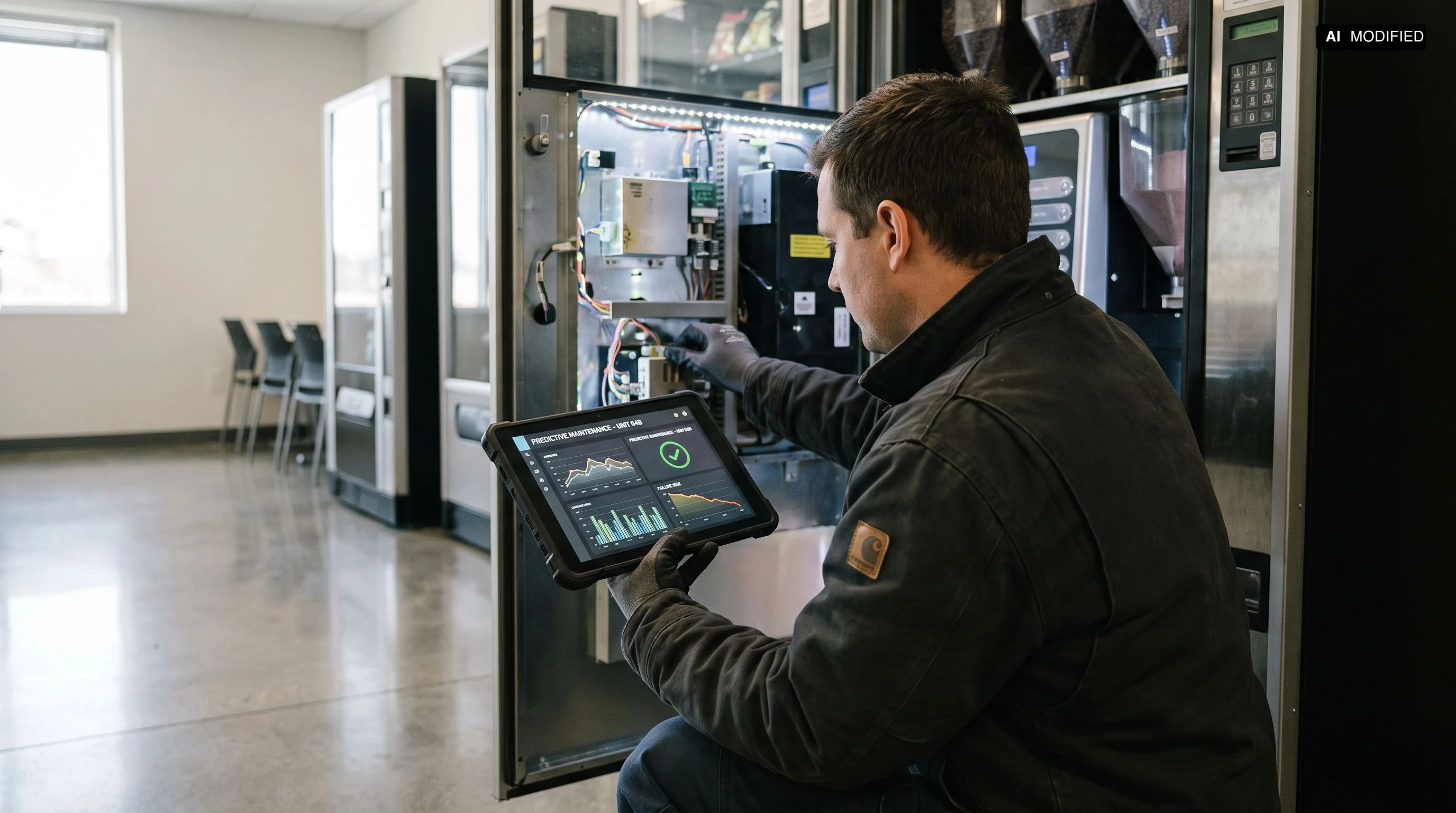
An IoT and ML framework, described in an arXiv preprint (July 2025), analysed 20 machines over six months in simulation. According to the study: 32 percent fewer unplanned outages, 27 percent fewer unnecessary technician visits. The BDV identifies predictive maintenance in BDV Intern (02/2025) as one of the central AI entry points for operators.
The technical foundation is the EVA-DTS Standard 6.2. It transfers telemetry data from the machine to the operator's back office, creating the data foundation without which no ML model can be trained. Anyone who has not yet implemented EVA-DTS cannot deploy predictive maintenance, regardless of which AI platform is selected.
Practical implementation begins with an inventory: what sensor data does your machine fleet already provide? Compressor temperature, door-open frequency, change system failures. The more complete the telemetry, the earlier the model detects anomalies.
2. Assortment optimisation: what sells in machine 47 doesn't sell in machine 12
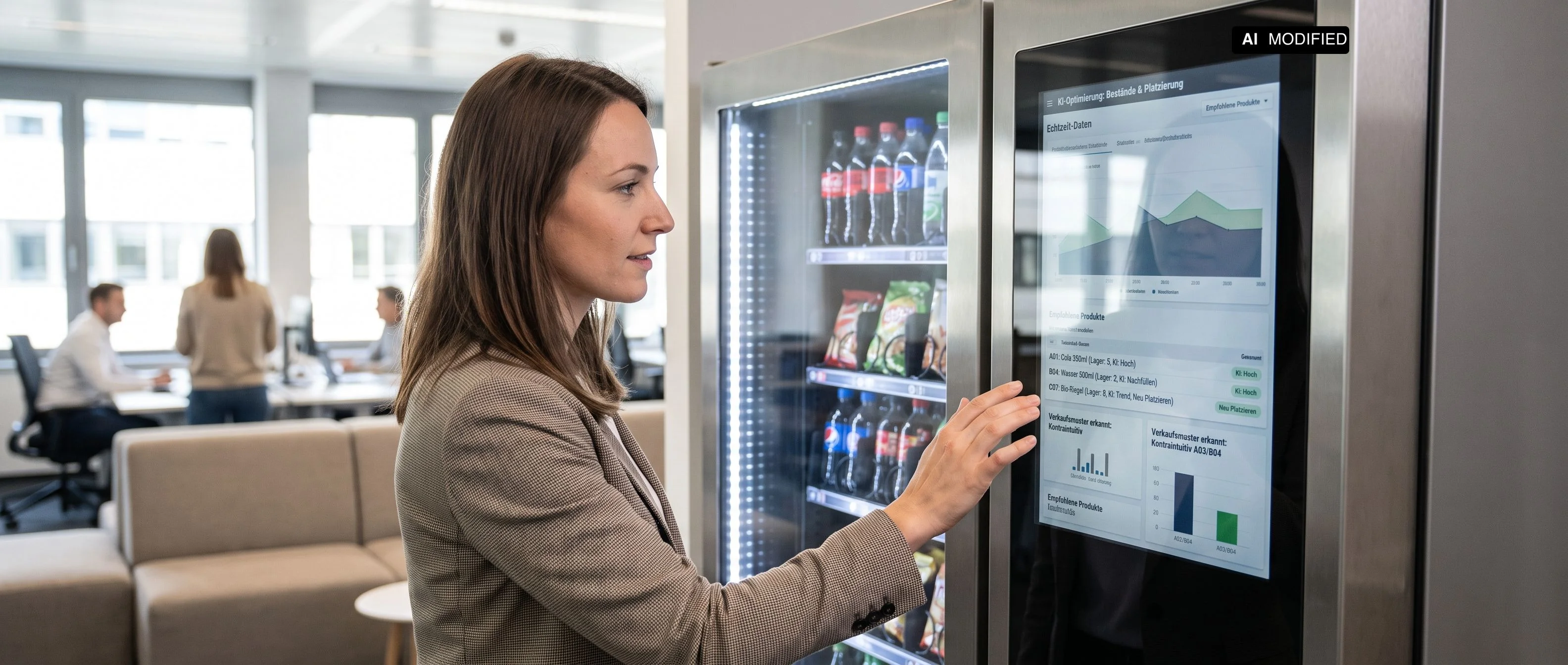
Accent Food Services (Pflugerville, TX) tested Hivery's AI platform for 18 months and reported 20 to 50 percent revenue increase per machine. Reyes Coca-Cola Bottling (Irvine, CA) achieved 6 percent higher revenue after the same implementation while reducing restocking visits by 15 percent.
The methodological difference from classic category management: AI systems like Hivery optimise at the individual-machine level and detect counterintuitive patterns. In a documented case, students at a campus machine bought lemonade not as a soft drink but as a mixer substitute. A planogram based on category average would have removed this item.
The market for vending management software with integrated analytics layer was 594 million US dollars in 2025; forecasts put it at over one billion dollars by 2034.
3. Dynamic pricing: time of day and payment method as levers
McKinsey research estimates that profit increases from dynamic pricing in retail are 2 to 5 percent annually. For vending operators, the Cantaloupe Micropayment Trends Report 2025 provides relevant baseline data: in 2024, the average transaction value for cashless US vending was 2.24 US dollars, 37 percent higher than cash payment (1.78 US dollars). 71 percent of all US vending sales were cashless, of which 77 percent were tap-to-pay.
Anyone wanting to differentiate payment willingness by time of day, location or assortment needs, first, complete cashless coverage and, second, a platform that can deploy pricing rules at the machine level. Note: all cited figures on dynamic pricing are from the US market. European comparative data were not available at editorial deadline; whether price sensitivity and regulatory framework are comparable must be verified on a location-specific basis.
4. Inventory management and routing: less diesel, less spoilage
AI-powered inventory management can reduce product spoilage by 22 percent according to VMFS USA; route optimisation with ML delivers up to 30 percent fuel savings according to the same source. Since these figures come from a single source without independent confirmation, they serve as indicative figures, not as a planning basis.
Independently verified: ML-based demand forecasting improves forecast accuracy by 10 to 20 percent, which means fewer empty shelves and less overstocking. The European market environment is growing rapidly: by end of 2024, Europe had 10,100 micro-market locations (up 14.8 percent versus 2023) and 7,400 smart fridges (up 95 percent versus 2023). Especially with smart fridges, where every pick is sensor-recorded, the data foundation for ML-based forecasting is particularly dense.
Route optimisation pays off only at a fleet size that manual planning cannot handle. Operators with more than 50 machines should prioritise inventory management and routing as their first AI evaluation step.
5. Anomaly detection and fraud protection: attack on every third machine
Connect Vending (UK) estimates the share of machines that have already been targets of tampering or fraud at up to 30 percent. According to the same source, AI systems reduce false positives by up to 70 percent and achieve detection accuracy of around 90 percent. These figures reflect the UK market; direct transfer to German operations requires local validation.
Panoptyc, a US provider of AI-camera-based theft detection, reported 40 percent more recorded suspicious incidents after a feature release. Cantaloupe combines AI camera with weight-based shelving in its Smart Aisle Technology for secure transaction assignment without manual review.
Compliance context: all card payment systems at machines are subject to PCI DSS. Violations are penalised with substantial fines. AI-powered real-time monitoring of transaction patterns serves as a dual tool: fraud prevention and audit trail for compliance documentation in one.
EU AI Act: compliance obligations in system selection
The EU AI Act has direct implications for AI-powered vending systems. The BDV published a dedicated article on this in BDV Intern (02/2025). For operators: anyone who integrates external AI platforms assumes shared responsibility for their compliance. In system selection, vendors should be able to demonstrate which risk category their solution falls into and what documentation obligations are associated with it.
Three prerequisites determine the right starting point
Telemetry quality: without structured EVA-DTS data, predictive maintenance cannot be deployed. Cashless coverage: dynamic pricing and anomaly detection require cashless infrastructure. Fleet size: route optimisation pays off only at a tour size that exceeds manual planning capacity.
Smaller operators achieve faster ROI through assortment optimisation at the individual-machine level: the data is already available, implementation barriers are low, and results are measurable within months.
Last updated: 2026-09-15
Go deeper: related guides
- Cup cost at coffee machines: What a cup really costs the operatorEconomics & TCO · 14 min read
- Retrofit cashless payment to a vending machine: MDB 4.3, costs and selection criteriaFundamentals & Getting Started · 17 min read
- The Ideal Vending Machine Mix: Combining Hot Drinks, Snacks and WaterFundamentals & Getting Started · 14 min read
More news
 KI Modified
EUDR and coffee vending machines: what the EU Deforestation Regulation requires before it applies
Preparing for the EUDR affects coffee vending operators mainly through coffee products, supply chain evidence and business roles—not the machines themselves. This article explains the deadlines from 30 December 2026 and 30 June 2027, and outlines the data operators should start collecting now.
 KI Modified
Commodity Monitor October 2026: Coffee eases, cocoa and sugar in focus
The ICO coffee price fell by 8.7 per cent in September 2026 to 262.18 US cents per pound. The monitor puts the decline in context for vending procurement, presents Fairtrade cocoa minimum prices for Ghana and Côte d’Ivoire separately, and omits a sugar figure because no reliable primary source is available.
 KI Modified
AI in Vending in 2026: Predictive Maintenance and Assortment Optimisation — How to Use the Technology
With 621,000 vending machines in Germany, revenue growth of 18.7% and the EU AI Act in force, AI applications in vending are no longer pilot projects in 2026. Find out which three areas are production-ready, what they deliver in practice and how to get started.