

Market Analysis
MilchPQV 2026: What the new milk regulation means for vending operators
On this page
- New obligations from 14 June 2026
- What changes concretely: Four key new rules
- For the first time legally defined: the term "fresh"
- Lactose-free: limit value now quantified
- Type of heat treatment: no room for vague terminology
- Animal species labelling for mixed products
- What MilchPQV means concretely for vending operators
- Raw milk vending machines: separate legal framework, MilchPQV does not apply
- Transition period until end of 2027: Checklist for operators
New obligations from 14 June 2026
On 14 June 2026, the Milk Products Quality Regulation (MilchPQV) came into force. It replaces four regulatory frameworks that previously applied in parallel: the Liquid Milk Labelling Regulation, the Milk Products Regulation, the Cheese Regulation and the Butter Regulation. The regulation was published in the Federal Law Gazette I No. 280 of 27 November 2025.
Fresh milk assortments in vending machines are growing: according to BDV market observation 2024, 40 per cent of operators in the fresh products segment offer milk products as a cafeteria complement; combination machines with refrigeration recorded growth of 4.5 per cent. For these operators, the MilchPQV creates new labelling requirements. For products already in circulation with old labelling, a transition period until 31 December 2027 applies.
What changes concretely: Four key new rules
For the first time legally defined: the term "fresh"
Prior to the MilchPQV, "fresh" was not a protected term in German milk law. Heat-treated liquid milk may only be designated as "fresh" if it is stored continuously at a maximum of 8 °C and is not released more than three weeks after heat treatment. For fermented products such as yoghurt, kefir and buttermilk, as well as for cream, an even shorter period applies: a maximum of two weeks, no further heat treatment after fermentation. Butter, condensed milk and dried milk are explicitly excluded: these products may no longer bear the term "fresh" in future.
Lactose-free: limit value now quantified
The indication "lactose-free" is henceforth only permitted if the product contains less than 0.1 g lactose per 100 g or 100 ml. Additionally, the precise indication "Lactose content: less than 0.1 g/100 g" must appear on the packaging. Products that have previously fallen below this limit but were marketed without declared analysis require new labelling. For vending operators who stock lactose-free milk or coffee cream, the rule is: suppliers must be able to provide written proof of the new labelling.

Type of heat treatment: no room for vague terminology
Instead of free formulations such as "gently heated", the MilchPQV prescribes three precisely defined terms: "pasteurised" (72–75 °C), "ultra-high temperature" (135 °C) or "sterilised" (above 100 °C). All other terms are no longer permitted. Mérieux NutriSciences points out that private label milk products in particular from smaller dairies must update their labels. If you source UHT milk or coffee cream from such a supplier, you should verify labelling compliance before the next purchase order.
Animal species labelling for mixed products
If a milk product contains raw milk from animal species other than cattle—such as sheep, goat or buffalo—the animal species and its percentage share must now appear explicitly on the label. For the typical vending operation with bovine milk products, this has no direct relevance. Operators who stock cheese from mixed milk such as goat's cheese or buffalo mozzarella should verify whether the animal species labelling on their suppliers' packaging already meets the new requirements.
What MilchPQV means concretely for vending operators
The regulation applies to packaged, heat-treated liquid milk and milk products. For vending operators, three areas of action emerge.
Supplier control. If you sell fresh milk, yoghurt, coffee cream, UHT milk or cheese in vending machines, you must ensure that products delivered from 14 June 2026 onwards carry MilchPQV-compliant labelling. Until 31 December 2027, products with old labelling may still be sold off if they were placed into circulation before the deadline. Check stored stock carefully and request written supplier confirmations.
Cold chain. The new "fresh" threshold of 8 °C is not a new technical requirement for most refrigerated machines. If you already operate according to HACCP standards and document the required cooling temperatures, you will meet this requirement in any case. Written temperature logs establish legal certainty during routine inspections by the veterinary authority or food safety authority.

Own labelling. Some operators affix their own price tags or product assortment cards to refrigerated machines or shelf sections, on which designations such as "fresh milk" or "lactose-free" appear. These labels must now comply with MilchPQV criteria: only products that meet the statutory limits may be marked as such.
For Office Coffee Service operators with automatic coffee machines and connected milk chillers, the milk in the machine tank is, according to current interpretation, not an end product within the meaning of MilchPQV; an official clarification from the BMEL is still pending. The regulation applies at the level of the delivered milk package. A query with a food law specialist or with the BDV is advisable for operators with large OCS fleets. The BDV has prepared MilchPQV implications in industry-specific terms in its members' magazine (BDV Intern 01/2026, p. 32).
Raw milk vending machines: separate legal framework, MilchPQV does not apply
Direct farm-gate distribution of raw milk is explicitly excluded from the scope of MilchPQV (§ 2 para. 3 no. 1a MilchPQV). For the estimated 4,000 raw milk vending machines in Germany, nothing changes through the new regulation. They remain under the previous special provisions: supply only at the producer site, temperature continuously below 6 °C, milk only from the day of release or the previous day, mandatory notice "Raw milk, boil before consumption" clearly visible on the machine, monthly microbiological testing and notification requirement to the veterinary authority and registration with the weights and measures authority within six weeks of commissioning.
Anyone considering a raw milk vending machine should inform themselves on the legal requirements for raw milk sales and contact the responsible regional dairy association, for example Milch Hessen. Pulse Vending also lists requirements and typical costs for entering into farm direct marketing.
Transition period until end of 2027: Checklist for operators
Until 31 December 2027, products placed into circulation before 14 June 2026 may still be sold off with old labelling. For vending operators, this means concretely:
- Run down stock with old labelling by end of 2027; do not procure any new supplies with non-compliant labels.
- Review supplier contracts: does the master contract contain a clause on labelling compliance? The BDV recommends adding appropriate provisions.
- Update own product assortment cards and machine labelling by the deadline.
- Update documentation of cooling temperatures for fresh products and retain for at least 12 months.
The consequences for breaches of labelling requirements are not quantified with specific penalty amounts in the publicly accessible part of MilchPQV. The basis remains the Food and Feed Code (LFGB), which provides for significant sanctions in cases of misleading labelling claims.
Go deeper: related guides
- Cup cost at coffee machines: What a cup really costs the operatorEconomics & TCO · 14 min read
- Retrofit cashless payment to a vending machine: MDB 4.3, costs and selection criteriaFundamentals & Getting Started · 17 min read
- The Ideal Vending Machine Mix: Combining Hot Drinks, Snacks and WaterFundamentals & Getting Started · 14 min read
More news
 KI Modified
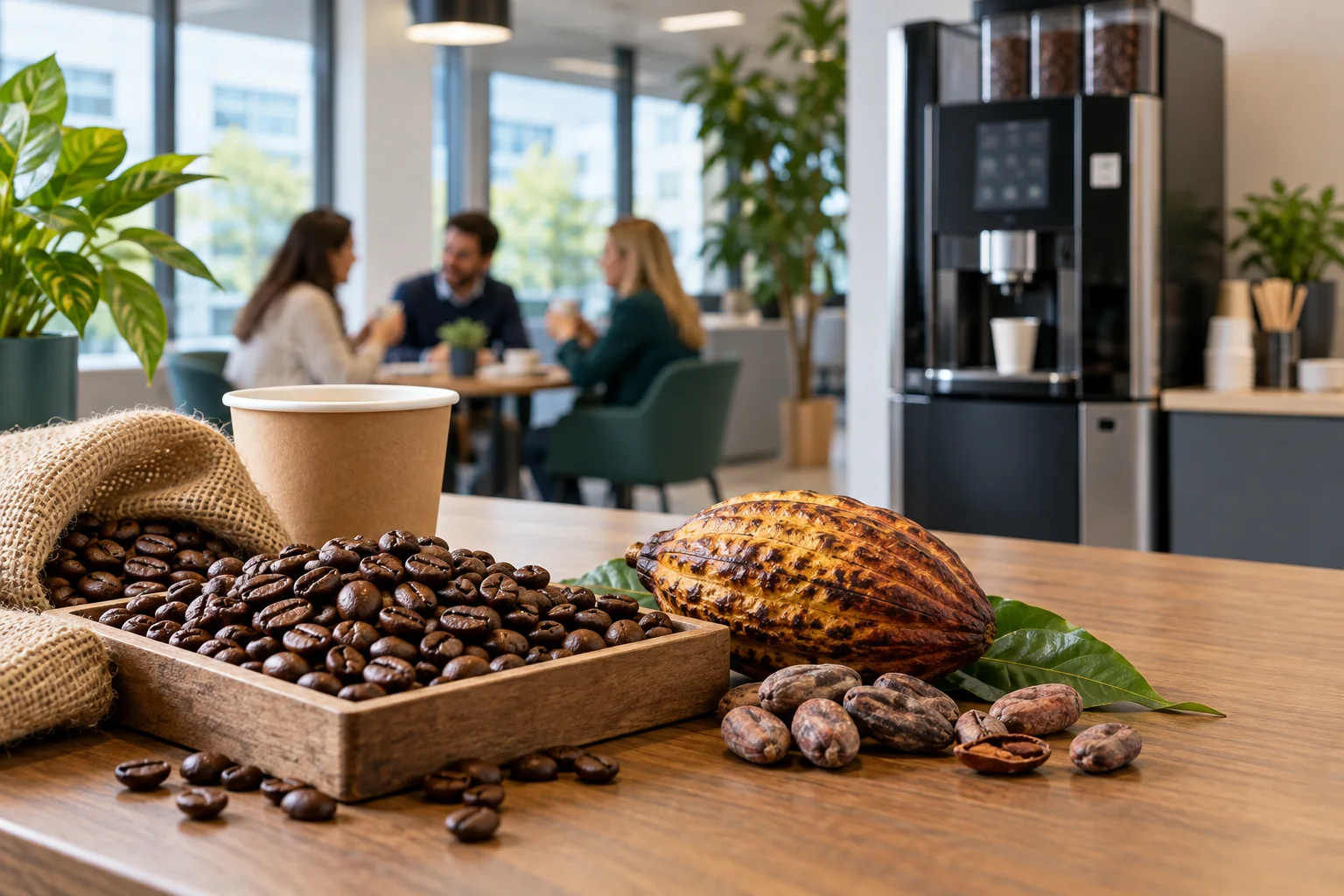
EUDR and coffee vending machines: what the EU Deforestation Regulation requires before it applies
Preparing for the EUDR affects coffee vending operators mainly through coffee products, supply chain evidence and business roles—not the machines themselves. This article explains the deadlines from 30 December 2026 and 30 June 2027, and outlines the data operators should start collecting now.
 KI Modified
Commodity Monitor October 2026: Coffee eases, cocoa and sugar in focus
The ICO coffee price fell by 8.7 per cent in September 2026 to 262.18 US cents per pound. The monitor puts the decline in context for vending procurement, presents Fairtrade cocoa minimum prices for Ghana and Côte d’Ivoire separately, and omits a sugar figure because no reliable primary source is available.
 KI Modified
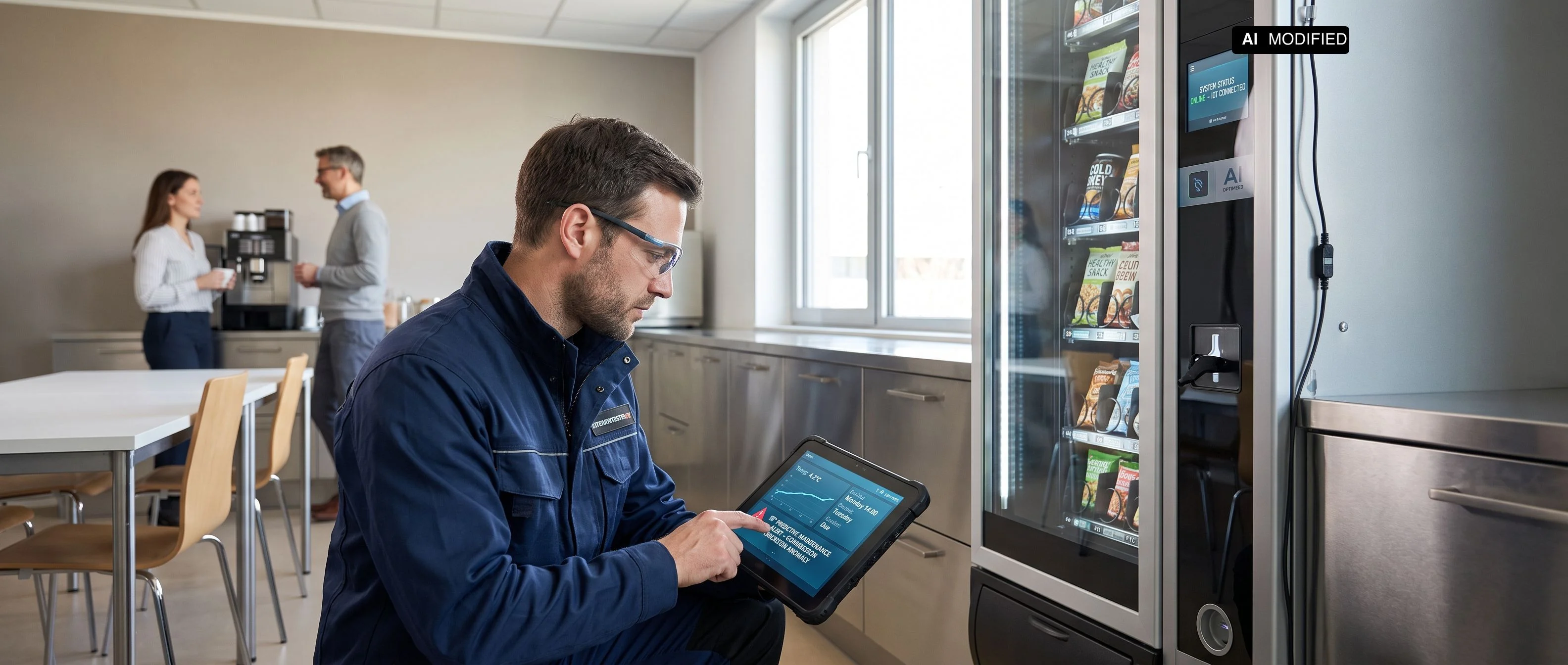
AI in Vending in 2026: Predictive Maintenance and Assortment Optimisation — How to Use the Technology
With 621,000 vending machines in Germany, revenue growth of 18.7% and the EU AI Act in force, AI applications in vending are no longer pilot projects in 2026. Find out which three areas are production-ready, what they deliver in practice and how to get started.