
Fundamentals & Getting Started
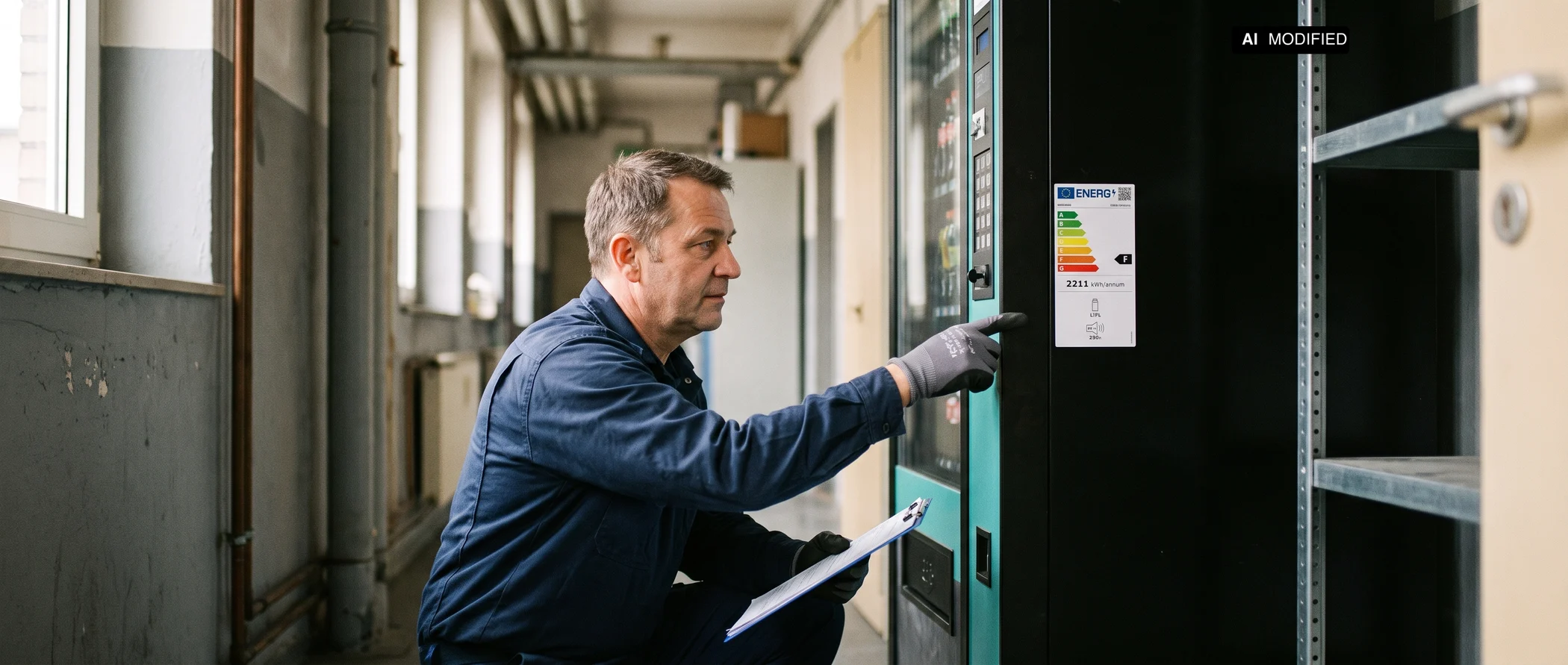
Energy label on the machine: What that letter really costs per year
 KI Modified
On this page
- What that letter on the energy label really costs per year
- The calculation, spelled out
- Why the same letter means different amounts
- Rated power is not a consumption figure
- What we have in our own inventory
- The class says nothing about the refrigerant
- Where the label applies and where it does not
- Standby is the figure no one mentions
- Why your meter will show something different
- What you should request before ordering
- The quotation comparison in four lines
- A calculation example to take away
What that letter on the energy label really costs per year
The short answer first: the letter does not tell you. It is an assessment per litre of useful volume, not a kilowatt-hour specification. Two machines of the same class can differ by several hundred euros per year, and a machine with a better letter can be the more expensive one. What you need is the kilowatt-hour figure from the label — and it is there too, just less prominently displayed.
The calculation, spelled out
Commercial electricity currently costs 27.15 cents per kilowatt-hour for annual consumption of 10,000 kWh. In the previous year it was 28.72 cents, a drop of 5.47 per cent. Using this figure, any consumption figure becomes an amount: annual consumption in kilowatt-hours times 27.15, divided by 100.
An example from our own measurements. The Azkoyen Palma+ H87 has class F on the EU energy label and an annual consumption of 2,211 kWh with 589 litres of useful volume. This amounts to €600.29 in electricity costs per year. The smaller Azkoyen Palma+ H70 has the same class F and 1,947 kWh at 427 litres, or €528.61. The difference between them is €71.68 per year, despite both labels showing the same letter.
Why the same letter means different amounts
Because the class is volume-normalised. When you calculate consumption per litre of useful volume, the picture actually reverses: the larger H87 requires 3.75 kWh per litre per year, the smaller H70 4.56. So the larger machine is 17.67 per cent more efficient per litre — yet ends up in the same class because the scale is broad enough to encompass both.
In euros per litre of useful volume per year, that is €1.02 for the H87 and €1.24 for the H70. Those who have space for the larger machine and fully stock it pay less per litre of refrigerated space. Those who operate the larger machine half-empty still pay €600.29.
From this follows the first practical rule: never compare two machines by class, but by kilowatt-hour consumption — and set this in relation to the volume you actually need.
Rated power is not a consumption figure
This is the most common mistake in quotation comparisons. The Azkoyen Palma+ H87 nameplate shows 520 watts. Those who derive annual consumption from this calculate 520 watts times 8,760 hours and arrive at 4,555 kWh, or €1,236.74. The label states 2,211 kWh. The difference is €636.45 per year.
The reason is simple: a refrigerated vending machine does not run at full load. The compressor cycles off once the set temperature is reached. From these two figures, the duty cycle can be calculated — 48.54 per cent in this case. However, this figure applies only to this machine under the conditions of the label measurement. Transferring it to another machine would be guesswork, not calculation.
Conversely: rated power is important for circuit protection, not for operating costs. 520 watts determines what the electrical circuit must withstand when the machine is connected. For operating costs, it is meaningless.
What we have in our own inventory
We currently list 15 machines with either a label class or annual consumption in their datasheet. Of these, 8 have only the letter, and 5 have a kilowatt-hour figure. This is the real message of this guide: for more than half of the machines for which any energy information exists, no cost can be calculated from the published figure.
Where annual values are available, the range is wide:
- Cleveron 302: 360 kWh, €97.74 per year
- Livello Smart Kiosk: 1,321 kWh, €358.65 per year
- Cleveron 403: 1,740 kWh, €472.41 per year
- Azkoyen Palma+ H70: 1,947 kWh, €528.61 per year
- Azkoyen Palma+ H87: 2,211 kWh, €600.29 per year
- Cleveron 402: 3,600 kWh, €977.40 per year
Between the most efficient and the most power-hungry machine on this list lies a factor of 10 and a difference of €879.66 per year — per machine. For a fleet of 10 machines, that is €8,796.60 difference in electricity costs alone. The machines are not comparable; they serve different purposes. But the figure shows the scale of this cost factor if it does not appear in quotation comparisons at all.
The class says nothing about the refrigerant
Another point evident from our datasheets: the label class and the refrigerant are two independent specifications. In our inventory, a class C machine with a fluorinated refrigerant stands next to machines of the same class using natural propane R290. Those who infer climate impact from the letter are drawing the wrong conclusion.
Which refrigerant is used in the machine is not stated on the energy label but in the technical datasheet. Ask for it if it matters to you — and require the information in writing, not as a verbal statement.
Where the label applies and where it does not
The labelling from which the class derives applies to refrigeration appliances with direct sales function — the H87 label cites regulation 2019/2018 itself. This is precisely why you will not find a class in our reports on hot-drink machines: this appliance category has no EU energy label. The datasheet shows only a rated power figure, nothing more.
For you, this means: for cold-drink and snack machines with refrigeration, you can request the label and obtain a reliable annual figure. For hot-drink machines, no such figure exists, and any annual figure quoted to you is an estimate based on assumptions. Ask what assumptions it contains — brewing cycles per day, keep-warm time, standby hours. Without these three figures, the number cannot be verified.
Standby is the figure no one mentions
In our entire inventory, exactly one machine has a standby value in its datasheet: the Crane BevMax Media specifies 8.20 watts standby at 253 watts rated power, or 3.24 per cent. Calculating this 8.20 watts over the full year gives 71.83 kWh and €19.50 — for the state in which the machine is doing nothing.
The amount is small, and it is a single value; it cannot be transferred to other machines. It is interesting as an order of magnitude and as a question for the manufacturer: if a supplier states the standby value, they have measured it. If they do not state it, you do not know whether it is two watts or twenty. For a fleet and a night setback you want to implement, this is the difference between a calculation and a guess.
Why your meter will show something different
The label value is created under standardised conditions. At the actual installation site, at least three factors work against this: ambient temperature, frequency of door openings, and fill level. We cannot quantify how much each of these affects consumption from our datasheets — manufacturers do not publish figures for this, and an estimate would be guesswork.
What can be said is: the label value is the most reliable comparable figure before purchase, and your own meter is the most reliable figure afterwards. A plug-in power meter costs little and settles the discussion after four weeks. Those operating a fleet should take this measurement on one machine per model type and note the factor between the label value and the measured value. You can then apply this factor to similar locations — it is your figure, not the manufacturer's.
What you should request before ordering
Five specifications, all five are available to the manufacturer:
- The annual consumption in kilowatt-hours from the EU energy label, not the class
- The useful volume and the set temperature to which this figure applies
- The rated power for electrical circuit protection, separately stated
- The refrigerant with its designation
- The standby power in watts
With the first figure and your own electricity rate, you have the annual cost. With the second, you can compare two machines of different sizes. The third is clarified by your electrician, the fourth by procurement, and the fifth you need as soon as you think about night setback.
The quotation comparison in four lines
When two quotations are on the table, you need no spreadsheet. Four lines per machine suffice, and they are all in the datasheet or on the label:
- Annual consumption in kilowatt-hours, times your electricity rate, divided by 100
- The same result divided by useful volume in litres
- The purchase price divided by the planned service life in years
- Both annual figures added together
The first line is your electricity cost, the second makes two machines of different sizes comparable, the third spreads the purchase price, and the fourth is the deciding figure. For the Azkoyen Palma+ H87 and Azkoyen Palma+ H70 from the example above, line one shows €600.29 and €528.61, and line two shows €1.02 and €1.24 per litre. Those who read only line one will think the smaller machine is more efficient; those who include line two see the opposite.
A calculation example to take away
Suppose your electricity rate is 27.15 cents per kWh and you have two quotations: one machine with 1,947 kWh and one with 2,211 kWh per year. The difference is €71.68 annually. Over a service life of eight years, that is €573.41. If the larger machine costs more than this amount additionally, it must pay for itself through revenue, not through electricity savings. If it costs less, the calculation is already decided by the electricity consumption.
And one more figure resulting from the drop in electricity prices: for the Azkoyen Palma+ H87, at 27.15 instead of 28.72 cents, that is €34.71 less per year than in 2025. Those who have not revised their calculations since last year are using an inflated figure.
Last updated: 10 September 2026. The electricity rate is an average for commercial customers at 10,000 kWh annual consumption; your own rate may differ significantly and should be used in every calculation. The consumption figures come from the EU energy labels and datasheets linked in our test reports for the machines mentioned.
Latest on this topic
- EUDR and coffee vending machines: what the EU Deforestation Regulation requires before it appliesMarket Analysis · October 13, 2026
- Commodity Monitor October 2026: Coffee eases, cocoa and sugar in focusMarket Analysis · October 13, 2026
- AI in Vending in 2026: Predictive Maintenance and Assortment Optimisation — How to Use the TechnologyMarket Analysis · October 2, 2026
More guides
 KI Modified
Retrofit cashless payment to a vending machine: MDB 4.3, costs and selection criteria
What do you need to retrofit a vending machine for cashless payment? This guide explains MDB 4.3, compatibility, terminal selection, installation, ongoing costs and typical checks, without making unsupported price promises.
 KI Modified
The Ideal Vending Machine Mix: Combining Hot Drinks, Snacks and Water
Which combination of hot drinks, snacks and water is right for an office, a public venue or a small site? This guide helps operators assess sales mix, site requirements, hygiene, refrigeration, replenishment and cashless payments.
 KI Modified
Hygiene plan for hot drinks vending machines: cleaning, HACCP and records
What cleaning obligations apply to hot drinks vending machines, which intervals must operators set themselves based on risk, and what records should the hygiene plan include? This guide distinguishes legal requirements, HACCP practice and standards guidance without prescribing blanket cleaning intervals.