
Fundamentals & Getting Started
Coffee Knowledge for Vending: From Origin to the Perfect Cup in the Machine
 KI Modified
On this page
- Arabica or Robusta: The fundamental decision for vending operators
- From plant to roasting: What operators need to know
- Brewing methods compared: Bean-to-Cup, Instant, Freshbrew
- Brew parameters: Temperature, pressure, grind
- The German vending market: figures and context
- The right bean for the location: selection criteria
- Three scenarios: calculating cost per cup
- Quality control in ongoing operation
- Checklist: Coffee procurement and quality assurance
- Frequently asked questions
- What temperature is right for machine coffee?
- How often must the bean hopper be changed?
- Bean-to-cup or instant: what makes sense for small offices?
- Does roast level make a difference in the machine?
- How do I know if the coffee in the machine has gone bad?
On average, each German drinks 161 litres of coffee annually in 2025. 125,500 tonnes are attributable for the first time to out-of-home consumption, a new record value according to the German Coffee Association. Vending operators sit directly in this trend: 75 per cent of product sales in the German vending machine market are accounted for by hot beverages, and industry sales grew in 2023 to 2024 by 18.7 per cent to 4.62 billion euros (BDV Vending Market Study 2024). Those who understand how bean origin, roast level and brew parameters work together can systematically control quality, reduce complaints and protect margins.
This guide explains what goes into a vending coffee bean, which brewing methods suit which locations, and how operators can ensure quality in ongoing operation using three key metrics (brew temperature, grind size, extraction). All figures are sourced; manufacturer claims are identified as such.
Arabica or Robusta: The fundamental decision for vending operators
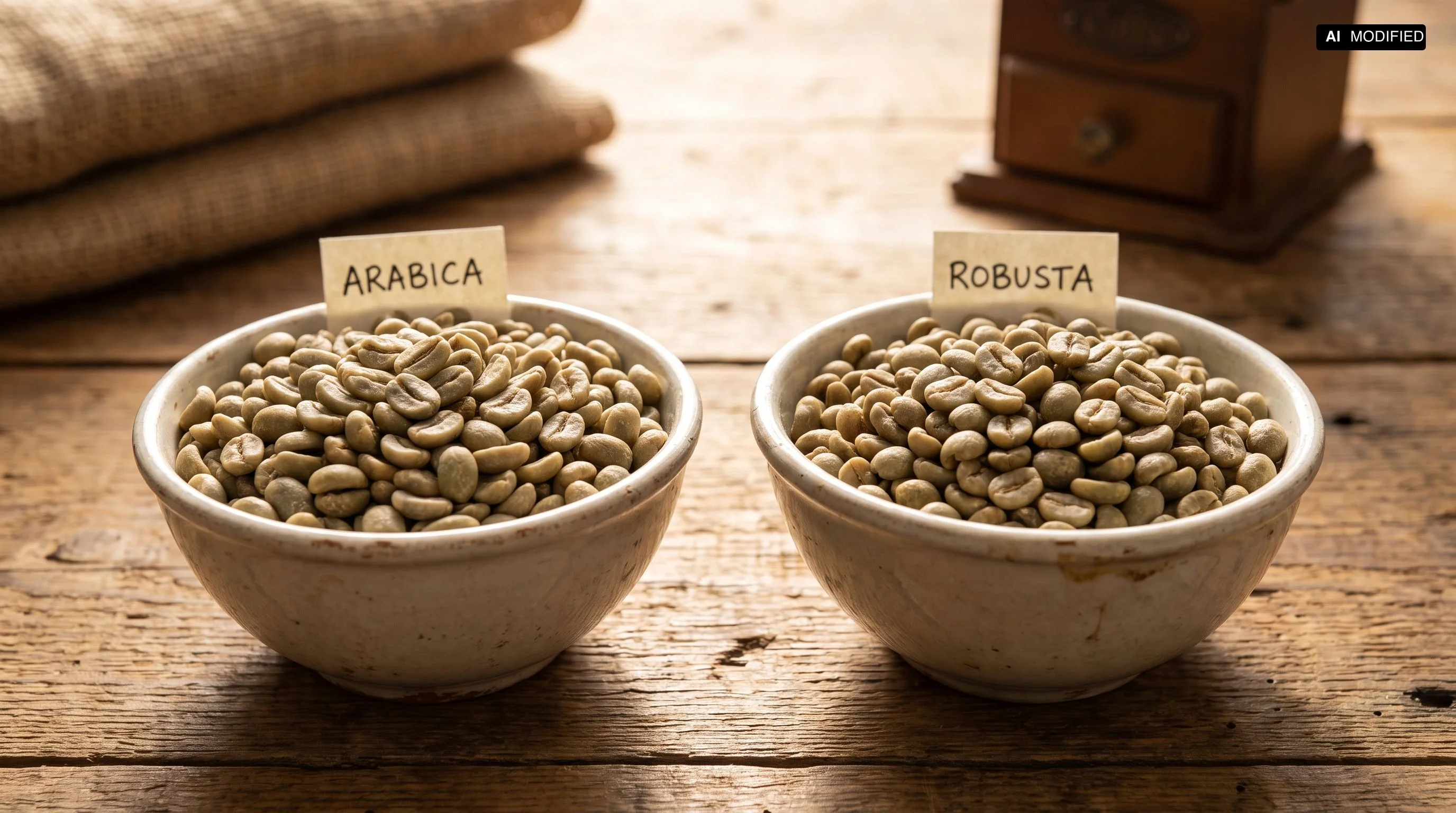
61 per cent of world production is Arabica, 39 per cent Robusta (ICO World Coffee Statistics). This ratio does not directly reflect vending blends: Arabica and Robusta are deliberately mixed because both varieties bring complementary strengths.
Arabica grows optimally at 600 to 2,000 metres elevation at 18 to 25 °C. The longer ripening period creates more fruit acids, finer aromas and a thin, light-brown crema (Coffee Association: From Plant to Bean). The raw material price is higher than Robusta, and the bean is more sensitive to incorrect storage temperature and humidity in the machine.
Robusta grows below 900 metres in hot, humid climates. The variety delivers more caffeine than Arabica and a denser, more stable crema. For espresso blends in the vending sector, Robusta is no quality compromise: particularly with milk-based beverages, Robusta crema stands up better. 70 per cent of EU coffee imports are Arabica (CBI Market Report), but vending blends frequently use 20 to 30 per cent Robusta to ensure extract and crema stability. The exact composition must be clarified contractually with the roaster.
What this means for procurement: A pure Arabica blend in the machine sounds premium. However, it forgoes the crema stability that Robusta provides. For locations with a high proportion of milk-based beverages, a 20-to-30-per-cent Robusta blend is the more reliable choice. For locations with predominantly black espresso, higher Arabica percentages can be justified.
From plant to roasting: What operators need to know
Global production stands at 158 million 60-kilogramme bags per year (Coffee Association). For operators, two steps in the long journey from growing region to machine are directly relevant: roast level and storage after package opening.
Roasting: The Maillard reaction is the chemical core of the roasting process. Amino acids and reducing sugars react under roasting heat to form colour and aroma compounds. The first crack marks the end of light roasting; the second crack marks the transition to dark roasting (Coffee Association: Processing). Light roasts retain more fruit acids and complexity. Dark roasts develop more bitter aromas and less acidity.
For the machine: medium to medium-dark roasts (between first and second crack) are most versatile. They extract reliably over a wide temperature and time window without turning immediately bitter or sour with minor grind adjustments. Light roasts are more sensitive to setting deviations, which with infrequent maintenance intervals represents a measurable quality risk.
Storage after opening: Roasted coffee oxidises noticeably after opening the vacuum package. In the machine, the bean hopper should be sized so it is completely emptied within five to seven days. Larger hoppers with long refill intervals are a quality risk. Freshness is not a given, but a logistical parameter.
{ "type": "image" }
Brewing methods compared: Bean-to-Cup, Instant, Freshbrew
74 per cent of the European hot beverage machine population in 2024 is accounted for by bean-to-cup and espresso machines; in 2015 it was still 58 per cent. The share of instant machines declined in the same period from 26 to 17 per cent, freshbrew from 16 to 9 per cent (EVA Market Report 2025). The market has made a clear choice: whole beans dominate.
Bean-to-Cup (automatic coffee machine): Whole beans are ground and brewed immediately before each pour. Freshness and aroma retention are maximised. 90 per cent of tabletop devices in the German vending market already work with whole beans (Automatenmarkt 2025). The effort required for cleaning and maintenance is higher than with instant systems. User acceptance is measurably better.
Instant: Soluble coffee is dissolved in hot water. Production uses hot water extraction at 170 to 190 °C and 15 to 20 atmospheres of pressure, followed by spray or freeze drying (Coffee Association: Processing). Advantage: lower cleaning effort, stable quality without a grinder. Aroma diversity falls far short of freshly ground coffee. For high-traffic locations with limited maintenance capacity, instant is a viable option, not the quality benchmark.
Freshbrew: Ground, portioned coffee is brewed in a paper or metal filter. Aromatically closer to bean-to-cup than instant, logistically more complex due to the portion inventory. Market share continues to decline. Supply requirements and disposal of spent portions make freshbrew increasingly unattractive for most operators.
Brew parameters: Temperature, pressure, grind
87 to 93 °C is the brew temperature recommended by the Specialty Coffee Association (SCA), supported by sensory studies (SCA: How Hot is Hot Enough?). Temperatures below 87 °C extract incompletely and produce sour, thin results. Temperatures above 93 °C over-extract and create bitterness.
Grind size: For espresso-based machines, a finer grind is required than for filter coffee. The precise setting depends on bean roast level, grinder type and ambient temperature; a universal micrometer standard value is not verified in any public source. In practice: adjust grind size with each new bean batch and verify with a reference espresso.
Brew pressure: Espresso machines operate at 9 bar brew pressure (manufacturer specification, not independently confirmed for all models). The pressure curve influences extraction and crema formation; deviations of more than 1 bar in the pump lead to measurable deterioration of pour quality. Pump pressure checks are part of routine maintenance, not annual inspection.
TDS and extraction: Total Dissolved Solids (TDS) describes dissolved solids in coffee as a proxy for strength. A TDS below 1.1 per cent with espresso indicates under-extraction (grind too coarse, brew time too short). Values above 1.5 per cent suggest over-extraction. Digital TDS metres (refractometer, approximately 30 to 80 EUR) enable objective quality control in daily operation without laboratory testing.
{ "type": "image" }
The German vending market: figures and context
621,000 machines are installed in Germany; 47 per cent of these are small professional automatic coffee machines (BDV Third Market Study 2024). The industry's total sales reached 4.62 billion euros in 2024, an increase of 18.7 per cent compared to 2023. Hot beverages account for 75 per cent of product sales. Those operating machines in this market are not selling coffee as a secondary product, but as core business.
Out-of-home consumption in Germany reached a record 125,500 tonnes in 2025. The whole bean segment grew by 130 per cent over ten years and stands at 193,800 tonnes. Total German roasted coffee sales in 2025 were 456,000 tonnes at a value of 8.98 billion euros, an increase of 23.5 per cent compared to the previous year (German Coffee Association, press release 2025).
Europe consumes 33 per cent of global coffee (3.26 million tonnes in 2023/24 according to CBI). The average price for a hot beverage from a vending machine in Europe in 2024 was 0.48 euros including VAT, an increase of 8.8 per cent compared to 2023 (EVA Market Report 2025).
What these figures mean for operators: Rising raw material prices (coffee sales +23.5 per cent at stable volumes) feed through with delay to bean procurement costs. Those holding long-term supply contracts with fixed bean prices have an advantage over spot market buyers. The average pour price of 0.48 euros allows margin for quality investment with optimised raw material procurement.
{ "type": "image" }
The right bean for the location: selection criteria
Three parameters structure the decision:
1. Usage frequency: With high throughput (more than 100 vends daily), freshness is less of a constraint than at locations with 20 to 30 vends daily. Low frequency requires smaller hoppers or more frequent refill intervals to avoid quality loss through oxidation. A 500-g hopper at 25 vends daily is empty after five days; a 2-kg hopper at the same 25 vends daily is still half full after more than three weeks.
2. Product range: Machines with milk-based beverages benefit from blends with a higher Robusta share. Locations with primarily black coffee can opt for higher Arabica percentages.
3. Pour price point: Premium beans cost approximately 0.22 euros per cup in raw material; budget blends approximately 0.09 euros per cup. The difference of 0.13 euros adds up at 100 vends daily to roughly 4,700 euros annually. This figure belongs on the table during supplier selection, not just at year-end accounting.
Roaster selection: Recommended criteria are: supply reliability, freshness guarantee (roast date on packaging), technical support for grinder adjustment and minimum order quantities per location. Market shares of individual roasters in the German vending segment are not publicly verifiable.
Three scenarios: calculating cost per cup
Cost per cup arises from raw material, energy, maintenance and machine amortisation. Three scenarios show the range:
Scenario 1: Small office, 30 vends/day, tabletop machine Purchase 3,000 EUR net, 5-year usage, 250 operating days per year:
- Depreciation: 3,000 / (5 x 365 x 30) = approx. 0.055 EUR/cup
- Raw material (budget blend): approx. 0.09 EUR/cup
- Energy (0.8 kWh/day x 0.30 EUR/kWh): approx. 0.008 EUR/cup
- Maintenance (flat-rate contract 300 EUR/year, 10,950 vends/year): approx. 0.027 EUR/cup
- Total: approx. 0.18 EUR net/cup
Scenario 2: Medium location, 80 vends/day, floor standing machine Purchase 8,000 EUR net, 7-year usage:
- Depreciation: 8,000 / (7 x 365 x 80) = approx. 0.039 EUR/cup
- Raw material (standard blend): approx. 0.14 EUR/cup
- Energy (1.5 kWh/day x 0.30 EUR/kWh): approx. 0.006 EUR/cup
- Maintenance (600 EUR/year, approx. 29,200 vends/year): approx. 0.021 EUR/cup
- Total: approx. 0.21 EUR net/cup
Scenario 3: High-frequency, 200 vends/day, full-service operator
- All-inclusive flat fee: to be clarified contractually, no publicly verified market standard
- Advantage: no investment risk, service guarantee contractually secured
- Risk: long-term contract commitment, limited variety flexibility
Conclusion: In-house operation is worthwhile from approximately 50 vends daily if cleaning and basic maintenance are handled internally. Below this or with decentralised multi-location setups, full-service operation is economically at least equivalent.
Quality control in ongoing operation
Sensory approval at installation is not a quality system. Those who want to systematically control coffee quality in the machine need three tools:
- Temperature log: Measure brew temperature at the pour point at least weekly with a beverage thermometer. Deviation of more than 3 °C from the set target is a service case, often caused by lime scale deposits on the thermoblock.
- TDS measurement: A refractometer (30 to 80 EUR) provides information on extraction strength. Values below 1.1 per cent TDS with espresso indicate under-extraction. Values above 1.5 per cent suggest over-extraction.
- Bean change log: Note the date and roast date with each refill. More than 30 days between roast date and the last vend from a hopper is a quality risk.
Checklist: Coffee procurement and quality assurance
- [ ] Confirm blend composition (Arabica/Robusta percentage) with roaster in writing
- [ ] Check roast date on every delivery; do not accept more than 6 weeks between roast date and delivery
- [ ] Align bean hopper capacity with location frequency: complete change within 5 to 7 days
- [ ] Request temperature measurement at installation and require target/actual documentation
- [ ] Adjust grind size with each new bean batch and document with reference espresso
- [ ] Introduce TDS measurement (refractometer approx. 30 to 80 EUR) for objective quality control
- [ ] Review maintenance contract with maximum response time of 24 hours for critical locations
- [ ] Recalculate annual raw material cost (EUR/cup) when bean prices fluctuate
Frequently asked questions
What temperature is right for machine coffee?
The Specialty Coffee Association recommends 87 to 93 °C brew temperature. Most vending automatic coffee machines are factory-set to 90 to 92 °C (manufacturer specification). Those who want to know exactly what reaches the cup measure with a beverage thermometer directly into the cup; a deviation of more than 3 °C from the target indicates lime scale deposits on the thermoblock.
How often must the bean hopper be changed?
At 30 vends daily with a 1-kg hopper (approx. 120 to 130 cups from 1 kg), this results in a cycle of around four days. At 10 vends daily, the same hopper is empty only after 12 to 13 days. The beans should be used up within 7 days at the latest; oxidation makes the coffee noticeably flatter in aroma thereafter.
Bean-to-cup or instant: what makes sense for small offices?
Bean-to-cup is the more economical choice from 20 vends daily, because raw material costs per cup are lower than with quality-comparable instant products. Below 15 vends daily, a tabletop automatic coffee machine only makes sense if cleaning capacity is available in-house; otherwise, costs from neglected maintenance accumulate and offset the raw material advantage.
Does roast level make a difference in the machine?
Yes. Light roasts are more sensitive to grind deviations: an incorrectly adjusted coarse grind produces noticeably sour under-extraction with light roasts, often still acceptable results with dark roasts. For machines with infrequent maintenance intervals, medium-dark roasts are more forgiving in ongoing operation.
How do I know if the coffee in the machine has gone bad?
Three signals: sour, musty smell when opening the bean hopper, oil residue on the grinder or brew group, and noticeably lighter crema than at the last service. None of these is a repair case: a bean change followed by cleaning of the brew group eliminates all three causes.
Last updated: 2026-09-11
Latest on this topic
- EUDR and coffee vending machines: what the EU Deforestation Regulation requires before it appliesMarket Analysis · October 13, 2026
- Commodity Monitor October 2026: Coffee eases, cocoa and sugar in focusMarket Analysis · October 13, 2026
- AI in Vending in 2026: Predictive Maintenance and Assortment Optimisation — How to Use the TechnologyMarket Analysis · October 2, 2026
More guides
 KI Modified
Retrofit cashless payment to a vending machine: MDB 4.3, costs and selection criteria
What do you need to retrofit a vending machine for cashless payment? This guide explains MDB 4.3, compatibility, terminal selection, installation, ongoing costs and typical checks, without making unsupported price promises.
 KI Modified
The Ideal Vending Machine Mix: Combining Hot Drinks, Snacks and Water
Which combination of hot drinks, snacks and water is right for an office, a public venue or a small site? This guide helps operators assess sales mix, site requirements, hygiene, refrigeration, replenishment and cashless payments.
 KI Modified
Hygiene plan for hot drinks vending machines: cleaning, HACCP and records
What cleaning obligations apply to hot drinks vending machines, which intervals must operators set themselves based on risk, and what records should the hygiene plan include? This guide distinguishes legal requirements, HACCP practice and standards guidance without prescribing blanket cleaning intervals.