
Fundamentals & Getting Started
Vending in hospitals and nursing homes: higher standards, higher margins
 KI Modified
On this page
- What is the market potential in Germany?
- What sets healthcare locations apart from standard locations
- The obligations: HACCP, LMHV, IfSG and BFSG
- What is mandatory law?
- Water coolers: special case for hygiene-sensitive locations
- BFSG: accessibility mandatory as of June 2025
- Hazard assessment 2026: expanded obligations
- Which machines are suitable for hospitals and nursing homes?
- What's the bottom line? Three scenarios
- Scenario 1: nursing home with 78 beds (national average)
- Scenario 2: hospital with 400 beds, three machines
- Scenario 3: nursing home chain with 20 facilities
- Which contract models fit the healthcare sector?
- How to win healthcare locations
- Checklist: is your operator concept healthcare-ready?
Last update: 2026-09-25
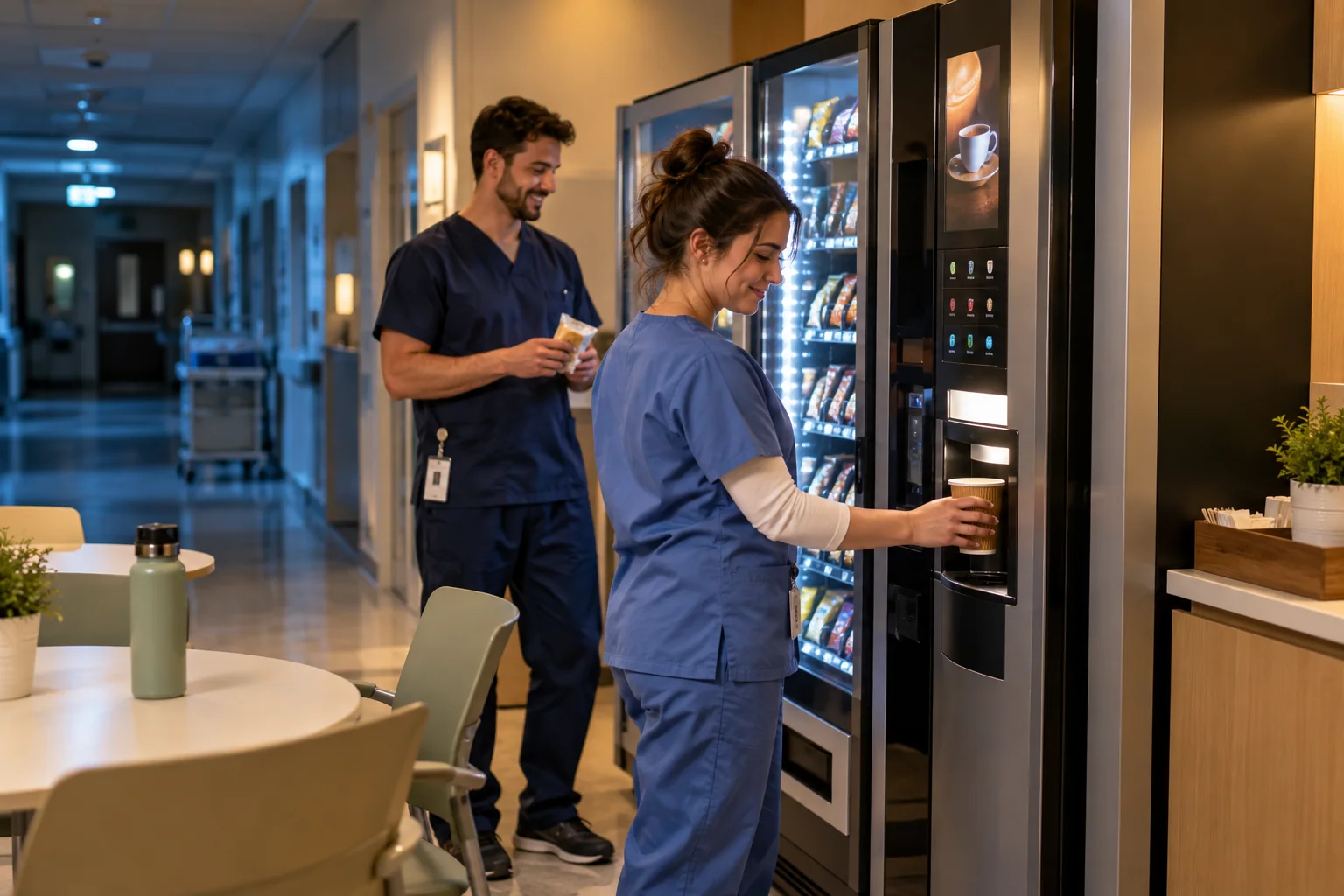
Today, 7 percent of the European vending machine fleet is located in healthcare facilities. The BDV market committee explicitly designated hospitals and nursing homes as a growth vector for the German vending market in its 2025 report, following total market growth of 18.7 percent from 2023 to 2024 and total revenue of €4.62 billion. The structure explains the potential: 1,807 hospitals with nearly 469,000 beds and 11,646 full-service nursing homes with over 814,000 residents comprise a network of captive customer groups requiring service around the clock. Night-shift nursing care at 3 a.m., visitors on Sunday afternoons, on-call doctor between operating-room shifts: the cafeteria is closed, but the vending machine operates.
At the same time, healthcare facilities are the most demanding venue category for vending operators in the German market. HACCP is not a voluntary certificate but a mandatory obligation under EU Regulation (EC) No. 852/2004. The hygiene standard is structurally higher than at office or industrial locations. Operators who meet these requirements with the right contract model and appropriate equipment unlock a margin tier unattainable at standard office sites. This guide provides operators with concrete figures, mandatory requirement checklists, and pricing models.
What is the market potential in Germany?
According to the BDV market study 2024, the German vending market comprises 621,000 machines, of which 76 percent are in the business market (manufacturing and offices). On average across Europe, 7 percent account for healthcare; ten years ago, the workplace market still represented 80 percent of the fleet, which shows the structural shift towards new segments. Germany has no public segment breakdown; the EVA benchmark serves as indicative guidance.
Using a conservative assumption of 5 percent healthcare share in the German fleet, approximately 31,000 machines would be located in hospitals and nursing homes. Convergence with the European average of 7 percent would mean approximately 12,400 additional machines. The BDV market study 2024 rates this scale as realistic growth potential.
The structural drivers are measurable. 1.24 million employees in German hospitals, a figure exceeded for the first time in 2024 (ad-hoc-news), plus approximately 468,803 beds (Destatis 2024, revised 2025) comprise a permanent occupant base that makes multiple daily vending purchases. A nursing home with 78 beds, the national average according to Pflegemarkt.com 2025, brings together daily staff, primary-care physicians, therapists, and visitors.
In parallel, a consolidation wave is underway: Destatis counted 1,914 hospitals in 2019; in 2024, there were 1,807, a decline of 5.6 percent over five years. Merged hospitals are larger and serve more departments, which tends to increase average vending machine revenue per location.
2024 EVA data shows that a European hot-beverage vending machine dispenses on average 178 portions per week. At a €0.48 unit price, this yields approximately €4,440 gross revenue per machine per year as a European benchmark. Hospital machines structurally exceed this average because patients and staff cannot switch to alternative vendors at night or weekends. According to the BDV market study 2024, 40 percent of operators offering fresh products replace or supplement cafeterias; for hospitals without night- and weekend-service cafeterias, a fresh-food combination machine is essential infrastructure, not an option.
What sets healthcare locations apart from standard locations
The most important distinction is not hygiene standards but liability structure. Under the Machinery Safety Regulation (Betriebssicherheitsverordnung, BetrSichV), the operator of a system is always the end customer—the hospital or nursing home—not the vending operator. The hazard assessment must be prepared by a "competent person" as defined in Section 2(6) BetrSichV (BDV Installation Requirements 2024). The operator supplies the documentation; the healthcare facility approves it and assumes liability.
Three additional differences from standard locations shape operational practice:
User base. Patients may be immunocompromised; nursing home residents may have mobility or cognitive limitations. An otherwise identical machine requires different configuration, servicing, and positioning. Decaffeinated beverage options and accessible controls are not extras in this context but necessary.
Operating hours. 24/7 operation is an expectation, not an option. A machine down on Sunday evening does not affect an empty office but active care providers with limited alternatives. Service level agreements with defined response times are mandatory for healthcare contracts; the specific response window must be contractually set.
Documentation density. Temperature logs, cleaning records, training certificates: HACCP compliance requires complete documentation (Bosta Kaffee Ratgeber). Remote monitoring systems that automatically log temperature deviations are an operational requirement here. In standard office settings, they are a convenience feature.
The obligations: HACCP, LMHV, IfSG and BFSG
What is mandatory law?
The legal foundation is clear: EU Regulation (EC) No. 852/2004 obligates every food business operator, including every vending operator, to establish a HACCP-based self-control system. The German implementing regulation is found in the Food Hygiene Regulation (LMHV) Sections 3–4. Employee training is mandatory under the Infection Protection Act (IfSG) Section 43 for anyone who handles food. This applies to every service technician who maintains a stocked machine.
The seven HACCP principles for vending machines are specifically: (1) hazard analysis for biological, chemical, and physical risks, (2) identification of critical control points, (3) establishment of critical limits (chilled goods maximum 7°C, optimally 2–5°C), (4) continuous monitoring, (5) corrective action upon deviation, (6) verification, and (7) documentation of all steps (Bosta Kaffee Ratgeber). In hospitals, monitoring for pathogenic bacteria is added: Pseudomonas aeruginosa, coliforms, and enterococci are relevant test parameters; total viable count alone is insufficient as a control measure (BDV Water Cooler Guide).
Water coolers: special case for hygiene-sensitive locations
The BDV explicitly classifies hospitals and nursing homes in its water cooler guide as "hygiene-sensitive locations." Beyond the HACCP standard, the following requirements apply: dispenser technology with backflow prevention, daily nozzle disinfection, complete HACCP protocol for the location, shortened cleaning intervals, and controlled water filter changes. Operators of water coolers in clinics must schedule testing for Pseudomonas aeruginosa as routine monitoring and document it per DIN 6650-08. Total viable count alone is insufficient as a control parameter.
BFSG: accessibility mandatory as of June 2025
The Accessibility Enhancement Act (BFSG) has applied to new vending machines in Germany since June 2025 (BDV Intern 01/2025). The practical relevance is particularly high in healthcare: wheelchair users, visually impaired individuals, and users with mobility limitations are a structural part of the user base. Mandatory requirements include clearly labelled tactile buttons, screenreader-compatible displays, and product dispensing heights accessible from a wheelchair. Existing machines are not subject to retroactive requirements; however, for new installations from June 2025 onwards, compliance is mandatory.
Hazard assessment 2026: expanded obligations
Since early 2026, expanded requirements mandate a complete hazard assessment for coffee machines at the customer site (BDV Intern 01/2026, interview with Frank Winkels, BDV). The hospital or nursing home, as the operator, bears responsibility; the vending operator must provide documentation in a form that enables the facility to conduct its own assessment. Operators who proactively bring these documents shorten internal decision cycles and gain a measurable advantage in tender processes over less-prepared competitors.
Which machines are suitable for hospitals and nursing homes?
Not every office machine is suitable for healthcare operation. Six technical criteria are critical for healthcare installations:
Closed brewing system. Prevents cross-contamination between the brewing group and the outlet. This is not an optional feature but a core component of any rigorous HACCP protocol for coffee machines in healthcare settings.
Automatic cleaning cycle with mandatory logging. The machine records cleaning completion and blocks operation if the cycle is incomplete. Without this feature, complete HACCP documentation is only possible manually, which is error-prone with rotating staff.
Dedicated milk cooling. For fresh milk systems, milk cooling must be separate from the main chamber to maintain HACCP temperature requirements continuously (Bevero, Lavazza Professional). Temperature rise in the milk tank when the main door is open is a known HACCP weakness in integrated systems.
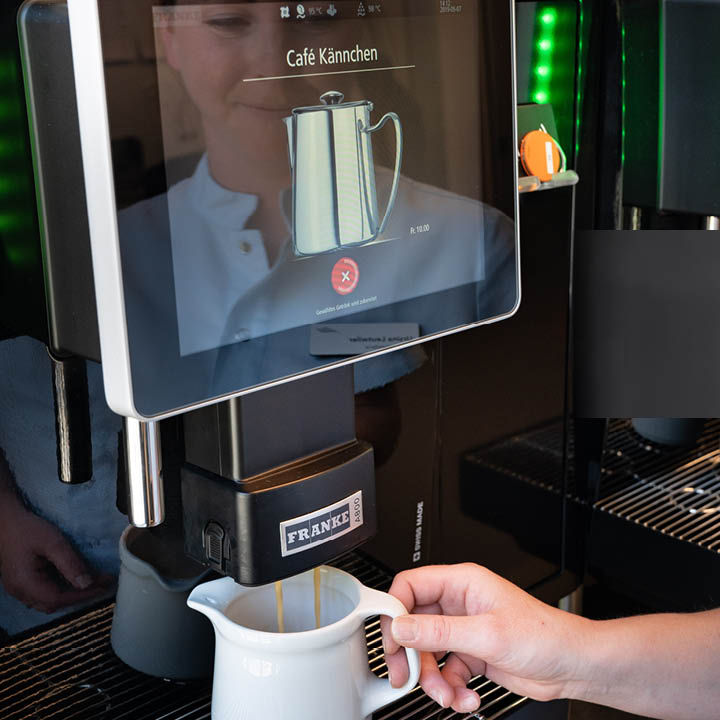
Cashless payment. In 2024, 85 percent of the European cashless-vending fleet was equipped with contactless payment, compared to 58 percent in 2019 (EVA Market Report 2025). Visitors and patients often lack cash; a machine without NFC capability loses measurable revenue in this environment.
Multilingual display. Healthcare staff in German hospitals come from many countries of origin. A configurable multilingual display reduces training time and minimizes errors during shift handovers.
24/7 operation capability and remote monitoring. For commercial-grade automatic coffee machines, this is standard; for combination machines with cooling, compressor capacity must be designed for continuous operation. Temperature deviations discovered only at the next service visit are an HACCP documentation problem with potential liability consequences. Nobel Kaffee operates approximately 3,000 machines in healthcare facilities with 5.3 million servings per month, demonstrating that scalable concepts work in this segment (Nobel Kaffee Health & Care).
What's the bottom line? Three scenarios
Scenario 1: nursing home with 78 beds (national average)
A nursing home with 78 beds typically employs approximately 40 full-time staff in care, administration, and kitchen services. Assumption: 60 people on-site daily (staff plus regular visitors), 1.5 hot beverages per person per day, 350 operating days.
60 × 1.5 × 350 = 31,500 servings per year. At €0.80 per unit: €25,200 gross revenue.
Full-service model at €0.20 per serving all-inclusive (machine, maintenance, supplies): €6,300 annual materials and service costs. Net margin before commission: €18,900. Facility commission (15 percent of revenue, benchmarked against US comparables; no public data for Germany): €3,780. Remaining operator margin: approximately €15,120 per year before depreciation and travel costs. With a machine purchase price of €5,000–8,000 and annual depreciation of €600 (10-year useful life) plus estimated €900 in travel costs, the net profit is approximately €13,620 per location per year.
Scenario 2: hospital with 400 beds, three machines
A hospital with 400 beds and approximately 600 staff, plus 200 daily visitors and outpatients. Three machines: automatic coffee machine in the entrance area, combination machine in the staff area, automatic coffee machine for night service in a high-traffic area. Conservative assumption: 700 servings daily total; of these, 400 coffees at €0.85, 200 snacks at €1.80, 100 cold beverages at €1.50.
Daily revenue: €340 + €360 + €150 = €850. Annual revenue at 365 days: €310,250.
Full-service costs at €0.20 per serving (700 × 365 × 0.20): €51,100. Net margin before commission: €259,150 for three machines. After commission (15 percent of revenue, €46,538): €212,612 operator margin for three machines, approximately €70,871 per machine, before administration and travel costs.
Scenario 3: nursing home chain with 20 facilities
Bundling 20 nursing homes in a full-service model provides economies of scale: centralized bean purchasing, consolidated service routes, unified HACCP documentation. Based on Scenario 1 (€15,120 operator margin per facility): 20 × €15,120 = €302,400 annual revenue. With centralized bean purchasing at 12 percent volume discount versus individual orders, materials costs drop from €6,300 to approximately €5,544 per machine. This yields €756 additional margin per facility, or €15,120 annually across 20 facilities. Travel costs typically drop 20–30 percent through route optimization versus decentralized service; the specific figure should be contractually defined.
*All three scenarios are based on industry benchmarks and internal calculations. Actual margins depend on the individual contract model, location, product mix, service frequency, and negotiated commission.*
Which contract models fit the healthcare sector?
Three models are established in the German healthcare sector:
Full-service / lease model (€0.15–€0.25 per serving all-inclusive). The operator provides the machine, service, cleaning, HACCP documentation, and supplies. The facility bears no capital costs. This model is preferred in healthcare because cleaning records and temperature logs are contractually defined and operational burden is minimized. Lease payments and coffee-service invoices are 100 percent deductible as business expenses (Bosta Kaffee Preisübersicht).
Leasing (from approximately €79 per month). The operator owns the machine; the monthly payment is fully deductible as a business expense. Maintenance responsibility and HACCP documentation rest with the operator. For small nursing homes with a single machine, this is a possible entry point with manageable capital requirements.
Revenue sharing / commission. The facility receives a percentage of net revenue. Benchmark for healthcare locations: 15–20 percent, based on US comparables (PVOS Academy). No publicly verified figures exist for Germany; the specific rate must be contractually agreed. In this model, the facility has financial interest in machine utilization and actively supports placement optimization.
How to win healthcare locations
Winning a hospital or nursing home as a location follows a different pace than securing an office building. Four points are decisive:
Identify the decision-maker. In hospitals, procurement or facilities management is responsible; in nursing homes, often the home administrator directly. The nursing director route works only if the product selection addresses resident needs: decaf options, low-sugar choices, easy-open packaging.
Bring the HACCP protocol. Presenting a complete HACCP plan, cleaning schedules, and temperature-log templates at the first meeting signals sector expertise and significantly shortens internal decision cycles. The BDV cleaning guides for five machine types provide a solid, industry-recognized template.
Proactively offer hazard assessment documentation. The 2026 requirements expect the operator to supply this. Offering it proactively shortens the facility's decision process and differentiates you from competitors who only supply a machine.
Name reference installations. Healthcare facilities award placement rights more quickly to operators with demonstrated sector expertise. If you have healthcare references, name them. Providers like Nobel Kaffee demonstrate with 3,000 healthcare machines and 5.3 million servings per month (Nobel Kaffee Health & Care) that this segment is scalable and can be professionally serviced.
Checklist: is your operator concept healthcare-ready?
Review seven points before your first meeting with a facility:
- HACCP protocol for the location is prepared and location-specific (not generic)
- Temperature-logging system active: chilled products logged continuously at 2–5°C
- Machine-specific cleaning plan prepared, based on the BDV cleaning guide for the relevant machine type
- IfSG Section 43 employee training for all service technicians is current and documented
- BetrSichV hazard assessment for the facility prepared (mandatory for new installations from 2026)
- BFSG compliance of the machine verified (mandatory for new installations from June 2025)
- Contract template includes: cleaning intervals, temperature SLA with defined response time, and escalation procedure for downtime
Editable checklist available as PDF upon request via the contact form.
Latest on this topic
- EUDR and coffee vending machines: what the EU Deforestation Regulation requires before it appliesMarket Analysis · October 13, 2026
- Commodity Monitor October 2026: Coffee eases, cocoa and sugar in focusMarket Analysis · October 13, 2026
- AI in Vending in 2026: Predictive Maintenance and Assortment Optimisation — How to Use the TechnologyMarket Analysis · October 2, 2026
More guides
 KI Modified
Retrofit cashless payment to a vending machine: MDB 4.3, costs and selection criteria
What do you need to retrofit a vending machine for cashless payment? This guide explains MDB 4.3, compatibility, terminal selection, installation, ongoing costs and typical checks, without making unsupported price promises.
 KI Modified
The Ideal Vending Machine Mix: Combining Hot Drinks, Snacks and Water
Which combination of hot drinks, snacks and water is right for an office, a public venue or a small site? This guide helps operators assess sales mix, site requirements, hygiene, refrigeration, replenishment and cashless payments.
 KI Modified
Hygiene plan for hot drinks vending machines: cleaning, HACCP and records
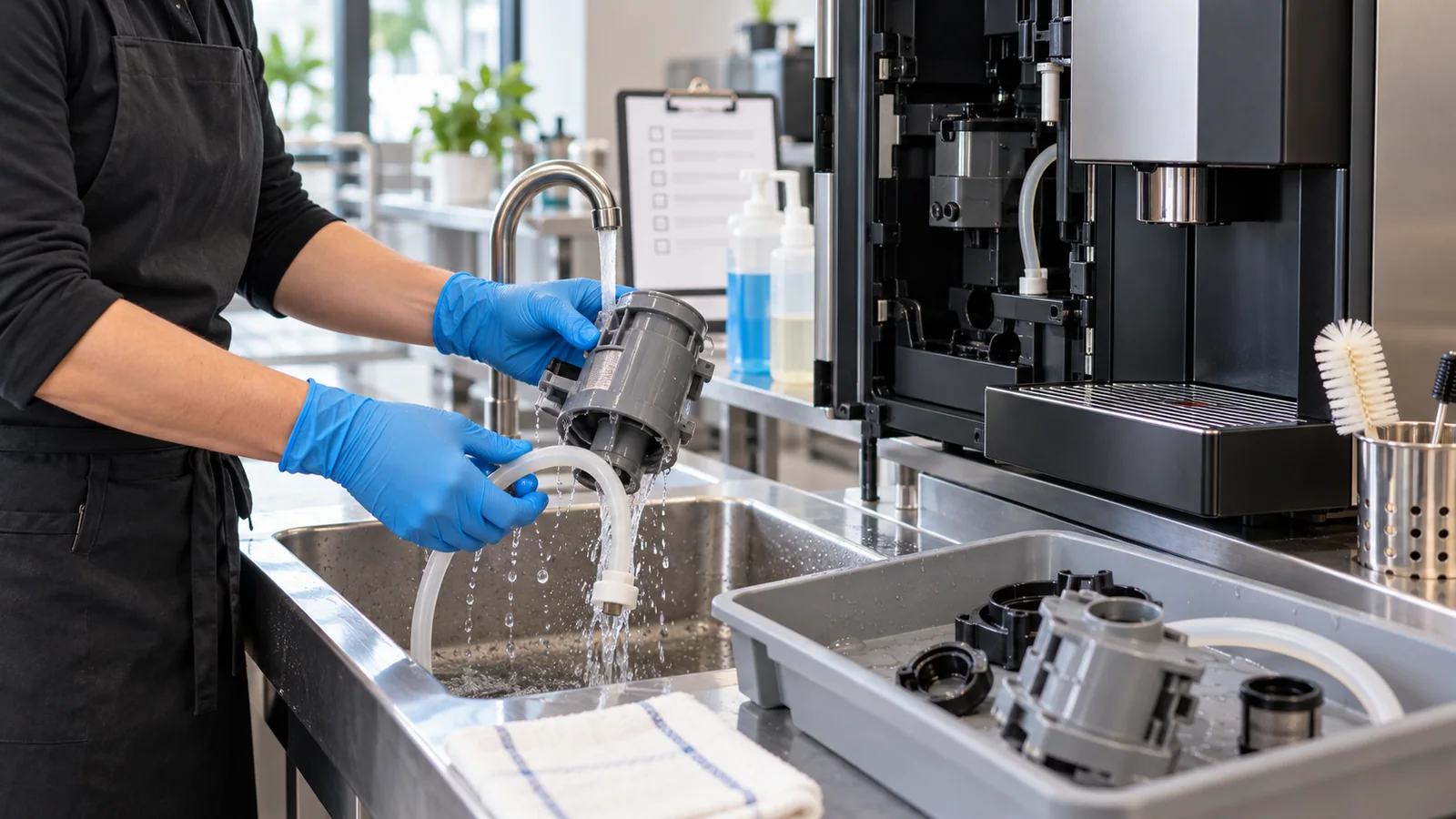
What cleaning obligations apply to hot drinks vending machines, which intervals must operators set themselves based on risk, and what records should the hygiene plan include? This guide distinguishes legal requirements, HACCP practice and standards guidance without prescribing blanket cleaning intervals.