
Fundamentals & Getting Started
Reusable Packaging in Vending: Legal Requirements, Cost Models and Practical Implementation
 KI Modified
On this page
- When does the reusable packaging offer requirement apply to vending machines?
- What hygiene and technical requirements apply?
- Which reusable model suits vending operations?
- How can costs and cost-effectiveness be calculated?
- How can reusable packaging be introduced in vending operations?
- Practical recommendations
- Conclusion
For vending machine operators, legal obligations are determined not by the term “reusable” alone, but by the specific dispensing process. If a drink or food is filled into a single-use cup or single-use plastic food container only when it is sold, a publicly accessible machine falls within the reusable packaging offer requirement under the BMUKN’s interpretation (§ 60 VerpackDG). For vending sales, this obligation can also be met by enabling the machine to fill customers’ own reusable containers (§ 61(2) VerpackDG). Under this interpretation, a machine that sells only goods that are already packaged does not fall within this reusable packaging offer requirement. Machines that are not publicly accessible and serve only a company’s employees are also exempt. This distinction is central to any implementation.
In practice, there are three basic models: customers bring their own cups, a standardised pool cup with a deposit, or a combination of the two. Customers’ own cups reduce the need for the operator’s own return logistics. A pool cup makes technical positioning easier, but requires returns, washing, storage and inventory management. The hybrid model offers more choice, but creates two parallel process chains.
There are no reliable general euro prices for retrofitting, pool fees, washing, returns or logistics in vending operations. A sound business case therefore uses the operator’s own operating data: dispensing volumes, single-use cup costs, service effort, return rates, loss, cleaning arrangements and failed fills. Blanket savings claims are not reliable.
Legal information does not replace an assessment of the individual case. Operators should document the location, product type, public access and filling process, and clarify the classification with the authority responsible under state law (§ 66(4) VerpackDG) or with qualified legal counsel. The food safety authority is the right contact for hygiene questions. The key primary sources are the BMUKN’s questions and answers on the reusable packaging offer requirement, the Packaging Law Implementation Act (VerpackDG), the German Environment Agency’s guidance on packaging and packaging waste and the BfR recommendations on customers’ own reusable cups.
When does the reusable packaging offer requirement apply to vending machines?
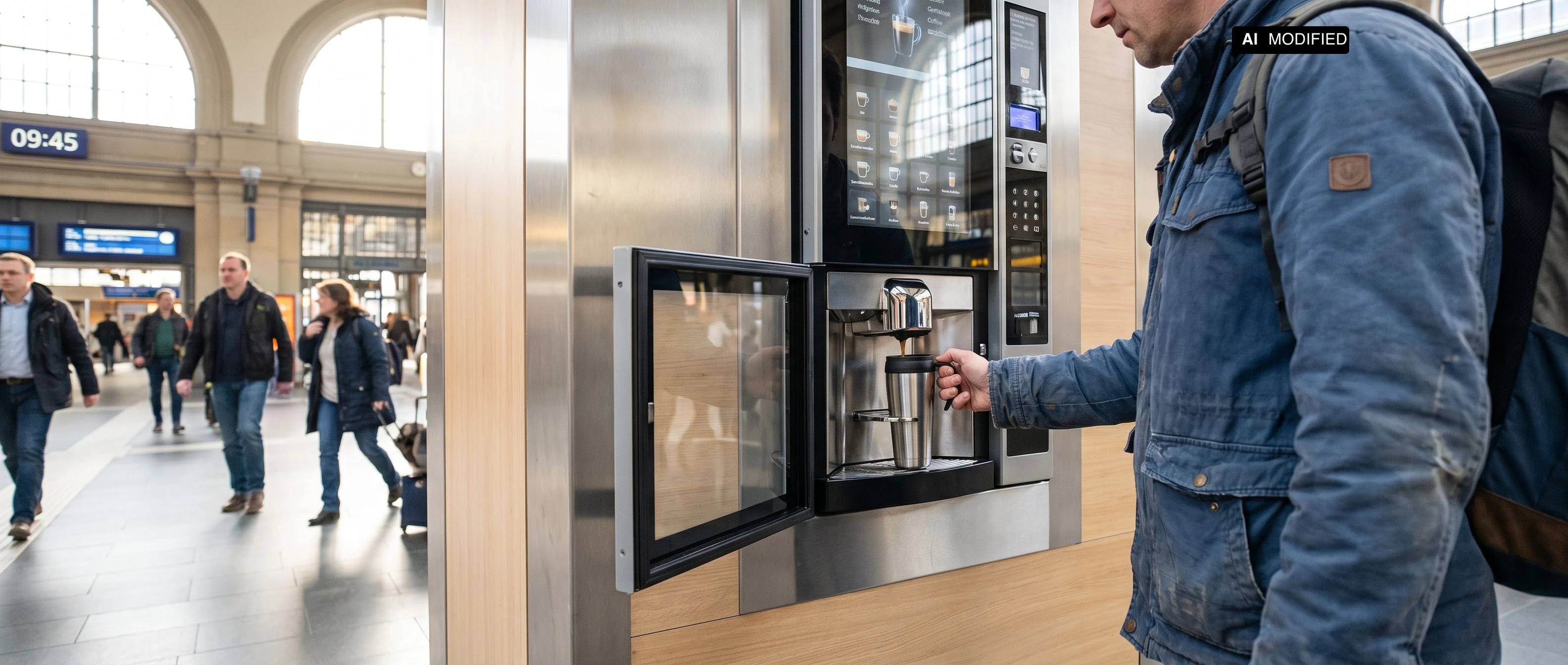
The first question is whether the machine is publicly accessible. A hot drinks machine in a railway station concourse, shopping centre, public-facing clinic or publicly accessible office building must be assessed differently from a machine on a closed company site. According to the official interpretation, the reusable packaging offer requirement applies to publicly accessible machines that fill drinks or comparable products into a cup or container only when they are sold. The operator must provide a way for customers’ own reusable containers to be filled there. The BMUKN explains this classification in its FAQ on the reusable packaging offer requirement.
Pre-packaged products are a different case. If a machine sells sealed bottles, cans, cups or other goods that were fully packaged before dispensing, this sales process alone does not fall within the specific reusable packaging offer requirement for filling on site, according to the cited authority interpretation. This exception applies to vending machines that sell only goods that are already pre-packaged. However, if a final distributor packages food or drinks itself, for example salads or sushi, such pre-packaged products may also be covered under the German Environment Agency’s guidance. Transferring a product that has already been offered in single-use packaging into reusable packaging after the fact does not meet the requirement. The German Environment Agency explicitly states that a product filled in advance may not be transferred into reusable packaging afterwards.
The site’s operating arrangements also matter. Official guidance describes machines that serve only a company’s employees and are not publicly accessible as exempt. Operators should not rely on a verbal assumption of exemption. It is useful to record the site, describe access arrangements and document who uses the machine. If access changes, for example by opening the site to visitors, the legal assessment may change.
The reusable packaging offer requirement has applied since 1 January 2023, initially under the Packaging Act. Since 12 August 2026, the rules have been set out in the Packaging Law Implementation Act (VerpackDG), in Sections 60 and 61. Some official interpretive guidance, including the BMUKN FAQ dated 2023, still refers to the earlier version of the law and should therefore be checked against the current legislation. For single-use beverage cups, the material alone is not decisive. The official explanations also cover lids and closures. Two points matter for cost calculations: reusable packaging must not be offered at a higher price or on less favourable terms than the single-use option (Section 60(1), sentence 3 VerpackDG). Breaches of the offer, pricing and information requirements may be treated as administrative offences and fined up to 10,000 euros (Section 66 VerpackDG).
At EU level, Regulation 2025/40 on packaging and packaging waste also applies. It contains further requirements on reuse, packaging prevention and reuse targets. Its specific effect on an individual machine depends on the product, packaging type, sales model and transitional provisions. Operators should therefore not draw a blanket conclusion for every vending process from the EU Regulation. The legal text of Regulation (EU) 2025/40 should be consulted for an assessment of a specific case.
The reusable option must be communicated clearly and legibly at the machine. A small note in the fine print is not enough to guide users in practice. The operator should explain the permitted cup type, how to position it and possible reasons for refusing it. That does not conclude the legal assessment. Product labelling, food hygiene, payment processes and any deposit procedures must also fit the chosen model.
What hygiene and technical requirements apply?
A customer’s own cup is not just any container for catching a drink. According to the recommendations of the German Federal Institute for Risk Assessment, it should be empty, clean, smooth and easy to clean. Containers that are visibly dirty should not be filled. This check must be addressed technically or organisationally in an unattended machine. A machine cannot reliably assess contamination in the way trained staff can. Operators therefore need clear acceptance rules and a safe way to stop the process.
For hot drinks, the BfR specifies smooth, heat-resistant materials suitable for contact with food. These include suitable stainless steel, porcelain and glass containers, as well as temperature-resistant plastics. Items made from melamine formaldehyde resin, especially so-called bamboo products, should not be used for hot or acidic drinks. This matters to operators because a machine usually cannot identify whether a customer’s cup is made from a suitable material. Communications should therefore state minimum requirements instead of promising to accept every cup without restriction.
Responsibility for hygienic filling lies with the food business or the staff carrying out the filling. A documented procedure is therefore also advisable for a vending machine. The BfR guidance also places duties on customers: they should not hold the container against the dispensing nozzle, and should not use the filling service if the machine is dirty. Under Section 61(3) VerpackDG, operators are liable for damage arising from filling customers’ own containers only in cases of intent and gross negligence. The German Food Federation’s guidelines provide a recognised basis for handling customers’ own containers and pool tableware. This means having a documented process: Which containers are accepted? When is filling stopped? How are the dispensing point and lines cleaned? Who checks for faults?
Technical suitability depends on several dimensions. A cup must fit under the dispensing unit, be positioned securely and remain stable while the drink is dispensed. Rim diameter, height, lid, handle, base shape and stackability can affect operation. A machine that dispenses only one standardised single-use cup is not automatically suitable for customers’ own containers. The European Vending and Coffee Service Association provides guidance on the dimensions of common single-use cups; this page does not specify requirements for reusable containers.
Failed fills are a particular concern. A cup positioned incorrectly may cause the drink to be dispensed beside the container, trigger a safety lock or soil the dispensing unit. The machine should enable dispensing only once it has detected a sufficiently secure position. If this function is not available, the operator must reduce the risk through approved container shapes, clear instructions and suitable testing. The research did not identify a general technical standard for automatic acceptance of all customers’ own reusable cups.
Hygiene requirements differ for pool cups. Here, the operator can use a defined container with specified material, volume and rim dimensions. Cleaning, release for use and storage must still be organised in a traceable way. Industry guidelines exist for pool systems. The Blue Angel DE-UZ 210 also covers criteria for containers, returns, logistics, reporting and circulation figures. The ecolabel is not an automatic operating permit. It can serve as a quality framework for a reusable system.
Which reusable model suits vending operations?
Customers’ own cups are the simplest option if the operator does not want to build its own pool of containers. The user brings a suitable, empty and clean cup. The machine or operator accepts it under the defined rules and fills it directly. There are no pool containers, central returns or washing routes. Retrofitting, operating logic, signage, training and additional troubleshooting remain cost and operational considerations.
This model is a better fit for sites with repeat users, where permitted cup shapes can be communicated clearly. At an open railway station, many different container types may be in use. A small insulated cup, a tall travel cup and a container with a large handle place different demands on positioning and splash protection. Operators should therefore test the formats they actually expect to encounter, not just one sample cup.
A standardised pool cup gives the operator greater technical control. Its volume, rim, material and stackability are specified. The operator can purchase a stock of cups or work with a pool provider. A deposit encourages returns, but does not replace return logistics. The process needs defined return points, transport, interim storage, washing, quality checks and a decision on damaged or unreturned containers. The German Environment Agency publication on the Blue Angel for reusable systems describes relevant requirements for such systems.
The pool model is more demanding to manage than customers’ own cups. The operator must track stock and plan for replacements. Loss is more than the loss of an individual container. It affects the number of cups needed in circulation and therefore the capital tied up in stock. No general return rate can be assumed for all vending sites. It must be measured at the operator’s own site.
The hybrid model accepts customers’ own cups and also provides a standard cup. It combines flexibility with technical safeguards. Users without their own cup can use the pool cup. Users with suitable containers avoid receiving an additional cup. However, the solution requires two process chains: an acceptance and error-handling process for customers’ cups, and a deposit, return and washing process for pool cups.
For individual machines with modest dispensing volumes, hybrid operation can become disproportionately complex. The operator must explain two types of container, handle different failure scenarios and test the dispensing point for both situations. Across multiple sites, a pool model may be easier to manage through central processes. This is not a general guarantee of cost-effectiveness. It depends on return routes, washing location, dispensing volumes, staff and existing logistics.
The choice should be based on six questions: How many drinks are dispensed each day? How public is the site? Which cup shapes are expected? Is there an accessible return point? Who handles cleaning and quality checks? Can the operator measure and address failed fills? Only once these questions have been answered can the operational effort for each model be assessed realistically.
How can costs and cost-effectiveness be calculated?
A sound cost calculation does not start with an assumed price per reusable cup. It separates investment, running costs and avoided single-use costs. For customers’ own cups, the calculation should include technical changes or retrofitting, software and operating logic, signage, training, hygiene effort, failed fills, faults and additional service visits. General investment prices have not been verified.
For pool cups, the cup stock and replacement stock must also be included. Other items are any pool or system fee, deposit administration, returns, transport, interim storage, washing, quality checks, rejects and loss. A centralised solution also creates internal costs. No generally transferable deposit amounts, pool fees, washing costs or return rates have been established for a specific vending system.
The basic formula for customers’ own cups is:
Total costs = technical changes + ongoing service + hygiene and training costs + costs of user errors and downtime minus avoided single-use cup costs.
The formula for pool cups is:
Total cost per dispensing = system fee + washing and logistics costs + cup replacement costs + administration costs + allocated investment minus avoided single-use cup costs.
For the hybrid model, the costs of both systems are added together. Integration, communication and service costs for the two process flows must also be included. These formulas do not produce a result on their own. They show which operating data must be collected.
Scenario 1: customers’ own cups
The operator first records drinks dispensed per day and the single-use cup cost per dispensing. Technical changes, monthly service, training time and documented failed fills are then tracked over a defined period. Avoided single-use costs are calculated by multiplying the number of drinks actually dispensed into reusable cups by the documented cost of a single-use cup, including relevant accessories. An example using a specific euro amount would not be reliable without these site-specific data. What matters is actual uptake, not the theoretical possibility.
Scenario 2: pool cups with a deposit
Here, the operator records pool cups issued, returns, containers not returned, washing batches, transport routes and rejects. Cost per dispensing is calculated by dividing the actual system, washing and logistics costs by the number of drinks dispensed. Cup loss is calculated from the purchase or replacement value and the number of containers not returned. The deposit amount must not simply be treated as a profit component. It is part of the return process and must be managed properly for accounting and operational purposes.
Scenario 3: hybrid model
For the hybrid model, dispensing into customers’ cups and pool cups is recorded separately. In addition, user errors by container type, aborted fills, cleaning events and service visits must be documented. The calculation is: costs of the customers’ own cup system plus costs of the pool cup system plus additional integration costs minus avoided single-use cup costs. A break-even point can be calculated only once dispensing volumes, single-use cup costs, returns, loss and service data are available.
LUCID registration should be considered separately from these operating costs. The Central Agency Packaging Register explains that registration itself is free. For packaging subject to mandatory system participation, a system participation agreement and data reports may also be required. Reusable packaging is addressed separately in the LUCID registration guide. The specific classification depends on the packaging and the company’s role.
How can reusable packaging be introduced in vending operations?
Start by recording each site and product. For each machine, document whether it is publicly accessible, who can use it and whether it serves employees only. Then record whether the product is dispensed pre-packaged or filled into a container only when sold. These two details are key to determining whether the specific reusable packaging offer requirement applies. Changes to site access or product range must be reflected in the documentation.
In the second step, choose the reusable model. The operator decides between customers’ own cups, pool cups and a hybrid model. This decision should be linked to the specific machine model. A general promise such as “reusable packaging available” is not enough. The operator must define which containers are accepted, how they should be positioned and when dispensing will be stopped. Instructions should be visible directly on the machine.
The third step is a technical assessment. Test height, rim diameter, base shape, handle, lid, material and temperature resistance. Testing should cover several containers and real dispensing situations. Also check drips, overfilling, splash protection, access for cleaning and reliable detection of the cup’s position. The operator should deliberately simulate failure cases: a crooked cup, a cup that is too tall, a dirty container and an interruption during dispensing.
In the fourth step, document the hygiene procedure in writing. It should specify permitted materials, visible contamination, reasons for refusal, cleaning intervals, responsibilities and measures to take after a failed fill. For pool cups, add washing, release for use, storage and rejects. The German Food Federation’s industry guidelines can serve as a basis. Responsibility remains with the food business.
In the fifth step, organise returns and deposits. A pool cup needs a return point, a transport route and a defined handover for washing. A return box without collection is not a complete process. The operator should track cups issued, returns, time in circulation, loss and damaged containers. In a hybrid model, pool cups and customers’ own cups must be considered separately.
In the sixth step, check the packaging register and document the relevant details. The Central Agency Packaging Register describes system participation and data reporting for relevant packaging. The operator should clarify its role, the packaging used and any potential reporting obligations. If the legal position is unclear, the operator should seek an assessment of the individual case from the authority or legal counsel.
Finally, measure quality and environmental performance. A pool provider or operator can use the criteria of the Blue Angel DE-UZ 210 as an assessment framework. Among other things, record returns, cleaning, logistics and circulation figures. Do not claim certification unless it has actually been awarded. Evidence of processes is distinct from an ecolabel.
Practical recommendations
- Classify the machine fleet: Create a short record for each machine covering its location, access type, user group, product type and dispensing process. A publicly accessible hot drinks machine must be assessed differently from a closed staff machine.
- Separate pre-packaged products from products filled on site: Document whether the product arrives in packaging or goes into a cup only when purchased. This distinction prevents different types of machine from being treated as if one blanket reusable packaging rule applied to all of them.
- Test one model for each process: Start with a specific machine and a clearly defined cup type. Test customers’ own containers, pool cups or both options not only in normal operation, but also with a crooked position, contamination and an interrupted dispensing cycle.
- Make cup rules visible: Explain clearly that cups must be empty, clean, smooth and suitable for hot food. Point out problematic materials and unsuitable shapes. Do not promise to accept every container customers bring without restriction.
- Assign hygiene responsibilities in writing: Define who handles cleaning, checks, fault management and documentation. For pool cups, also set requirements for washing, release for use, storage, rejects and return transport.
- Track costs using actual data: Measure dispensing volumes, single-use cup consumption, failed fills, service time, returns, loss and washing effort. Blanket savings claims without these figures are not sufficient for an operator’s decision.
- Plan returns before launch: If a pool cup is used, the return point, collection, transport and washing must be in place before launch. A deposit alone resolves neither loss nor cleaning.
- Check LUCID and the company’s packaging role: Clarify whether registration, system participation or data reports are relevant to the specific packaging and the company’s role. Free registration does not automatically mean that all other packaging obligations no longer apply.
- Plan for an individual assessment by the authorities: For mixed product ranges, changing sites or unclear access, check the classification before rollout. Keep the site and process description together with the decision.
- Set measurement criteria: A monthly report should include at least dispensing volumes, reusable share, failed fills, returns, loss, rejects, service visits and hygiene issues. This is the only way to assess whether a model is technically stable and economically viable.
Conclusion
Reusable packaging in vending starts with the correct legal classification. Under the BMUKN’s interpretation, publicly accessible machines that fill drinks or food into a container only when sold fall within the reusable packaging offer requirement and can meet it by filling customers’ own reusable containers (Section 61(2) VerpackDG). According to the cited guidance, machines that sell only goods that are already pre-packaged and staff machines used solely within a company must be distinguished from these.
There are three models for operators. Customers’ own cups reduce pool and return logistics, but require clear hygiene and acceptance rules. Standardised pool cups make geometry and process control easier, but create work around deposits, returns, washing, transport and loss. The hybrid model offers the widest choice and the greatest process complexity.
A reliable business case depends on site data. Investment, service, cups, cleaning, logistics, loss and failed fills must be tracked separately and compared with the single-use costs actually avoided. General euro amounts or return rates for vending operations have not been verified.
Operators should therefore start with a documented pilot process, assess the technical suitability of real containers, define hygiene procedures and responsibilities, and resolve return and LUCID questions before rollout. Legal requirements, technical safety and operating costs belong in a single assessment.
Latest on this topic
- EUDR and coffee vending machines: what the EU Deforestation Regulation requires before it appliesMarket Analysis · October 13, 2026
- Commodity Monitor October 2026: Coffee eases, cocoa and sugar in focusMarket Analysis · October 13, 2026
- AI in Vending in 2026: Predictive Maintenance and Assortment Optimisation — How to Use the TechnologyMarket Analysis · October 2, 2026
More guides
 KI Modified
Retrofit cashless payment to a vending machine: MDB 4.3, costs and selection criteria
What do you need to retrofit a vending machine for cashless payment? This guide explains MDB 4.3, compatibility, terminal selection, installation, ongoing costs and typical checks, without making unsupported price promises.
 KI Modified
The Ideal Vending Machine Mix: Combining Hot Drinks, Snacks and Water
Which combination of hot drinks, snacks and water is right for an office, a public venue or a small site? This guide helps operators assess sales mix, site requirements, hygiene, refrigeration, replenishment and cashless payments.
 KI Modified
Hygiene plan for hot drinks vending machines: cleaning, HACCP and records
What cleaning obligations apply to hot drinks vending machines, which intervals must operators set themselves based on risk, and what records should the hygiene plan include? This guide distinguishes legal requirements, HACCP practice and standards guidance without prescribing blanket cleaning intervals.