
Fundamentals & Getting Started
TCO Compass: Understanding and Calculating Total Cost of Ownership Correctly
 KI Modified
On this page
- What is TCO and why is purchase price not enough?
- Three scenarios: purchase, leasing and rental calculated
- Scenario A: Purchase of a coffee vending machine
- Scenario B: Leasing
- Scenario C: Rental model
- Operating costs in detail
- Energy
- Maintenance and service interval
- Cashless payment as a standalone TCO block
- Telemetry and SIM
- Hidden costs: what operators systematically overlook
- Deriving per-cup cost from TCO
- TCO drivers 2024–2026: what operators must watch now
- TCO checklist: 10 line items for every new location
Last updated: 2026-09-11
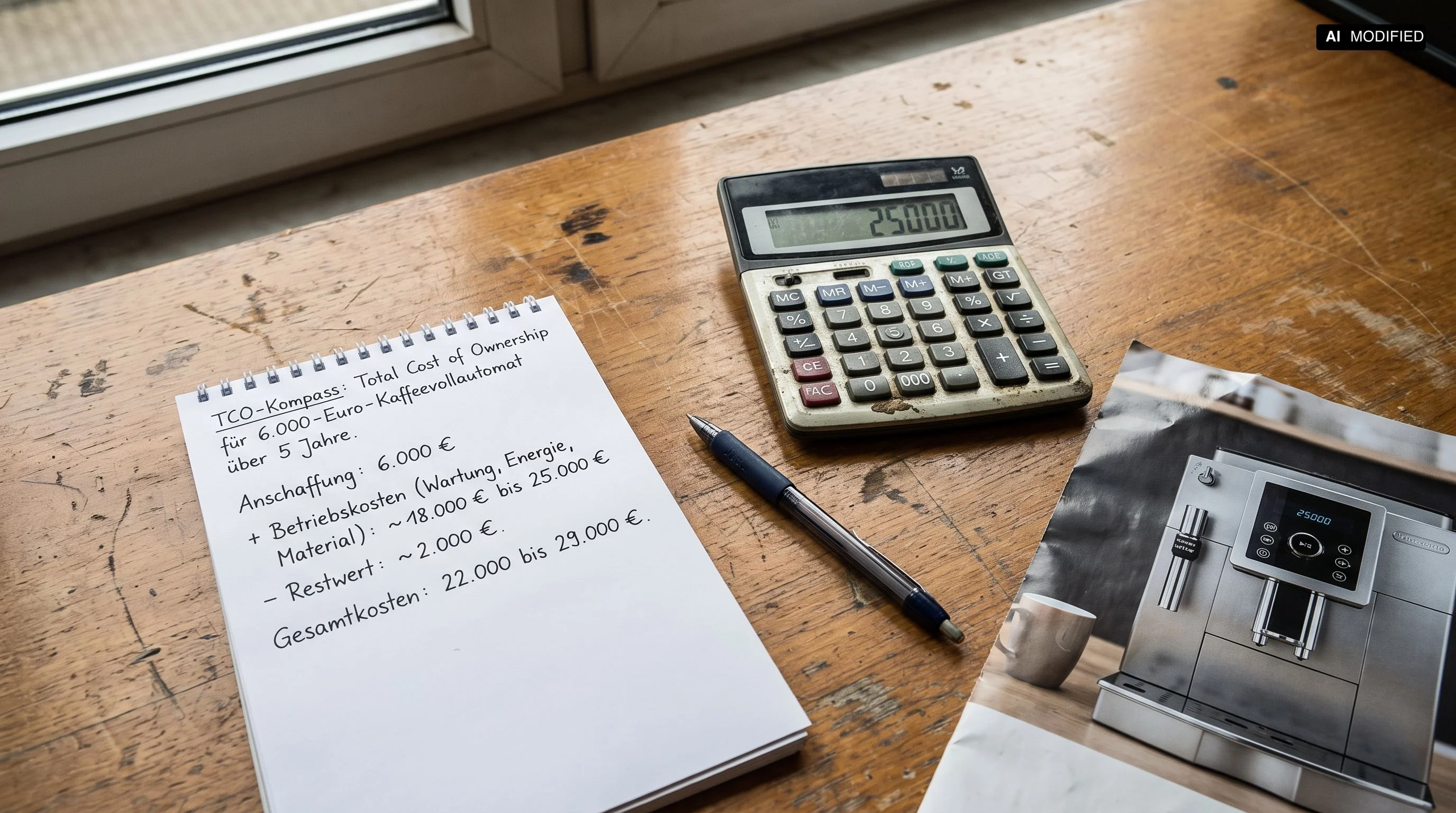
Six out of ten operators budget based on purchase price alone. That is insufficient. Total Cost of Ownership (TCO) adds acquisition costs, all operating costs over the service life, and subtracts residual value. For a typical coffee vending machine in the €6,000 class, this produces total costs of €22,000 to €29,000 over five years, depending on maintenance intensity, refill frequency and financing model. Understanding TCO enables operators to compare machines and locations fairly, derive the correct per-cup cost, and make economically sound decisions between purchase, leasing and rental.
The German Vending Machine Association (BDV) provides a multi-level calculation schema that separates base costs, site costs and contribution margin calculation. This guide explains the formula, works through three scenarios and identifies the cost positions most often overlooked.
What is TCO and why is purchase price not enough?
TCO stands for Total Cost of Ownership: all costs a machine generates over its entire useful life. The formula is: acquisition costs plus the sum of all operating costs minus residual value at the end of the service period. Standard observation periods in vending: five years for hot and cold beverage machines, seven years for snack and merchandise machines, three years for table-top units (BDV Calculation Schema, marktbox.de). The BDV applies 8.5 percent p.a. as the standard imputed interest rate, regardless of whether the machine is purchased or financed.
Three cost categories form the framework:
- Base costs (fixed, machine-specific): depreciation or leasing rate, imputed interest, insurance, maintenance contract
- Site costs (variable, location-specific): refill trips, technician time, location fee/commission, energy
- Product costs (variable, revenue-dependent): cost of goods sold, packaging, payment system fees
A machine with a low purchase price but frequent service requirements and high energy consumption often incurs higher total TCO than a more expensive, low-maintenance model. This shift is the primary reason why comparing purchase price alone is misleading: according to BDV per-cup cost calculation, depreciation and overhead together account for 33 percent of cup costs. Cost of goods sold accounts for only 30 percent.
Three scenarios: purchase, leasing and rental calculated
Scenario A: Purchase of a coffee vending machine
Starting point: €6,000 net purchase price. Installation fee one-time €250, including labour and materials per BDV Standard Value. Depreciation over five years: €1,200/year. Imputed interest (8.5% on average capital employed): approximately €255/year.
Annual operating costs at 50 cups/day and 250 operating days (12,500 cups/year):
| Line Item | Lower Bound EUR/Year | Upper Bound EUR/Year |
|---|---|---|
| Energy | 180 | 480 |
| Maintenance contract | 360 | 1,440 |
| Coffee beans (€0.083 × 12,500) | 1,038 | 1,038 |
| Disposable cups (€0.015 × 12,500) | 188 | 188 |
| Depreciation + imputed interest | 1,455 | 1,455 |
| Annual Total | 3,221 | 4,601 |
TCO over five years: €6,250 acquisition and installation plus €16,105 to €23,005 operating costs equals €22,000 to €29,000. Not included: location commission (5–15% of net revenue), technician travel time and telemetry.
Scenario B: Leasing
Leasing rates for new machines start at €89/month according to VendWerk (August 2025). Over 60 months this sums to €5,340 in pure financing cost, excluding energy, service and materials. Leasing payments are fully tax-deductible as operating expenses; for purchase, depreciation applies over the standard useful life.
The liquidity benefit is real: no capital outlay at the beginning. Total TCO typically exceeds purchase TCO by 15–25 percent because financing costs and leasing margin are factored in (manufacturer claim, not independently verified for all providers). Energy, service and refill costs stack on top as they do with purchase.
Scenario C: Rental model
The BDV calculation example for a point-of-use water dispenser rental demonstrates rental logic clearly: €1,200 annual revenue from machine rental versus €829 calculated operator costs, representing a profit margin of 30.9 percent (BDV, Rental Calculation Water Dispenser). For the operator, rental provides maximum liquidity protection with zero capital outlay. At the same time, total TCO over the service life is highest because the operator passes through their own TCO calculation including margin.
Scenarios compared: purchase with sufficient equity delivers the lowest TCO. Leasing protects liquidity at moderate TCO premium. Rental maximizes flexibility but produces the highest total cost. Which model fits depends on interest rates, equity ratio, tax situation and planned operating period. kaffeemaschine-leasen.de provides supplementary per-cup cost calculation with additional model variants.
Operating costs in detail
Energy
Hot beverage machines consume €15–40/month in electricity (BDV, marktbox.de). Snack machines without cooling run €10–17/month; with cooling (fresh products, beverages) €20–50/month (Bosta Kaffee). Over five years, electricity alone totals €600 to €3,000. For a refrigerated combo machine, the energy line item rivals the cost of a standalone maintenance contract.
Maintenance and service interval
A maintenance contract for a freestanding coffee machine costs €30–120/month. Table-top units are calculated at €240/year maintenance fee plus €160/year warranty reserve for bean-grind units (BDV Table-Top Calculation).
Service interval drives labour costs more sharply than hourly rate. At 1×/week refill there are 4.3 service visits/month; at 2×/week there are 8.7. A bean machine requires 20 minutes per service call; a cold or snack machine takes 10 minutes (BDV Calculation Schema Site Costs). Every unnecessary visit from intervals set too short cuts directly into costs.
Cashless payment as a standalone TCO block
85 percent of all pay-vend machines in Europe were cashless-equipped in 2024; in 2019 it was 58 percent (EVA Market Report 2025). A cashless terminal costs approximately €800 one-time. Running costs add €73.90–€103.49/month per machine at 1,000 transactions/month, including transaction fees of €0.061–€0.103 per transaction (BDV Cashless Payment Calculation 2022). Over 60 months this yields €4,434 to €6,209 cashless TCO per machine. Omitting this block from the calculation understates total costs by 15–25 percent.
Telemetry and SIM
SIM card and monitoring platform cost €5–15/month (VENDY1). Over five years this adds €300–900. In simple TCO calculations this line item is routinely omitted, even though it is prerequisite for remote access and data-driven refill optimisation.
Hidden costs: what operators systematically overlook
Internal labour time is the most underestimated comparison item. An operator who orders coffee beans in the office, fills containers and cleans the machine spends approximately €260/month on locked-in labour costs, per cost analysis from Bosta Kaffee. These costs appear in no machine TCO but are a direct economic argument for switching to a fully automatic machine with professional service.
Additional frequently missing line items, documented by Singh Vendo and VENDY1:
- Spare parts: coin validators, display modules, spiral motors. Costs to be clarified contractually; no public standard value available.
- Water filters: change interval depends on local water hardness. Annual costs not publicly quantified.
- Cleaning supplies: €0.05–€0.15 per vend (BDV Calculation Schema).
- Transport and disposal: removal and recycling costs accrue at the end of service life; German benchmarks not publicly quantified.
- BDV Quality Seal (if pursued): €2,750 plus VAT every three years, including audit, reporting and travel (BDV Quality Seal Brochure).
Deriving per-cup cost from TCO
The BDV published a per-cup cost calculation for the corporate market in Issue 03/2024 (p. 38). At a selling price of €0.80 per coffee vend, the cost structure breaks down as follows (BDV Per-Cup Cost Calculation 03/2024):
| Cost Position | Cents | Share |
|---|---|---|
| Material (beans, milk, sugar, water) | 21 | 30% |
| Labour (refill, cleaning, service) | 9 | 11% |
| Depreciation (machine wear) | 14 | 18% |
| Overhead (administration, storage, fleet) | 12 | 15% |
| VAT (19% on €0.80) | 13 | 16% |
| Profit | 11 | 14% |
Cost of goods sold accounts for only about 30 percent of cup costs. Depreciation and overhead combined (33 percent) dominate. A machine with higher purchase price but lower service and energy costs is often cheaper in TCO than an apparently inexpensive entry-level model.
Raw material costs vary significantly by system type: coffee beans cost €0.083/cup including milk and sugar, freshbrew €0.047/cup and instant €0.044/cup net (BDV Contribution Margin Calculation). Switching from beans to freshbrew saves approximately €450 net in material costs annually at 12,500 cups/year. This shifts the break-even per-cup price downward.
The European average selling price for hot beverages was €0.48 inc. VAT in 2024, an increase of 8.8 percent over 2023 (EVA Market Report 2025). At 178 vends per machine per week (European average, still below pre-crisis level of 230) this yields approximately €4,440 gross revenue/year per machine. Operators who do not know their TCO do not know whether this revenue sustains the location.
TCO drivers 2024–2026: what operators must watch now
Three cost blocks face particular pressure currently:
Labour costs rose 12 percent in 2024 (BDV Market Study via Gastrospiegel, 03.12.2024). The 2022 BDV calculator still applies €11.60/hour wages; realistic for 2026 are €14–18 depending on region (not independently verified). Every unnecessary service visit from poorly optimised refill intervals cuts directly into costs.
Cost of goods sold now accounts for 43 percent of revenue with upward pressure from raw material costs (Gastrospiegel/BDV Market Study 2024). Operators who last adjusted per-cup price two years ago are calculating with outdated foundations.
Machine complexity grows with rising demand for combo machines (+4.5% annually) and fresh-product units (automatenmarkt.de). More features mean more failure points and costlier spare parts. Maintenance contract clauses limiting spare part costs become more important than ever.
Nationwide, approximately 621,000 machines were in operation in 2024; 76 percent in the corporate market (production, office). The total revenue of the German vending market is €4.62 billion (BDV Market Study 2024). Despite growth, TCO management remains the decisive lever for profitability in a business with structurally tight margins.
For tax aspects, VAT rates (7% vs. 19% depending on product) and taxable fringe benefit values for tax-free employee refreshment, the Working Paper of the German Bundestag Scientific Services (WD 4-3000-011/26, 11.02.2026) provides authoritative foundations.
TCO checklist: 10 line items for every new location
A complete TCO calculation before contract signature includes the following positions:
- Record purchase price or leasing rate (net)
- Add installation fee (typically €250, one-time)
- Set depreciation period (3 years table-top / 5 years hot and cold beverage / 7 years snack)
- Calculate imputed interest (8.5% p.a. on average capital employed)
- Estimate energy costs (€15–50/month by machine type and cooling requirement)
- Obtain maintenance contract and record monthly rate
- Calculate refill frequency and service time (visits × minutes × hourly cost rate)
- Determine cost of goods sold per vend (beans: €0.083, freshbrew: €0.047, instant: €0.044 net)
- Add cashless costs (terminal approximately €800 one-time, running €74–103/month)
- Capture hidden items: telemetry (€5–15/month), water filters, cleaning supplies, disposal at end of life
The complete BDV calculation template (comprehensive, table-top, water dispenser, cashless payment) is available free at bdv-vending.de as a working foundation. It contains fields for all ten items and automatically calculates the contribution margin per location. Operators who complete this template before signing a contract avoid the most common TCO gaps.
Latest on this topic
- EUDR and coffee vending machines: what the EU Deforestation Regulation requires before it appliesMarket Analysis · October 13, 2026
- Commodity Monitor October 2026: Coffee eases, cocoa and sugar in focusMarket Analysis · October 13, 2026
- AI in Vending in 2026: Predictive Maintenance and Assortment Optimisation — How to Use the TechnologyMarket Analysis · October 2, 2026
More guides
 KI Modified
Retrofit cashless payment to a vending machine: MDB 4.3, costs and selection criteria
What do you need to retrofit a vending machine for cashless payment? This guide explains MDB 4.3, compatibility, terminal selection, installation, ongoing costs and typical checks, without making unsupported price promises.
 KI Modified
The Ideal Vending Machine Mix: Combining Hot Drinks, Snacks and Water
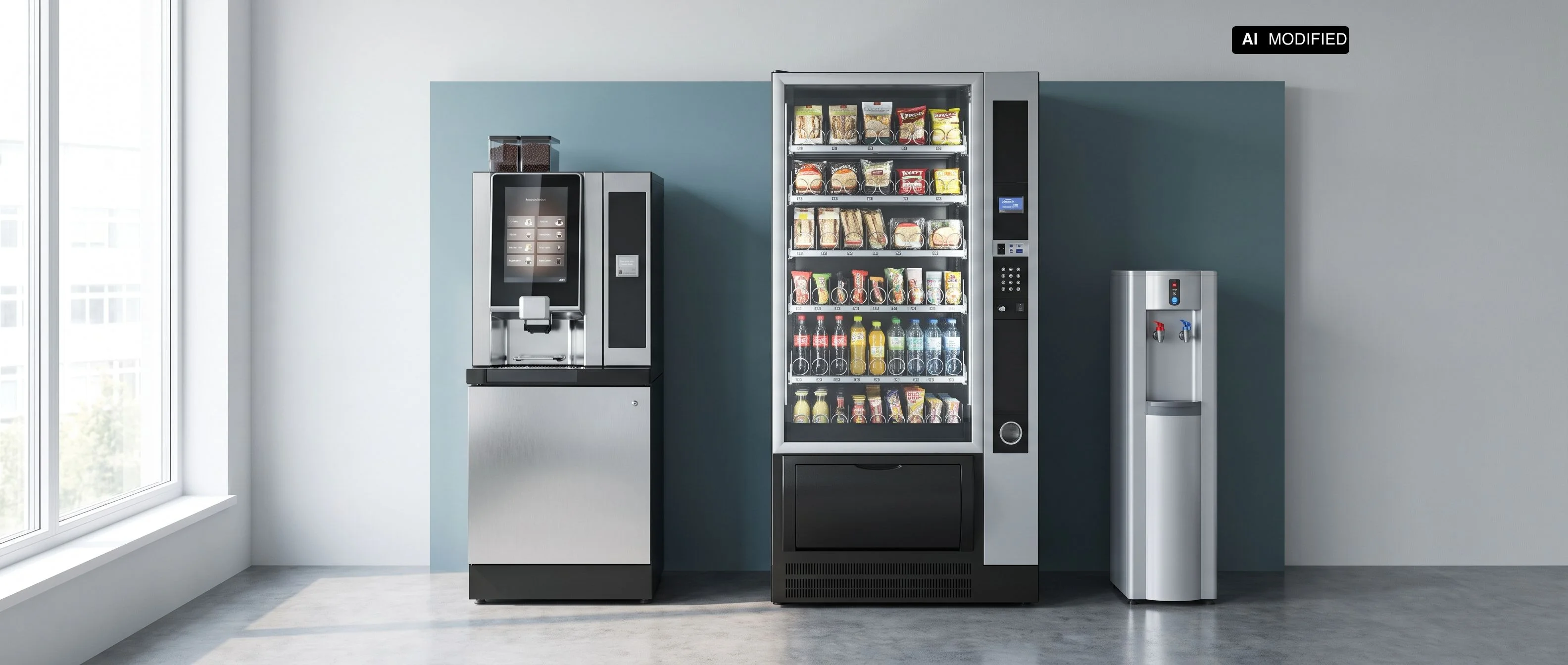
Which combination of hot drinks, snacks and water is right for an office, a public venue or a small site? This guide helps operators assess sales mix, site requirements, hygiene, refrigeration, replenishment and cashless payments.
 KI Modified
Hygiene plan for hot drinks vending machines: cleaning, HACCP and records
What cleaning obligations apply to hot drinks vending machines, which intervals must operators set themselves based on risk, and what records should the hygiene plan include? This guide distinguishes legal requirements, HACCP practice and standards guidance without prescribing blanket cleaning intervals.