
Fundamentals & Getting Started
Telemetry and Data Analytics in Vending: EVA-DTS, Back Office and Business Intelligence for Professionals

On this page
- Why telemetry is becoming essential for vending operators
- EVA-DTS: The common denominator for back-office interfaces
- What the standard does and does not do
- The right questions for every provider
- MDB: The internal interface everything depends on
- Multi-Drop Bus explained
- EVA EPS as a payment data channel
- An overview of back-office platforms on the market
- Cantaloupe: Seed platform and G11 Telemeter
- Vendon: IoT gateway focused on remote management
- Nayax: Payment terminal and telemetry from one provider
- Four questions to ask before choosing a platform
- ROI calculation: Drivers, costs and realistic expectations
- The BDV benchmark as a starting point
- Driver 1: Avoid unnecessary visits
- Driver 2: Detect faults earlier
- What telemetry costs
- AI applications: Five areas already in use
- What is already being used
- What AI does not replace
- Implementation guide: What to clarify before rollout
- Step 1: Take stock of your machines
- Step 2: Check connectivity at each site
- Step 3: Clarify data protection and fiscalisation in advance
- Step 4: Run a pilot before rollout
- Outlook: Connectivity as an industry standard
Last updated: 2026-10-03
Why telemetry is becoming essential for vending operators
621,000 machines, 11.5 million sales a day, €3.37 billion in annual revenue: in 2024, the German vending market grew by 18.7 percent (German Vending Machine Industry Association, BDV). At this pace, managing stock with paper forms and a rigid weekly schedule no longer works. An operator running 200 machines and visiting 15 to 20 of them each day can hardly avoid empty machines, faults and suboptimal product ranges without real-time data.
Telemetry connects sensors and standardised protocols so that sales, stock and status data from each machine flow directly into a back-office platform. The result: fewer unnecessary visits, earlier fault detection and a product range shaped by actual purchasing behaviour. For operators with more than 50 machines, the investment typically pays off sooner than vendor projections suggest. For very small operators with fewer than 20 machines, the break-even point needs to be clarified in the contract.
This guide explains how EVA-DTS, MDB and current back-office systems fit together, which platforms are shaping the market and which questions operators need to answer before choosing a system.
EVA-DTS: The common denominator for back-office interfaces
What the standard does and does not do
The European Vending Association Data Transfer Standard (EVA-DTS, current version 6.2, 325 pages) is the main interface through which machines exchange structured data with back-office systems. The European Vending & Coffee Service Association (EVA) provides the specification free of charge to registered industry participants.
EVA-DTS is bidirectional. The machine transmits sales audit data (cumulative revenue snapshots), stock levels, machine status and fault alerts. The back-office system sends configuration data, price changes and planogram updates in return. Transmission methods include Bluetooth, USB, Wi-Fi or Ethernet. From version 6.1.2, the standard includes provisions for data security, auditable archives, transaction immutability and recovery points. This is no academic footnote: fiscalisation requirements in several EU markets make these features a prerequisite for legal operation.
EVA-DTS is not a real-time protocol. The standard transmits snapshot data: cumulative sales figures at a particular point in time, not each individual purchase at the moment the customer presses a button. Real-time alerts require operators to use an additional platform layer that interprets the standard and monitors thresholds.
The right questions for every provider
Not every back-office system implements EVA-DTS in full. Before making a decision, ask three questions: Which EVA-DTS version is supported? Are all data fields imported, including machine status and maintenance alerts? And how is the immutability of transaction data demonstrated for fiscalisation purposes?
MDB: The internal interface everything depends on
Multi-Drop Bus explained
Before a machine can send data to a back-office system, that data has to get out of the machine. This is handled by the Multi-Drop Bus protocol (MDB, current version 4.3, as of July 2019, 344 pages). MDB connects the machine’s main control unit to peripheral devices: coin changers, banknote readers and payment terminals.
Telemetry devices connect at this interface. They receive data from the machine over MDB and forward it to a cloud platform. Without MDB compatibility, standardised data retrieval is not possible. The BDV describes MDB as vending’s USB standard: interoperable across manufacturers and effectively mandatory for participating in the market (BDV).
MDB 4.3 introduced relevant telemetry enhancements: expanded support for contactless payment, mobile payment and EVA-DTS integration. Operators running older machines with MDB versions below 4.3 should check whether the telemetry device includes a hardware adapter or software layer. Without the adapter, an older machine remains outside the data set.
One point from Nayax’s explanation of EVA-DTS: cashless terminals connected via MDB automatically supply transaction data for back-office analysis. This means that moving to cashless payments often already provides a telemetry foundation, without requiring a separate telemetry device.
EVA EPS as a payment data channel
Alongside MDB, the EVA Electronic Payment Specification (EVA EPS v2) connects payment terminals with card networks and mobile payment systems. The relevance for telemetry: open-site payment systems (card, NFC, app pay) automatically supply transaction data for back-office analysis. The EVA Market Report 2025 shows that 85 percent of European machines were equipped with cashless payment functionality in 2024, compared with 58 percent in 2019. Of these, 65 percent are open-site systems with full data transparency, and 35 percent are closed-site systems using a company card or key.
An overview of back-office platforms on the market
Cantaloupe: Seed platform and G11 Telemeter
Cantaloupe combines hardware (the G11 Telemeter, which is waterproof, has 4G mobile connectivity and is compatible with most machine brands) with the Seed platform as its central software. It is PCI-DSS compliant and covers vending, micro-markets and OCS in a shared interface (Cantaloupe Telemetry).
Specific features listed by the manufacturer include weekly sales summaries, bestseller lists, cash accountability reports, pre-pick orders for precise stock management and machine-status alerts. For operators managing vending and micro-markets under one roof, the single-platform approach is an efficiency advantage (manufacturer claim, not independently verified).
Vendon: IoT gateway focused on remote management
Vendon uses the vBox gateway as its IoT connectivity solution and Vendon Cloud as its platform. It serves more than 2,000 customers in over 90 countries, with a focus on real-time stock monitoring, remote diagnostics, remote resets, predictive maintenance and machine downtime analysis (Vendon Cloud).
Vendon cites a 172 percent ROI in the first year, an 80 percent reduction in downtime and a 65 percent reduction in unnecessary visits (manufacturer claims, not independently verified). For coffee machines, there is a dedicated remote management module: recipes, cleaning logs and error codes can be accessed and, in some cases, managed without an on-site visit (Vendon coffee machine remote management).
Nayax: Payment terminal and telemetry from one provider
Nayax positions its card reader as a combined payment and telemetry endpoint: data flows from the machine over MDB to the Nayax card reader, which uses it for both payment processing and the NayaxVend Management Suite (Nayax: Importance of Telemetry in Vending). Available data points include real-time sales data, stock levels, machine status, temperature and downtime, accessible via mobile app.
Nayax data formed the basis for EVA market analysis in the UK: 80 percent of transactions at UK machines with a Nayax reader are cashless, and the average transaction value is 90 percent higher than for cash payments (data basis: UK Nayax reader estate, EVA Market Report 2025).
Four questions to ask before choosing a platform
No system leads on every dimension. Before making a decision, you need answers to four questions:
First: Which machine brands and MDB versions are in your estate? Ask the provider for explicit compatibility lists. Older machines with MDB below 4.3 may require adapter solutions.

Second: Do you need coffee or OCS management? Not every provider includes specialist modules for recipes, brew groups and cleaning logs in its standard package.
Third: How are you charged? SaaS licences, transaction fees and hardware purchases have different implications for cash flow and accounting.
Fourth: What reporting obligations apply? Fiscalisation under KassenSichV, HACCP temperature logging and financial security require specific EVA-DTS features that not every platform fully supports.
ROI calculation: Drivers, costs and realistic expectations
The BDV benchmark as a starting point
The BDV cites an industry benchmark from an operator study of 200 machines per technician and 15 to 20 machines per daily route (BDV). Every unnecessary visit to a machine that is still sufficiently stocked costs driving time, fuel and technician labour. Every machine that runs empty because telemetry is lacking and is not restocked until the next route day loses revenue.
Driver 1: Avoid unnecessary visits
With telemetry-based dynamic route planning, operators visit only those machines where stock levels and forecast demand justify it. The actual savings depend on the vehicle fleet, site locations and licensing model. The BDV describes the effect as follows: “Telemetry software transfers data from machines in real time. This enables better stock management and maintenance. Dynamic route planning can determine the optimal route for servicing and replenishing machines, saving time and costs and reducing environmental emissions.” (BDV Operator and Market Report 2023)
Driver 2: Detect faults earlier
A 2025 preprint (arXiv:2507.02934) describes an IoT/machine learning system that detects faults with 94 percent accuracy, reduces unplanned downtime by 32 percent and unnecessary technician dispatches by 27 percent, and increases machine capacity per technician per day from 8 to 11 to 14 (arXiv:2507.02934, preprint without completed peer review; use as a guide). For an operator with 50 machines, one unplanned outage per machine per week, at 20 sales a day and an average price of €1.50, means €210 in lost revenue per outage. Across a fleet of 50 machines and an outage rate of 10 percent, that adds up to more than €1,000 per week.
What telemetry costs
Providers do not publish hardware costs or licence fees. Industry estimates for mobile connectivity are in the range of US$8 to US$12 per device per month (not directly verified; to be clarified contractually). Platform licences are additional. To produce a sound ROI estimate, ask the provider for the device price, installation costs, monthly fee, contract term and minimum order quantity.
AI applications: Five areas already in use
What is already being used
In magazine issue 02/2025, the BDV describes AI as a new foundational technology, comparable to smartphones or the internet. Five applications are established in practice (BDV):
Predictive maintenance. AI systems analyse patterns in telemetry data: temperature trends, motor current and error codes. Early signs of failure are detected before the machine stops working. The technician arrives with the right spare part and without an unnecessary diagnostic visit.
Product range optimisation. Algorithms use sales patterns to derive optimised planograms. The ideal range for a kiosk in a production hall differs from that for a site in a fitness studio. Without data, technicians can only estimate this difference from experience.
Dynamic route planning. The current stock status, rather than the weekly calendar, determines when each machine needs replenishing. The impact can extend to reducing vehicle fleets.
Customer data analysis. At sites with a loyalty programme or app connection, behavioural analysis enables personalised offers. In Germany, this is regulated by the GDPR, but can be implemented technically with an appropriate consent framework.
Automated fault reporting. Chatbot-supported systems receive error codes, classify the fault and automatically create a service ticket: 24 hours a day, seven days a week, without an on-call technician having to interpret the error code manually.
What AI does not replace
No algorithm can replace a technician’s site-specific experience. Predictive maintenance requires sufficient training data: for an estate with 15 different models from 8 manufacturers, manufacturer-specific models or a longer training period are needed. Operators who start using telemetry today will have a data set in 12 to 18 months on which AI models can be trained effectively.
Implementation guide: What to clarify before rollout
Step 1: Take stock of your machines
Which machines in your estate are MDB-compatible? Which MDB version do they use? Are there older machines without a standardised interface? These details determine whether you need standard telemeters or adapter solutions. An accurate list of brands, models and years of manufacture is the starting point for any worthwhile tender.
Step 2: Check connectivity at each site
4G mobile connectivity works at most sites, but can fail in underground car parks, basements and shielded industrial halls. Wi-Fi as an alternative requires network access approval from the site operator and clear responsibility for outages. The contract must specify whose SIM agreement covers ongoing connectivity costs.
Step 3: Clarify data protection and fiscalisation in advance
EVA-DTS 6.1.2 includes provisions for data security and transaction immutability. In Germany, the Cash Register Security Ordinance (KassenSichV) and the GDPR also apply. The provider must confirm in writing which requirements its system meets and how, with reference to specific version numbers. A verbal “It’s all included” is not enough.
Step 4: Run a pilot before rollout
A three-month pilot covering 20 machines, with KPIs defined in advance (out-of-stock rate, fault response time, route efficiency), provides a sound basis for a decision. Without a pilot, ROI cannot be verified. Operators who move straight to a full rollout based on vendor projections have no negotiating basis when the contract comes up for renewal.
Outlook: Connectivity as an industry standard
The EVA Market Report 2025 identifies connectivity and back-office systems as one of the seven biggest changes in the industry over the past ten years (EVA). The increase in cashless system penetration from 58 percent in 2019 to 85 percent in 2024 is more than a payment upgrade: it is the technical foundation for telemetry infrastructure.
For operators, this means that those who do not build telemetry infrastructure today will be excluded in three to five years from tenders requiring real-time data and fiscalisation. The barrier to entry is low. EVA standards are freely accessible. The platforms are mature. The first step is an honest assessment of your machine estate, followed by a pilot with measurable KPIs.
Latest on this topic
- EUDR and coffee vending machines: what the EU Deforestation Regulation requires before it appliesMarket Analysis · October 13, 2026
- Commodity Monitor October 2026: Coffee eases, cocoa and sugar in focusMarket Analysis · October 13, 2026
- AI in Vending in 2026: Predictive Maintenance and Assortment Optimisation — How to Use the TechnologyMarket Analysis · October 2, 2026
More guides
 KI Modified
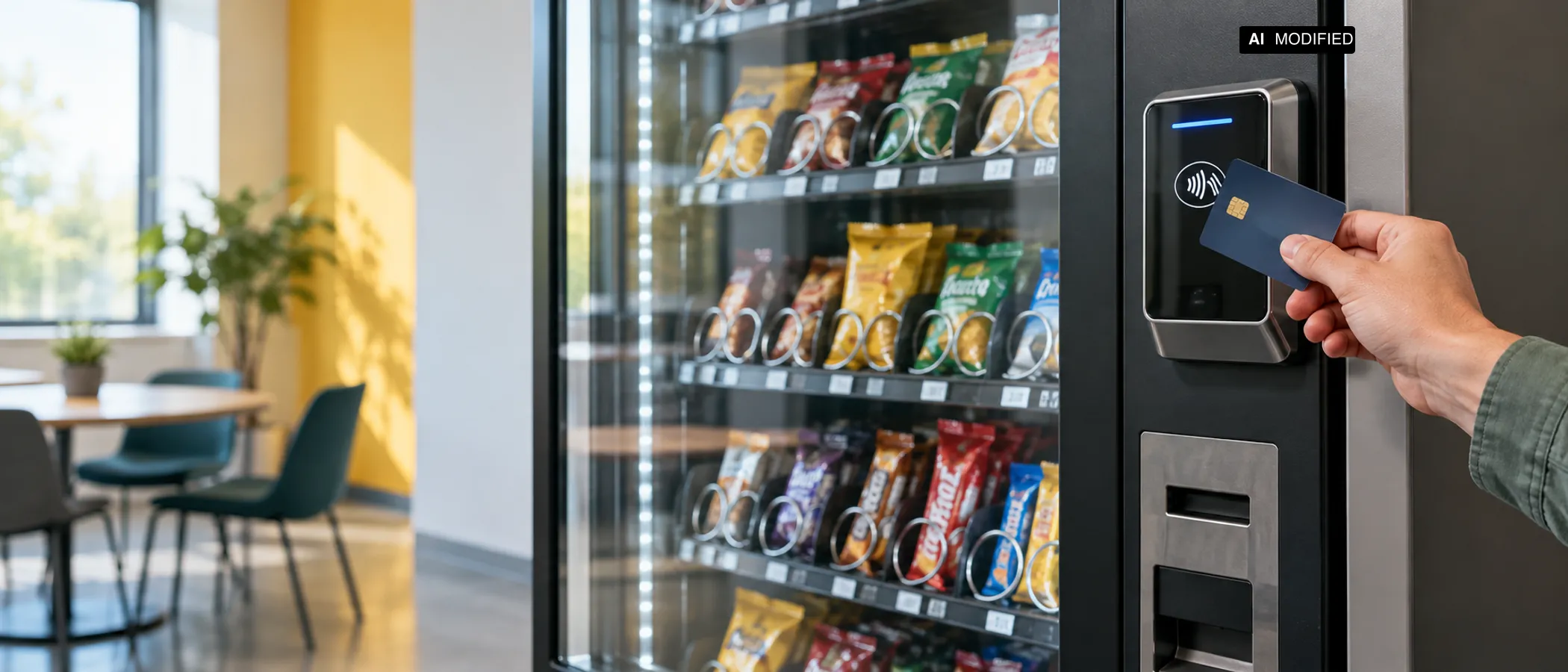
Retrofit cashless payment to a vending machine: MDB 4.3, costs and selection criteria
What do you need to retrofit a vending machine for cashless payment? This guide explains MDB 4.3, compatibility, terminal selection, installation, ongoing costs and typical checks, without making unsupported price promises.
 KI Modified
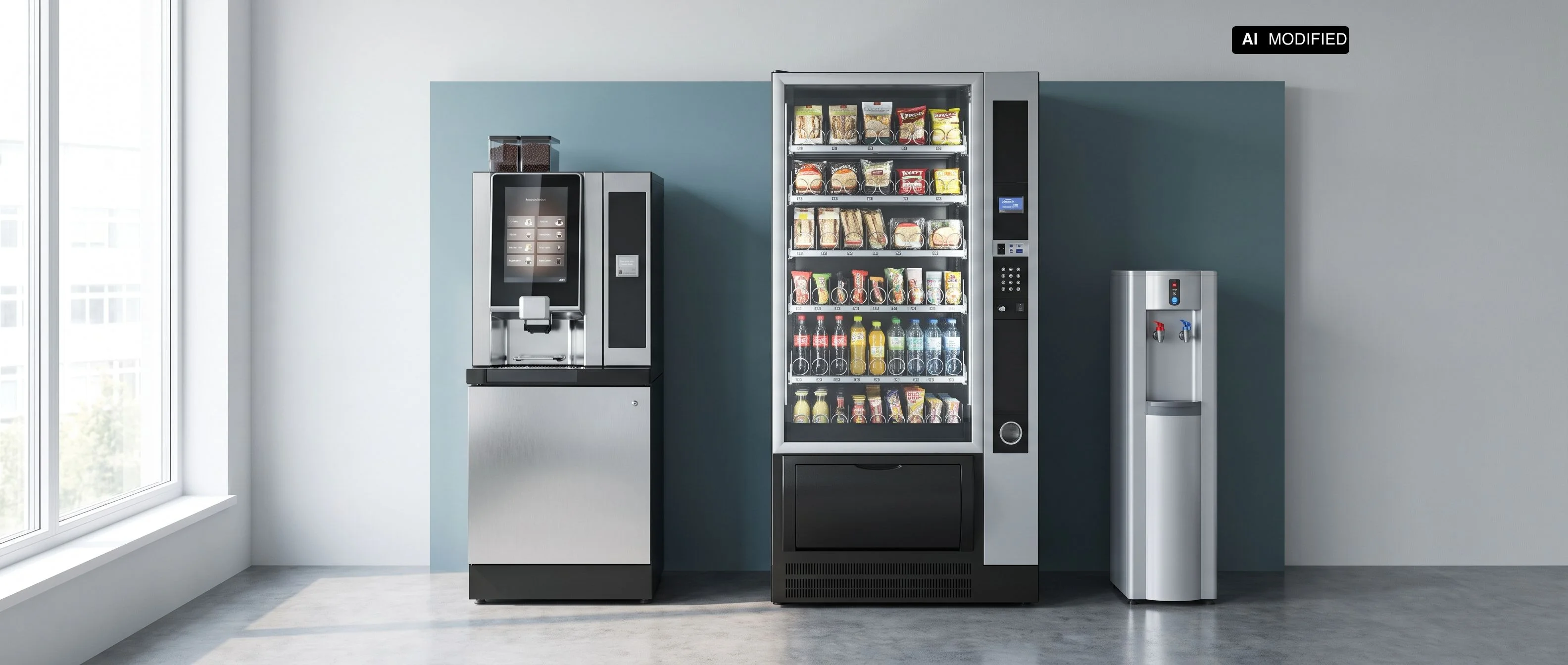
The Ideal Vending Machine Mix: Combining Hot Drinks, Snacks and Water
Which combination of hot drinks, snacks and water is right for an office, a public venue or a small site? This guide helps operators assess sales mix, site requirements, hygiene, refrigeration, replenishment and cashless payments.
 KI Modified
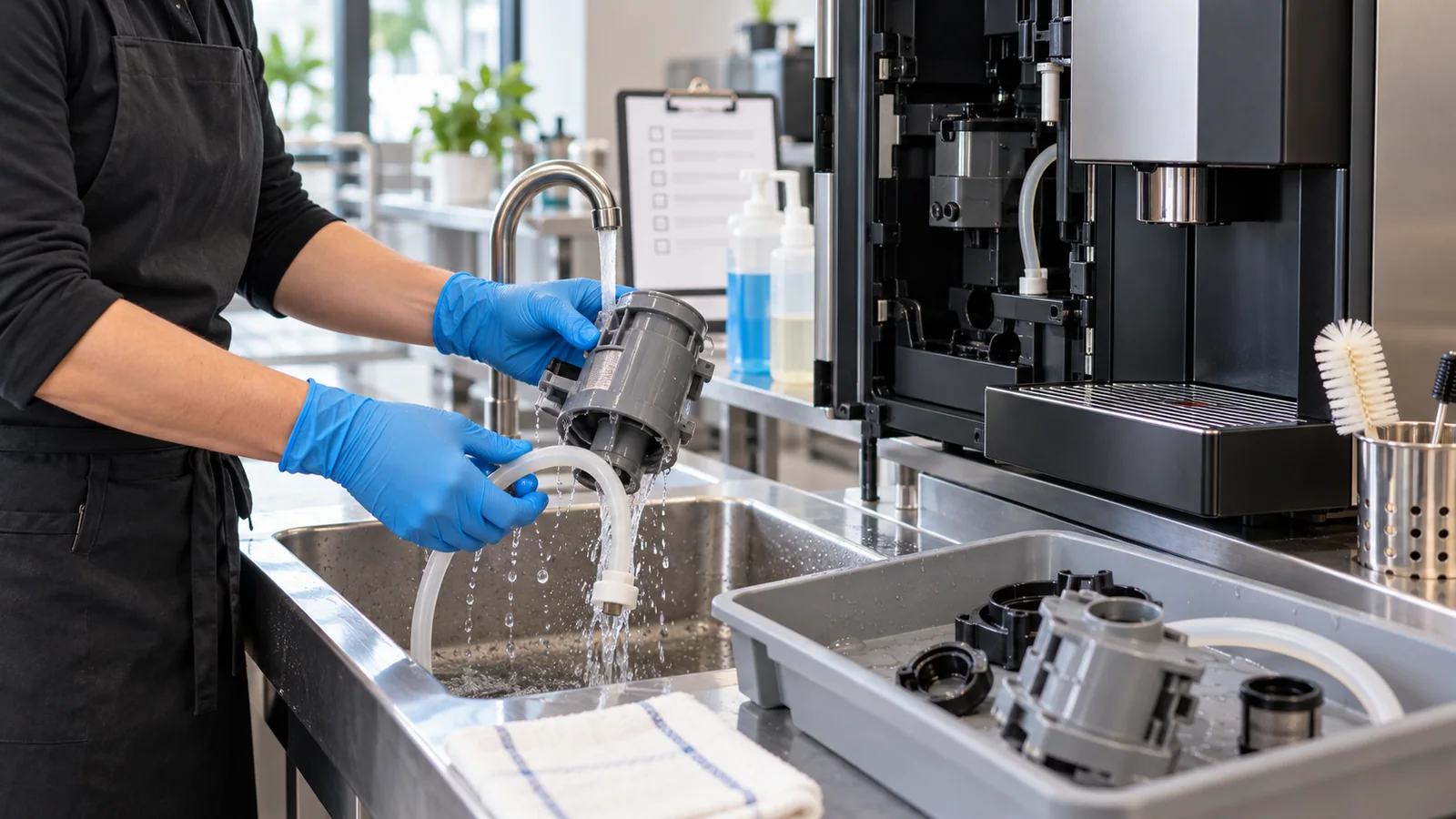
Hygiene plan for hot drinks vending machines: cleaning, HACCP and records
What cleaning obligations apply to hot drinks vending machines, which intervals must operators set themselves based on risk, and what records should the hygiene plan include? This guide distinguishes legal requirements, HACCP practice and standards guidance without prescribing blanket cleaning intervals.