
Fundamentals & Getting Started
Water Dispensers Reviewed: POU vs. Bottled – The Complete 5-Year Cost Breakdown
 KI Modified
On this page
- How do POU and bottled-water dispensers differ?
- The 5-year calculation: three operating scenarios
- Scenario 1: 10 people, 160 litres per month
- Scenario 2: 20 people, 4,000 litres per year
- Scenario 3: 50 and 300 people
- Hidden costs: what supplier quotes leave out
- Installation requirements: what you need technically
- Hygiene and operator responsibilities
- Rent or buy: which model is right?
- When does POU really pay off?
- Sustainability: transport emissions and system footprint
- Checklist: which system suits your site?
From 10 employees, a bottled-water dispenser costs 50 to 100 percent more over five years than a point-of-use (POU) unit connected to the mains. For 50 people, the difference is around €28,000; for 300 people, it exceeds €100,000. Depending on team size, break-even comes after one to four years: if you serve more than 20 people, the additional cost of a POU unit is generally recovered within two years. The main obstacle is the initial installation: a separate water connection compliant with DIN 1717, with a pressure of 1.5 to 6 bar, and a one-off installation fee of €150 to €300 are required. Even if you want to avoid this work or have a fixed-term lease, you can still choose POU as a rental model from around €30/month. Bottled-water dispensers make economic sense only at sites without a water connection (construction sites, warehouses, temporary offices) and for teams of fewer than ten people with a short planning horizon.
Last updated: September 2026
How do POU and bottled-water dispensers differ?
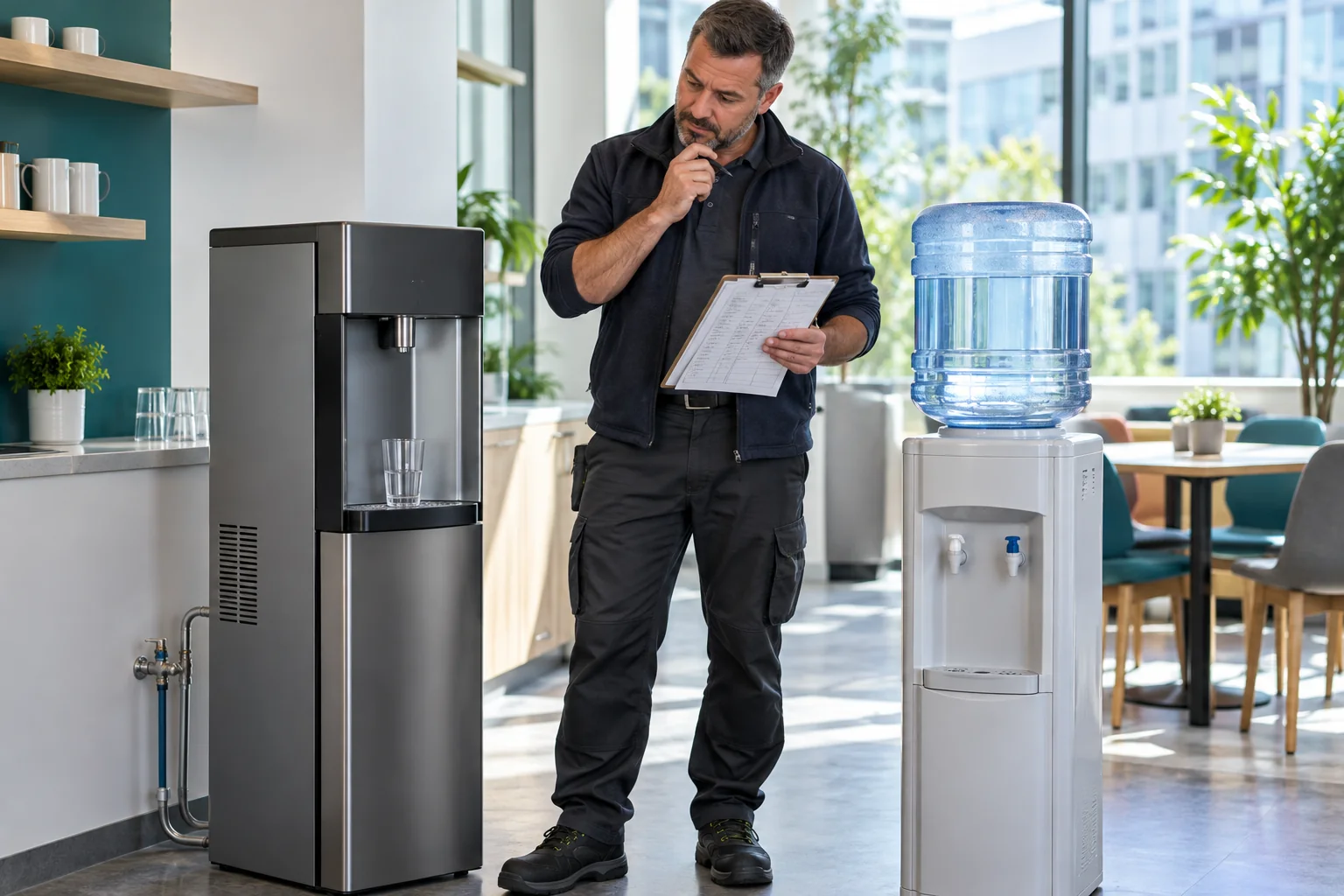
POU stands for “Point of Use”: the unit is connected directly to the water supply, filters mains water internally, and cools or carbonates it as needed. A bottled-water dispenser (also called a dispenser or bottled water cooler) operates independently of the mains: a reusable 19-litre bottle is loaded from the top (top loader) or bottom (bottom loader), and the water is delivered by gravity or pump.
Both systems typically cool water to 4 to 10 degrees Celsius and can optionally provide hot water up to 90 degrees. POU units with sparkling water include a CO2 cylinder, which triggers additional safety requirements under DGUV 110-007. Bottled-water dispensers need no plumbing installation, but they do require regular water deliveries.
The key cost difference is not the price of the unit, but the price of the water. Mains water costs around 0.2 cents per litre (German national average). Bottled water costs 40 to 50 cents per litre for still water and up to 68 cents per litre for spring water (Aquaspender, Mein-Wasserspender). That is a price multiplier of 100 to 340. At significant levels of consumption, this difference adds up relentlessly.
The 5-year calculation: three operating scenarios
The following calculations are based on comparisons by Tradingtwins, Aquaspender and Mein-Wasserspender. All amounts are net and rounded to the nearest €500.
Scenario 1: 10 people, 160 litres per month
Assumption: 1,920 litres per year, five years of operation.
POU (purchase): Purchase price approx. €1,200 (basic still-water model), one-off installation €200, maintenance and filter changes €240/year × 5 = €1,200, energy approx. €150/year × 5 = €750, water (€0.002/litre × 9,600 litres) = €19. Total cost over five years: around €3,500 to €5,500, depending on the actual maintenance required. Tradingtwins calculates €4,848; Aquaspender calculates €5,438 based on slightly different consumption assumptions.
Bottled water (purchase + delivery): Unit approx. €400, bottled water €0.42/litre × 9,600 litres = €4,032, energy €150/year × 5 = €750. Total cost over five years: around €6,000 to €8,000. Tradingtwins arrives at €8,025 (higher water price and consumption assumption), while Aquaspender calculates €6,000.
Break-even: after 3 to 4 years (Tradingtwins).
Scenario 2: 20 people, 4,000 litres per year
POU over five years: approx. €7,500. Bottled water over five years: approx. €15,000. Source: Mein-Wasserspender. The bottled-water model costs twice as much; break-even comes after 1 to 2 years. From this team size onwards, POU is the more economical choice in almost any site scenario.
Scenario 3: 50 and 300 people
For 50 people, Tradingtwins shows €4,940 (POU) versus €33,275 (bottled water) over five years. The difference of €28,335 is equivalent to the annual salary of a full-time employee paid at minimum wage. Break-even comes in under twelve months.
For 300 people and 4,800 litres per month: POU €22,752 versus bottled water €124,800 over five years, a ratio of 1:5.5 (Aquaspender). At this scale, a site would sensibly operate several POU units in parallel; the cost gap remains proportional.
The rule of thumb: the more people served and the longer the operating period, the wider the gap. Bottled water at 42 to 68 cents per litre (compared with 0.2 cents for mains water) scales linearly with consumption and time.
Hidden costs: what supplier quotes leave out
Quoted unit prices show only part of the total cost. Four cost items are missing from many quotes:
Storage costs for bottled-water dispensers: A full 19-litre bottle weighs around 20 kilograms. If you cannot arrange direct weekly deliveries, you need storage space for at least two to three bottles. B2B.de puts the imputed storage cost at €20 to €50 per month. Over five years, that adds up to €1,200 to €3,000, which does not appear in any quoted unit price.
Staff time for changing bottles: Lifting a top-loader bottle is a recognised occupational safety risk. At 5 to 10 minutes per bottle change, weekly demand adds up to 43 to 87 hours over five years. Businesses absorb these costs internally without ever seeing them in a calculation.
Energy costs: Both system types consume a comparable amount of electricity. Welltec Wasser gives €150 to €200 per year for cooling and keeping hot water ready; B2B.de calculates €60 to €120 per year. The difference is due to cooling capacity and overnight shut-off. Units with automatic overnight shut-off measurably reduce annual consumption.
CO2 premium for POU units with sparkling water: Basic still-water POU units cost €790 to €1,500 net. Models that support CO2 start at €1,700 and go up to €3,500; built-in solutions and sites with special hygiene requirements can cost up to €8,000 (Aquaspender). Planning for this requirement from the outset avoids a costly retrofit.
Installation requirements: what you need technically
POU units cannot be used everywhere. The German Vending Machine Industry Association (BDV) sets out the following minimum requirements in its Watercooler 2024 installation guidelines:

- Separate, shut-off angle valve (3/4 or 3/8 inch)
- Check valve that can be tested, compliant with DIN 1717
- Water pressure of 1.5 to 6 bar
- Water stop recommended
- Drinking water quality compliant with TrinkwV
The one-off installation fee is €150 to €300 (B2B.de). Plumbing work for a new connection is charged separately. Tradingtwins gives €60 as a baseline, excluding pipework. If there is no water connection at all, POU is not an option at that site.
For sparkling-water models, DGUV 110-007 also applies: a maximum of 3 percent CO2 by volume in the room. The BDV rule of thumb is 7 square metres of floor area per kilogram of CO2 cylinder contents, with a ceiling height of 2.50 metres. This amounts to 17 cubic metres of room volume per kilogram of CO2. In small kitchenettes under 20 square metres with poor ventilation, this can become a practical limitation.
By comparison, a bottled-water dispenser needs only a standard power socket (230 V, 10 A). This is the only area in which bottled-water dispensers are easier to install from an infrastructure perspective.
Hygiene and operator responsibilities
Regardless of system type, the operator—the business itself—is responsible for the risk assessment, not the equipment supplier or operator. The BDV Water Dispenser Guide names DIN 6650-08 as the inspection standard. Testing checks for pathogenic bacteria: Pseudomonas aeruginosa, coliforms and faecal streptococci. According to the BDV, the total bacterial count guideline of 100 CFU is not a legally binding standard; in practice, it is often mistakenly interpreted as a limit.
Cleaning rules for POU units (BDV Watercooler Cleaning Instructions):
- Empty and clean the drip tray at least once a week
- Clean the dispensing area daily with a disposable cloth and disinfectant spray
- Do not allow the filling vessel to come into direct contact with the outlet
- Have qualified staff carry out maintenance at regular intervals (agree the interval in the contract)
Equivalent cleaning rules apply to bottled-water systems. Bottles must be changed without contamination, which requires verifiable training for the employees involved.
Requirements are stricter in hospitals, care homes and settings with immunocompromised users. More frequent sampling and shorter maintenance intervals are required there, even though the law does not prescribe specific minimum intervals. In these environments, a maintenance contract with defined SLAs is an operator responsibility, not an optional extra.
Rent or buy: which model is right?
Both system types are available to rent or buy. Renting preserves capital, but increases monthly costs.
POU rental: from €30 per month, typically €30 to €50 per month including service (Mein-Wasserspender). Contract terms range from 12 to 60 months. The BDV cost example shows the operator’s perspective: at monthly rental income of €100, the margin after costs is around 31 percent. Buying rather than renting means retaining this margin over the long term.
Bottled-water rental: €20 to €40 per month (B2B.de). Note: this rental fee covers only the unit. Bottled water is charged separately and accounts for most of the ongoing costs. Comparing rental prices alone without including water significantly underestimates the total cost.
Clear buying recommendation: buy if the planned period of use is more than three years and a water connection is available. Rental models make sense for fixed-term leases that do not permit structural alterations, short-term needs of less than two years, or when no investment budget is available.
When does POU really pay off?
Three independent sources, all pointing in the same direction:
- 10 people: break-even after 3 to 4 years (Tradingtwins)
- 20 people: break-even after 1 to 2 years (Mein-Wasserspender)
- 50 people: break-even in under 12 months (€4,940 POU vs. €33,275 bottled water over 5 years, Tradingtwins)
If you have fewer than ten employees and do not plan to stay at a site long term, POU is attractive only through an affordable rental model without high upfront installation costs. For everyone else, the bottled-water dispenser looks cheaper by unit price, but is the more expensive choice over its useful life.
US data as a guide: Culligan Quench puts the savings from mains-connected units compared with bottled water at up to 80 percent. This figure cannot be transferred directly to the German market (bottled-water prices here are significantly lower than US single-bottle prices), but the direction is consistent with all German cost calculation sources.
Sustainability: transport emissions and system footprint
Reusable 19-litre bottles reduce plastic waste compared with single-use bottles. However, they require return transport, cleaning and refilling, each step involving energy use and vehicle emissions. In its sustainability flyer, the BDV explicitly names mains-connected water dispensers as a measure to reduce CO2 emissions in vending operations.
No German source provides a quantified CO2 saving in kilograms of CO2 equivalent (as of September 2026, not independently confirmed). All industry sources recognise POU’s qualitative advantage. For businesses reporting sustainability under GRI or CSRD, the POU decision is also easier to document.
Checklist: which system suits your site?
Check these eight points before deciding:
- [ ] Is a water connection with pressure of 1.5 to 6 bar within reach of the unit?
- [ ] Is a check valve compliant with DIN 1717 already installed, or can one be fitted?
- [ ] How many people use the unit daily? (Under 10: bottled water is still viable; from 20: POU is clearly more advantageous)
- [ ] Do you want sparkling water? (Check room requirements for CO2 under DGUV 110-007 in advance)
- [ ] How long do you plan to stay at the site? (Under 2 years: rent; from 3 years: buy)
- [ ] Who will handle weekly cleaning and annual maintenance by qualified staff?
- [ ] Are there heightened hygiene requirements (hospital, food production, immunocompromised users)?
- [ ] Buy or rent? (Compare the rental term with the break-even scenario)
For offices with 20 or more people, a permanent water connection and a planned period of use exceeding three years: buy a POU unit, with basic still and chilled water features; budget €1,200 to €2,000 net, allow €200 to €300 for installation, and agree a maintenance contract from €20 per month. If you want sparkling water, budget €1,700 to €3,500 for the unit and check room volume and CO2 safety in advance.
Latest on this topic
- EUDR and coffee vending machines: what the EU Deforestation Regulation requires before it appliesMarket Analysis · October 13, 2026
- Commodity Monitor October 2026: Coffee eases, cocoa and sugar in focusMarket Analysis · October 13, 2026
- AI in Vending in 2026: Predictive Maintenance and Assortment Optimisation — How to Use the TechnologyMarket Analysis · October 2, 2026
More guides
 KI Modified
Retrofit cashless payment to a vending machine: MDB 4.3, costs and selection criteria
What do you need to retrofit a vending machine for cashless payment? This guide explains MDB 4.3, compatibility, terminal selection, installation, ongoing costs and typical checks, without making unsupported price promises.
 KI Modified
The Ideal Vending Machine Mix: Combining Hot Drinks, Snacks and Water
Which combination of hot drinks, snacks and water is right for an office, a public venue or a small site? This guide helps operators assess sales mix, site requirements, hygiene, refrigeration, replenishment and cashless payments.
 KI Modified
Hygiene plan for hot drinks vending machines: cleaning, HACCP and records
What cleaning obligations apply to hot drinks vending machines, which intervals must operators set themselves based on risk, and what records should the hygiene plan include? This guide distinguishes legal requirements, HACCP practice and standards guidance without prescribing blanket cleaning intervals.